NewsNight practices "Gender Discrimination" both in it's reporting and implied social impact and gendered discipline:
Thursday, September 15, 2005
Beth Nissan presented a 'piece' on clothing donations. It showed mountains of donated items intended for the Gulf Coast but due to the volume it was doubtful and so sadly so that it would make it's destination. More than likely all those lovely frocks would serve as LANDFILL ! The 'piece' featured three young girls as playing in their Mum's attic storage chest. There was no 'boys' shown in this piece. The intended 'moral' to the story was that LANDFILL going into the 'base' of the NEW New Orleans was clean and endearing. What this 'piece' didnt' expand on and should have it that those clothes will more than likely not end up in landfill sites but bundled and sold for recycle to 'child sweat shops' in Mexico.
Erica Hill featured a different 'piece' of a victim family that viewed the president's speech. It was a smile nice for the camera moment to enforce the 'strong and just' president this country has in HIS (NOT THE COUNTRY'S, BUT BUSH'S) generosity as if he was fixing their misery out of the oil derricks on Prarie Chapel Ranch. This 'piece' lacked reaction from the public in general and a focus of what others in the Democratic Party might say regarding the increasing tax burden this country has in the face of constituency pandering tax cuts.
Friday, September 16, 2005
Aaron trying to always be the 'peace maker' of NewsNight sends Beth Nissan on a mission of bonding between '? sisters ?' who see their lives differently. The assignment should she decide to accept it, is to reveal, not herself but a perfectly wonderful and tragic story about a newspaper by the name of "The Sea Coast Echo" of Bay St. Louis, Mississippi.
Unfortunately she decided to take the assignment and in vicious jealousy practically sentenced this magnificent local newspaper with original and priceless achival editions from 1892. Needless to say the achives were caught in the flood and need MUSEUM curator expertise to preserve the damage documents. They should be a museum all themselves.
The transcript is below but rather than inspiring the Majors like The Washington Post, The New York Times and The Los Angeles Times from 'HELPING' with new publishing equipement and a curator to assist in the recovery of the achives, Ms. Nissen perfers to sentence "The Echo" to death.
I would think if nothing else CNN would consider taking a small paper under it's wing and starting a 'Blind Trust Fund' managed by a local bank that would serve to preserve a piece of Southern Americana vital to understanding this country's southern history including volitile subjects including segregation and racism to the extent this area of the country understood it. In my opinion, the survival of this paper should have been secured through efforts by those that would exploit it's story before it was ever aired.
Jerk ! I also don't understand how a 'miracle' occurs when such damage resulted, but, hey I call me crazy but I am not a woman kissing up to a Neocon Executive Producers either.
BETH NISSEN, CNN CORRESPONDENT (voice over): This is one of many small miracles on the Mississippi Gulf Coast.
RANDY PONDER, PUBLISHER, "THE SEA COAST ECHO": Newspapers?
NISSEN: The delivery of the hometown newspaper. The "Sea Coast Echo." A miracle, because these are the offices of "The Echo" in Bay St. Louis, Mississippi.
PONDER: You see the water line on the wall there. That's how high the water was here.
NISSEN: Everything you need to put out a newspaper was ruined. All of reporter Bennie Shellbetter's (ph) files. All of the newspapers equipment, computers.
PONDER: I came in the day after the storm. Went to my servers, my computers, thinking I could save some data. No, can't do it. The connections had already corroded. Saltwater.
NISSEN: Saltwater ruined the paper's presses too.
PONDER: This press will never run again. Every metal part in this is already corroded. There's basically not much that can be saved.
NISSEN: Not the shipment of new news print delivered just before the storm. Not the old news print in bound volumes in "The Echo"'s archives. PONDER: Those are the actual printed pages of this newspaper, all the way back to 1892. NISSEN: The oldest volumes were on the bottom shelf.
PONDER: This particular issue's from 1894. This right here cannot be replaced. This is the history of Hancock County right there.
NISSEN: What kept "The Echo" from being history was sheer determination. Four days after the storm, news editor Jeff Belcher assembled a four page special edition, which was printed at a friendly Kentucky newspaper, driven into the area by volunteers.
GEOFF BELCHER, NEWS EDITOR, "THE SEA COAST ECHO": I think it was really important to get it out immediately. You know, television doesn't exist around here right now at all. Radio has been limited. People want to know ways going on.
NISSEN: Within a week, the newspaper's tiny staff had turned the storm-damaged dining room of publisher Randy Ponder into a news room, writing stories on newly purchased computers, laying out the front pages, reporting the best they could on cell phones.
BELCHER: Land lines are down completely so all the phone numbers we had for everybody are gone. When we want to contact somebody, we have to pretty much go physically go find them.
NISSEN: The paper is then printed twice a week on the presses of the "Picayune Item," about an hour's drive north.
PONDER: The second issue, we had eight pages. The third issue, we had 12 pages. And we're going to get that paper back up to 36 pages.
NISSEN: That's going to be hard to do. The paper has lost its advertisers.
PONDER: This was Ricky's Bar and Grill. He was a regular advertiser of "The Sea Coast Echo." Basically, every business on the street was an advertiser of "The Sea Coast Echo." Total destruction on the street. Total destruction.
NISSEN: For now, the paper's being printed on credit, published at a loss. But published on faith that this little paper is important in a community where so many have lost so much.
PONDER: If someone does not get a newspaper delivered on time to their house, they'll call and they won't say what happened to that newspaper, why didn't I get that newspaper? They'll say I didn't get my newspaper, my newspaper. Yes, we're losing money on it, but we're doing what we're supposed to do. I have newspapers if anyone would like one.It's an obligation of the newspaper to continue publishing as long as we can.
NISSEN: Beth Nissen, CNN, on the Mississippi Gulf Coast.
Aaron realizing the 'error' tried to set it straight, I suppose:
AARON BROWN, CNN HOST: Anderson, the headline in today's paper, the "Seacoast Echo," "Gone to the Dogs, Veterinarians from around the nation come to help Hancock's animals." The "Seacoast Echo." Since 1892, they say, "We're still here. And they are."
I just need to stop my comment here except to say I don't make empty comment for the sake of self indulgence and pity. This entire blog is about the injustice and bad habits of a news agency with global reach. You won't find one word of 'poor me.'
September 19, 2005
Again tonight, Bethy was feathured in a completely irrelevant segment that made a lonely USA postman into a hero for the lack of people to deliver mail to in Waveland, Mississippi. It was hideous. The fact of the matter is HIS Zip Code is vacated. He needs to help in other places and EARN his salary rather than be granted his salary in sympathy. Poor Bethy has been doing 'Poor Me' pieces for so long that is all she knows. To be outraged at the waste of government money in a Postal Delivery Man that could be used elsewhere in a support measure to other Post Offices was just too much of a stretch for Bethy.
And what did the scripted Aaron have to say?
Intro :
BROWN: Coming up on the program -- thank you -- coming up on the program, neither rain nor heat nor hurricane, as it turns out, a special delivery. Because this is a special edition of NEWSNIGHT.
(COMMERCIAL BREAK)
BROWN: A story now about honoring promises, one eternal, the other nearly so. That hope must be nurtured and that the mail must go through. Here's NEWSNIGHT's Beth Nissen.
Blah, blah, blah, blah, blah...
Post 'Nissen Piece':
BROWN: In our next hour, the question that still has not gone away. Where is FEMA? And next, where is Rita? The 11:00 update from the National Hurricane Center. From New Orleans and New York, this is a special edition of NEWSNIGHT.
............................................................................
more to follow ....
Sunday, September 18, 2005
Female Codependency, A Beth Nissan Speciality. Is she allowed to be or do anything else?

Bethy has been victimizing women for years now since the team of Brown and Nissen at ABC in 1998 including "Hot Topics" such as an artist that paints with pudding and Japanese Animae. She took on something a little more challenging after 911 when she was premiered in a 'piece' regarding dusting and cleaning heavy duty style. For awhile there she was on a roll with reporting the war wounded until Sharon "The Religious Bigot" von Zwieten realized Bethy had an exclusive revealing Bush's war wounded was over 10,000 and 'On the Rise.' One curiosity, I have never noted any 'pieces' by Beth from Seattle, Washington.


Wednesday, September 14, 2005
The Continued Bigorty of CNN
NewsNight begins tonight with minimally age discrimination whereby Anderson Cooper succeeds to the lead allowing Aaron Brown to provide a reporters status and the days news of New Orleans.
It's pretty obvious, Anderson Cooper has all the 'power' interviews. There is no reason why Aaron Brown couldn't do the same thing from his New York Office. I have seen it many times before. This is the Anderson Cooper ride to glory hour while Aaron is taking a position of MC. The odd aspect is that Anderson's interviews is in regard to deaths of the elderly. Age when it serves the priorities and status of sainthood of Cooper is a subject and not a discrimination.
Aaron was given a full six minutes to be verbally abused by Greg Bozell, a Neocon that finds joy in bigotry called a "Celebration in Color Blindness" in the rescue efforts in New Orleans. He called Aaron a 'Race Baiter.' Bozell likes to call things names. Cliches are the modus operendi of the Neocons.
Anderson handled the 'power' issue of insurance which featured Bush.
The Frankenstein voice that introduces all of Anderson's programs again follows him to NewsNight. Anderson has top biling over Aaron and is given the lead again at the 1100 hour.
Complaining pays off. At 11:22 pm Aaron was given the opportunity to handle the issue of the dead at the nursing home and the hospital as only Aaron can with the assistance of Jonathan Fried. By the end of the segment Aaron's voice indicated an elevated mood and optimism regarding the continued broadcast.
This broadcast likes to tout it's achievements in putting families back together. Obviously as witnessed on film that is the case. There is however a disconnect from the reality that the very people being united still has overwhelming grief to deal with in being 'displaced New Orleanians' facing homelessness.
The point is where conservatives like to take the high moral gound in some areas they still disconnect from the reality that caused the flooding and levee break. This federal administration did not preserve the wetlands or keep the levees up to date preserving the lives, the homes, the livlihoods of these of very people.
In addition, I don't want to sound ungrateful for all the efforts in bringing people together and having them alive (I would want it to be me.) but this negligence by the federal government has caused a huge expense to this nation that could have easily been avoided with prudent spending rather than pork barrel spending. The conservatives on the networks fail horribly when it comes to reality and accountability in this situation. The people of this country deserve better. They should not have to be made to absorb the mistakes of an out of control Republican administration that has demonstrated over and over again their negligence of the best interests of the people of this nation while terrorizing them at every turn to maintain control over the elections and more exploitation of people confused to their well being and where it truly is defined.
It's pretty obvious, Anderson Cooper has all the 'power' interviews. There is no reason why Aaron Brown couldn't do the same thing from his New York Office. I have seen it many times before. This is the Anderson Cooper ride to glory hour while Aaron is taking a position of MC. The odd aspect is that Anderson's interviews is in regard to deaths of the elderly. Age when it serves the priorities and status of sainthood of Cooper is a subject and not a discrimination.
Aaron was given a full six minutes to be verbally abused by Greg Bozell, a Neocon that finds joy in bigotry called a "Celebration in Color Blindness" in the rescue efforts in New Orleans. He called Aaron a 'Race Baiter.' Bozell likes to call things names. Cliches are the modus operendi of the Neocons.
Anderson handled the 'power' issue of insurance which featured Bush.
The Frankenstein voice that introduces all of Anderson's programs again follows him to NewsNight. Anderson has top biling over Aaron and is given the lead again at the 1100 hour.
Complaining pays off. At 11:22 pm Aaron was given the opportunity to handle the issue of the dead at the nursing home and the hospital as only Aaron can with the assistance of Jonathan Fried. By the end of the segment Aaron's voice indicated an elevated mood and optimism regarding the continued broadcast.
This broadcast likes to tout it's achievements in putting families back together. Obviously as witnessed on film that is the case. There is however a disconnect from the reality that the very people being united still has overwhelming grief to deal with in being 'displaced New Orleanians' facing homelessness.
The point is where conservatives like to take the high moral gound in some areas they still disconnect from the reality that caused the flooding and levee break. This federal administration did not preserve the wetlands or keep the levees up to date preserving the lives, the homes, the livlihoods of these of very people.
In addition, I don't want to sound ungrateful for all the efforts in bringing people together and having them alive (I would want it to be me.) but this negligence by the federal government has caused a huge expense to this nation that could have easily been avoided with prudent spending rather than pork barrel spending. The conservatives on the networks fail horribly when it comes to reality and accountability in this situation. The people of this country deserve better. They should not have to be made to absorb the mistakes of an out of control Republican administration that has demonstrated over and over again their negligence of the best interests of the people of this nation while terrorizing them at every turn to maintain control over the elections and more exploitation of people confused to their well being and where it truly is defined.
Tuesday, September 13, 2005
The 'Honor Segment has been dropped by NewsNight with it's "Special Edition" Status
A Look at U.S. Military Deaths in Iraq
By The Associated Press Mon Sep 12, 6:52 PM ET
As of Monday, Sept. 12, 2005, at least 1,897 members of the U.S. military have died since the beginning of the Iraq'
The AP count is six higher than the Defense Department's tally, last updated at 10 a.m. EDT Monday.
The British military has reported 95 deaths; Italy, 26; Ukraine, 18; Poland, 17; Bulgaria, 13; Spain, 11; Slovakia, three;
El Salvador, Estonia, Thailand and the Netherlands, two each; and Denmark, Hungary, Kazakhstan and Latvia one death each.
By The Associated Press Mon Sep 12, 6:52 PM ET
As of Monday, Sept. 12, 2005, at least 1,897 members of the U.S. military have died since the beginning of the Iraq'
The AP count is six higher than the Defense Department's tally, last updated at 10 a.m. EDT Monday.
The British military has reported 95 deaths; Italy, 26; Ukraine, 18; Poland, 17; Bulgaria, 13; Spain, 11; Slovakia, three;
El Salvador, Estonia, Thailand and the Netherlands, two each; and Denmark, Hungary, Kazakhstan and Latvia one death each.
Aaron Brown becomes CNN's Local Niger
He has no control over his programming. It is dedicated to Anderson Cooper's Promotion of 360 with complete disregard for the audience that is disrespected as much as Aaron is. There is no other program CNN proctors that has this issue. Aaron wrote an e-mail but never did a personal pre-program announcement. Aaron is intimately learning what it is to be submissive to his 'Masters.'
Well, Aaron is even happy being a niger. House nigers can be. A well payed house niger. Bring them all on broard there boy.
One has to be a good niger at CNN to prevent news like this from making the public aware of the aggression of their own government.
Pentagon plans strike-first nuclear policy
12.09.05 1.00pm
By Rupert Cornwell
WASHINGTON - The Pentagon has drawn up a new strategy, built on the 2002 "Bush doctrine" of pre-emptive military strikes, that would allow the US to make first use of nuclear weapons to thwart an a WMD attack against the country.
Under the scheme, developed by the Joint Chiefs of Staff but yet to be ratified by Donald Rumsfeld, the Defence Secretary, commanders would be able to request permission from the President to use nuclear weapons in a variety of scenarios.
According to the Washington Post, one possibility is an enemy that is using, or "is about to use" weapons of mass destruction against US military forces or civilian population.
http://www.nzherald.co.nz/section/story.cfm?c_id=2&objectid=10345189
This is Bush's Pre-emption. This will cause aggression by other nations before the USA could pull this off and Bush knows that and desires it SO HE HAS A REASON. The aggression of Pre-emption is aggression enough for any nation at this point. The USA is no longer a safe place to live. It's a target. Find your country of origin. Leave the USA to the Neocons.
To show how much CNN 'niger's' their priorities, Anderson Cooper just interviewed the police captain from New Orleans who was more than willing to make an appearance in gratitude of Dr. Phil coming to his department's rescue in providing 'help' for officers over stressed by the lack of FEMA and Bush Administration precense in the emergency that followed Katrina. The feds didn't participate sooner due to the fact they didn't receive the memo. There was no personal privacy in the captain's grieving for an officer whom's name was mentioned to express his guilt in his ability to 'hold on' to all his officers until they were on the other side of this issue. The question is will Dr. Phil open the sessions with New Orleans to cameras providing still more invasion of privacy? If Dr. Phil wants to be generous with those in need of psychological counceling in New Orleans, he should by all means do so, but also by allowing the dignity of those he helps without exposing these issues publically. CNN sucks !!
In other words, the man was made to prostrate himself in a public appearance in gratitude for the services to his officers that obviously The City of New Orleans cannot afford right now as the mayor has stated he has tried. This is exploitation is not a matter of willingness. It's a matter of CNN asking in the first place !
It's too late to take it back. It's a matter of liability now due to the break down of confidentiality. CNN carries the burden.
The word that describes an entry like this is 'ugly.' It isn't pleasant for me either.
Morning Papers exhibited it's ususal Christian prefernece.
The Dallas Morning News
International Herald Tribune
The Christian Science Monitor. And in the monitor for your reading pleasure today is and interesting Anti-Semitic piece on how the Synagogues in Gaza were appropriately burned to the ground by returning Palestinians instead of being perhaps MOVED to Israel. See Israel had to get the settlers out before they could move the buildings or even respected. No hatred there of course.
Palestinians rush into the new Gaza
The last Israeli soldier left Gaza Monday, ending Israel's 38-year occupation in the strip.
By Ilene R. Prusher Staff writer of The Christian Science Monitor NETZARIM, GAZA – Nearly every Palestinian who could Monday flooded into lands Israel had occupied for 38 years, their mood pulsing with celebration tinged with frustration.
Synagogues in several of the largest settlements in Gaza, which Israel did not demolish, were burned or bulldozed, a move condemned by Israel's foreign minister as "a barbarous act by people who have no respect for holy places."
The Washington Post
The Oregonian
I am sure CNN feels vindicated regarding any issue over racism because they featured an issue identified by Bob Herbert today regarding the endangering of primarily black people crossing a bridge to safety while being prevented by caucasian police during the flooding. That doesn't cut it because the people addressing the issue as part of that group were caucasian (What the South calls Poor White Trash. Just as bad as nigers). It was intended to water down the reality of racism not bolster it. Besides that this entry isn't about any of that aspect of the programming which I could go on and on about.
Well, Aaron is even happy being a niger. House nigers can be. A well payed house niger. Bring them all on broard there boy.
One has to be a good niger at CNN to prevent news like this from making the public aware of the aggression of their own government.
Pentagon plans strike-first nuclear policy
12.09.05 1.00pm
By Rupert Cornwell
WASHINGTON - The Pentagon has drawn up a new strategy, built on the 2002 "Bush doctrine" of pre-emptive military strikes, that would allow the US to make first use of nuclear weapons to thwart an a WMD attack against the country.
Under the scheme, developed by the Joint Chiefs of Staff but yet to be ratified by Donald Rumsfeld, the Defence Secretary, commanders would be able to request permission from the President to use nuclear weapons in a variety of scenarios.
According to the Washington Post, one possibility is an enemy that is using, or "is about to use" weapons of mass destruction against US military forces or civilian population.
http://www.nzherald.co.nz/section/story.cfm?c_id=2&objectid=10345189
This is Bush's Pre-emption. This will cause aggression by other nations before the USA could pull this off and Bush knows that and desires it SO HE HAS A REASON. The aggression of Pre-emption is aggression enough for any nation at this point. The USA is no longer a safe place to live. It's a target. Find your country of origin. Leave the USA to the Neocons.
To show how much CNN 'niger's' their priorities, Anderson Cooper just interviewed the police captain from New Orleans who was more than willing to make an appearance in gratitude of Dr. Phil coming to his department's rescue in providing 'help' for officers over stressed by the lack of FEMA and Bush Administration precense in the emergency that followed Katrina. The feds didn't participate sooner due to the fact they didn't receive the memo. There was no personal privacy in the captain's grieving for an officer whom's name was mentioned to express his guilt in his ability to 'hold on' to all his officers until they were on the other side of this issue. The question is will Dr. Phil open the sessions with New Orleans to cameras providing still more invasion of privacy? If Dr. Phil wants to be generous with those in need of psychological counceling in New Orleans, he should by all means do so, but also by allowing the dignity of those he helps without exposing these issues publically. CNN sucks !!
In other words, the man was made to prostrate himself in a public appearance in gratitude for the services to his officers that obviously The City of New Orleans cannot afford right now as the mayor has stated he has tried. This is exploitation is not a matter of willingness. It's a matter of CNN asking in the first place !
It's too late to take it back. It's a matter of liability now due to the break down of confidentiality. CNN carries the burden.
The word that describes an entry like this is 'ugly.' It isn't pleasant for me either.
Morning Papers exhibited it's ususal Christian prefernece.
The Dallas Morning News
International Herald Tribune
The Christian Science Monitor. And in the monitor for your reading pleasure today is and interesting Anti-Semitic piece on how the Synagogues in Gaza were appropriately burned to the ground by returning Palestinians instead of being perhaps MOVED to Israel. See Israel had to get the settlers out before they could move the buildings or even respected. No hatred there of course.
Palestinians rush into the new Gaza
The last Israeli soldier left Gaza Monday, ending Israel's 38-year occupation in the strip.
By Ilene R. Prusher Staff writer of The Christian Science Monitor NETZARIM, GAZA – Nearly every Palestinian who could Monday flooded into lands Israel had occupied for 38 years, their mood pulsing with celebration tinged with frustration.
Synagogues in several of the largest settlements in Gaza, which Israel did not demolish, were burned or bulldozed, a move condemned by Israel's foreign minister as "a barbarous act by people who have no respect for holy places."
The Washington Post
The Oregonian
I am sure CNN feels vindicated regarding any issue over racism because they featured an issue identified by Bob Herbert today regarding the endangering of primarily black people crossing a bridge to safety while being prevented by caucasian police during the flooding. That doesn't cut it because the people addressing the issue as part of that group were caucasian (What the South calls Poor White Trash. Just as bad as nigers). It was intended to water down the reality of racism not bolster it. Besides that this entry isn't about any of that aspect of the programming which I could go on and on about.
It's kinda interesting to realize how CNN has nigered this programming with Aaron burdening Cooper's issues because New Orleans was once the largest Jewish community in the country before WWII under the guidance of Rabbi Max Heller. I like his name just fine. Nice man. Interesting man. He is not related to the devil.
Monday, September 12, 2005
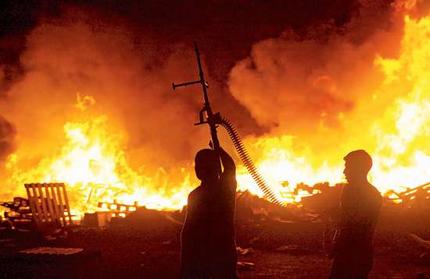
The Christian Science Monitor article overlooked the reality that it was Palestinian militants that burned down the synagogues. This is still another demonstration of how Mr. Abbas is not in control of his militants. It is still another demonstration of the hated Christian Evangelicals have of Jews. I don't want to hear how this recognition of it spreads the hatred either. If it does then it would have anyway. Without recognition of the problem it only grows.
Friday, September 9, 2005
A Profound Difference
The Bigotry that exists within these pages is due to some degree of the difference between the precepts of Judaism and Evangelical Christianity.
The basis of Evangelical Christianity is a self-centered belief that everything is in the control of the individual once a personal relationship with god is established. A place in an afterlife paradise is insured to anyone who lives on the path perscribed by the New Testament.
Yeah, sure the New Testament is a departure from Judaism but it is far more than that. It is an intolerance exhibited by this religious sect that dominates social structure. They are convinced with a strong self centered promise that they are the only correct religion for anyone interested in a place in heaven.
Judaism has several precepts but the one that departs from self-centered worship is the demand on every individual to be connected to community. One person's burden is not their's alone. That learning of compassion as connected to the rewards of a religion is from it's earliest teachings and is why Jewish have always been people that have flourished in once obscure professions. Each community member shared in the success of each other's overcoming of their burdens.
Acceptance of difference is a way of life with the Jewish, it is not with Evangelical Christians.
The articles cited below do not glow of compassion but do reflect of self centered concerns and the rewards of the physical life and not spiritual.
The basis of Evangelical Christianity is a self-centered belief that everything is in the control of the individual once a personal relationship with god is established. A place in an afterlife paradise is insured to anyone who lives on the path perscribed by the New Testament.
Yeah, sure the New Testament is a departure from Judaism but it is far more than that. It is an intolerance exhibited by this religious sect that dominates social structure. They are convinced with a strong self centered promise that they are the only correct religion for anyone interested in a place in heaven.
Judaism has several precepts but the one that departs from self-centered worship is the demand on every individual to be connected to community. One person's burden is not their's alone. That learning of compassion as connected to the rewards of a religion is from it's earliest teachings and is why Jewish have always been people that have flourished in once obscure professions. Each community member shared in the success of each other's overcoming of their burdens.
Acceptance of difference is a way of life with the Jewish, it is not with Evangelical Christians.
The articles cited below do not glow of compassion but do reflect of self centered concerns and the rewards of the physical life and not spiritual.
The Religious Bigorty of CNN NewsNight "Morning Papers"
Christian Science Monitor
Where do gas prices go next?
A few critical factors will govern how far gas prices fall from last week's record levels.
By Mark Trumbull Staff writer of The Christian Science Monitor Gasoline prices have begun to ease, but even when all Gulf Coast refineries are running again later this year, consumers may not see a full retreat to pre-Katrina levels.
That conclusion, analysts say, stems from a simple equation involving the cost of a barrel of crude, markups by middlemen, and little margin for error in the nation's energy infrastructure. Across the country, gasoline prices soared into uncharted territory - above $3 per gallon last weekend - stunning motorists and prompting many to shorten or skip Labor Day trips.
DEFINATELY AN AREA OF COMPASSION. I am sure the Katrina survivors are worried about their fuel expenses in Houston. Oh. Wait. They didn't have cars, that's right.
Washington Post
Rocky Mountain News
New York Daily News
Aaron Brown hosted about one third of his show. In trying to over take FOX News, Ms. Bigot is creating an Angel of Anderson Cooper. "Angels of the Storm" Not every religion believes in angels. Somehow I think there was a profound lack of them in New Orleans. The failure of Christianity I suppose. Needless to say Ms. Bigot von Zwieten is no Angel. Hatefully bigoted through and though.
Where do gas prices go next?
A few critical factors will govern how far gas prices fall from last week's record levels.
By Mark Trumbull Staff writer of The Christian Science Monitor Gasoline prices have begun to ease, but even when all Gulf Coast refineries are running again later this year, consumers may not see a full retreat to pre-Katrina levels.
That conclusion, analysts say, stems from a simple equation involving the cost of a barrel of crude, markups by middlemen, and little margin for error in the nation's energy infrastructure. Across the country, gasoline prices soared into uncharted territory - above $3 per gallon last weekend - stunning motorists and prompting many to shorten or skip Labor Day trips.
DEFINATELY AN AREA OF COMPASSION. I am sure the Katrina survivors are worried about their fuel expenses in Houston. Oh. Wait. They didn't have cars, that's right.
Washington Post
Rocky Mountain News
New York Daily News
Aaron Brown hosted about one third of his show. In trying to over take FOX News, Ms. Bigot is creating an Angel of Anderson Cooper. "Angels of the Storm" Not every religion believes in angels. Somehow I think there was a profound lack of them in New Orleans. The failure of Christianity I suppose. Needless to say Ms. Bigot von Zwieten is no Angel. Hatefully bigoted through and though.
Wednesday, September 7, 2005
These articles appeared in a Christian News Rag on Tuesday. The day after the devastation.
The Neocon Press
THE GREED OF ALL GREED. They certainly do recognize a bargain when they see one. As this rag states "The Lucky Ones." You know I can imagine buying up property if I could afford it in New Orleans. But it wouldn't be self-serving. Instead it would be to protect the former property owners and/or their descendants with great hope of meeting them and giving them back what they had lost. Allowing them to pick up and start over in the place they called home. But this? Dear God. This is Chirstian. Opportunism? I see. I guess where Federal Dollars are rolling in like water proud evangelicals are standing at the watering trough, toxic or not.
Katrina resettling Gulf Coast
By Sara B. Miller and Amanda Paulson Staff writers of The Christian Science Monitor
BATON ROUGE, LA. – It was their dream home. What Cendy Crownover called her "little dollhouse."
But last weekend, she and her husband Kelly put away thoughts of their lovingly remodeled crown molding and oak flooring, now submerged, so they could start anew: with a realtor 80 miles away, in Baton Rouge.
"It's going to be a tough two years," says Ms. Crownover, estimating the time it might take to rebuild their house, which sat just 11 blocks from the breached levee in New Orleans's Lakeview district.
The Crownovers are joining a real estate frenzy that has hit Baton Rouge and beyond - a flurry of down payments, all-cash home sales, and contracts signed before the house is seen. Yet in many ways, these are the lucky ones. More than 100,000 evacuees are still displaced in shelters throughout the region. Others are crowding in with families and strangers, some sharing one bathroom with 20 others.
http://www.csmonitor.com/2005/0906/p01s04-usec.html
POLITICAL SKILL. I see. A president needs political skill in the face of the deaths of thousands of citizens. It would be nice to try coming up with policies with fiscal responsibilities for a change. You know. Something Moral. When one combines the two articles you begin to understand their desperate nature to keep a blood sucker in the Oval Office.
For Bush, a test of political skill
Moods have risen a bit, but Bush is under pressure on many fronts.
By Linda Feldmann Staff writer of The Christian Science Monitor
WASHINGTON – Four years ago, when George W. Bush emerged from the 9/11 attacks with sky-high marks for decisiveness and leadership, he accumulated a reserve of political capital that saw him through reelection.
Now, nearly nine months into his second term, President Bush faces perhaps the most profound test of executive and political skill of his life. One week after hurricane Katrina slammed into the Gulf Coast, wreaking unfathomable devastation, his administration is still scrambling to make up for a delayed initial response that faced broad, bipartisan criticism. Americans are reeling over gasoline prices, and remain skeptical over the course of the Iraq war. Plans for a bold second-term agenda - including Social Security reform and tax reform - sit in doubt.
http://www.csmonitor.com/2005/0906/p01s01-uspo.html
THE GREED OF ALL GREED. They certainly do recognize a bargain when they see one. As this rag states "The Lucky Ones." You know I can imagine buying up property if I could afford it in New Orleans. But it wouldn't be self-serving. Instead it would be to protect the former property owners and/or their descendants with great hope of meeting them and giving them back what they had lost. Allowing them to pick up and start over in the place they called home. But this? Dear God. This is Chirstian. Opportunism? I see. I guess where Federal Dollars are rolling in like water proud evangelicals are standing at the watering trough, toxic or not.
Katrina resettling Gulf Coast
By Sara B. Miller and Amanda Paulson Staff writers of The Christian Science Monitor
BATON ROUGE, LA. – It was their dream home. What Cendy Crownover called her "little dollhouse."
But last weekend, she and her husband Kelly put away thoughts of their lovingly remodeled crown molding and oak flooring, now submerged, so they could start anew: with a realtor 80 miles away, in Baton Rouge.
"It's going to be a tough two years," says Ms. Crownover, estimating the time it might take to rebuild their house, which sat just 11 blocks from the breached levee in New Orleans's Lakeview district.
The Crownovers are joining a real estate frenzy that has hit Baton Rouge and beyond - a flurry of down payments, all-cash home sales, and contracts signed before the house is seen. Yet in many ways, these are the lucky ones. More than 100,000 evacuees are still displaced in shelters throughout the region. Others are crowding in with families and strangers, some sharing one bathroom with 20 others.
http://www.csmonitor.com/2005/0906/p01s04-usec.html
POLITICAL SKILL. I see. A president needs political skill in the face of the deaths of thousands of citizens. It would be nice to try coming up with policies with fiscal responsibilities for a change. You know. Something Moral. When one combines the two articles you begin to understand their desperate nature to keep a blood sucker in the Oval Office.
For Bush, a test of political skill
Moods have risen a bit, but Bush is under pressure on many fronts.
By Linda Feldmann Staff writer of The Christian Science Monitor
WASHINGTON – Four years ago, when George W. Bush emerged from the 9/11 attacks with sky-high marks for decisiveness and leadership, he accumulated a reserve of political capital that saw him through reelection.
Now, nearly nine months into his second term, President Bush faces perhaps the most profound test of executive and political skill of his life. One week after hurricane Katrina slammed into the Gulf Coast, wreaking unfathomable devastation, his administration is still scrambling to make up for a delayed initial response that faced broad, bipartisan criticism. Americans are reeling over gasoline prices, and remain skeptical over the course of the Iraq war. Plans for a bold second-term agenda - including Social Security reform and tax reform - sit in doubt.
http://www.csmonitor.com/2005/0906/p01s01-uspo.html
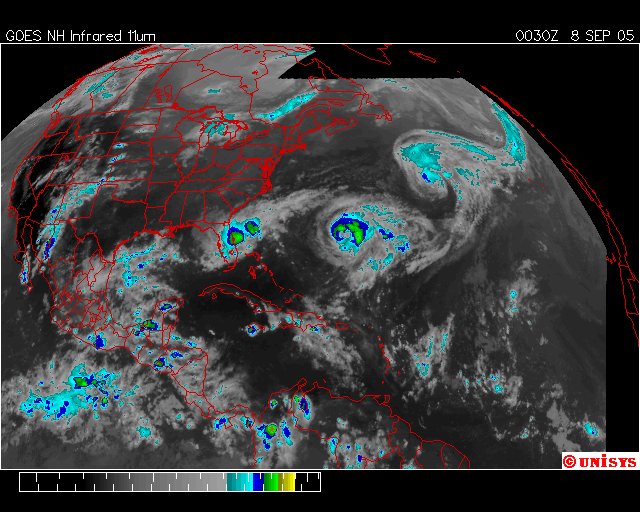
September 7, 2005. It would appear that Ophelia is splitting it's eye while being pulled west across Florida. If this storm heads for the Gulf and meets up with a convection system that now spans Mexico, I don't want to know the velocity it can reach. I don't want anyone to get comfortable with the idea 'we can relax.' Now, is not the time. A few weeks from now but the solar radiation is still with us.
There is no doubt at this time that the progress of Tropical Storm Ophelia is of concern and should never be dismissed as insignificant. Katrina killed 11 people as a Cat One Hurricane.
Lies that kill !! How responsible was the reporting of Katrina in the deaths discovered in it's wake?
You have no morals and lie like hell !
You kill people.
The storm has barely moved at all?
1017
It's Not a 'Blame Game'
I really think the longer the investigation is put off the obscure the facts will become and the more manipulated and buried by Bush's administration it will come.
The current storm nearest the continent, Ophelia has moved closer to the Gulf.
http://weather.unisys.com/satellite/sat_ir_enh_east_loop-12.html
Tropical weather may dampen Jags' opener
MARK LONG
Associated Press
JACKSONVILLE, Fla. - Tropical weather could play a bigger role than heat and humidity in Jacksonville's season opener.
Tropical Storm Ophelia strengthened Wednesday off Florida's Atlantic coast, threatening parts of the state and southern Georgia with strong wind and heavy rain. The system could affect Sunday's game against the Seattle Seahawks and make Jaguars coach Jack Del Rio's jersey swap a moot point.
http://www.mercurynews.com/mld/mercurynews/sports/football/nfl/oakland_raiders/12583366.htm
Here we go again and currently CNN is stating they haven't got a clue. They must do weather reports for Bush.
You kill people.
The storm has barely moved at all?
1017
It's Not a 'Blame Game'
I really think the longer the investigation is put off the obscure the facts will become and the more manipulated and buried by Bush's administration it will come.
The current storm nearest the continent, Ophelia has moved closer to the Gulf.
http://weather.unisys.com/satellite/sat_ir_enh_east_loop-12.html
Tropical weather may dampen Jags' opener
MARK LONG
Associated Press
JACKSONVILLE, Fla. - Tropical weather could play a bigger role than heat and humidity in Jacksonville's season opener.
Tropical Storm Ophelia strengthened Wednesday off Florida's Atlantic coast, threatening parts of the state and southern Georgia with strong wind and heavy rain. The system could affect Sunday's game against the Seattle Seahawks and make Jaguars coach Jack Del Rio's jersey swap a moot point.
http://www.mercurynews.com/mld/mercurynews/sports/football/nfl/oakland_raiders/12583366.htm
Here we go again and currently CNN is stating they haven't got a clue. They must do weather reports for Bush.
Ms. Bigot minimizes lives
conti2005 - 7:32 PM ET September 7, 2005 (#71488 of 71492)Impeach Bush and Cheney ! Rove is their 'Front Man'
Propaganda. Propaganda. Did Rove have this planned to CYA?
It's Not a 'Blame Game'
The Propaganda Networks are trying to down play the devastation of Katrina. They are attempting to HIDE the tragedy of Bush/Cheney. You'll excuse me but I don't like citizens lives toyed with in propaganda campaigns of incompetents. It only goes to show the level of 'influence' this form of excrement thinks they have. They don't mind when government is so negligent that it murders it's own people.
Radar back in the day wasn't mildly perfected until 1935. .
...............
Radar was patented (British patent) in April, 1935.
http://inventors.about.com/library/inventors/blra [...]
..................
It wasn't used for weather forecasting for much, much later.
Since 1943 U.S. military aircraft have been flying into hurricanes to measure wind velocities and directions, the location and size of the eye, the pressures within the storms, and their thermal structure. A coordinated system of tracking hurricanes was developed in the mid-1950s, and periodic improvements have been made over the years.
Radar, sea-based recording devices, geosynchronous weather satellites (since 1966), and other devices now supply data to the NHC in Florida, which follows each storm virtually from the beginning. Improved systems of prediction and communication have been able to help minimize loss of life in hurricanes, but property damage is still heavy, especially in coastal regions.
Gilbert, a Category 5 storm that was the strongest hurricane to hit the western hemisphere in the 20th century, devastated Jamaica and parts of Mexico in 1988 with winds that gusted up to 350 km/hr (218 mph).
Cat 4 - Hugo - Landfall Charleston, SC - total deaths in the USA - 50.
Destructive hurricanes in recent U.S. history include the Category 4 storms Hugo (1989), which caused more than $4 billion in damage and more than 50 deaths,
Cat 5 - Andrew - South Florida - total deaths in the USA - 50
Andrew (1992), with more than $20 billion in damage, more than 50 deaths, and thousands left homeless;
Fran (1996), a Category 3 hurricane, with more than $3 billion in damage and 28 deaths.
Not since the 1950's have storms of this nature ever caused widespread deaths as Katrina has.
The reason.
Nobody cared about the Black Americans of New Orleans that lived in the most dangerous weather path in the country. NOW. The propaganda nut cases want to give 'The Party' a way OUT of their accounting for so much damage and death in the Gulf States.
"And tomorrow marks the 105th anniversary of the Galveston, Texas hurricane that destroyed the city and left about 8,000 people dead. The city of Galveston was rebuilt 5 feet higher than it was before. Should New Orleans do the same?"
THAT IS AN OUTRAGE !!!
In 1900. There was no Early Warning System for ANY weather, yet alone Global Warming Storms.
THEY ARE DOING THIS BECAUSE OF THE NUMBER OF DEAD BEING A MINIMUM OF 10,000.
Knock it off. I don't appreciate having my life and the lives of others minimized so it all can happen again !!!!
Propaganda. Propaganda. Did Rove have this planned to CYA?
It's Not a 'Blame Game'
The Propaganda Networks are trying to down play the devastation of Katrina. They are attempting to HIDE the tragedy of Bush/Cheney. You'll excuse me but I don't like citizens lives toyed with in propaganda campaigns of incompetents. It only goes to show the level of 'influence' this form of excrement thinks they have. They don't mind when government is so negligent that it murders it's own people.
Radar back in the day wasn't mildly perfected until 1935. .
...............
Radar was patented (British patent) in April, 1935.
http://inventors.about.com/library/inventors/blra [...]
..................
It wasn't used for weather forecasting for much, much later.
Since 1943 U.S. military aircraft have been flying into hurricanes to measure wind velocities and directions, the location and size of the eye, the pressures within the storms, and their thermal structure. A coordinated system of tracking hurricanes was developed in the mid-1950s, and periodic improvements have been made over the years.
Radar, sea-based recording devices, geosynchronous weather satellites (since 1966), and other devices now supply data to the NHC in Florida, which follows each storm virtually from the beginning. Improved systems of prediction and communication have been able to help minimize loss of life in hurricanes, but property damage is still heavy, especially in coastal regions.
Gilbert, a Category 5 storm that was the strongest hurricane to hit the western hemisphere in the 20th century, devastated Jamaica and parts of Mexico in 1988 with winds that gusted up to 350 km/hr (218 mph).
Cat 4 - Hugo - Landfall Charleston, SC - total deaths in the USA - 50.
Destructive hurricanes in recent U.S. history include the Category 4 storms Hugo (1989), which caused more than $4 billion in damage and more than 50 deaths,
Cat 5 - Andrew - South Florida - total deaths in the USA - 50
Andrew (1992), with more than $20 billion in damage, more than 50 deaths, and thousands left homeless;
Fran (1996), a Category 3 hurricane, with more than $3 billion in damage and 28 deaths.
Not since the 1950's have storms of this nature ever caused widespread deaths as Katrina has.
The reason.
Nobody cared about the Black Americans of New Orleans that lived in the most dangerous weather path in the country. NOW. The propaganda nut cases want to give 'The Party' a way OUT of their accounting for so much damage and death in the Gulf States.
"And tomorrow marks the 105th anniversary of the Galveston, Texas hurricane that destroyed the city and left about 8,000 people dead. The city of Galveston was rebuilt 5 feet higher than it was before. Should New Orleans do the same?"
THAT IS AN OUTRAGE !!!
In 1900. There was no Early Warning System for ANY weather, yet alone Global Warming Storms.
THEY ARE DOING THIS BECAUSE OF THE NUMBER OF DEAD BEING A MINIMUM OF 10,000.
Knock it off. I don't appreciate having my life and the lives of others minimized so it all can happen again !!!!
Friday, September 2, 2005
Oppression of Identity
IT would seem this is a permanent condition at NewsNight. It's unfortunate that an anchor that cares about his audience isn't allowed to connect with them.
No one is more fatigued by this issue than me. It's a darn shame.
Now CNN's Newsnight e-mails aren't signed at all and Aaron Brown is still not connecting with his audience in pre-programming announcements.
Rude and uncharacteristic of the anchor I always thought respected his audience.
No one is more fatigued by this issue than me. It's a darn shame.
Now CNN's Newsnight e-mails aren't signed at all and Aaron Brown is still not connecting with his audience in pre-programming announcements.
Rude and uncharacteristic of the anchor I always thought respected his audience.
Tuesday, August 30, 2005
Last Night I was impressed with the interaction between Ms. Hill ...
.... during the news segments. Aaron and she engaged in conversation regarding the news she reported rather than regressing into 'Breakfast Table' talk intended to portray marrieds as instruction to the public on how to nurture a Christian relationship.
Aaron carried the unexpected conversation that Ms. Hill was unprepared for to clarify the brevity of the moment on television that touches people in their homes while viewing. The news message by Ms. Hill took on more importance and her view about the issue was included as important by Aaron.
The segment which occurs twice in a news hour transformed from two people socially involved and flirtatious, which is competely inappropriate and sexually harassing, into a respect for the subject and somewhat mutually respect between journalists.
I hope a better view of relationships between professionals continue to build across the programming at CNN. Aaron turned on a dime when he realized how poorly his message was received and the degree of disrespect it exhibited toward professional women.
Thank you, Aaron.
The goal of this blog is to be dismantled in mutual respect by equity. I hoping we have reached that balance and I begin to feel less threatened by the propaganda that tries to establish a different reality and a threatening one.
Aaron carried the unexpected conversation that Ms. Hill was unprepared for to clarify the brevity of the moment on television that touches people in their homes while viewing. The news message by Ms. Hill took on more importance and her view about the issue was included as important by Aaron.
The segment which occurs twice in a news hour transformed from two people socially involved and flirtatious, which is competely inappropriate and sexually harassing, into a respect for the subject and somewhat mutually respect between journalists.
I hope a better view of relationships between professionals continue to build across the programming at CNN. Aaron turned on a dime when he realized how poorly his message was received and the degree of disrespect it exhibited toward professional women.
Thank you, Aaron.
The goal of this blog is to be dismantled in mutual respect by equity. I hoping we have reached that balance and I begin to feel less threatened by the propaganda that tries to establish a different reality and a threatening one.
Monday, August 29, 2005
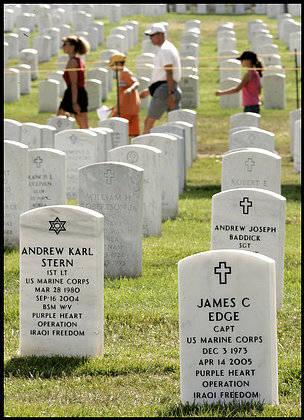
The Star of David shows up in Arlington National Cemetary, too.
7:57 PM - Aaron isn't writing the program's e-mail.
..............................................
conti2005 - 8:17 PM ET August 29, 2005 (#60733 of 60733)Impeach Bush and Cheney ! Rove is their 'Front Man'
Tune in tonight and get the 'low down' on what is happening ...
... since Katrina came ashore. Not that we cared before.
You know what is most fascinating is that this storm was really taylor -made for the USA, wasn't it? Manifested off Florida, skirted across the Gulf reeking devastation to the oil derricks and landing on the poorest of the country illustrating EXACTLY how UNGODLY the so called compassionate government is.
Of course, on NewsNight, we will hear from FEMA Director Michael Brown espousing the POLITICS of the day. Will he answer the tough questions like: Was this a Global Warming issue? Does it continue to be? Is there such a thing as Global Warming? What the heck happened to all those poor people who could not find assitance leaving their impoverished neighborhoods? Do you feel responsible for the deaths that are ultimately going to be evident? What do you say for yourself if there are dead children and families? Want to explain to a nation disgusted with your lousy butt exactly what a jerk you are !?!
No, you will not hear the most needed questions to be asked. You'll hear 'whimp out' Brown ask 'user friendly' questions to these politcians to try and elevate their sorry behinds before they loose anymore of their 'BASE' which these people were !!
In addition, we will have a Holy Roller moment to sing the praises of fossil fuel innovative technology to make our nation great.
Most of the program is videotaped for your ease of message reception rather than a burdened delivary of the news.
There will be Mistress Erica Hill for the 'newsy-cutsie' segements and of course 'The Crock A Dandy Doodle Do' could never miss the chance to be all he can be.
Later....
1059
Although Erica's poncho is important to the little dear, there was no "Honor Segment that Remembers Death American Soldiers."
Thursday, August 25, 2005
Hurricane Katrina Makes Landfall; AKA "We had no idea it would be this bad."
Hurricane Katrina Makes Landfall
Aired August 25, 2005 - 22:00 ET
THIS IS A RUSH TRANSCRIPT. THIS COPY MAY NOT BE IN ITS FINAL FORM AND MAY BE UPDATED.
PAULA ZAHN, CNN ANCHOR: Katrina is pretty ugly right now. She's robed folks -- about a million of them -- of Florida of electricity tonight and we're going to find out exactly where she is, but back to the issue of Lance Armstrong, there are a number of reasons why he's so different from the rest of us. It's fascinating. Simply put, his body isn't the standard issue model that most of us are born with. From his lungs to his muscles, he's in a class of his own. First, though, back to the breaking news from Florida, where Hurricane Katrina made landfall this evening near the Miami-Dade- Broward County line. The storm, unfortunately, has already claimed at least two lives. One man was killed when a large tree fell on his car. Another man, struck by a tree while checking damage to his trailer.More than five million people are in Katrina's path tonight and many are bracing for some very serious flooding. We begin with David Mattingly in Hollywood, Florida, who's been whipped around pretty good tonight by some pretty strong winds. David?
DAVID MATTINGLY, CNN CORRESPONDENT: Paula, this storm is doing exactly what people said it would do. It's moving slowly and it's dumping lots of rain on South Florida right now. A great deal of concern about flooding in some low-lying areas. The Last time they saw a rain event like this was 1999, with another category one hurricane. Since that time, they've invested a lot of money in pumping stations in different municipalities, trying to take care of all this storm water that they're expecting with this storm. So this storm tonight -- these new systems really getting --
ZAHN: From David Mattingly right now, because of all the electrical problems down there, we're not getting a very clear audio signal from him. But let's move a little further north up the coast. John Zarrella, who's standing by in Delray Beach, Florida, not far from an area where some of the mandatory evacuations have actually taken place. What are you seeing, John?
JOHN ZARRELLA, CNN CORRESPONDENT: Well, Paula, what we are seeing here in Delray Beach as we've had consistent throughout the evening, tropical storm-force winds whipping the area. Power is out all over this area. Southern Palm Beach County, down into all through Broward County and certainly into Miami-Dade County, where they are really getting hammered. We thought originally the storm would be a little further north up where we are, the eye of the storm, the center of the storm. But at last minute it jogged a little bit to the left before making landfall. Now, as bad as it seems with these heavy rains and with all this wind, it's still just a category one hurricane and the worst of what this storm may bring is in terms of flooding.
(BEGIN VIDEOTAPE)
ZARRELLA (voice-over): In the Miami suburb of Sweetwater, sandbags are as much a part of hurricane preparation as water and ice. For residents, it's a fact of life here: Rain, lots of it, brings flooding.
UNIDENTIFIED MALE: So the city sits like in a pool. If you were able to look at a city at a plain, it's lower than anything else. It's like a pool. So the residents here are scared. They've gone through many bad times. No-name storm Irene were the most recent ones, that they had two or three feet of water inside their homes.
ZARRELLA: The sandbags will help, but with Katrina, that may not be enough. The storm is expected to drop up to 15 inches of rain, perhaps more in some areas. For local and state officials, water is more of a concern than wind.
UNIDENTIFIED MALE: It's a hurricane and hurricanes are hurricanes. And they have -- They bring with them the possibility of really severe flooding and wind damage, and so, it's important to take this seriously.
ZARRELLA: Just look back to 1999. Hurricane experts say Irene, a late-season storm, dumped nearly 20 inches of rain on South Florida. The aftermath from Katrina may produce images similar to these: Cows and horses standing in standing water, crops underwater. It was an October surprise.
UNIDENTIFIED MALE: It was just really horrible. We never anticipated it. Our power went out.
UNIDENTIFIED FEMALE: We never expected it to be this bad.
ZARRELLA: Now, most people know what to expect, including the South Florida Water Management District, which controls the flow of water through hundreds of miles of canals. The district has spent $600 million since Irene to improve flood control. In advance of Katrina, Lake Okeechobee has been lowered by a foot. Massive pumps have already been turned on and floodgates opened to drain water out to the ocean; making room for whatever Katrina brings. The hope is they've made enough room.
(END VIDEOTAPE)
ZARRELLA: Now, what officials here don't want to see is a repeat of 1999. During Irene, five young kids were killed when they walked out in standing water. There was a live power line in that. Their mother came out, she was killed as well. Those are the kinds of things that the flood waters can bring, Paula. And that is the potential down the road that we face from Katrina -- Paula?
ZAHN: John Zarrella, thanks for the update. A little bit earlier on we were trying to check in with David Mattingly, who's a little further south down the coast from where you just heard John Zarrella report from. Right now a million people in Southern Florida are without power. And David was able to file this report before the winds were really kicking up. Let's listen.
(BEGIN VIDEOTAPE)
MATTINGLY (on camera): Well, Paula, we're riding through a very angry eastern edge of this storm. It made landfall south of here and since then, we've had some very high winds, some torrential rains; rain so dense it was almost a white out condition. Actually, before it got dark, you could barely see the ocean, which was less than 100 yards away from here. There was that much rain. There has been reported, one traffic fatality reported and there our light has just gone. The conditions deteriorated here so quickly that our equipment has been going down faster than we've actually been able to keep it up. So Paula, I'm going to send it back to you right now, but just let you know this storm is packing quite a punch right now.
ZAHN: David, we're going to at least leave your audio signal up while we try to give people a better sense of how this whole area is getting whacked. There have been some mandatory evacuations called for in Palm Beach County, particularly low-lying areas, but where you are in Hollywood, which we could explain to our audience is sort of halfway between Miami and Ft. Lauderdale, no one has been asked to leave their homes, correct?
MATTINGLY: That's right. They asked for voluntary evacuations in low-lying areas. This was affecting -- great, our light's come back on, so maybe you can see me now -- This was affecting the coastal area here at Hollywood Beach where we are. We haven't seen a whole lot of people that have actually left. The hotel that we are near has actually still got quite a few guests in it and they expect to stay here through until tomorrow morning. But again, the toughest part of this storm, now relentlessly just pounding the coast right here at Hollywood Beach. And I don't know if you saw the tape that we showed -- that we brought in earlier, but there were quite a few trees down when those first waves of tropical storm-force winds came through. The ground was very saturated with all the rainwater that had preceded it. So, there were a lot of trees going down, a lot of people without power. Before all of this happened, there were already 200,000 people, more than that actually, who were sitting in the dark in Broward County alone. So who knows how many more are affected right now as the real punch of this storm is really just coming into this coastal area here?
(END VIDEOTAPE)
ZAHN: That was David Mattingly reporting from a little bit earlier tonight from Hollywood, Florida. Max Mayfield is tracking Katrina at the National Hurricane Center in Coral Gables, Florida, where they have been hit by the storm as well. The eye of the hurricane just having passed through there. So, you're going to hear some electrical problems as well. But when we talked with him a short time ago, this is exactly what he had to say.
(BEGIN VIDEOTAPE)
ZAHN: So Max, where is Katrina right now?
MAX MAYFIELD, NATIONAL HURRICANE CENTER: Paula, the center of the hurricane is right over the middle of Miami-Dade county. It's moving south, due west and will likely exit the southwest Florida coast early tomorrow morning and then we'll be shifting our focus up into the northeastern Gulf of Mexico. And you know, the folks up there in the panhandle and the northeastern portion of the Gulf that went through Ivan and Hurricane Dennis, they may have to go through the drill again, unfortunately.
ZAHN: But you're not as concerned about the high winds tonight as you are about all the rain that could fall. Are you still expecting 15 inches of rain in some places?
MAYFIELD: Well, we are in some isolated areas, but I don't want to minimize that wind either. I mean, we just had a gust to 86 miles per hour here at the Hurricane Center a few minutes ago. We've had two deaths from trees falling on people up in Broward County. This is not over. Even though the center of the hurricane is moving east here, that southeastern eye wall there has some very, very strong thunderstorms in it with some very strong winds. And that's still over the populated area. So we've had some damage down here: Some trees are down, a lot of power outages. This is still going to be a long night for Miami-Dade and Broward counties.
ZAHN: Of course it is now we're hearing that some one million folks are without power at this hour, but tell us about your flooding concerns right now.
MAYFIELD: Well, we think that the slow motion here is -- you know, we're going six to 12 inches over a large section of South Florida. And all this rain -- you can see in these rain bands well out to the southeast. Even when the hurricane goes out into the Gulf of Mexico those rain bands will still be spreading over us all through tonight and tomorrow. So, we've still got some flooding ahead of us and we need to learn some lessons from previous hurricanes. We've had people down here losing their lives by driving into a canal and not knowing where the road ended.
ZAHN: And how is the tide going to affect all this tonight? High tide coming in about midnight Eastern time.
MAYFIELD: That's not a real concern. We don't have too much of a tidal range in southeast Florida. So, that's not a real concern. It will take most of the storm surge, flooding, that's already occurred. And I don't think that was at least life-threatening. We certainly lost -- we had some beach erosion, but the main concern will be the wind and the rain.
ZAHN: Well, Max Mayfield, we wish you luck as you ride out the storm. Thanks so much for your update.
MAYFIELD: Thank you.
ZAHN: And as we said at the top of the hour, at least two deaths are now being tied to Katrina. A Ft. Lauderdale man was killed when a tree fell on his car. Mike Deeson is covering the hurricane for CNN affiliate WTSP. And joins us now from Ft. Lauderdale. What can you tell us about some of the other damage you've seen?
MIKE DEESON, WTSP CORRESPONDENT: Well, Paula, there's been damage throughout the Ft. Lauderdale area. We're hit with rain that's almost like a sheet of water right now. This gives you an indication of the power of the storm. This tree came down, oh, a couple of hours ago when the wind came through here. Lots of areas of Ft. Lauderdale are without power. As a matter of fact, there was a hospital with 20 patients on ventilators that not only lost power, but also lost backup power. The Ft. Lauderdale -- the fire department had to come there and put their power on and were prepared to transport all the patients from there. There is a lot of damage along the beach from sand, which came across when the hurricane first came ashore. We shot some video earlier of that. And the sand actually was very painful as the wind blew up and there gusts of wind of 97 miles an hour. And people were surprised by the strength of the storm because being a category 1 it was supposed to be a milder storm here. Lots of debris on the streets. A lot of live power wires are there. And the electrical company is out there trying to do some work as best they can in weather like this, which is just miserable condition. But the biggest danger is the trees. A lot of trees down. A lot of trees, and surprisingly folks are out in this weather driving around. We saw a lot of folks driving around, as we were doing our story. And an overpass south of here, closer to Miami International Airport, had a collapse within the past hour. We don't think there are any injuries on that, but somehow the storm forced that to collapse, a little overpass near the airport. We expect more conditions like this for about another two hours or so, and then the storm will pass on and apparently is moving a little bit southwest of the original track that it was supposed to have. But it's a pretty miserable night. And it will continue to be a miserable day here in Ft. Lauderdale tomorrow -- Paula.
ZAHN: Mike, the one thing we haven't had a chance to talk about is any evidence of flooding there yet.
DEESON: There are areas of flooding. Throughout the low-lying areas and along the beaches, you can see the water moving in. I saw some cars that had parked in a public parking lot that all of a sudden the water was rising up there. And they expect that to be some of the worst damage tomorrow. Also, I want to tell you there were some insurance adjusters down here already trying to assess the damage. Because it moved through slowly, they expect it to be worse than initially anticipated on a category 1.
ZAHN: Mike Deeson, you gave us an excellent idea of what close to 5 million folks in the southern part of the country are up against tonight. Really appreciate that live report. Let's quickly go to Jason Carroll, who's standing by in Deerfield Beach. That's just north of Ft. Lauderdale, where we just checked in with Mike Deeson. Let's find out from him what is going on. We can see from the billowing clothes it's blowing like mad there as well.
JASON CARROLL, CNN CORRESPONDENT: You know, it's been like that all day. But actually, Paula, if you can believe it, things are actually a little bit better now -- actually, a lot better now than what they like earlier today. In fact, I was speaking to some people out here and they were telling me even though it this was a category 1 the winds in Deerfield Beach were so intense it surprised a lot of people who were expected -- since they thought it was a category one, they weren't expecting the winds to be as strong as they were. Between 5:00 and 8:00, Paula, the winds were relentless. Wind gusts out here, 50 miles per hour. This is a lot of what we've seen around in the area here. Downed trees such as this. We took a drive throughout the area and this is what we've been seeing. I remember, earlier today this tree used to be about ten yards up the way this way. We are without power in Deerfield Beach, like many residents. Many of the buildings up here are looking just like this, without power. It's going to be a long night for the people out here, Paula. It's going to be candles and flashlights. We haven't experienced as much rain so much, and I know that some forecasters were expecting anywhere between 6 and 15 inches. Also talk of flooding. That's not what we really saw here in Deerfield. In Deerfield Beach, which was, again, surprising to many people, was the level of wind, the ferocity of the wind that existed here during the day, that continues to exist. But again, nowhere near what we experienced earlier today in terms of what we're experiencing right now.
ZAHN: And Jason, it's hard to believe this, but David Mattingly was telling us that the folks there got a little bit of a break for once in that high tide doesn't happen for a couple of hours. And so the bulk of the rain, I guess, that's falling in some parts of this area hit by Katrina won't be so much affected by the tide, which I guess is pretty good news.
CARROLL: Absolutely. I mean, everyone here is desperately waiting for any sort of good news. We just lost a light. There we go, we got it back again. But again, we were expecting a lot more rain, actually, and not expecting so much wind. And I think that's why it's surprising to a lot of residents who have been through a lot of hurricanes to get just the opposite here in this area. Now, we still have a lot more to go before this hurricane is through this area. So, we're going to have to wait to see what happens in the next couple hours. If we end up getting more rain as some of these bands continue to come through here. So, we'll have to see.
ZAHN: We're going to let you find a little security now, maybe find something to lean up against, because you're getting blown around pretty good out there. Stay safe. Thanks so much, Jason Carroll. And a reminder for all of you out there, CNN is your headquarters for hurricane coverage. It's going to be a very long night. And we're going to stick with the story as long as it takes. Also coming up on the program, tonight the cruise of a lifetime and why it could be deadly. But first, at just about 16 minutes past the hour, time for the other news of the day and Erica Hill in Atlanta. Hi, Erica.
ERICA HILL, HEADLINE NEWS: Hi. Thanks, Paula. We start off with an Associated Press report now that the CIA watchdog has recommended disciplinary reviews for those who were involved in intelligence failures prior to the 9/11 attacks. Now, the highly classified review, which was delivered to Congress this week, reportedly harshly criticizes a number of the agency's current and former senior staff. It's up to CIA director Porter Goss now to decide whether disciplinary proceedings will go ahead. Women at the nation's most prestigious military academy face hostile attitudes, harassment and assault. Those findings from a nine-month investigation. A Pentagon report says West Point and the U.S. Naval Academy do not provide a safe nor professional environment for women. Although it does praise the schools for the preventive action that they've taken, it says serious problems do persist. Some civil rights groups who speak for African-Americans and Hispanics have come out in support of Supreme Court nominee John Roberts. The groups praised Roberts' commitment to the constitution and criticized civil rights groups on the left for claiming to speak for them. And Martha Stewart's court-issued electronic ankle bracelet will soon become so last season. The lifestyle mogul unveiled plans for two new television shows beginning when house arrest is behind her. That anklet, by the way, comes off on August 31. Probably not a day too soon for her, Paula.
ZAHN: Can't you imagine the party?
HILL: Oh, it's going to be a party all right. And fantastic food.
ZAHN: Somehow I don't think we've been on the invite list yet. HILL: I haven't gotten mine. ZAHN: Yeah. Me neither. Thanks. Much more ahead on the program tonight. Updates on Hurricane Katrina. And a storm of controversy over this.
(BEGIN VIDEO CLIP)
ZAHN (voice-over) This senator wants you to pay private companies for the weather forecast.
PHIL BOYER, AIRCRAFT OWNERS & PILOTS ASSOCIATION: We strongly oppose anything that's going to take a taxpayer-paid service and then resell it back to those same taxpayers.
ZAHN: Guess whose state is home to these private companies?
SHANNON NOWLAN, BROTHER LOST AT SEA: We're not talking about cattle here, we're talking about my brother.
ZAHN: Her brother went on a cruise and never came home.
JAMES WALKER, MARITIME ATTORNEY: They don't warn the public because of course they're in the business of selling dream vacations.
ZAHN: Men and women overboard. What's being done to prevent it? Later, allegations aside, what a body.
UNIDENTIFIED MALE: The guy's a superhero.
ZAHN: What makes Lance Armstrong's body different from just about any body on the planet? And speaking of anybody, the science and art of everybody.
UNIDENTIFIED MALE: What he's done is really amazing.
ZAHN: And even more amazing, taking this amazing voyage could save your life.
UNIDENTIFIED MALE: These aren't dramatizations. You know, this is reality. ZAHN: And this is
NEWSNIGHT. (END VIDEOTAPE)(COMMERCIAL BREAK)ZAHN: Our big story tonight -- Hurricane Katrina. The 11th named storm of the season is making its way across southeastern Florida tonight, with winds of up to 92 miles per hour. We're going to quickly check in now with Jacqui Jeras at the CNN Weather Center Atlanta for the very latest. Still packing a pretty powerful punch, isn't she?
JACQUI JERAS, CNN METEOROLOGIST: Yeah, it really is. And it has been doing that over the last number of hours. In fact, this thing made landfall about 6:00, and we've been seeing some very heavy rains and some flooding and winds ever since then. There you can see the center of circulation. It's right over the Everglades at this time, now about 15 miles away from Homestead. And although we have those wind gusts, as you mentioned, up to 92 miles per hour -- we had 95 at Key Biscayne -- it's the flooding that's the big problem. Take a look at these bright reds on this radar picture here. That is some of the very heavy rains that are coming down on the rate of one to three inches per hour. I'm going to switch over from our live radar source and show you how Doppler radar can estimate rainfall. In this orangeish area here near Coral Gables, up toward South Miami Beach, there's about three to five inches of rain here. But look at some of these reds over Key Biscayne. We have confirmation of seven to nine inches of rain, which has fallen here, and Doppler radar down near Cutler Ridge is estimating somewhere between seven and 13 inches of rain. And that's just been over the last handful of hours or so. So this is becoming a very serious situation with the flooding. There is a flash flood warning in effect for Miami-Dade County and a flood watch, as you can see, in effect for much of Southern Florida. This rain is going to be continuing throughout the night tonight and into tomorrow. The storm is dropping down to the southwest. It's kind of west- southwest right now, actually a little farther down than we thought originally as it tracked across the Florida peninsula. However, that's not necessarily good news, because that means it's going to be over land a shorter period of time. There, you can see the forecast, becoming a tropical storm, and then likely back to hurricane strength as it moves over the open waters of the Gulf of Mexico. In fact, it could become a rather strong hurricane before making its second landfall. We expect that will probably happen sometime late Sunday or into the early morning hours of Monday. Everybody that lives into the northeastern coast needs to be paying attention. And Paula, you even need to pay attention to the storm as well, everybody who lives in the Northeast and the mid-Atlantic states, because we think eventually this storm will be moving up the spine of the Appalachians, and bring some very heavy rain to parts of the mid- Atlantic and Northeast -- Paula.
ZAHN: Well, frankly, we're all praying she just falls apart, so the rest of the folks don't have to worry about it the way 5 million Floridians have tonight.
JERAS: Paula, I apologize. I can't hear you.
ZAHN: That's OK. But we will be coming back to you a little bit later for the latest on Katrina. Really appreciate Jacqui Jeras' update. And if you want to get the latest official forecast, rain or shine, you can surf to the National Weather Service Web site. It's free, with no pop-up ads or spam. Sounds good? Well, there is now a bill in Congress that would take that away from you. Why? In part because a powerful U.S. senator believes that private companies ought to have a monopoly on much of that business. Private companies that happen to be based in his state. Here's Bruce Morton.
(BEGIN VIDEOTAPE)
BRUCE MORTON, CNN CORRESPONDENT (voice-over): The weather, like death and taxes, is always with us. Washington is arguing these days about how we should learn about the weather. Pennsylvania Republican Senator Rick Santorum, whose state is home to more than a dozen commercial weather companies, maybe 1,000 jobs at stake, has introduced a bill saying that except for the preparation and issuance of severe weather forecasts and warnings designed for the protection of life and property of the general public, the National Weather Service should not provide any service that is or could be provided by the private sector. Why, says Santorum, should the government compete against private industry? The industry agrees.
STEVEN ROOT, COMMERCIAL WEATHER SERVICES ASSOCIATION: Other companies in the oceanographic areas are losing business because the National Weather Service is addressing specific needs, individual user needs, that they shouldn't be doing.
MORTON: But about 6 million people a day, amateur pilots, farmers, others, get weather information from Web sites run by the Weather Service's parent agency, the National Oceanic and Atmospheric Administration. Hey, they say, taxpayers paid for this, why can't we see it?
PHIL BOYER, AIRCRAFT OWNERS & PILOTS ASSOCIATION: Well, we strongly oppose anything that's going to take a taxpayer-paid service, and then resell it back to those same taxpayers. MORTON: Internet sites like this one provide pilots with vital information as they plan a flight, giving them details of their root weather pattern.
BOYER: Our history has shown that once you start charging for as critical as this, a pilot will make a go-no decision on basically, well, maybe I'd better not pay for this one, it isn't -- it doesn't look bad outside.
MORTON: The argument started when the government moved away from old guidelines last year over concerns that the government's new weather forecasting technology would compete with the commercial companies supplying weather displays to newspapers, TV, and so on. CNN and CNN.com both use commercial weather companies. Everyone agrees Santorum's bill isn't going anywhere this year. But next year, hey, you can't even predict the weather that far ahead. Bruce Morton, CNN, Washington.
(END VIDEOTAPE)
ZAHN: And just ahead -- what's being done to prevent you from falling overboard on a cruise and what isn't. And America's best-known mother is back in Crawford, Texas. What is Cindy Sheehan saying about the president now? Around the country and the world, this is NEWSNIGHT.
(COMMERCIAL BREAK)
ZAHN: Hurricane Katrina still battering southeastern Florida at this hour. Let's check back in with Rob Marciano in Hollywood, Florida. He's on the phone, because, as you can guess, it's a little hard to get pictures out of the area tonight. Describe to us what you're seeing -- actually, we are catching a glimpse of you now. Rob, what are you seeing?
ROB MARCIANO, CNN CORRESPONDENT: Hi, Heidi (sic). Well, we've pretty much seen the center of this storm make landfall just to the south of us. And what that's done for us is we've gotten winds in all sorts of directions. And it's been very difficult to maintain a live shot without getting all this equipment wet. So what's happened in the last couple of hours is the microphone went dead, and now we're talking to you on a cell phone. At first, the winds were offshore as the storm approached. As the storm got a little bit closer to us, they started coming out of the north and the northeast, and then eventually they came onshore, as the storm passed to our south. Now, because it passed to our south, we were in one of the strongest areas of the storm, and there was some damaging results. Aside from the two fatalities that were likely reported earlier on this program, according to emergency managers here in Broward County, there were three mobile homes that nearly were completely devastated. And there's also a tractor-trailer on I-75 that was blown over from these winds. That guy at least was able to walk away. Anyway, it's a reminder to us all that a hurricane's a hurricane. You know, I don't care what the category is. You get winds of 75, 80 miles an hour, there's going to be some damage, and we're just going to have to see what exactly kind of damage there will be, there was, when we get up tomorrow morning. That has been the most surprising part of the storm according to the emergency managers,
(INAUDIBLE) telling everyone
(INAUDIBLE) category one storm. But it's done some damage, and we'll have to see. And it's not over yet, Heidi (sic). Now, we've got winds that are coming out of the south. So that means the storm itself, the center of it, is to our southwest by about 35 miles, and from what Jacqui Jeras told me earlier, it's still very close to hurricane strength
(INAUDIBLE) throughout the night, a tremendous amount of rain has fallen. I'm sure Jacqui mentioned that flooding is going to be a threat here for the next couple of -- next day. And of course, the Panhandle of Florida the next target after that. That's the latest from here, Heidi (sic).
ZAHN: Rob, I know the communication has been so bad, you didn't even know we had rotating anchors here tonight. It's Paula Zahn. One quick question for you, how much more of a storm is going to bear down on you there?
MARCIANO: Are you still -- are you still
(INAUDIBLE)?
ZAHN: Yeah, I think this is -- I don't think this is going to work too well. Rob's not going to be able to hear me, given the strength of that wind. But in some places in Florida tonight, they're saying that some 2 or 3 million folks can expect another couple of hours of battering winds and an awful lot of rain. Once again, emergency management people are telling us in many ways, they're much more concerned about flooding at this hour, in spite of the winds being pretty strong, because 15 inches of rain might fall in some areas. That was Rob Marciano reporting from Hollywood, directly above where the storm first made landfall. Now, we move on to something completely different. This is literally a one-in-a-million story. Many people fall overboard on ocean cruises, but probably more than you think. And it's not something the cruise industry likes to talk about, or, say the critics, do something about. Here's Deborah Feyerick.
(BEGIN VIDEOTAPE)
DEBORAH FEYERICK, CNN CORRESPONDENT (voice-over): He was on top of the world when his cruise ship pulled out of Miami last July. Chris Caldwell, a disc jockey raising three kids, was off to the Caribbean with his girlfriend. He had called his sister Shannon to tell her he had just gotten engaged.
SHANNON NOWLAN, BROTHER LOST AT SEA: What? Really? Well, call me after the cruise so we can talk about this.
FEYERICK: But it would be the last time she would ever hear his voice. On the final night of his cruise, just 14 miles off the Florida coast, Chris Caldwell vanished. (on camera): Is it crazy for you that here's somebody who was so full of life, and now he just disappeared, he just vanished, and there are no answers? NOWLAN: There's no answers. And you know, it's really amazing.
FEYERICK (voice-over): No answers. And the thing is, it happens more often than you might think. The trade group that represents major cruise lines says 10 to 12 people have gone overboard in the last year and a half.
MICHAEL CRYE, INTERNATIONAL COUNCIL OF CRUISE LINES: I think you need to keep this in perspective. Ten to 12 people out of maybe 15 million who cruised in that same timeframe is something less than one person goes missing for every million people.
FEYERICK: But for Shannon and others going through the same thing, that's not the point. NOWLAN: That's not very high statistically. But we're not talking about cattle here. We're talking about my brother. We're talking about somebody's sister. We're talking about somebody's mom and dad, niece, nephew, uncle, aunt.
FEYERICK: No one saw Chris Caldwell fall overboard, and investigators have few few clues. Part of the reason: No surveillance cameras monitoring the railings. Cruise ships aren't required by law to have them.
CRYE: I can tell you that it would be -- require an investment of literally millions of dollars to have those types of security cameras installed and monitored. And is it a significant enough problem to justify that kind of an expense?
FEYERICK: The cruise industry is a $25 billion business. Lawyer James Walker says some of that money should be spent on cameras to alert the crew when someone falls overboard. And his concerns go further than just surveillance.
JAMES WALKER, ATTORNEY: They don't warn the public. They don't want the public to know that there are risks in going on a cruise, because of course they're in the business of selling dream vacations.
FEYERICK: Walker represents people who say they were hurt or victimized on ships. He says most people don't even realize cruise ships are not governed by U.S. law.
WALKER: They set themselves up in foreign countries in order to escape any type of regulation by the United States. They're not subject to wage and labor laws. They try to isolate themselves from paying any type of income tax.
FEYERICK: But cruise spokesman Michael Crye says it's because ships flying the stars and stripes must be built in America and staffed entirely by Americans. Crye says the cruise industry is not responsible for keeping track of the number of passengers lost at sea. And while he sympathizes with families, the number of people disappearing is not significant enough to warrant changes in security.
CRYE: The record of the cruise industry is one of the best in the entire -- in the entire world. It is the safest form of transportation that there is in the United States.
FEYERICK: Yet when people do vanish in or near U.S. waters, search and rescue teams are called to help. (on camera): When you're doing 14 miles, are the chances pretty good you're going to find somebody, or does it really depend?
LT. KIM GUEDRY, COAST GUARD: It's really dependent on the time that we receive the report until the time we start searching, given that information.
FEYERICK (voice-over): Fourteen miles. That's how far Chris Caldwell was from shore when he vanished. His fiancee didn't immediately realize he was missing. And then it took three hours for the crew to search the ship. Only then, as is procedure, did the captain alert the Coast Guard. Lieutenant Kim Guedry, who handles search and rescue, says that kind of delay can be frustrating.
GUEDRY: It expands our search area, basically, is what it does.
FEYERICK: A search area that ultimately spread 3,000 miles and lasted a day.
NOWLAN: On Saturday evening, the Coast Guard called me and told me that they were calling off the search, and that basically that no one could have survived as long as they had been looking in the water, so that he was presumed dead at that point.
FEYERICK: So what happened to Chris Caldwell? A bartender who spoke to authorities said Caldwell was in the casino acting loud and drunk. That description has haunted Shannon and her family.
NOWLAN: If a bartender reported to someone that he was belligerent and very, you know, heavily drinking, then why didn't they escort him back to his room?
FEYERICK: That begs the question, who is ultimately responsible when someone is lost at sea?
CRYE: You can't treat adults as children. You have to give them the benefit of the doubt. You cannot tell them what to do and guard against any eventuality. So otherwise, you would be taking away from the experience of the cruise itself.
FEYERICK: When her brother disappeared, Shannon was eight months pregnant. (on camera): He knew you were having this baby, and he'll never got a chance to meet that baby.
NOWLAN: That's really hard. Because she's the most amazing thing that's ever happened to me, and I'd really like to share that with him.
FEYERICK (voice-over): A small number lost at sea, but a number to those who love them no less significant. Deborah Feyerick, CNN, New York.
(END VIDEOTAPE)
ZAHN: Still to come tonight, we will of course keep an eye on South Florida, where Hurricane Katrina is lingering and bearing down and causing lots of problems. A million people without power at this hour. Also, doping. Controversy aside, what makes Lance Armstrong tick? Inside perhaps the most impressive piece of human machinery on the planet. And later, what is the picture of the day? The storm? Or something else? That's all I'm going to tell you. From New York, this is NEWSNIGHT.
(COMMERCIAL BREAK)
ZAHN: And we're back. Check out the power of this Hurricane Katrina as she continues to whip through southeastern Florida. Actually, the picture isn't as dramatic as some of the things we saw from our correspondents a little bit earlier. 80-mile-an-hour winds, 15 inches of rain falling in some places. And the bad news is now the warnings are going up for the west coast of Florida as the storm, while moving slow, is starting to turn left and head west.
Now on to the issue of Lance Armstrong. Tonight on "LARRY KING LIVE" he once again denied using performance enhancing drugs. This after a report in a French sports daily, alleging the seven-time Tour de France winner used a blood-boosting medicine back in 1999.
(BEGIN VIDEO CLIP)
LANCE ARMSTRONG, CYCLIST: I've said it for seven years -- I've said it for longer than seven years, I have never doped. I can say it again. But I've said it for seven years. It doesn't help. But the fact of the matter is I haven't. And if you consider my situation, a guy who comes back from arguably, you know, a death sentence, why would I then enter into a sport and dope myself up and risk my life again? That's crazy. I would never do that. No way.
(END VIDEO CLIP)
So whether or not he put something in his body he shouldn't have, and answer to that is we just don't know, it is still an incredible body. To explain why, perhaps unique. To explain why, here's Dr. Sanjay Gupta.
(BEGIN VIDEOTAPE)
SANJAY GUPTA, CNN MEDICAL CORRESPONDENT (voice-over): He's possibly the best endurance athlete in the world. Most of us know Lance Armstrong's name, but few know how he does it. It all starts with his genes. Edward Coil is director of the Human Performance Lab at the University of Texas in Austin. World record holders, Olympic medalists and promising elite athletes all come here to increase their performance. At the young age of 21, Lance Armstrong was one of them. Coil evaluated his physiology regularly for seven years.
EDWARD COYLE, DIR. HUMAN PERFORMANCE LAB: We found that even at a young age, because of his intense training, he had a big engine, a big heart and was able to consume large amounts of oxygen. Probably less than 1 percent of the population would have as much of a genetic head start as Armstrong has.
GUPTA: Lance Armstrong's physiology characteristics are nothing short of astounding. His heart, it can pump nine gallons of blood per minute, working at his hardest, compared to only five gallons per minute for the average person. In one minute of maximum exertion, Armstrong's heart can beat twice that of a normal person. His lungs. He gets almost double the amount of oxygen out of every breath that a healthy 20-year-old would. Everyone takes in the same breath, but Armstrong uses his two times more efficiently. He also has more red blood cells to deliver oxygen to his body, meaning he can breathe better at higher altitudes. And that's a key in the treacherous Pyrenees and Alps mountains along the route of the Tour de France. His muscles. Lance's muscles produce less lactic acid than most people, which means his muscles can go longer and harder without major fatigue.
COYLE: An average person, when going to exhaustion, would have to stay stopped, or wouldn't be able to move for -- you know, for 10, 15 minutes. While Armstrong's able to recover within just a couple of minutes, within one or two, and then go right back up to maximum. You know, that's why you'll see him repeatedly trying to break away and then eventually succeeding.
GUPTA: While Lance may have the genetics and condition of a world-class athlete, he has also had cancer lingering in his genes. He was diagnosed with the disease before ever winning the Tour de France. COYLE: Lance visited the laboratory eight months after finishing chemo, and essentially we found nothing wrong with his body. And that really helped him in giving him the confidence that he could pick up right where he left off.
GUPTA: All of this can ultimately make many people think Armstrong is superhuman.
UNIDENTIFIED MALE: The guy's a superhero. GUPTA: And that's a question his mother has heard many times before.
LINDA ARMSTRONG KELLY, LANCE ARMSTRONG'S MOTHER: Is Lance superhuman? That's a question everyone has asked. He didn't get that way sitting on the couch eating potato chips. So lots of hard work, a lot of dedication.
(END VIDEOTAPE)
GUPTA: Seemingly a genetic head start, if you will, Paula, but lots of dedication as well. Overcoming cancer and, worth pointing out again, that he's been studied for a long time, since the age of about 21, showing these unique, if you will, genetic attributes, Paula.
ZAHN: So despite what this doctor has just said about what seems to be his genetic superiority, the fact is he still has these allegations coming at him that he allegedly used a performance- enhancing drug called EPO. What exactly is that? And how does it help athletes if they use it?
GUPTA: Yes. EPO stands for erythrhopoyetin. The name's not that important. But essentially it's a blood stimulator. What it does, it makes more blood cells in your body that carry oxygen so you can carry a lot more oxygen than the average person. Why is that beneficial? Well, if you're at altitude, for example, you don't have enough oxygen up there. When your body has EPO in, it's more efficient at those altitudes. Also, just in terms of endurance athleticism, it can make you a better athlete as well. Now, it's important to note that when he had cancer, when you get chemotherapy, it shrinks the number of red blood cells in your body. So EPO is a medication that's given for a legitimate purpose at that point, to increase the red blood cells back to normal. And he admits having taken it during his chemotherapy. But again, the EPO right now is what's in dispute as to whether or not those were actually positive in his '99 samples, Paula.
ZAHN: Yeah. That's the critical date, 1999. Dr. Sanjay Gupta, thank you for clearing that all up. And just ahead, we're going to head back to Florida for the very latest on Hurricane Katrina. CARROLL: Well, hurricane Katrina is not done with south Florida yet, not by a longshot. Especially not here in Deerfield Beach. We'll have an update coming up for you as NEWSNIGHT continues right after this.
(COMMERCIAL BREAK)
ZAHN: And we're back in a moment. A late check on Hurricane Katrina. But first, at just about nine minutes before the hour, once again, time to check in on the headlines with Erica Hill in Atlanta. Hi, Erica.
HILL: Hi again, Paula. We start off with a story we've been covering for it seems like a long time there. Iraq war protester Cindy Sheehan now saying she will follow President Bush back to Washington when he returns to the capital following his five-week vacation. Sheehan, who is now back in Crawford after visiting her sick mother, says she and her supporters will begin a vigil in Washington on September 24th. Walter Reed Army Medical Center is definitely now on the critical list. A high-level commission backing the Defense Department's plan to close the historic medical facility which treated Winston Churchill, Dwight Eisenhower and General Douglas MacArthur, as well as the countless victims of foreign wars. And about half a million people in and around Los Angeles lost power for a while today. Southern California Edison imposing rolling blackouts because of problems with its 2,800-megawatt transmission line from Oregon. Full power, though, was restored, Paula, at 8:00 p.m. Eastern, 5:00 Pacific.
ZAHN: Thanks so much, Erica, for that update. I just want to remind you all, we'll have the very latest for you on CNN throughout the night on Hurricane Katrina as she bears down on the southeast coast of Florida, taking a turn a little bit to the north and to the west, which means she's expected to whack the west coast of Florida, later on in the storm cycle. CNN is your hurricane headquarters, and we're going to check back in with Jason Carroll in southeastern Florida, along the coast, right after this break.
(COMMERCIAL BREAK)
ZAHN: Hurricane Katrina making a mess of things in Southern Florida tonight, leaving two people dead in her wake. Let's go back to Jason Carroll in Deerfield Beach, just north of Ft. Lauderdale. How bad is it there now?
CARROLL: Well, the wind is letting up just a little bit. Not as bad as what it was like out here certainly earlier today between 3:00 and 5:00. The wind was relentless, Paula. It's the only way to describe it. Standing out here, trying to deliver a live shot was nearly impossible, even just trying to speak. The result of the 50- mile-per-hour gusts, things like this that we've been seeing all around here, downed trees, limbs, branches. What we try to do is when we are doing stories like this, we look for visual sort of images of what the wind looks like. You can look at our clothing, you can see how it sort of blows around. We also try to look for visual landmarks, like those signs out there. Something like that might translate for you, when you see that "do not enter" sign, how it's flapping in the wind. Power obviously a concern for people out here; 200,000 people without power. Very long night for the people in South Florida -- Paula.
ZAHN: We wish them the best, because there's still some more punch in that storm left. Coming up next, the picture of the day, and the only clue I'm going to give you tonight is it's not the storm.
(COMMERCIAL BREAK)
(BEGIN VIDEOTAPE)
UNIDENTIFIED FEMALE: This week in history, Hurricane Andrew devastated parts of the Bahamas, Florida and Louisiana. More than 125,000 people were left without homes. Andrew is the costliest natural disaster ever to hit the U.S. In 1989, the Major League Baseball permanently banned Pete Rose for gambling on baseball games. Though Rose initially denied the claims, 15 years later, he admitted to betting on the team he managed, the Cincinnati Reds.In 1911, "The Mona Lisa" was stolen from the Louvre museum in Paris. Two years later, the painting was recovered. It now sits protected behind the thick box of triplex glass.And that is this week in history.
(END VIDEOTAPE)
ZAHN: And I want to leave you all with our picture of the day. These are some young women getting ready for their "American Idol" tryouts, as the tryouts sort of criss-cross the country. Austin, Texas, the second stop along the way. Serious business there.And we want to thank you all for joining us for NEWSNIGHT tonight. Hope you have a good rest of the night, and the folks in Florida do OK down there.
TO ORDER A VIDEO OF THIS TRANSCRIPT, PLEASE CALL 800-CNN-NEWS OR USE OUR SECURE ONLINE ORDER FORM LOCATED AT www.fdch.com
Aired August 25, 2005 - 22:00 ET
THIS IS A RUSH TRANSCRIPT. THIS COPY MAY NOT BE IN ITS FINAL FORM AND MAY BE UPDATED.
PAULA ZAHN, CNN ANCHOR: Katrina is pretty ugly right now. She's robed folks -- about a million of them -- of Florida of electricity tonight and we're going to find out exactly where she is, but back to the issue of Lance Armstrong, there are a number of reasons why he's so different from the rest of us. It's fascinating. Simply put, his body isn't the standard issue model that most of us are born with. From his lungs to his muscles, he's in a class of his own. First, though, back to the breaking news from Florida, where Hurricane Katrina made landfall this evening near the Miami-Dade- Broward County line. The storm, unfortunately, has already claimed at least two lives. One man was killed when a large tree fell on his car. Another man, struck by a tree while checking damage to his trailer.More than five million people are in Katrina's path tonight and many are bracing for some very serious flooding. We begin with David Mattingly in Hollywood, Florida, who's been whipped around pretty good tonight by some pretty strong winds. David?
DAVID MATTINGLY, CNN CORRESPONDENT: Paula, this storm is doing exactly what people said it would do. It's moving slowly and it's dumping lots of rain on South Florida right now. A great deal of concern about flooding in some low-lying areas. The Last time they saw a rain event like this was 1999, with another category one hurricane. Since that time, they've invested a lot of money in pumping stations in different municipalities, trying to take care of all this storm water that they're expecting with this storm. So this storm tonight -- these new systems really getting --
ZAHN: From David Mattingly right now, because of all the electrical problems down there, we're not getting a very clear audio signal from him. But let's move a little further north up the coast. John Zarrella, who's standing by in Delray Beach, Florida, not far from an area where some of the mandatory evacuations have actually taken place. What are you seeing, John?
JOHN ZARRELLA, CNN CORRESPONDENT: Well, Paula, what we are seeing here in Delray Beach as we've had consistent throughout the evening, tropical storm-force winds whipping the area. Power is out all over this area. Southern Palm Beach County, down into all through Broward County and certainly into Miami-Dade County, where they are really getting hammered. We thought originally the storm would be a little further north up where we are, the eye of the storm, the center of the storm. But at last minute it jogged a little bit to the left before making landfall. Now, as bad as it seems with these heavy rains and with all this wind, it's still just a category one hurricane and the worst of what this storm may bring is in terms of flooding.
(BEGIN VIDEOTAPE)
ZARRELLA (voice-over): In the Miami suburb of Sweetwater, sandbags are as much a part of hurricane preparation as water and ice. For residents, it's a fact of life here: Rain, lots of it, brings flooding.
UNIDENTIFIED MALE: So the city sits like in a pool. If you were able to look at a city at a plain, it's lower than anything else. It's like a pool. So the residents here are scared. They've gone through many bad times. No-name storm Irene were the most recent ones, that they had two or three feet of water inside their homes.
ZARRELLA: The sandbags will help, but with Katrina, that may not be enough. The storm is expected to drop up to 15 inches of rain, perhaps more in some areas. For local and state officials, water is more of a concern than wind.
UNIDENTIFIED MALE: It's a hurricane and hurricanes are hurricanes. And they have -- They bring with them the possibility of really severe flooding and wind damage, and so, it's important to take this seriously.
ZARRELLA: Just look back to 1999. Hurricane experts say Irene, a late-season storm, dumped nearly 20 inches of rain on South Florida. The aftermath from Katrina may produce images similar to these: Cows and horses standing in standing water, crops underwater. It was an October surprise.
UNIDENTIFIED MALE: It was just really horrible. We never anticipated it. Our power went out.
UNIDENTIFIED FEMALE: We never expected it to be this bad.
ZARRELLA: Now, most people know what to expect, including the South Florida Water Management District, which controls the flow of water through hundreds of miles of canals. The district has spent $600 million since Irene to improve flood control. In advance of Katrina, Lake Okeechobee has been lowered by a foot. Massive pumps have already been turned on and floodgates opened to drain water out to the ocean; making room for whatever Katrina brings. The hope is they've made enough room.
(END VIDEOTAPE)
ZARRELLA: Now, what officials here don't want to see is a repeat of 1999. During Irene, five young kids were killed when they walked out in standing water. There was a live power line in that. Their mother came out, she was killed as well. Those are the kinds of things that the flood waters can bring, Paula. And that is the potential down the road that we face from Katrina -- Paula?
ZAHN: John Zarrella, thanks for the update. A little bit earlier on we were trying to check in with David Mattingly, who's a little further south down the coast from where you just heard John Zarrella report from. Right now a million people in Southern Florida are without power. And David was able to file this report before the winds were really kicking up. Let's listen.
(BEGIN VIDEOTAPE)
MATTINGLY (on camera): Well, Paula, we're riding through a very angry eastern edge of this storm. It made landfall south of here and since then, we've had some very high winds, some torrential rains; rain so dense it was almost a white out condition. Actually, before it got dark, you could barely see the ocean, which was less than 100 yards away from here. There was that much rain. There has been reported, one traffic fatality reported and there our light has just gone. The conditions deteriorated here so quickly that our equipment has been going down faster than we've actually been able to keep it up. So Paula, I'm going to send it back to you right now, but just let you know this storm is packing quite a punch right now.
ZAHN: David, we're going to at least leave your audio signal up while we try to give people a better sense of how this whole area is getting whacked. There have been some mandatory evacuations called for in Palm Beach County, particularly low-lying areas, but where you are in Hollywood, which we could explain to our audience is sort of halfway between Miami and Ft. Lauderdale, no one has been asked to leave their homes, correct?
MATTINGLY: That's right. They asked for voluntary evacuations in low-lying areas. This was affecting -- great, our light's come back on, so maybe you can see me now -- This was affecting the coastal area here at Hollywood Beach where we are. We haven't seen a whole lot of people that have actually left. The hotel that we are near has actually still got quite a few guests in it and they expect to stay here through until tomorrow morning. But again, the toughest part of this storm, now relentlessly just pounding the coast right here at Hollywood Beach. And I don't know if you saw the tape that we showed -- that we brought in earlier, but there were quite a few trees down when those first waves of tropical storm-force winds came through. The ground was very saturated with all the rainwater that had preceded it. So, there were a lot of trees going down, a lot of people without power. Before all of this happened, there were already 200,000 people, more than that actually, who were sitting in the dark in Broward County alone. So who knows how many more are affected right now as the real punch of this storm is really just coming into this coastal area here?
(END VIDEOTAPE)
ZAHN: That was David Mattingly reporting from a little bit earlier tonight from Hollywood, Florida. Max Mayfield is tracking Katrina at the National Hurricane Center in Coral Gables, Florida, where they have been hit by the storm as well. The eye of the hurricane just having passed through there. So, you're going to hear some electrical problems as well. But when we talked with him a short time ago, this is exactly what he had to say.
(BEGIN VIDEOTAPE)
ZAHN: So Max, where is Katrina right now?
MAX MAYFIELD, NATIONAL HURRICANE CENTER: Paula, the center of the hurricane is right over the middle of Miami-Dade county. It's moving south, due west and will likely exit the southwest Florida coast early tomorrow morning and then we'll be shifting our focus up into the northeastern Gulf of Mexico. And you know, the folks up there in the panhandle and the northeastern portion of the Gulf that went through Ivan and Hurricane Dennis, they may have to go through the drill again, unfortunately.
ZAHN: But you're not as concerned about the high winds tonight as you are about all the rain that could fall. Are you still expecting 15 inches of rain in some places?
MAYFIELD: Well, we are in some isolated areas, but I don't want to minimize that wind either. I mean, we just had a gust to 86 miles per hour here at the Hurricane Center a few minutes ago. We've had two deaths from trees falling on people up in Broward County. This is not over. Even though the center of the hurricane is moving east here, that southeastern eye wall there has some very, very strong thunderstorms in it with some very strong winds. And that's still over the populated area. So we've had some damage down here: Some trees are down, a lot of power outages. This is still going to be a long night for Miami-Dade and Broward counties.
ZAHN: Of course it is now we're hearing that some one million folks are without power at this hour, but tell us about your flooding concerns right now.
MAYFIELD: Well, we think that the slow motion here is -- you know, we're going six to 12 inches over a large section of South Florida. And all this rain -- you can see in these rain bands well out to the southeast. Even when the hurricane goes out into the Gulf of Mexico those rain bands will still be spreading over us all through tonight and tomorrow. So, we've still got some flooding ahead of us and we need to learn some lessons from previous hurricanes. We've had people down here losing their lives by driving into a canal and not knowing where the road ended.
ZAHN: And how is the tide going to affect all this tonight? High tide coming in about midnight Eastern time.
MAYFIELD: That's not a real concern. We don't have too much of a tidal range in southeast Florida. So, that's not a real concern. It will take most of the storm surge, flooding, that's already occurred. And I don't think that was at least life-threatening. We certainly lost -- we had some beach erosion, but the main concern will be the wind and the rain.
ZAHN: Well, Max Mayfield, we wish you luck as you ride out the storm. Thanks so much for your update.
MAYFIELD: Thank you.
ZAHN: And as we said at the top of the hour, at least two deaths are now being tied to Katrina. A Ft. Lauderdale man was killed when a tree fell on his car. Mike Deeson is covering the hurricane for CNN affiliate WTSP. And joins us now from Ft. Lauderdale. What can you tell us about some of the other damage you've seen?
MIKE DEESON, WTSP CORRESPONDENT: Well, Paula, there's been damage throughout the Ft. Lauderdale area. We're hit with rain that's almost like a sheet of water right now. This gives you an indication of the power of the storm. This tree came down, oh, a couple of hours ago when the wind came through here. Lots of areas of Ft. Lauderdale are without power. As a matter of fact, there was a hospital with 20 patients on ventilators that not only lost power, but also lost backup power. The Ft. Lauderdale -- the fire department had to come there and put their power on and were prepared to transport all the patients from there. There is a lot of damage along the beach from sand, which came across when the hurricane first came ashore. We shot some video earlier of that. And the sand actually was very painful as the wind blew up and there gusts of wind of 97 miles an hour. And people were surprised by the strength of the storm because being a category 1 it was supposed to be a milder storm here. Lots of debris on the streets. A lot of live power wires are there. And the electrical company is out there trying to do some work as best they can in weather like this, which is just miserable condition. But the biggest danger is the trees. A lot of trees down. A lot of trees, and surprisingly folks are out in this weather driving around. We saw a lot of folks driving around, as we were doing our story. And an overpass south of here, closer to Miami International Airport, had a collapse within the past hour. We don't think there are any injuries on that, but somehow the storm forced that to collapse, a little overpass near the airport. We expect more conditions like this for about another two hours or so, and then the storm will pass on and apparently is moving a little bit southwest of the original track that it was supposed to have. But it's a pretty miserable night. And it will continue to be a miserable day here in Ft. Lauderdale tomorrow -- Paula.
ZAHN: Mike, the one thing we haven't had a chance to talk about is any evidence of flooding there yet.
DEESON: There are areas of flooding. Throughout the low-lying areas and along the beaches, you can see the water moving in. I saw some cars that had parked in a public parking lot that all of a sudden the water was rising up there. And they expect that to be some of the worst damage tomorrow. Also, I want to tell you there were some insurance adjusters down here already trying to assess the damage. Because it moved through slowly, they expect it to be worse than initially anticipated on a category 1.
ZAHN: Mike Deeson, you gave us an excellent idea of what close to 5 million folks in the southern part of the country are up against tonight. Really appreciate that live report. Let's quickly go to Jason Carroll, who's standing by in Deerfield Beach. That's just north of Ft. Lauderdale, where we just checked in with Mike Deeson. Let's find out from him what is going on. We can see from the billowing clothes it's blowing like mad there as well.
JASON CARROLL, CNN CORRESPONDENT: You know, it's been like that all day. But actually, Paula, if you can believe it, things are actually a little bit better now -- actually, a lot better now than what they like earlier today. In fact, I was speaking to some people out here and they were telling me even though it this was a category 1 the winds in Deerfield Beach were so intense it surprised a lot of people who were expected -- since they thought it was a category one, they weren't expecting the winds to be as strong as they were. Between 5:00 and 8:00, Paula, the winds were relentless. Wind gusts out here, 50 miles per hour. This is a lot of what we've seen around in the area here. Downed trees such as this. We took a drive throughout the area and this is what we've been seeing. I remember, earlier today this tree used to be about ten yards up the way this way. We are without power in Deerfield Beach, like many residents. Many of the buildings up here are looking just like this, without power. It's going to be a long night for the people out here, Paula. It's going to be candles and flashlights. We haven't experienced as much rain so much, and I know that some forecasters were expecting anywhere between 6 and 15 inches. Also talk of flooding. That's not what we really saw here in Deerfield. In Deerfield Beach, which was, again, surprising to many people, was the level of wind, the ferocity of the wind that existed here during the day, that continues to exist. But again, nowhere near what we experienced earlier today in terms of what we're experiencing right now.
ZAHN: And Jason, it's hard to believe this, but David Mattingly was telling us that the folks there got a little bit of a break for once in that high tide doesn't happen for a couple of hours. And so the bulk of the rain, I guess, that's falling in some parts of this area hit by Katrina won't be so much affected by the tide, which I guess is pretty good news.
CARROLL: Absolutely. I mean, everyone here is desperately waiting for any sort of good news. We just lost a light. There we go, we got it back again. But again, we were expecting a lot more rain, actually, and not expecting so much wind. And I think that's why it's surprising to a lot of residents who have been through a lot of hurricanes to get just the opposite here in this area. Now, we still have a lot more to go before this hurricane is through this area. So, we're going to have to wait to see what happens in the next couple hours. If we end up getting more rain as some of these bands continue to come through here. So, we'll have to see.
ZAHN: We're going to let you find a little security now, maybe find something to lean up against, because you're getting blown around pretty good out there. Stay safe. Thanks so much, Jason Carroll. And a reminder for all of you out there, CNN is your headquarters for hurricane coverage. It's going to be a very long night. And we're going to stick with the story as long as it takes. Also coming up on the program, tonight the cruise of a lifetime and why it could be deadly. But first, at just about 16 minutes past the hour, time for the other news of the day and Erica Hill in Atlanta. Hi, Erica.
ERICA HILL, HEADLINE NEWS: Hi. Thanks, Paula. We start off with an Associated Press report now that the CIA watchdog has recommended disciplinary reviews for those who were involved in intelligence failures prior to the 9/11 attacks. Now, the highly classified review, which was delivered to Congress this week, reportedly harshly criticizes a number of the agency's current and former senior staff. It's up to CIA director Porter Goss now to decide whether disciplinary proceedings will go ahead. Women at the nation's most prestigious military academy face hostile attitudes, harassment and assault. Those findings from a nine-month investigation. A Pentagon report says West Point and the U.S. Naval Academy do not provide a safe nor professional environment for women. Although it does praise the schools for the preventive action that they've taken, it says serious problems do persist. Some civil rights groups who speak for African-Americans and Hispanics have come out in support of Supreme Court nominee John Roberts. The groups praised Roberts' commitment to the constitution and criticized civil rights groups on the left for claiming to speak for them. And Martha Stewart's court-issued electronic ankle bracelet will soon become so last season. The lifestyle mogul unveiled plans for two new television shows beginning when house arrest is behind her. That anklet, by the way, comes off on August 31. Probably not a day too soon for her, Paula.
ZAHN: Can't you imagine the party?
HILL: Oh, it's going to be a party all right. And fantastic food.
ZAHN: Somehow I don't think we've been on the invite list yet. HILL: I haven't gotten mine. ZAHN: Yeah. Me neither. Thanks. Much more ahead on the program tonight. Updates on Hurricane Katrina. And a storm of controversy over this.
(BEGIN VIDEO CLIP)
ZAHN (voice-over) This senator wants you to pay private companies for the weather forecast.
PHIL BOYER, AIRCRAFT OWNERS & PILOTS ASSOCIATION: We strongly oppose anything that's going to take a taxpayer-paid service and then resell it back to those same taxpayers.
ZAHN: Guess whose state is home to these private companies?
SHANNON NOWLAN, BROTHER LOST AT SEA: We're not talking about cattle here, we're talking about my brother.
ZAHN: Her brother went on a cruise and never came home.
JAMES WALKER, MARITIME ATTORNEY: They don't warn the public because of course they're in the business of selling dream vacations.
ZAHN: Men and women overboard. What's being done to prevent it? Later, allegations aside, what a body.
UNIDENTIFIED MALE: The guy's a superhero.
ZAHN: What makes Lance Armstrong's body different from just about any body on the planet? And speaking of anybody, the science and art of everybody.
UNIDENTIFIED MALE: What he's done is really amazing.
ZAHN: And even more amazing, taking this amazing voyage could save your life.
UNIDENTIFIED MALE: These aren't dramatizations. You know, this is reality. ZAHN: And this is
NEWSNIGHT. (END VIDEOTAPE)(COMMERCIAL BREAK)ZAHN: Our big story tonight -- Hurricane Katrina. The 11th named storm of the season is making its way across southeastern Florida tonight, with winds of up to 92 miles per hour. We're going to quickly check in now with Jacqui Jeras at the CNN Weather Center Atlanta for the very latest. Still packing a pretty powerful punch, isn't she?
JACQUI JERAS, CNN METEOROLOGIST: Yeah, it really is. And it has been doing that over the last number of hours. In fact, this thing made landfall about 6:00, and we've been seeing some very heavy rains and some flooding and winds ever since then. There you can see the center of circulation. It's right over the Everglades at this time, now about 15 miles away from Homestead. And although we have those wind gusts, as you mentioned, up to 92 miles per hour -- we had 95 at Key Biscayne -- it's the flooding that's the big problem. Take a look at these bright reds on this radar picture here. That is some of the very heavy rains that are coming down on the rate of one to three inches per hour. I'm going to switch over from our live radar source and show you how Doppler radar can estimate rainfall. In this orangeish area here near Coral Gables, up toward South Miami Beach, there's about three to five inches of rain here. But look at some of these reds over Key Biscayne. We have confirmation of seven to nine inches of rain, which has fallen here, and Doppler radar down near Cutler Ridge is estimating somewhere between seven and 13 inches of rain. And that's just been over the last handful of hours or so. So this is becoming a very serious situation with the flooding. There is a flash flood warning in effect for Miami-Dade County and a flood watch, as you can see, in effect for much of Southern Florida. This rain is going to be continuing throughout the night tonight and into tomorrow. The storm is dropping down to the southwest. It's kind of west- southwest right now, actually a little farther down than we thought originally as it tracked across the Florida peninsula. However, that's not necessarily good news, because that means it's going to be over land a shorter period of time. There, you can see the forecast, becoming a tropical storm, and then likely back to hurricane strength as it moves over the open waters of the Gulf of Mexico. In fact, it could become a rather strong hurricane before making its second landfall. We expect that will probably happen sometime late Sunday or into the early morning hours of Monday. Everybody that lives into the northeastern coast needs to be paying attention. And Paula, you even need to pay attention to the storm as well, everybody who lives in the Northeast and the mid-Atlantic states, because we think eventually this storm will be moving up the spine of the Appalachians, and bring some very heavy rain to parts of the mid- Atlantic and Northeast -- Paula.
ZAHN: Well, frankly, we're all praying she just falls apart, so the rest of the folks don't have to worry about it the way 5 million Floridians have tonight.
JERAS: Paula, I apologize. I can't hear you.
ZAHN: That's OK. But we will be coming back to you a little bit later for the latest on Katrina. Really appreciate Jacqui Jeras' update. And if you want to get the latest official forecast, rain or shine, you can surf to the National Weather Service Web site. It's free, with no pop-up ads or spam. Sounds good? Well, there is now a bill in Congress that would take that away from you. Why? In part because a powerful U.S. senator believes that private companies ought to have a monopoly on much of that business. Private companies that happen to be based in his state. Here's Bruce Morton.
(BEGIN VIDEOTAPE)
BRUCE MORTON, CNN CORRESPONDENT (voice-over): The weather, like death and taxes, is always with us. Washington is arguing these days about how we should learn about the weather. Pennsylvania Republican Senator Rick Santorum, whose state is home to more than a dozen commercial weather companies, maybe 1,000 jobs at stake, has introduced a bill saying that except for the preparation and issuance of severe weather forecasts and warnings designed for the protection of life and property of the general public, the National Weather Service should not provide any service that is or could be provided by the private sector. Why, says Santorum, should the government compete against private industry? The industry agrees.
STEVEN ROOT, COMMERCIAL WEATHER SERVICES ASSOCIATION: Other companies in the oceanographic areas are losing business because the National Weather Service is addressing specific needs, individual user needs, that they shouldn't be doing.
MORTON: But about 6 million people a day, amateur pilots, farmers, others, get weather information from Web sites run by the Weather Service's parent agency, the National Oceanic and Atmospheric Administration. Hey, they say, taxpayers paid for this, why can't we see it?
PHIL BOYER, AIRCRAFT OWNERS & PILOTS ASSOCIATION: Well, we strongly oppose anything that's going to take a taxpayer-paid service, and then resell it back to those same taxpayers. MORTON: Internet sites like this one provide pilots with vital information as they plan a flight, giving them details of their root weather pattern.
BOYER: Our history has shown that once you start charging for as critical as this, a pilot will make a go-no decision on basically, well, maybe I'd better not pay for this one, it isn't -- it doesn't look bad outside.
MORTON: The argument started when the government moved away from old guidelines last year over concerns that the government's new weather forecasting technology would compete with the commercial companies supplying weather displays to newspapers, TV, and so on. CNN and CNN.com both use commercial weather companies. Everyone agrees Santorum's bill isn't going anywhere this year. But next year, hey, you can't even predict the weather that far ahead. Bruce Morton, CNN, Washington.
(END VIDEOTAPE)
ZAHN: And just ahead -- what's being done to prevent you from falling overboard on a cruise and what isn't. And America's best-known mother is back in Crawford, Texas. What is Cindy Sheehan saying about the president now? Around the country and the world, this is NEWSNIGHT.
(COMMERCIAL BREAK)
ZAHN: Hurricane Katrina still battering southeastern Florida at this hour. Let's check back in with Rob Marciano in Hollywood, Florida. He's on the phone, because, as you can guess, it's a little hard to get pictures out of the area tonight. Describe to us what you're seeing -- actually, we are catching a glimpse of you now. Rob, what are you seeing?
ROB MARCIANO, CNN CORRESPONDENT: Hi, Heidi (sic). Well, we've pretty much seen the center of this storm make landfall just to the south of us. And what that's done for us is we've gotten winds in all sorts of directions. And it's been very difficult to maintain a live shot without getting all this equipment wet. So what's happened in the last couple of hours is the microphone went dead, and now we're talking to you on a cell phone. At first, the winds were offshore as the storm approached. As the storm got a little bit closer to us, they started coming out of the north and the northeast, and then eventually they came onshore, as the storm passed to our south. Now, because it passed to our south, we were in one of the strongest areas of the storm, and there was some damaging results. Aside from the two fatalities that were likely reported earlier on this program, according to emergency managers here in Broward County, there were three mobile homes that nearly were completely devastated. And there's also a tractor-trailer on I-75 that was blown over from these winds. That guy at least was able to walk away. Anyway, it's a reminder to us all that a hurricane's a hurricane. You know, I don't care what the category is. You get winds of 75, 80 miles an hour, there's going to be some damage, and we're just going to have to see what exactly kind of damage there will be, there was, when we get up tomorrow morning. That has been the most surprising part of the storm according to the emergency managers,
(INAUDIBLE) telling everyone
(INAUDIBLE) category one storm. But it's done some damage, and we'll have to see. And it's not over yet, Heidi (sic). Now, we've got winds that are coming out of the south. So that means the storm itself, the center of it, is to our southwest by about 35 miles, and from what Jacqui Jeras told me earlier, it's still very close to hurricane strength
(INAUDIBLE) throughout the night, a tremendous amount of rain has fallen. I'm sure Jacqui mentioned that flooding is going to be a threat here for the next couple of -- next day. And of course, the Panhandle of Florida the next target after that. That's the latest from here, Heidi (sic).
ZAHN: Rob, I know the communication has been so bad, you didn't even know we had rotating anchors here tonight. It's Paula Zahn. One quick question for you, how much more of a storm is going to bear down on you there?
MARCIANO: Are you still -- are you still
(INAUDIBLE)?
ZAHN: Yeah, I think this is -- I don't think this is going to work too well. Rob's not going to be able to hear me, given the strength of that wind. But in some places in Florida tonight, they're saying that some 2 or 3 million folks can expect another couple of hours of battering winds and an awful lot of rain. Once again, emergency management people are telling us in many ways, they're much more concerned about flooding at this hour, in spite of the winds being pretty strong, because 15 inches of rain might fall in some areas. That was Rob Marciano reporting from Hollywood, directly above where the storm first made landfall. Now, we move on to something completely different. This is literally a one-in-a-million story. Many people fall overboard on ocean cruises, but probably more than you think. And it's not something the cruise industry likes to talk about, or, say the critics, do something about. Here's Deborah Feyerick.
(BEGIN VIDEOTAPE)
DEBORAH FEYERICK, CNN CORRESPONDENT (voice-over): He was on top of the world when his cruise ship pulled out of Miami last July. Chris Caldwell, a disc jockey raising three kids, was off to the Caribbean with his girlfriend. He had called his sister Shannon to tell her he had just gotten engaged.
SHANNON NOWLAN, BROTHER LOST AT SEA: What? Really? Well, call me after the cruise so we can talk about this.
FEYERICK: But it would be the last time she would ever hear his voice. On the final night of his cruise, just 14 miles off the Florida coast, Chris Caldwell vanished. (on camera): Is it crazy for you that here's somebody who was so full of life, and now he just disappeared, he just vanished, and there are no answers? NOWLAN: There's no answers. And you know, it's really amazing.
FEYERICK (voice-over): No answers. And the thing is, it happens more often than you might think. The trade group that represents major cruise lines says 10 to 12 people have gone overboard in the last year and a half.
MICHAEL CRYE, INTERNATIONAL COUNCIL OF CRUISE LINES: I think you need to keep this in perspective. Ten to 12 people out of maybe 15 million who cruised in that same timeframe is something less than one person goes missing for every million people.
FEYERICK: But for Shannon and others going through the same thing, that's not the point. NOWLAN: That's not very high statistically. But we're not talking about cattle here. We're talking about my brother. We're talking about somebody's sister. We're talking about somebody's mom and dad, niece, nephew, uncle, aunt.
FEYERICK: No one saw Chris Caldwell fall overboard, and investigators have few few clues. Part of the reason: No surveillance cameras monitoring the railings. Cruise ships aren't required by law to have them.
CRYE: I can tell you that it would be -- require an investment of literally millions of dollars to have those types of security cameras installed and monitored. And is it a significant enough problem to justify that kind of an expense?
FEYERICK: The cruise industry is a $25 billion business. Lawyer James Walker says some of that money should be spent on cameras to alert the crew when someone falls overboard. And his concerns go further than just surveillance.
JAMES WALKER, ATTORNEY: They don't warn the public. They don't want the public to know that there are risks in going on a cruise, because of course they're in the business of selling dream vacations.
FEYERICK: Walker represents people who say they were hurt or victimized on ships. He says most people don't even realize cruise ships are not governed by U.S. law.
WALKER: They set themselves up in foreign countries in order to escape any type of regulation by the United States. They're not subject to wage and labor laws. They try to isolate themselves from paying any type of income tax.
FEYERICK: But cruise spokesman Michael Crye says it's because ships flying the stars and stripes must be built in America and staffed entirely by Americans. Crye says the cruise industry is not responsible for keeping track of the number of passengers lost at sea. And while he sympathizes with families, the number of people disappearing is not significant enough to warrant changes in security.
CRYE: The record of the cruise industry is one of the best in the entire -- in the entire world. It is the safest form of transportation that there is in the United States.
FEYERICK: Yet when people do vanish in or near U.S. waters, search and rescue teams are called to help. (on camera): When you're doing 14 miles, are the chances pretty good you're going to find somebody, or does it really depend?
LT. KIM GUEDRY, COAST GUARD: It's really dependent on the time that we receive the report until the time we start searching, given that information.
FEYERICK (voice-over): Fourteen miles. That's how far Chris Caldwell was from shore when he vanished. His fiancee didn't immediately realize he was missing. And then it took three hours for the crew to search the ship. Only then, as is procedure, did the captain alert the Coast Guard. Lieutenant Kim Guedry, who handles search and rescue, says that kind of delay can be frustrating.
GUEDRY: It expands our search area, basically, is what it does.
FEYERICK: A search area that ultimately spread 3,000 miles and lasted a day.
NOWLAN: On Saturday evening, the Coast Guard called me and told me that they were calling off the search, and that basically that no one could have survived as long as they had been looking in the water, so that he was presumed dead at that point.
FEYERICK: So what happened to Chris Caldwell? A bartender who spoke to authorities said Caldwell was in the casino acting loud and drunk. That description has haunted Shannon and her family.
NOWLAN: If a bartender reported to someone that he was belligerent and very, you know, heavily drinking, then why didn't they escort him back to his room?
FEYERICK: That begs the question, who is ultimately responsible when someone is lost at sea?
CRYE: You can't treat adults as children. You have to give them the benefit of the doubt. You cannot tell them what to do and guard against any eventuality. So otherwise, you would be taking away from the experience of the cruise itself.
FEYERICK: When her brother disappeared, Shannon was eight months pregnant. (on camera): He knew you were having this baby, and he'll never got a chance to meet that baby.
NOWLAN: That's really hard. Because she's the most amazing thing that's ever happened to me, and I'd really like to share that with him.
FEYERICK (voice-over): A small number lost at sea, but a number to those who love them no less significant. Deborah Feyerick, CNN, New York.
(END VIDEOTAPE)
ZAHN: Still to come tonight, we will of course keep an eye on South Florida, where Hurricane Katrina is lingering and bearing down and causing lots of problems. A million people without power at this hour. Also, doping. Controversy aside, what makes Lance Armstrong tick? Inside perhaps the most impressive piece of human machinery on the planet. And later, what is the picture of the day? The storm? Or something else? That's all I'm going to tell you. From New York, this is NEWSNIGHT.
(COMMERCIAL BREAK)
ZAHN: And we're back. Check out the power of this Hurricane Katrina as she continues to whip through southeastern Florida. Actually, the picture isn't as dramatic as some of the things we saw from our correspondents a little bit earlier. 80-mile-an-hour winds, 15 inches of rain falling in some places. And the bad news is now the warnings are going up for the west coast of Florida as the storm, while moving slow, is starting to turn left and head west.
Now on to the issue of Lance Armstrong. Tonight on "LARRY KING LIVE" he once again denied using performance enhancing drugs. This after a report in a French sports daily, alleging the seven-time Tour de France winner used a blood-boosting medicine back in 1999.
(BEGIN VIDEO CLIP)
LANCE ARMSTRONG, CYCLIST: I've said it for seven years -- I've said it for longer than seven years, I have never doped. I can say it again. But I've said it for seven years. It doesn't help. But the fact of the matter is I haven't. And if you consider my situation, a guy who comes back from arguably, you know, a death sentence, why would I then enter into a sport and dope myself up and risk my life again? That's crazy. I would never do that. No way.
(END VIDEO CLIP)
So whether or not he put something in his body he shouldn't have, and answer to that is we just don't know, it is still an incredible body. To explain why, perhaps unique. To explain why, here's Dr. Sanjay Gupta.
(BEGIN VIDEOTAPE)
SANJAY GUPTA, CNN MEDICAL CORRESPONDENT (voice-over): He's possibly the best endurance athlete in the world. Most of us know Lance Armstrong's name, but few know how he does it. It all starts with his genes. Edward Coil is director of the Human Performance Lab at the University of Texas in Austin. World record holders, Olympic medalists and promising elite athletes all come here to increase their performance. At the young age of 21, Lance Armstrong was one of them. Coil evaluated his physiology regularly for seven years.
EDWARD COYLE, DIR. HUMAN PERFORMANCE LAB: We found that even at a young age, because of his intense training, he had a big engine, a big heart and was able to consume large amounts of oxygen. Probably less than 1 percent of the population would have as much of a genetic head start as Armstrong has.
GUPTA: Lance Armstrong's physiology characteristics are nothing short of astounding. His heart, it can pump nine gallons of blood per minute, working at his hardest, compared to only five gallons per minute for the average person. In one minute of maximum exertion, Armstrong's heart can beat twice that of a normal person. His lungs. He gets almost double the amount of oxygen out of every breath that a healthy 20-year-old would. Everyone takes in the same breath, but Armstrong uses his two times more efficiently. He also has more red blood cells to deliver oxygen to his body, meaning he can breathe better at higher altitudes. And that's a key in the treacherous Pyrenees and Alps mountains along the route of the Tour de France. His muscles. Lance's muscles produce less lactic acid than most people, which means his muscles can go longer and harder without major fatigue.
COYLE: An average person, when going to exhaustion, would have to stay stopped, or wouldn't be able to move for -- you know, for 10, 15 minutes. While Armstrong's able to recover within just a couple of minutes, within one or two, and then go right back up to maximum. You know, that's why you'll see him repeatedly trying to break away and then eventually succeeding.
GUPTA: While Lance may have the genetics and condition of a world-class athlete, he has also had cancer lingering in his genes. He was diagnosed with the disease before ever winning the Tour de France. COYLE: Lance visited the laboratory eight months after finishing chemo, and essentially we found nothing wrong with his body. And that really helped him in giving him the confidence that he could pick up right where he left off.
GUPTA: All of this can ultimately make many people think Armstrong is superhuman.
UNIDENTIFIED MALE: The guy's a superhero. GUPTA: And that's a question his mother has heard many times before.
LINDA ARMSTRONG KELLY, LANCE ARMSTRONG'S MOTHER: Is Lance superhuman? That's a question everyone has asked. He didn't get that way sitting on the couch eating potato chips. So lots of hard work, a lot of dedication.
(END VIDEOTAPE)
GUPTA: Seemingly a genetic head start, if you will, Paula, but lots of dedication as well. Overcoming cancer and, worth pointing out again, that he's been studied for a long time, since the age of about 21, showing these unique, if you will, genetic attributes, Paula.
ZAHN: So despite what this doctor has just said about what seems to be his genetic superiority, the fact is he still has these allegations coming at him that he allegedly used a performance- enhancing drug called EPO. What exactly is that? And how does it help athletes if they use it?
GUPTA: Yes. EPO stands for erythrhopoyetin. The name's not that important. But essentially it's a blood stimulator. What it does, it makes more blood cells in your body that carry oxygen so you can carry a lot more oxygen than the average person. Why is that beneficial? Well, if you're at altitude, for example, you don't have enough oxygen up there. When your body has EPO in, it's more efficient at those altitudes. Also, just in terms of endurance athleticism, it can make you a better athlete as well. Now, it's important to note that when he had cancer, when you get chemotherapy, it shrinks the number of red blood cells in your body. So EPO is a medication that's given for a legitimate purpose at that point, to increase the red blood cells back to normal. And he admits having taken it during his chemotherapy. But again, the EPO right now is what's in dispute as to whether or not those were actually positive in his '99 samples, Paula.
ZAHN: Yeah. That's the critical date, 1999. Dr. Sanjay Gupta, thank you for clearing that all up. And just ahead, we're going to head back to Florida for the very latest on Hurricane Katrina. CARROLL: Well, hurricane Katrina is not done with south Florida yet, not by a longshot. Especially not here in Deerfield Beach. We'll have an update coming up for you as NEWSNIGHT continues right after this.
(COMMERCIAL BREAK)
ZAHN: And we're back in a moment. A late check on Hurricane Katrina. But first, at just about nine minutes before the hour, once again, time to check in on the headlines with Erica Hill in Atlanta. Hi, Erica.
HILL: Hi again, Paula. We start off with a story we've been covering for it seems like a long time there. Iraq war protester Cindy Sheehan now saying she will follow President Bush back to Washington when he returns to the capital following his five-week vacation. Sheehan, who is now back in Crawford after visiting her sick mother, says she and her supporters will begin a vigil in Washington on September 24th. Walter Reed Army Medical Center is definitely now on the critical list. A high-level commission backing the Defense Department's plan to close the historic medical facility which treated Winston Churchill, Dwight Eisenhower and General Douglas MacArthur, as well as the countless victims of foreign wars. And about half a million people in and around Los Angeles lost power for a while today. Southern California Edison imposing rolling blackouts because of problems with its 2,800-megawatt transmission line from Oregon. Full power, though, was restored, Paula, at 8:00 p.m. Eastern, 5:00 Pacific.
ZAHN: Thanks so much, Erica, for that update. I just want to remind you all, we'll have the very latest for you on CNN throughout the night on Hurricane Katrina as she bears down on the southeast coast of Florida, taking a turn a little bit to the north and to the west, which means she's expected to whack the west coast of Florida, later on in the storm cycle. CNN is your hurricane headquarters, and we're going to check back in with Jason Carroll in southeastern Florida, along the coast, right after this break.
(COMMERCIAL BREAK)
ZAHN: Hurricane Katrina making a mess of things in Southern Florida tonight, leaving two people dead in her wake. Let's go back to Jason Carroll in Deerfield Beach, just north of Ft. Lauderdale. How bad is it there now?
CARROLL: Well, the wind is letting up just a little bit. Not as bad as what it was like out here certainly earlier today between 3:00 and 5:00. The wind was relentless, Paula. It's the only way to describe it. Standing out here, trying to deliver a live shot was nearly impossible, even just trying to speak. The result of the 50- mile-per-hour gusts, things like this that we've been seeing all around here, downed trees, limbs, branches. What we try to do is when we are doing stories like this, we look for visual sort of images of what the wind looks like. You can look at our clothing, you can see how it sort of blows around. We also try to look for visual landmarks, like those signs out there. Something like that might translate for you, when you see that "do not enter" sign, how it's flapping in the wind. Power obviously a concern for people out here; 200,000 people without power. Very long night for the people in South Florida -- Paula.
ZAHN: We wish them the best, because there's still some more punch in that storm left. Coming up next, the picture of the day, and the only clue I'm going to give you tonight is it's not the storm.
(COMMERCIAL BREAK)
(BEGIN VIDEOTAPE)
UNIDENTIFIED FEMALE: This week in history, Hurricane Andrew devastated parts of the Bahamas, Florida and Louisiana. More than 125,000 people were left without homes. Andrew is the costliest natural disaster ever to hit the U.S. In 1989, the Major League Baseball permanently banned Pete Rose for gambling on baseball games. Though Rose initially denied the claims, 15 years later, he admitted to betting on the team he managed, the Cincinnati Reds.In 1911, "The Mona Lisa" was stolen from the Louvre museum in Paris. Two years later, the painting was recovered. It now sits protected behind the thick box of triplex glass.And that is this week in history.
(END VIDEOTAPE)
ZAHN: And I want to leave you all with our picture of the day. These are some young women getting ready for their "American Idol" tryouts, as the tryouts sort of criss-cross the country. Austin, Texas, the second stop along the way. Serious business there.And we want to thank you all for joining us for NEWSNIGHT tonight. Hope you have a good rest of the night, and the folks in Florida do OK down there.
TO ORDER A VIDEO OF THIS TRANSCRIPT, PLEASE CALL 800-CNN-NEWS OR USE OUR SECURE ONLINE ORDER FORM LOCATED AT www.fdch.com
Subscribe to:
Posts (Atom)