1019
Aaron Brown did not write his e-mail or make his pre-program announcement.
Most of the program is taped to control the message and not deliver the news.
The weather in Chicago tomorrow is "Knock it off." There are heroes. It would be nice if this news team would take their roll in the world seriously. They chronically 'play' with their viewership. They don't deserve ANY of us !
Wednesday, August 10, 2005
Tuesday, August 9, 2005
August 9, 2005.
This is the kind of propaganda engaged in by the Religious Right that is intended to lead to illegal invaions of other nations.
THIS IS DANGEROUS.
It was stated by Russia who oversees the Iranian project that they would provide the reactor cores to the facility and then remove them after they were deleted so there was no doubt Iran did not exercise nuclear weapon proliferation.
We have no way of knowing ANY reporting by "The Washington Times" is accurate.
We need to adhere to the reports of IAEA for accuracy because we don't know if Iran is even accurate in their 'muscle flexing.'
The IAEA is the only authority to respect.
But, yet NewsNight will propagate more and more of the propaganda that enhances Bush's "Culture of Fear."
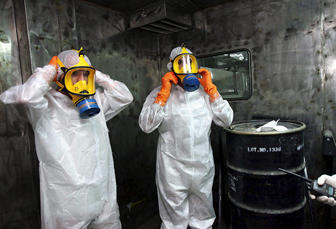
Caption :: Two technicians adjust their protective wear, alongside a box containig uranium ore concentrate, known as yellowcake, at the Uranium Conversion Facility of Iran, just outside the city of Isfahan, 410 kilometers, 255 miles south of the capital Tehran, Monday, Aug. 8, 2005. Iran resumed uranium conversion activities at the facility Monday. (AP Photo/Mehdi Ghasemi, ISNA)


Iran restarts its nuclear activities
By Seth Rosen
THE WASHINGTON TIMES
August 9, 2005
Iran resumed uranium-conversion activities at its Isfahan nuclear facility yesterday, breaching an agreement with European countries in an action that Western nations have said could lead them to seek U.N. sanctions against Tehran.
The United States will consult with its European allies before deciding whether to refer Iran to the United Nations Security Council, State Department spokesman Adam Ereli said in Washington.
August 15, 2005
Tests appear to clear Iran over nuke traces
15.08.05 1.00pm
VIENNA - Tests by the UN nuclear watchdog appear to confirm that traces of weapons-grade uranium found in Iran came from abroad, reinforcing Tehran's assertion it does not seek atomic weapons, a diplomat said today.
The International Atomic Energy Agency (IAEA) has said the issue of contamination is one of two main outstanding questions in its two-year investigation into Iran's nuclear programme. Tehran insists the programme is peaceful, but Western countries suspect it may be a front for developing nuclear weapons.
An analysis of Pakistani components for enrichment centrifuges identical to ones Iran bought on the black market appear to back Tehran's assertion that traces of bomb-grade uranium were the result of contamination, a Western diplomat familiar with the IAEA said.
"There's still some final corroboration to go on but all the preliminary analysis does show that the particles seem to have come from Pakistan," he said, adding that the final result was unlikely to change as a result of work still outstanding.
This appeared to confirm earlier results, reported by Reuters on June 10, that also suggested Tehran did not produce the highly-enriched uranium itself.
THE WASHINGTON TIMES
August 9, 2005
Iran resumed uranium-conversion activities at its Isfahan nuclear facility yesterday, breaching an agreement with European countries in an action that Western nations have said could lead them to seek U.N. sanctions against Tehran.
The United States will consult with its European allies before deciding whether to refer Iran to the United Nations Security Council, State Department spokesman Adam Ereli said in Washington.
August 15, 2005
Tests appear to clear Iran over nuke traces
15.08.05 1.00pm
VIENNA - Tests by the UN nuclear watchdog appear to confirm that traces of weapons-grade uranium found in Iran came from abroad, reinforcing Tehran's assertion it does not seek atomic weapons, a diplomat said today.
The International Atomic Energy Agency (IAEA) has said the issue of contamination is one of two main outstanding questions in its two-year investigation into Iran's nuclear programme. Tehran insists the programme is peaceful, but Western countries suspect it may be a front for developing nuclear weapons.
An analysis of Pakistani components for enrichment centrifuges identical to ones Iran bought on the black market appear to back Tehran's assertion that traces of bomb-grade uranium were the result of contamination, a Western diplomat familiar with the IAEA said.
"There's still some final corroboration to go on but all the preliminary analysis does show that the particles seem to have come from Pakistan," he said, adding that the final result was unlikely to change as a result of work still outstanding.
This appeared to confirm earlier results, reported by Reuters on June 10, that also suggested Tehran did not produce the highly-enriched uranium itself.
The inappropriate control over the message continues.
It's reasonable to assume Aaron might perfer to allow a recorded program introduction, but, I sincerely doubt it. Somehow, Aaron doesn't 'cave' that easily. So, although he wrote his own tribute to Peter Jennings in his e-mail the program intro was recorded.
Let's see if NewsNight lives upto it's bigoted attitude in supporting Police Brutality in Los Angeles and supporting Christian theory placed in the same 'category' as Evolution.
10:58 pm
The 'issue' of Christian Intelligent Design was used as an inticement to pull people into a program that was never going to discuss it this program hour.
True to form the Executive Producer lavished her love of death and grieving by embellishing the issue of Los Angeles Police Department Brutality with lots of images of a grieving mother. Ms. Lopez is supposed to be understood in grief but failed in her attempt to stop the bullet barrage of the LAPD even with a crucifix she held in front of them begging for mercy as her infant daughter was in the building with her father now under fire.
The LAPD openly and viciously stated Mr. Lopez was a known legal issue. That is supposed the settle the arguement in the police's favor.
Not with me it doesn't.
Nothing is that simple.
The LAPD knew this man. Hence, the criticism and not exoneration of the police needs to be addressed. Supposedly according to this accounting there is an investigation. Investigations under this administration amounts to nothing. They are exercises in futility. The fact of the matter is The Lopez family was probably well known to the police regarding domestic issues including drugs as well as the social service department. If anyone bothered to look beyond 'the moment' the police are defining their actions around there would be a significant record that easily points to intervention that should have happened long ago. As a result of the failure of 'the system' to protect children and police that no longer care to know the neighborhoods they patrol but only seek to kill with overwhelming force a nineteen month old child is dead when she should not be. THAT is something you will never hear from this program.
At 10:54 pm the Religiously Bigoted "Morning Papers" segement played.
Christian Science Monitor
Washington Times - convert message AGAIN is a picture of a GAS MASK
Daily News New York
Cincinnati Enquirer
Guardian
Chicago Sun Times
Always building hate with intentions of attracting Evangelicals? No probably just satisfying some stupid federal rule about 'bended knee' televison. I expected Barbara Walters to lead a pray vigile for all the superfluous nonsense she spouted tonight on Larry King Live regarding Jenning's First Wife. Barbara used the downcast 'eyes of curtosy' so frequently I though she was about to don a Nun's Habit. Evidently, the 'picture' that was supposed to come out of that mess was the concept that men who have only one wife in life don't die of lung cancer. Sick. The programming of CNN always carries these weirdo agendas of immoral judgement no matter what the subject.
Why is the Barbara Walter behavior inappropriate? Because it is becoming a cultural disciminaiton people with one surviving marriage are useing to falsely inflate their egos. Just last week during another interview with Walter Cronkite (It was actually Art Linkletter. Needless to say the show didn't impress me. The average age of people on Larry King Live has gotten to be close to ancient. A little more contemporary would be interesting, too.) the 'message' that he was chosen for evangelizing against the drug culture with the death of his daughter. He noted he was not among the many married. He paused for a moment as if to realize his host was but being gracious Larry King made little of it. I find the 'discrimination' rude, unkind and socially encouraged by this news team to produce a social 'attitude,' as if they could. Divorce happens for whatever reason it does including domestic violence. If an attitude based in religious dogma exists frequently what occurs is what we witnessed within the context of this one hour program in Los Angeles. Socially we went through this mess decades ago. It's wrong to retrograde our society as if we need to revisit all the social ills this form of basically 'hatred' manifests.
There were similar dysfunction with this program as with most the others. The division of time was different in that Aaron anchored more 'live' time but the same tone and same racism existed.
Let's see if NewsNight lives upto it's bigoted attitude in supporting Police Brutality in Los Angeles and supporting Christian theory placed in the same 'category' as Evolution.
10:58 pm
The 'issue' of Christian Intelligent Design was used as an inticement to pull people into a program that was never going to discuss it this program hour.
True to form the Executive Producer lavished her love of death and grieving by embellishing the issue of Los Angeles Police Department Brutality with lots of images of a grieving mother. Ms. Lopez is supposed to be understood in grief but failed in her attempt to stop the bullet barrage of the LAPD even with a crucifix she held in front of them begging for mercy as her infant daughter was in the building with her father now under fire.
The LAPD openly and viciously stated Mr. Lopez was a known legal issue. That is supposed the settle the arguement in the police's favor.
Not with me it doesn't.
Nothing is that simple.
The LAPD knew this man. Hence, the criticism and not exoneration of the police needs to be addressed. Supposedly according to this accounting there is an investigation. Investigations under this administration amounts to nothing. They are exercises in futility. The fact of the matter is The Lopez family was probably well known to the police regarding domestic issues including drugs as well as the social service department. If anyone bothered to look beyond 'the moment' the police are defining their actions around there would be a significant record that easily points to intervention that should have happened long ago. As a result of the failure of 'the system' to protect children and police that no longer care to know the neighborhoods they patrol but only seek to kill with overwhelming force a nineteen month old child is dead when she should not be. THAT is something you will never hear from this program.
At 10:54 pm the Religiously Bigoted "Morning Papers" segement played.
Christian Science Monitor
Washington Times - convert message AGAIN is a picture of a GAS MASK
Daily News New York
Cincinnati Enquirer
Guardian
Chicago Sun Times
Always building hate with intentions of attracting Evangelicals? No probably just satisfying some stupid federal rule about 'bended knee' televison. I expected Barbara Walters to lead a pray vigile for all the superfluous nonsense she spouted tonight on Larry King Live regarding Jenning's First Wife. Barbara used the downcast 'eyes of curtosy' so frequently I though she was about to don a Nun's Habit. Evidently, the 'picture' that was supposed to come out of that mess was the concept that men who have only one wife in life don't die of lung cancer. Sick. The programming of CNN always carries these weirdo agendas of immoral judgement no matter what the subject.
Why is the Barbara Walter behavior inappropriate? Because it is becoming a cultural disciminaiton people with one surviving marriage are useing to falsely inflate their egos. Just last week during another interview with Walter Cronkite (It was actually Art Linkletter. Needless to say the show didn't impress me. The average age of people on Larry King Live has gotten to be close to ancient. A little more contemporary would be interesting, too.) the 'message' that he was chosen for evangelizing against the drug culture with the death of his daughter. He noted he was not among the many married. He paused for a moment as if to realize his host was but being gracious Larry King made little of it. I find the 'discrimination' rude, unkind and socially encouraged by this news team to produce a social 'attitude,' as if they could. Divorce happens for whatever reason it does including domestic violence. If an attitude based in religious dogma exists frequently what occurs is what we witnessed within the context of this one hour program in Los Angeles. Socially we went through this mess decades ago. It's wrong to retrograde our society as if we need to revisit all the social ills this form of basically 'hatred' manifests.
There were similar dysfunction with this program as with most the others. The division of time was different in that Aaron anchored more 'live' time but the same tone and same racism existed.
Friday, August 5, 2005
The Bigotry of CNN
8:17 pm - Tonight the bigot assessment begins with the fact Aaron Brown did not write his own e-mail. Guaranteed tonight is another news hour at the movies night whereby the editors have it hands down to the 'message' they deliver rather than the news.
Here is some 'backlash' for you. Aaron isn't doing his pre-program announcements. If he isn't on then the criticism stands because those that seek a viewership outside him as an achor seeks to deceive others to achieve a rating. So much for Christian values.
Here is some 'backlash' for you. Aaron isn't doing his pre-program announcements. If he isn't on then the criticism stands because those that seek a viewership outside him as an achor seeks to deceive others to achieve a rating. So much for Christian values.
One Soldier was mentioned, Mr. Pugh, age 25.
Death was the theme of the entire show with Soledad O'Brien as anchor. They rarely own up to Aaron being out. No one tunes in. Loss and children was the majority of the subjects Amazing. This continues to be about the saddest reason for a news program I have ever witnessed.
Thursday, August 4, 2005
The Drastic Change in Direction regarding Honoring the American Dead Soldiers
This segment was started while David Bohrman was Executive Producer. This is from a transcript November 25, 2004 after there was a change in Ex. Prod. but the segment continued as a form of respect of the soldier regardless the legitimacy of the war. The 'viewer' e-mail maybe fictious but that is irrelevant to the fact this commitment was important.
BROWN: We received an e-mail from a viewer recently about the names we show on the program every night, the names of men and women, young and not so young, who die each and every day in Iraq.
"When I hear the music," she writes, "my eyes fill with tears but I try to stop everything. I look at their names. I try to hold each one in my mind to honor each one for a moment. It's painful," she wrote, "but it makes me more honest."
Those are the names, the hundreds of names by now, that we tend to focus on the most but for every one there are many, many more, thousands more who have been wounded in the war.
THE SEGMENT is frequently omitted from programming and when shown only lists two names to reduce the impact of the reality of death in Iraq.
BROWN: We received an e-mail from a viewer recently about the names we show on the program every night, the names of men and women, young and not so young, who die each and every day in Iraq.
"When I hear the music," she writes, "my eyes fill with tears but I try to stop everything. I look at their names. I try to hold each one in my mind to honor each one for a moment. It's painful," she wrote, "but it makes me more honest."
Those are the names, the hundreds of names by now, that we tend to focus on the most but for every one there are many, many more, thousands more who have been wounded in the war.
THE SEGMENT is frequently omitted from programming and when shown only lists two names to reduce the impact of the reality of death in Iraq.
The Bigotry of NewsNight
9:51 PM - Aaron Brown's pre-program announcement is done by recording. Aaron still is limited to his exposure to his audience. His expertise is unappreciated and so is his audience who demands it.
At 10;21 PM the programmers have primarily taped segments to CONTROL the message and exploit a crash in Toronto to bring up 911 through the roll of a stewardess who saved lives yesterday. This only goes to prove the 'religion' of 'CNN's NewsNight' is a bogus roll, a marketing tool, to control the message to an audience of The Culture of Fear of Bush.
The entire hatred of religious diversity begins with the FACT this program USES Evangelical Christianity as a making tool to a 'Culture of Fear' that is SUPPOSED to lead to 'The Party' preference that exploits this country and it's resources for personal gain of those that 'have' continue to 'have' at the expense of interanational relationships and stability, while the populous are innoculated with religion into passivility and obedience. Evangelical Christianity, the opiate of the people, literally.
Proof: Below is an emotional accounting of the events of a downing (It wasn't a crash) of an Airbus in Toronto. The accounting is converted from FACT to emotional stress to Evangelical content and then carried into the 'FEAR' scenario of 911. Imagine that. It would seem very event in life that carries trauma is somehow converted into a 911 scenario.
BROWN: Talk to you later.Good evening again, everyone.As you can imagine, we still have very little idea why an Air France jumbo jet skidded through and off a runway in Toronto yesterday. We know that there was bad weather in the area, very bad. We know the black boxes have been recovered. Those are the hard facts.Much of the rest are soft facts, memories and impressions, often vivid and frightening. We begin tonight with the last five minutes of that flight.
(BEGIN VIDEOTAPE)
BROWN (voice-over): The final five minutes, Flight 358 was already late because of bad weather. Inside the cabin, passengers were not worried. Not yet.
... BROWN: There are 309 survivor stories. And each one adds a few facts to the overall picture. Beyond the 309, there are also family members who watched that plane burn and assumed, as we all did, the worst. Phil Lecaille, his wife and two of his four children were on the plane. His oldest daughter was in Buffalo, New York, watching on TV. We spoke earlier to Audrey, her father and here sister, Emily, who was also on board.
(BEGIN VIDEOTAPE)
BROWN: Phil, you're an experienced traveler. You're coming in for the landing. What are you seeing out of the window?
WITH PHL BEING AN EXPERIENCED TRAVELER HE KNOWS BEYOND KNOWLEDGE OF ANY OTHER POTENTIAL PASSENGER WHAT HAPPENED HERE. THERE IS NO DEFINITON OF EXPERIENCED AND FOR ALL WE KNOW THIS WAS HIS SECOND FLIGHT IN THIS LIFE.
PHIL LECAILLE, PASSENGER: Well, under the window, we're in a severe storm. Surrounded by lightning. The plane is shaking. Dropping in altitude. From time to time. And the -- well, very, very dense clouds, basically. That's what we've seen.
BROWN: You hit the runway. You touch down. And are you aware -- do you hear the brakes being applied? Are you aware that this is not -- this is not the way it's supposed to be?
P. LECAILLE: We felt the plane was hydroplaning. It was gliding, basically, on the sheet of water, pouring by the airport. And all of a sudden, we knew we were off-track. We hit the grass or the fence. The plane actually probably lost a front wheel. And we could feel the front of the plane bobbing up and down, as the plane was progressing towards highway 401, which is like the key highway in Toronto. We hit the second fence then. And at that time, actually, flames started to catch fire on the right engine where my daughter, Emily, was sitting.
BROWN: Let me stop you at that point for a second. Let me turn to Emily for a second.
The young women are added for exploitive familial emotional content.
BROWN: Phil, do you remember where you sat?
P. LECAILLE: Absolutely. My first thought was that if we had to die, we have to die together. So I wanted to get Emily together with us. And when we saw that it wasn't blowing up, which I expected, I told them, "Just leave everything. Just run. Run, run, run. Run for the exit." So we basically -- I don't know. I think I pushed them, probably. And we ended up in front of the exit door, which just opened at that time. And they were actually the first guys out of the plane, out of the back chute.
BROWN: Let me leave that there and turn to Audrey for a second.
... BROWN: Phil, have you thought about -- I can't imagine that you haven't. Obviously the close calls in life don't get any closer than this. Have you thought about why y'all -- why everyone made it out? Why you made it out? Why your kids made it out? Why it all ended well?
P. LECAILLE: I appreciate the question, Aaron, because I've been asking myself the question since last night. And clearly, I know it sounds like a cliche, but it was a sheer miracle that we all got out without any injury, like serious injury. It appeared to me and to a lot of people around us, that we were protected. Somehow, you know? And I don't know how. But if you believe in God, it's time to thank God for this miracle. I never heard of a plane crash with nobody dying or, you know, nobody being seriously injured. And none of us -- of course, we escaped and we ran like crazy. But we were physically intact. So, I don't know why. I don't know why, but I can tell you, we are protected somehow.
BROWN: By a miracle. It works for me.
It works for me.
It works for me.
It works for me.
I BET IT DOES. Is that not one of the most scripted Evangelical moments ever. Not at any time is there identity of this 'witness' to his 'miracle.' It must be very comforting to realize god is taking care of airline flights these days.
The entire presenation turns into an exploitation of facts and emergency to return the identity to the events of 911.
Beth Nissan consents to create this 'tour' of stewardess evolution in air flight. It has absolutely no relevance, except a pay check, to the content of the program . It distorts the subject enough to go anywhere with it and indeed it does. It leaves Toronto right back in time to 911. The segment ends with the World Trade Towers burning and still standing.
BROWN: Frank Hurlehey, with EMS in Toronto.
As soon as we learned yesterday that everyone had survived the crash, had somehow had gotten off that plane without serious injury, our question was how. And the heroes became the flight attendants. Evacuating 309 people from a burning jet in two minutes is what they are trained to do. In the new normal, being a flight attendant has taken on new meaning, new duties. It did not begin that way. Here's NEWSNIGHT'S Beth Nissen.
Is NEWSNIGHT the only place where Nissan functions?
(BEGIN VIDEOTAPE)
BETH NISSEN, CNN CORRESPONDENT (voice-over): Early air travel was not all that comfortable, not all that safe. The first airline stewardesses in the 1930s were registered nurses, on board to make passengers feel more secure, to nurse them through the experience.
UNIDENTIFIED FEMALE: It seemed to me men, at that time, were very afraid to fly. We had all of the wherewithal. They alerted me when they were faint. There need oxygen.
NISSEN: but the late 1930s, there were more than 200 nurses working for the new airline industry. Then came World War II. Experienced nurses were needed at the front, served on early medevac flights. In the booming post-war period, when commercial flying really took off, stewardesses no longer had to have nursing skills. What was more important was a fresh face, a slim figure and a draw to globe circling adventure and glamor. Air travel was mostly reserved for the famous and the rich. By the early 1950s, stewardesses numbered in the thousands.
UNIDENTIFIED MALE: It's a wonderful feeling you get as you board your plane. A warm welcome for everyone from the pretty girl in the trim uniform.
NISSEN: Air fares were controlled so airlines used stewardesses as marketing tools. Stewardesses were schooled in the airplane function and safety. But also keeping the seams of their hose straight, their heels polished and comportment.
UNIDENTIFIED MALE: Poise and sense of balance are acquired through rhythmic exercise. Nothing is more disconcerting to the passenger than a lurching air hostess who tumbles in one's lap.
NISSEN: Rules were strict. Stewardesses could not be married, and they were forced to retire at 32. Then, the airline industry swung into the '60s. They wore short skirts and carried a brief message -- the skies were sexy.
UNIDENTIFIED MALE: She'll slip into something a little more comfortable.
UNIDENTIFIED FEMALE: I'm Mary Beth, fly me to Miami.
UNIDENTIFIED FEMALE: I'm Maggie, fly me to New York.
UNIDENTIFIED FEMALE: Whether it's me or Kathy or Cheryl, we're going to fly you like you've never been flown before.
NISSEN: But things slowly changed as progress was made in civil rights, women's rights. In the 1970s, stewardesses were joined by stewards, and both started to be called flight attendants. With the deregulation of the airlines, businesses added thousands of flights, millions of passengers. Flight attendants became part traffic cop, part fast food worker, part safety officer.
UNIDENTIFIED FEMALE: They seem upset (ph).
(UNIDENTIFIED FEMALE) Nobody knows
(UNINTELLIGIBLE) because nobody can breathe. We can't get to the cockpit. The door won't open.NISSEN: The role of flight attendant in airplane safety became clear since September 11th. Since then, they are trained in everything from cockpit security to in-flight arrests.
UNIDENTIFIED FEMALE: Don't take anything with you. You, you, get in line
(UNINTELLIGIBLE)NISSEN: Industry safety officials say the actions of the Air France flight crew in Toronto, show what professional flight attendants have become. Not just service staff at 30,000 feet. But the flying public's first and best line of defense. Beth Nissen, CNN, New York.
(END VIDEOTAPE)
BROWN: In a moment, another space spectacular.
THESE are clearly calculated events to AFFECT the audience creating a venue for Bush's Culture of Fear. This is government television even if by voluntary cooperation. It is askewed with 'video editing' a primary tool to deliver the desired EFFECT. A message EXCLUSIVE to Christianity.
At 10;21 PM the programmers have primarily taped segments to CONTROL the message and exploit a crash in Toronto to bring up 911 through the roll of a stewardess who saved lives yesterday. This only goes to prove the 'religion' of 'CNN's NewsNight' is a bogus roll, a marketing tool, to control the message to an audience of The Culture of Fear of Bush.
The entire hatred of religious diversity begins with the FACT this program USES Evangelical Christianity as a making tool to a 'Culture of Fear' that is SUPPOSED to lead to 'The Party' preference that exploits this country and it's resources for personal gain of those that 'have' continue to 'have' at the expense of interanational relationships and stability, while the populous are innoculated with religion into passivility and obedience. Evangelical Christianity, the opiate of the people, literally.
Proof: Below is an emotional accounting of the events of a downing (It wasn't a crash) of an Airbus in Toronto. The accounting is converted from FACT to emotional stress to Evangelical content and then carried into the 'FEAR' scenario of 911. Imagine that. It would seem very event in life that carries trauma is somehow converted into a 911 scenario.
BROWN: Talk to you later.Good evening again, everyone.As you can imagine, we still have very little idea why an Air France jumbo jet skidded through and off a runway in Toronto yesterday. We know that there was bad weather in the area, very bad. We know the black boxes have been recovered. Those are the hard facts.Much of the rest are soft facts, memories and impressions, often vivid and frightening. We begin tonight with the last five minutes of that flight.
(BEGIN VIDEOTAPE)
BROWN (voice-over): The final five minutes, Flight 358 was already late because of bad weather. Inside the cabin, passengers were not worried. Not yet.
... BROWN: There are 309 survivor stories. And each one adds a few facts to the overall picture. Beyond the 309, there are also family members who watched that plane burn and assumed, as we all did, the worst. Phil Lecaille, his wife and two of his four children were on the plane. His oldest daughter was in Buffalo, New York, watching on TV. We spoke earlier to Audrey, her father and here sister, Emily, who was also on board.
(BEGIN VIDEOTAPE)
BROWN: Phil, you're an experienced traveler. You're coming in for the landing. What are you seeing out of the window?
WITH PHL BEING AN EXPERIENCED TRAVELER HE KNOWS BEYOND KNOWLEDGE OF ANY OTHER POTENTIAL PASSENGER WHAT HAPPENED HERE. THERE IS NO DEFINITON OF EXPERIENCED AND FOR ALL WE KNOW THIS WAS HIS SECOND FLIGHT IN THIS LIFE.
PHIL LECAILLE, PASSENGER: Well, under the window, we're in a severe storm. Surrounded by lightning. The plane is shaking. Dropping in altitude. From time to time. And the -- well, very, very dense clouds, basically. That's what we've seen.
BROWN: You hit the runway. You touch down. And are you aware -- do you hear the brakes being applied? Are you aware that this is not -- this is not the way it's supposed to be?
P. LECAILLE: We felt the plane was hydroplaning. It was gliding, basically, on the sheet of water, pouring by the airport. And all of a sudden, we knew we were off-track. We hit the grass or the fence. The plane actually probably lost a front wheel. And we could feel the front of the plane bobbing up and down, as the plane was progressing towards highway 401, which is like the key highway in Toronto. We hit the second fence then. And at that time, actually, flames started to catch fire on the right engine where my daughter, Emily, was sitting.
BROWN: Let me stop you at that point for a second. Let me turn to Emily for a second.
The young women are added for exploitive familial emotional content.
BROWN: Phil, do you remember where you sat?
P. LECAILLE: Absolutely. My first thought was that if we had to die, we have to die together. So I wanted to get Emily together with us. And when we saw that it wasn't blowing up, which I expected, I told them, "Just leave everything. Just run. Run, run, run. Run for the exit." So we basically -- I don't know. I think I pushed them, probably. And we ended up in front of the exit door, which just opened at that time. And they were actually the first guys out of the plane, out of the back chute.
BROWN: Let me leave that there and turn to Audrey for a second.
... BROWN: Phil, have you thought about -- I can't imagine that you haven't. Obviously the close calls in life don't get any closer than this. Have you thought about why y'all -- why everyone made it out? Why you made it out? Why your kids made it out? Why it all ended well?
P. LECAILLE: I appreciate the question, Aaron, because I've been asking myself the question since last night. And clearly, I know it sounds like a cliche, but it was a sheer miracle that we all got out without any injury, like serious injury. It appeared to me and to a lot of people around us, that we were protected. Somehow, you know? And I don't know how. But if you believe in God, it's time to thank God for this miracle. I never heard of a plane crash with nobody dying or, you know, nobody being seriously injured. And none of us -- of course, we escaped and we ran like crazy. But we were physically intact. So, I don't know why. I don't know why, but I can tell you, we are protected somehow.
BROWN: By a miracle. It works for me.
It works for me.
It works for me.
It works for me.
I BET IT DOES. Is that not one of the most scripted Evangelical moments ever. Not at any time is there identity of this 'witness' to his 'miracle.' It must be very comforting to realize god is taking care of airline flights these days.
The entire presenation turns into an exploitation of facts and emergency to return the identity to the events of 911.
Beth Nissan consents to create this 'tour' of stewardess evolution in air flight. It has absolutely no relevance, except a pay check, to the content of the program . It distorts the subject enough to go anywhere with it and indeed it does. It leaves Toronto right back in time to 911. The segment ends with the World Trade Towers burning and still standing.
BROWN: Frank Hurlehey, with EMS in Toronto.
As soon as we learned yesterday that everyone had survived the crash, had somehow had gotten off that plane without serious injury, our question was how. And the heroes became the flight attendants. Evacuating 309 people from a burning jet in two minutes is what they are trained to do. In the new normal, being a flight attendant has taken on new meaning, new duties. It did not begin that way. Here's NEWSNIGHT'S Beth Nissen.
Is NEWSNIGHT the only place where Nissan functions?
(BEGIN VIDEOTAPE)
BETH NISSEN, CNN CORRESPONDENT (voice-over): Early air travel was not all that comfortable, not all that safe. The first airline stewardesses in the 1930s were registered nurses, on board to make passengers feel more secure, to nurse them through the experience.
UNIDENTIFIED FEMALE: It seemed to me men, at that time, were very afraid to fly. We had all of the wherewithal. They alerted me when they were faint. There need oxygen.
NISSEN: but the late 1930s, there were more than 200 nurses working for the new airline industry. Then came World War II. Experienced nurses were needed at the front, served on early medevac flights. In the booming post-war period, when commercial flying really took off, stewardesses no longer had to have nursing skills. What was more important was a fresh face, a slim figure and a draw to globe circling adventure and glamor. Air travel was mostly reserved for the famous and the rich. By the early 1950s, stewardesses numbered in the thousands.
UNIDENTIFIED MALE: It's a wonderful feeling you get as you board your plane. A warm welcome for everyone from the pretty girl in the trim uniform.
NISSEN: Air fares were controlled so airlines used stewardesses as marketing tools. Stewardesses were schooled in the airplane function and safety. But also keeping the seams of their hose straight, their heels polished and comportment.
UNIDENTIFIED MALE: Poise and sense of balance are acquired through rhythmic exercise. Nothing is more disconcerting to the passenger than a lurching air hostess who tumbles in one's lap.
NISSEN: Rules were strict. Stewardesses could not be married, and they were forced to retire at 32. Then, the airline industry swung into the '60s. They wore short skirts and carried a brief message -- the skies were sexy.
UNIDENTIFIED MALE: She'll slip into something a little more comfortable.
UNIDENTIFIED FEMALE: I'm Mary Beth, fly me to Miami.
UNIDENTIFIED FEMALE: I'm Maggie, fly me to New York.
UNIDENTIFIED FEMALE: Whether it's me or Kathy or Cheryl, we're going to fly you like you've never been flown before.
NISSEN: But things slowly changed as progress was made in civil rights, women's rights. In the 1970s, stewardesses were joined by stewards, and both started to be called flight attendants. With the deregulation of the airlines, businesses added thousands of flights, millions of passengers. Flight attendants became part traffic cop, part fast food worker, part safety officer.
UNIDENTIFIED FEMALE: They seem upset (ph).
(UNIDENTIFIED FEMALE) Nobody knows
(UNINTELLIGIBLE) because nobody can breathe. We can't get to the cockpit. The door won't open.NISSEN: The role of flight attendant in airplane safety became clear since September 11th. Since then, they are trained in everything from cockpit security to in-flight arrests.
UNIDENTIFIED FEMALE: Don't take anything with you. You, you, get in line
(UNINTELLIGIBLE)NISSEN: Industry safety officials say the actions of the Air France flight crew in Toronto, show what professional flight attendants have become. Not just service staff at 30,000 feet. But the flying public's first and best line of defense. Beth Nissen, CNN, New York.
(END VIDEOTAPE)
BROWN: In a moment, another space spectacular.
THESE are clearly calculated events to AFFECT the audience creating a venue for Bush's Culture of Fear. This is government television even if by voluntary cooperation. It is askewed with 'video editing' a primary tool to deliver the desired EFFECT. A message EXCLUSIVE to Christianity.
Wednesday, August 3, 2005

Central Park
What's next Sharon? Eqaul time for a Purple Evangelical Exhibit ? The Royalty of all religious royalty. The Evangelicals who have the answers for all humankind ! Christo's Gates and the Gapstow Bridge, 21 February 2005. Sharon von Zwieten the only authority in town that matters. The Birds ! The Birds !


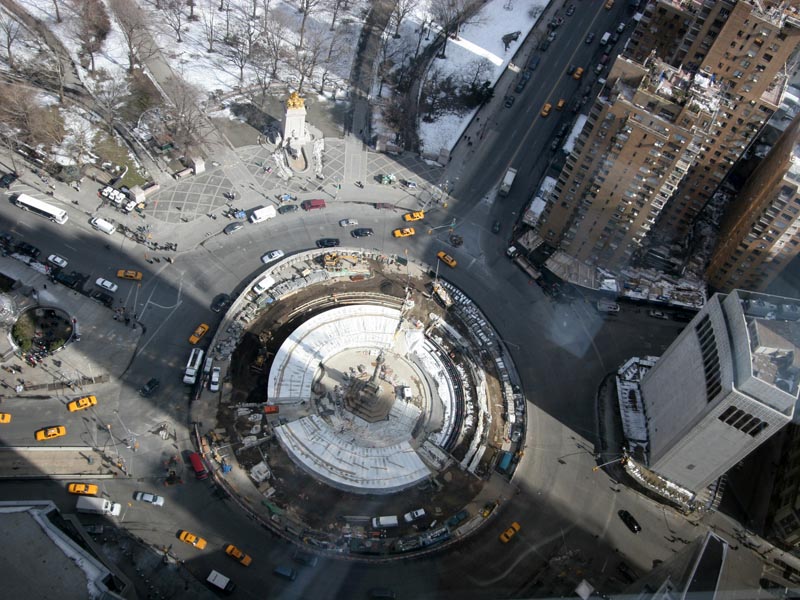

Looking down her nose at the world is to realize her view !
Ms. Bigot's view down her long and arrogant Evangelical Nose is blighted by New York City aestetics. What a shame !
The Case of 2 Columbus Circle (NYT)
688 wordsPublished: June 29, 2005
So far, Edward Durell Stone is not having a good century. Two years ago, the extraordinary house he built for A. Conger Goodyear in Old Westbury, N.Y., was nearly torn down. Early this month, the board of trustees at the University of Arkansas approved the razing of an apartment complex designed by Stone, an Arkansas native who died in 1978. But the real insult has come from New York City, and specifically from the Landmarks Preservation Commission, which has refused to hold hearings to discuss the fate of Stone's controversial building at 2 Columbus Circle.
The Museum of Arts and Design, formerly the American Craft Museum, has purchased the building and plans to strip away its marble facade, replacing it with a neutral, not to say impersonal, sheath designed by Brad Cloepfil. The redesign enjoys the support of Mayor Michael Bloomberg, who was a member of the museum's board of trustees and who appointed the head of the landmarks commission, Robert Tierney.
It's one thing to doom this building -- for that is what this redesign means -- after a hearing by the landmarks commission. No one expects that a proper hearing would automatically lead to a vote for preserving Stone's original design. This, after all, is the building that famously evoked from The Times's great architecture critic Ada Louise Huxtable the word ''lollipop,'' a word that has stuck to this building like a wet sucker to a flannel blanket.
Stone's design -- its Islamic overtones, its gleaming white marble in a dark setting -- has been controversial from the start, and the controversy has been amplified by the checkered history of the building, which was built as a museum but has served as the headquarters of the city's Cultural Affairs Department and now stands vacant.
Yet dooming this building without a hearing is an enormous mistake, one that seriously erodes the Landmarks Preservation Commission's purpose and whatever political independence it has managed to attain since it was first created. It's hard to say, in fact, whether the commission has refused to hear this case as a matter of taste or a matter of politics. If it is a matter of politics, then the commission is headed down the wrong road entirely. But if it is a matter of taste -- a sense that this building is too ugly to live and has somehow never fit its setting -- then the commission is still headed down the wrong road. Its purpose is to weigh openly questions of taste against questions of historical merit, not to impose, by a fiat of neglect, its own unexpressed will.
The building at 2 Columbus Circle is already an architectural monument, the work of a major architect, whether the commission likes it or not. The National Trust for Historic Preservation and the World Monuments Fund have declared this building one of the nation's most endangered structures, but the city has done nothing to protect it.
The real question here is, of course, the character of the New York we live in. Some buildings, some neighborhoods, have a completeness, a consistency, about them that is easy to justify, historically and aesthetically. They help confirm our notion of urban coherence. But this is not an entirely coherent city, certainly not architecturally. Stone created at least two grand irruptions in the familiar pattern: 2 Columbus Circle and his house at 130 East 64th Street, which was protected by the landmarks commission when Stone's widow tried to tear down its facade -- a striking white concrete grille in a row of conventional town houses. The point of preservation, as the landmarks commission once understood, is to protect the complexity of the past, not to iron it out.
The Case of 2 Columbus Circle (NYT)
688 wordsPublished: June 29, 2005
So far, Edward Durell Stone is not having a good century. Two years ago, the extraordinary house he built for A. Conger Goodyear in Old Westbury, N.Y., was nearly torn down. Early this month, the board of trustees at the University of Arkansas approved the razing of an apartment complex designed by Stone, an Arkansas native who died in 1978. But the real insult has come from New York City, and specifically from the Landmarks Preservation Commission, which has refused to hold hearings to discuss the fate of Stone's controversial building at 2 Columbus Circle.
The Museum of Arts and Design, formerly the American Craft Museum, has purchased the building and plans to strip away its marble facade, replacing it with a neutral, not to say impersonal, sheath designed by Brad Cloepfil. The redesign enjoys the support of Mayor Michael Bloomberg, who was a member of the museum's board of trustees and who appointed the head of the landmarks commission, Robert Tierney.
It's one thing to doom this building -- for that is what this redesign means -- after a hearing by the landmarks commission. No one expects that a proper hearing would automatically lead to a vote for preserving Stone's original design. This, after all, is the building that famously evoked from The Times's great architecture critic Ada Louise Huxtable the word ''lollipop,'' a word that has stuck to this building like a wet sucker to a flannel blanket.
Stone's design -- its Islamic overtones, its gleaming white marble in a dark setting -- has been controversial from the start, and the controversy has been amplified by the checkered history of the building, which was built as a museum but has served as the headquarters of the city's Cultural Affairs Department and now stands vacant.
Yet dooming this building without a hearing is an enormous mistake, one that seriously erodes the Landmarks Preservation Commission's purpose and whatever political independence it has managed to attain since it was first created. It's hard to say, in fact, whether the commission has refused to hear this case as a matter of taste or a matter of politics. If it is a matter of politics, then the commission is headed down the wrong road entirely. But if it is a matter of taste -- a sense that this building is too ugly to live and has somehow never fit its setting -- then the commission is still headed down the wrong road. Its purpose is to weigh openly questions of taste against questions of historical merit, not to impose, by a fiat of neglect, its own unexpressed will.
The building at 2 Columbus Circle is already an architectural monument, the work of a major architect, whether the commission likes it or not. The National Trust for Historic Preservation and the World Monuments Fund have declared this building one of the nation's most endangered structures, but the city has done nothing to protect it.
The real question here is, of course, the character of the New York we live in. Some buildings, some neighborhoods, have a completeness, a consistency, about them that is easy to justify, historically and aesthetically. They help confirm our notion of urban coherence. But this is not an entirely coherent city, certainly not architecturally. Stone created at least two grand irruptions in the familiar pattern: 2 Columbus Circle and his house at 130 East 64th Street, which was protected by the landmarks commission when Stone's widow tried to tear down its facade -- a striking white concrete grille in a row of conventional town houses. The point of preservation, as the landmarks commission once understood, is to protect the complexity of the past, not to iron it out.

The Bigotry of NewsNight
They are off to a running start without Aaron doing his program announcements.
How about a taste of 'distaste.' The staff has abandoned the 'Honor Roll for the Dead American Soldiers.' Instead they want to forget the dead and have the widows who are now wealthier on government money to move on quickly and enjoy life. The 'New' status of the Military Class is one of oppotunistic wealth depending on the skill of a spouse to live through war. It can be fun to be a Military Class widow. CNN's Sharon von Zwieten will make sure the social status for the Republican Party provides for the fun, sun and money of any widow who has found the guts to be a social climber as well as a participant in The CNN Military Class Merry Widow Waltz.
Washington Post
Washington Times
Christian Science Monitor - No subliminal messages tonight? Not even 'walk this way' military widows welcome?
San Antonio Express
Boston Herald
Chicago Sun Times
How about a taste of 'distaste.' The staff has abandoned the 'Honor Roll for the Dead American Soldiers.' Instead they want to forget the dead and have the widows who are now wealthier on government money to move on quickly and enjoy life. The 'New' status of the Military Class is one of oppotunistic wealth depending on the skill of a spouse to live through war. It can be fun to be a Military Class widow. CNN's Sharon von Zwieten will make sure the social status for the Republican Party provides for the fun, sun and money of any widow who has found the guts to be a social climber as well as a participant in The CNN Military Class Merry Widow Waltz.
Washington Post
Washington Times
Christian Science Monitor - No subliminal messages tonight? Not even 'walk this way' military widows welcome?
San Antonio Express
Boston Herald
Chicago Sun Times
Tuesday, August 2, 2005
The Religious Bigotry of CNN's NewsNight's "Morning Papers"
There was no "Honor Segment" of the American Dead at War.
This is also turning into a venue of treason.
International Herald Tribune
The Christian Science Monitor
This is the area highly motivated to act against states best interests. It isn't intended to be helpful but with the 'new wave' of states taking on what rightfully belongs for the federal government to take on including environmental and non exploitive initiatives.
The 'segment' was about al Qaeda but the only 'print' that stood out was the title "Cap State Spending : the next new wave?"
It is a movement from somewhere supposedly in California which would give it a 'tilt' of 'liberalism' but if it is starting in California it is to 'blind side' the left in this country. The federal initiatives is to stop the liberals at the State Level from succeeding. In other words Bush is plenty PISSED off as are morons such as these that states have been increasing taxes for years to bring about success in job growth regardless the intentions of the feds. See that doesn't happen in Red States. The Reds tax high anyway but they chronically spend it on pork such as the Feds are doing now.
Example: North Carolina. The tax rates in the state are high on all venues. The spending 'enables' pork projects such as traffic loops that never really solve problems so much as add to urban sprawl. There are currently seven loops in the planning or started in the state. There isn't that room in NC yet alone the construction projects that follow. The current traffic on several of these planned loops don't even have significant traffic problems to build a loop. But, urban plannig being what it is will insure pork projects come first while education comes last.
When Bush cut federal taxes and trashed the economy he didn't expect the liberal states to benefit by out smarting him. He expected them to be the sheep the red states are and follow his example. "The Blind Leading The Blind" so to speak expect the Commander and Chief Blind Man knows where the cliff is the sheep will fall into and do. The ideology of the Red States results in poor economies that are dominated by miltiary. So, when Red States tax high for aesthetic reasons it is to make things nice for the rich folks while the poor folks find pride in military service.
The 'title' that appeared on NewsNight's "Morning Papers" in the Christian Science Monitor is treasonist. It was a 'message' to those that were watching there is a way to undo the 'revolt' of the Blue States that has lead in a direction of prosperity without trapping their youth in military service.
The Washington Times
The Times of London
The Guardian
Boston Herald
Chicago Sun Times
The program is chronically caucasian with every commercial touting those values.
THE LAST LOW BLOW ... is a planned assault against the integrity of the spouses of the miliary dead.
For a few months now CNN has tastelessly played the "Panasonic" commercial called "Life is color" whereby at the conclusion of this commercial a woman is walking behind a hearse in "Defiance" of her spouse's death. I thought that was enough of an atrocity given the 'pain' of the country considering a regular segment of this program was an Honor Segment for the USA military dead.
Now, realizing Ms. Bigot feels she has overwhelming control of all minds within telecast reach has created a real life role model.
Premiering as this role model is the gaunt, Carol "The Gauntlet" Costello. The woman dressed in black in the 'dead of summer' from head to toe, drapped in 'wealth' from head to toe doing nothing but pundancy propaganda for Bush from 5AM through most of American Morning. This is OBVIOUSLY an invitation to what Ms. Bigot preceives as 'wealthy' military widows to find meaning in life as a 'chic' Repuglican grassroots politico with promises of being much more.
Since, the guant Carol "I have run the Gauntlet of Life's Colors" Costello is maxing the sex appeal what comes across is a 'saavy' widow on her way to her next man. Perhaps, another military man who might increase her financial bottomline further with his death in Iraq.
I did not create this stuff up, it 'screams' across the airewave. It is very sexy and enticing and reeks of inappropriate priorities for any news network. But. Not a surprise coming from this one.
This is also turning into a venue of treason.
International Herald Tribune
The Christian Science Monitor
This is the area highly motivated to act against states best interests. It isn't intended to be helpful but with the 'new wave' of states taking on what rightfully belongs for the federal government to take on including environmental and non exploitive initiatives.
The 'segment' was about al Qaeda but the only 'print' that stood out was the title "Cap State Spending : the next new wave?"
It is a movement from somewhere supposedly in California which would give it a 'tilt' of 'liberalism' but if it is starting in California it is to 'blind side' the left in this country. The federal initiatives is to stop the liberals at the State Level from succeeding. In other words Bush is plenty PISSED off as are morons such as these that states have been increasing taxes for years to bring about success in job growth regardless the intentions of the feds. See that doesn't happen in Red States. The Reds tax high anyway but they chronically spend it on pork such as the Feds are doing now.
Example: North Carolina. The tax rates in the state are high on all venues. The spending 'enables' pork projects such as traffic loops that never really solve problems so much as add to urban sprawl. There are currently seven loops in the planning or started in the state. There isn't that room in NC yet alone the construction projects that follow. The current traffic on several of these planned loops don't even have significant traffic problems to build a loop. But, urban plannig being what it is will insure pork projects come first while education comes last.
When Bush cut federal taxes and trashed the economy he didn't expect the liberal states to benefit by out smarting him. He expected them to be the sheep the red states are and follow his example. "The Blind Leading The Blind" so to speak expect the Commander and Chief Blind Man knows where the cliff is the sheep will fall into and do. The ideology of the Red States results in poor economies that are dominated by miltiary. So, when Red States tax high for aesthetic reasons it is to make things nice for the rich folks while the poor folks find pride in military service.
The 'title' that appeared on NewsNight's "Morning Papers" in the Christian Science Monitor is treasonist. It was a 'message' to those that were watching there is a way to undo the 'revolt' of the Blue States that has lead in a direction of prosperity without trapping their youth in military service.
The Washington Times
The Times of London
The Guardian
Boston Herald
Chicago Sun Times
The program is chronically caucasian with every commercial touting those values.
THE LAST LOW BLOW ... is a planned assault against the integrity of the spouses of the miliary dead.
For a few months now CNN has tastelessly played the "Panasonic" commercial called "Life is color" whereby at the conclusion of this commercial a woman is walking behind a hearse in "Defiance" of her spouse's death. I thought that was enough of an atrocity given the 'pain' of the country considering a regular segment of this program was an Honor Segment for the USA military dead.
Now, realizing Ms. Bigot feels she has overwhelming control of all minds within telecast reach has created a real life role model.
Premiering as this role model is the gaunt, Carol "The Gauntlet" Costello. The woman dressed in black in the 'dead of summer' from head to toe, drapped in 'wealth' from head to toe doing nothing but pundancy propaganda for Bush from 5AM through most of American Morning. This is OBVIOUSLY an invitation to what Ms. Bigot preceives as 'wealthy' military widows to find meaning in life as a 'chic' Repuglican grassroots politico with promises of being much more.
Since, the guant Carol "I have run the Gauntlet of Life's Colors" Costello is maxing the sex appeal what comes across is a 'saavy' widow on her way to her next man. Perhaps, another military man who might increase her financial bottomline further with his death in Iraq.
I did not create this stuff up, it 'screams' across the airewave. It is very sexy and enticing and reeks of inappropriate priorities for any news network. But. Not a surprise coming from this one.
Saturday, July 30, 2005
CNN's NewsNight has not done the "USA Military Dead Honor Segment" for at least three day.
When they have it has been sparce with only two soldiers respected for their sacrifice.
For those with a continual interest, kindly check at:
Michael Moore Webpage on the link below, there is an accounting of the current fatalities as well as links to cites that maintain those numbers. Currently, at "The Washington Post" the latest update includes one soldier as recent as June 16th I believe.
http://www.michaelmoore.com/
It's just a good cite to look up everday.
For those with a continual interest, kindly check at:
Michael Moore Webpage on the link below, there is an accounting of the current fatalities as well as links to cites that maintain those numbers. Currently, at "The Washington Post" the latest update includes one soldier as recent as June 16th I believe.
http://www.michaelmoore.com/
It's just a good cite to look up everday.
Friday, July 29, 2005

Paula Zahn NOW featured enticing heterosexual commericals compliments of Budweiser. Following the PROGRAMMING of Homophobia was an hour of Larry King Live fearturing the Hogan Family of Hypermasculinity and Hyperfemininity. The Programers at CNN have become estranged from civility while pursuing the indoctrination of Evangelical Christianity in a political theater. They have become abusive to the American Landscape.
CNN is getting stranger by the day. NOW, their speciality is Homophobia and Child Abuse.
CNN is getting stranger by the day. NOW, their speciality is Homophobia and Child Abuse.
What will never be viewed on CNN are gay men or women and definately not couples advocating for Gay Marriage. What they dish out now is paranoid control ranting that lends itself to abuse of people Bush's Society deems undesireables. This segment is about social control of behaviors. It places homosexuality back in the closet and out of OFFENSIVE presence to society and piers. If you can 'HIDE IT' then no one will know, "Dont' ask, Don't tell" and therefore homosexuality does not exist in the USA. Don't hold hands or embrace in pubic, sex is only for behind closed doors, no homosexual families basically make them invisible even to themselves. THAT is homophobia and this segment is breeding it.
Young people are sequestered into a ? camp ? for over eight long months of emotional disconnect from their sexual identity. It is a form of sexual abuse and it is dangerous. They need to be shut down by society. I can imagine the flood of tears that goes on in the beginning for a good six to eight weeks until a young man or woman now shackled away from society has their will broken and their personal identity assaulted enough to illicite DESIRED behaviors. The gay community needs to address this including demands of investigation of child abuse.
ZAHN: Behind the scenes at a gay-to-straight camp. Does it really work?In a minute, we're going to take you inside a controversial religious camp, its aim, to make gay teenagers go straight.
(BEGIN VIDEO CLIP)
REV. JOHN SMID, LOVE IN ACTION: Our goal is to help teenagers discover a way to live in sexual self-control.
(END VIDEO CLIP)
ZAHN: So does it work? We're going to take you inside the conversion process next. And you will meet a man who has been through it himself.
(COMMERCIAL BREAK)
ZAHN: Welcome back. Last night we met a gay teenager whose parents sent him to a religious program to turn him straight. It's a fascinating and controversial subject. So we want to continue now with part two of our report. Here's Deborah Feyerick.
(BEGIN VIDEOTAPE)
DEBORAH FEYERICK, CNN CORRESPONDENT: Last summer, Ben Marshall's parents told him he was going to camp. It didn't go over well.
BEN MARSHALL, LOVE IN ACTION GRADUATE: I was just so angry that my parents were accepting who I thought I was. And that they were sending me to get fixed. I told all my friends they were sending me to straight camp.
FEYERICK: The program is called Refuge. It claims to help gay and lesbian teens turn away from homosexuality and what it calls other addictive behaviors.SMID: My hope is that people will realize through Christ you absolutely can find the victory to say no to those temptations.
FEYERICK: Reverend John Smid says he renounced his own homosexuality two decades ago. He claims the program is not about curing or converting, it's about choices he believes teenagers can make.
SMID: Our goal is to help teenagers to discover a way to live in sexual self-control.
: The teens are cut off, isolated from everyone who's not in the program. When they do go out, they travel in groups of threes.
SMID: Father, I just pray for these men Lord, that --
FEYERICK: As in the adult program, the teens study Bible. A lot of passages dealing with what's described as sexual immortality. There's also group therapy where teens talk about their parents and their sexual experiences. Everyone keeps a journal, what the program calls moral inventories.
MARSHALL: That was one thing, one of the recurring assignments that they gave me was, tell me who you are, tell me about yourself, and I couldn't answer those questions.
FEYERICK: Refuge is not a registered mental health clinic. Only one counselor is licensed. Mainstream psychiatrists oppose conversion treatment.
DR. JACK DRESCHER, AMERICAN PSYCHIATRIC ASSN: There are people who have tried to commit suicide because the treatments didn't work.
FEYERICK: Dr. Jack Drescher is an expert on psychoanalysis and homosexuality.
DRESCHER: Religious people who are struggling with homosexual feelings are a very desperate patient population. These people are in a lot of pain. And they are desperate. And this movement is praying off that desperation.
FEYERICK: Brandon Tidwell, an Evangelical Christian, says he was one of those people desperate to have what he calls a straight lifestyle. He spent three months at the adult program.
BRANDON TIDWELL, LOVE IN ACTION GRADUATE: They are creating an unrealistic environment which then creates an unrealistic hope for their participants that they can live their lives like that outside of those four walls. And it's just not a reality.
FEYERICK: Rather than deny his homosexuality, Tidwell embraced it. He says two other friends he met at the program did the same. They are also gay. Aren't some of the young men afraid that once they leave here, they're not going to be in a safe environment, they're going to be exposed to temptation?
SMID: Yes, when men leave here I think that's one of the biggest awareness they have, is that the world that they're going back to can be a dangerous place.
FEYERICK: Twenty four teenagers have gone through the program since it began three years ago. Reverend Smid says he doesn't know how many of them have straightened out. Yet for now, one of them seems to be Ben Marshall. He stayed with the program for eight months and has now joined a church group. He says he no longer lusts after men as much as he used to. Did they fix you? Did it fix you?
MARSHALL: Not by the standards that I was thinking. I was thinking their goal was to make me come out on the other side lusting towards women. I was going to be epitome of straight. I was going to be the big burly athlete. I thought they were going to totally try to change who I was. And they didn't. I guess it fixed me, yes. I mean, I'm happy where I am.
(END VIDEOTAPE)
ZAHN: And that was Deborah Feyerick taking us inside the process. Joining me now is Gerard Wellman, who last year went through a similar program for adults. He now works for Love In Action International, which runs the Refuge program -- Refugee or Refuge, whatever you want to call it. Let me ask you this, you have been through this programs that we just said, and yet you still fantasize about men. You think about men. So how can you tell us tonight that's successful conversion?
GERARD WELLMAN, LOVE IN ACTION INTERNATIONAL: Well it's not about the temptation. It's about behavior. It's entirely about behavior. It's about adjusting behavior, for me, it was adjusting my behavior to fit my faith.
ZAHN: So all you're reality doing then is suppressing your natural instinct?
WELLMAN: Right. Absolutely.
ZAHN: SO what do you consider yourself?
WELLMAN: What do I consider myself? I considered myself someone who struggles with homosexuality. A Christian who struggles with homosexuality.
ZAHN: And do you think that will last your lifetime?
WELLMAN: Probably.
ZAHN: So you don't think these programs could ever effectively do anything other than suppress what you think is a natural --
WELLMAN: Absolutely not. Absolutely, I agree. But the interesting thing is that programs don't claim to change desires. Our program claims to change behavior. And that is where the success is that I found.
ZAHN: In spite of what you're saying, you no doubt know that the American Psychiatric Association and the American Medical Association, both condemn this conversion therapy. And the biggest problem they have with it is they say that the therapy assumes that homosexuality is a mental disorder. Is that the way you see it.
WELLMAN: Well that is an interesting point. What I'd like to clarify is that there's hundreds of thousands of people out there just like me. Who -- before entering the program, I was involved in homosexual behavior that did not fit what I wanted for my life. At that time, I felt desperate and hopeless and lonely. And I think society forgets about those people. And so if any program can help align my behavior with my faith, that's a good program.
ZAHN: And yet we just heard the psychiatrist in Deborah's piece saying that those people who are lonely, those people who feel discriminated against, who are pushed through these conversion programs, often end up feeling more desperate, and in some cases even suicidal. Do you acknowledge tonight that that can be an end result of this type of therapy?
WELLMAN: I think change is definitely possible for people that desire it. People who do not desire it I do not think there's a high likelihood of change, if they don't desire it. People who do desire it do change. And at the end they often report, as we saw in the video, feeling much more happy, that's been my experience. Much more happy, much more contented, because their behavior is aligning with their faith./
ZAHN: But in a way, aren't you denying who you are?
WELLMAN: Aren't we all. I mean don't we all have desires. I mean every married man out there that has heterosexual fantasies does not act on them out of obedience or respect to his wife. It's the exact same scenario.
ZAHN: Once again, though, the criticism of this is you're taking a population of kids, whose sexual identity in some cases probably isn't yet fully informed…
WELLMAN: Absolutely not. Absolutely not.
ZAHN: You're forcing them into which is a different situation, and when you're going through this program, in the 20s. Do you understand the vulnerability of these kids?
WELLMAN: In that regard…
ZAHN: ... and the potential long-term damaging consequences of this type of therapy?
WELLMAN: I don't acknowledge that. Because what we are doing, we are respecting the parents' responsibility to raise their children as they see fit. It's the same thing as music lessons, for instance. Should parents not be allowed to enroll their children in music lessons? Of course not. It's the parents' responsibility to raise their children as they see fit. And what we're dealing with, we are dealing with teens that are reporting by the hundreds to us, in exodus, feelings of suicidal thoughts, desperation, loneliness, and we are helping those teens.
ZAHN: But you know, the critics out there saying, wait a minute, you know, music lessons aren't going to lead to suicide. You know, that's not a fair analogy to make it all...
WELLMAN: Well, it's an interesting point, but there are no studies that show that suicide is a result...
ZAHN: And there are probably no studies too that point to any hard-core evidence that this stuff works.Very brief answer to this: Do you think these programs promote homophobia?
WELLMAN: Absolutely not. Absolutely not. There is no question in my mind that that is not the case. If anything, it's the exact opposite. Entire exact opposite.
IF THIS WEREN'T HOMOPHOBIA, it would also encompass heterosexuality and controlling their sexual urges. This entire focus is an outrage !!
ZAHN: Yeah, I'm sure you've heard from some of those people on Web sites who feel quite the opposite. So there is a lot to debate here, on both sides.
WELLMAN: Oh, there certainly is. The debate is not over.
ZAHN: All right, Gerard, thanks for traveling here tonight.
WELLMAN: Sure thing.
ZAHN: Appreciate your time.
WELLMAN: Sure thing.
ZAHN: Coming up next, we change our focus dramatically -- a cold remedy millions swear by.
I HAVE A BETTER remedy.
Turn the channel selector to off !!
http://transcripts.cnn.com/TRANSCRIPTS/0507/28/pzn.01.html
What will never be viewed on CNN are gay men or women and definately not couples advocating for Gay Marriage. What they dish out now is paranoid control ranting that lends itself to abuse of people Bush's Society deems undesireables. This segment is about social control of behaviors. It places homosexuality back in the closet and out of OFFENSIVE presence to society and piers. If you can 'HIDE IT' then no one will know, "Dont' ask, Don't tell" and therefore homosexuality does not exist in the USA. Don't hold hands or embrace in pubic, sex is only for behind closed doors, no homosexual families basically make them invisible even to themselves. THAT is homophobia and this segment is breeding it.
Young people are sequestered into a ? camp ? for over eight long months of emotional disconnect from their sexual identity. It is a form of sexual abuse and it is dangerous. They need to be shut down by society. I can imagine the flood of tears that goes on in the beginning for a good six to eight weeks until a young man or woman now shackled away from society has their will broken and their personal identity assaulted enough to illicite DESIRED behaviors. The gay community needs to address this including demands of investigation of child abuse.
ZAHN: Behind the scenes at a gay-to-straight camp. Does it really work?In a minute, we're going to take you inside a controversial religious camp, its aim, to make gay teenagers go straight.
(BEGIN VIDEO CLIP)
REV. JOHN SMID, LOVE IN ACTION: Our goal is to help teenagers discover a way to live in sexual self-control.
(END VIDEO CLIP)
ZAHN: So does it work? We're going to take you inside the conversion process next. And you will meet a man who has been through it himself.
(COMMERCIAL BREAK)
ZAHN: Welcome back. Last night we met a gay teenager whose parents sent him to a religious program to turn him straight. It's a fascinating and controversial subject. So we want to continue now with part two of our report. Here's Deborah Feyerick.
(BEGIN VIDEOTAPE)
DEBORAH FEYERICK, CNN CORRESPONDENT: Last summer, Ben Marshall's parents told him he was going to camp. It didn't go over well.
BEN MARSHALL, LOVE IN ACTION GRADUATE: I was just so angry that my parents were accepting who I thought I was. And that they were sending me to get fixed. I told all my friends they were sending me to straight camp.
FEYERICK: The program is called Refuge. It claims to help gay and lesbian teens turn away from homosexuality and what it calls other addictive behaviors.SMID: My hope is that people will realize through Christ you absolutely can find the victory to say no to those temptations.
FEYERICK: Reverend John Smid says he renounced his own homosexuality two decades ago. He claims the program is not about curing or converting, it's about choices he believes teenagers can make.
SMID: Our goal is to help teenagers to discover a way to live in sexual self-control.
: The teens are cut off, isolated from everyone who's not in the program. When they do go out, they travel in groups of threes.
SMID: Father, I just pray for these men Lord, that --
FEYERICK: As in the adult program, the teens study Bible. A lot of passages dealing with what's described as sexual immortality. There's also group therapy where teens talk about their parents and their sexual experiences. Everyone keeps a journal, what the program calls moral inventories.
MARSHALL: That was one thing, one of the recurring assignments that they gave me was, tell me who you are, tell me about yourself, and I couldn't answer those questions.
FEYERICK: Refuge is not a registered mental health clinic. Only one counselor is licensed. Mainstream psychiatrists oppose conversion treatment.
DR. JACK DRESCHER, AMERICAN PSYCHIATRIC ASSN: There are people who have tried to commit suicide because the treatments didn't work.
FEYERICK: Dr. Jack Drescher is an expert on psychoanalysis and homosexuality.
DRESCHER: Religious people who are struggling with homosexual feelings are a very desperate patient population. These people are in a lot of pain. And they are desperate. And this movement is praying off that desperation.
FEYERICK: Brandon Tidwell, an Evangelical Christian, says he was one of those people desperate to have what he calls a straight lifestyle. He spent three months at the adult program.
BRANDON TIDWELL, LOVE IN ACTION GRADUATE: They are creating an unrealistic environment which then creates an unrealistic hope for their participants that they can live their lives like that outside of those four walls. And it's just not a reality.
FEYERICK: Rather than deny his homosexuality, Tidwell embraced it. He says two other friends he met at the program did the same. They are also gay. Aren't some of the young men afraid that once they leave here, they're not going to be in a safe environment, they're going to be exposed to temptation?
SMID: Yes, when men leave here I think that's one of the biggest awareness they have, is that the world that they're going back to can be a dangerous place.
FEYERICK: Twenty four teenagers have gone through the program since it began three years ago. Reverend Smid says he doesn't know how many of them have straightened out. Yet for now, one of them seems to be Ben Marshall. He stayed with the program for eight months and has now joined a church group. He says he no longer lusts after men as much as he used to. Did they fix you? Did it fix you?
MARSHALL: Not by the standards that I was thinking. I was thinking their goal was to make me come out on the other side lusting towards women. I was going to be epitome of straight. I was going to be the big burly athlete. I thought they were going to totally try to change who I was. And they didn't. I guess it fixed me, yes. I mean, I'm happy where I am.
(END VIDEOTAPE)
ZAHN: And that was Deborah Feyerick taking us inside the process. Joining me now is Gerard Wellman, who last year went through a similar program for adults. He now works for Love In Action International, which runs the Refuge program -- Refugee or Refuge, whatever you want to call it. Let me ask you this, you have been through this programs that we just said, and yet you still fantasize about men. You think about men. So how can you tell us tonight that's successful conversion?
GERARD WELLMAN, LOVE IN ACTION INTERNATIONAL: Well it's not about the temptation. It's about behavior. It's entirely about behavior. It's about adjusting behavior, for me, it was adjusting my behavior to fit my faith.
ZAHN: So all you're reality doing then is suppressing your natural instinct?
WELLMAN: Right. Absolutely.
ZAHN: SO what do you consider yourself?
WELLMAN: What do I consider myself? I considered myself someone who struggles with homosexuality. A Christian who struggles with homosexuality.
ZAHN: And do you think that will last your lifetime?
WELLMAN: Probably.
ZAHN: So you don't think these programs could ever effectively do anything other than suppress what you think is a natural --
WELLMAN: Absolutely not. Absolutely, I agree. But the interesting thing is that programs don't claim to change desires. Our program claims to change behavior. And that is where the success is that I found.
ZAHN: In spite of what you're saying, you no doubt know that the American Psychiatric Association and the American Medical Association, both condemn this conversion therapy. And the biggest problem they have with it is they say that the therapy assumes that homosexuality is a mental disorder. Is that the way you see it.
WELLMAN: Well that is an interesting point. What I'd like to clarify is that there's hundreds of thousands of people out there just like me. Who -- before entering the program, I was involved in homosexual behavior that did not fit what I wanted for my life. At that time, I felt desperate and hopeless and lonely. And I think society forgets about those people. And so if any program can help align my behavior with my faith, that's a good program.
ZAHN: And yet we just heard the psychiatrist in Deborah's piece saying that those people who are lonely, those people who feel discriminated against, who are pushed through these conversion programs, often end up feeling more desperate, and in some cases even suicidal. Do you acknowledge tonight that that can be an end result of this type of therapy?
WELLMAN: I think change is definitely possible for people that desire it. People who do not desire it I do not think there's a high likelihood of change, if they don't desire it. People who do desire it do change. And at the end they often report, as we saw in the video, feeling much more happy, that's been my experience. Much more happy, much more contented, because their behavior is aligning with their faith./
ZAHN: But in a way, aren't you denying who you are?
WELLMAN: Aren't we all. I mean don't we all have desires. I mean every married man out there that has heterosexual fantasies does not act on them out of obedience or respect to his wife. It's the exact same scenario.
ZAHN: Once again, though, the criticism of this is you're taking a population of kids, whose sexual identity in some cases probably isn't yet fully informed…
WELLMAN: Absolutely not. Absolutely not.
ZAHN: You're forcing them into which is a different situation, and when you're going through this program, in the 20s. Do you understand the vulnerability of these kids?
WELLMAN: In that regard…
ZAHN: ... and the potential long-term damaging consequences of this type of therapy?
WELLMAN: I don't acknowledge that. Because what we are doing, we are respecting the parents' responsibility to raise their children as they see fit. It's the same thing as music lessons, for instance. Should parents not be allowed to enroll their children in music lessons? Of course not. It's the parents' responsibility to raise their children as they see fit. And what we're dealing with, we are dealing with teens that are reporting by the hundreds to us, in exodus, feelings of suicidal thoughts, desperation, loneliness, and we are helping those teens.
ZAHN: But you know, the critics out there saying, wait a minute, you know, music lessons aren't going to lead to suicide. You know, that's not a fair analogy to make it all...
WELLMAN: Well, it's an interesting point, but there are no studies that show that suicide is a result...
ZAHN: And there are probably no studies too that point to any hard-core evidence that this stuff works.Very brief answer to this: Do you think these programs promote homophobia?
WELLMAN: Absolutely not. Absolutely not. There is no question in my mind that that is not the case. If anything, it's the exact opposite. Entire exact opposite.
IF THIS WEREN'T HOMOPHOBIA, it would also encompass heterosexuality and controlling their sexual urges. This entire focus is an outrage !!
ZAHN: Yeah, I'm sure you've heard from some of those people on Web sites who feel quite the opposite. So there is a lot to debate here, on both sides.
WELLMAN: Oh, there certainly is. The debate is not over.
ZAHN: All right, Gerard, thanks for traveling here tonight.
WELLMAN: Sure thing.
ZAHN: Appreciate your time.
WELLMAN: Sure thing.
ZAHN: Coming up next, we change our focus dramatically -- a cold remedy millions swear by.
I HAVE A BETTER remedy.
Turn the channel selector to off !!
http://transcripts.cnn.com/TRANSCRIPTS/0507/28/pzn.01.html
How do you spell, D E V I A N T ?
Abusing Gay Minds is NOW a priority on Paula Zahn NOW. No acceptance here, only being put properly in one's place. Out of sight and out of mind. Get it straight the only overt sexuality at CNN is heterosexuality and marriage.
Wednesday, July 27, 2005
The Religious Bigotry of CNN's NewsNight "Morning Papers"
Cincinnati Enquirer
Des Moines Register
Christian Science Monitor
Boston Herald
Orlando Sentinel
The Programming to this show is about the saddest element of my day. They never leave Aaron alone to do a good show. I'll have to review the last few days on aire but it is sad. Last night he conducted an interview with an Evangelical Christian that revealed a side of an extremist Republican I could not believe. Rick Santorum is the most bigoted and biased human being I have heard speak next to Bush/Cheney/Frist. Santorum is so well rehersed that the spontaneity seems real but once I dove into more detail all the 'stump' speech was right there. He is not a nice man. I have to put up what I wrote which will be below this on this blog.
There was no Honor Segment Tonight to respect those that died and of course we never see Dover, now do we?
Des Moines Register
Christian Science Monitor
Boston Herald
Orlando Sentinel
The Programming to this show is about the saddest element of my day. They never leave Aaron alone to do a good show. I'll have to review the last few days on aire but it is sad. Last night he conducted an interview with an Evangelical Christian that revealed a side of an extremist Republican I could not believe. Rick Santorum is the most bigoted and biased human being I have heard speak next to Bush/Cheney/Frist. Santorum is so well rehersed that the spontaneity seems real but once I dove into more detail all the 'stump' speech was right there. He is not a nice man. I have to put up what I wrote which will be below this on this blog.
There was no Honor Segment Tonight to respect those that died and of course we never see Dover, now do we?
Tuesday, July 26, 2005

London Bombers, Discovery flight, Romney for President
New Details Emerge About Suspected London Bombers; Discovery Liftoff
Aired July 26, 2005 - 22:00 ET
THIS IS A RUSH TRANSCRIPT. THIS COPY MAY NOT BE IN ITS FINAL FORM AND MAY BE UPDATED.
AARON BROWN, HOST: Good evening again tonight. We know far more about two of the four suspects in last week's bombings in London. Men who are still on the loose, men who may still have access to explosives. British police released their names yesterday. Today details of their lives began to emerge. Both came to Britain as children, their parents asylum seekers from Eastern Africa, meaning that the young men almost certainly picked up their radical beliefs in Britain. The flat in North London where they were known to have stayed is now the focus of an intensive investigation. We begin to night with ITV's Paul Davies.
(BEGIN VIDEOTAPE)
PAUL DAVIES, "ITV" NEWS CORRESPONDENT (voice-over): A tower block like so many others in North London, but the owner won't be returning to claim the bicycle on this balcony, for this flat was the home of two failed bombers. It's a fact those who lived along side the wanted me are still coming to terms with. Parvish Gukany (ph) used to play football with Yasin Hassan Omar and Muktar Said-Ibrahim and remembers them as two friendly neighbors.
UNIDENTIFIED MALE: It's hard to believe that terrorist attacks are coming out of my flat. So, that's really hard to believe. I'm shocked as well. And they were nice people, so I couldn't believe it: Someone like that, doing stuff like that.
DAVIES: Today as children played outside Curtis House, a major police investigation continued with forensic officers searching an underground garage, even the dustbins, taking away various articles for further inspection. It's now believed it was in this one-bedroom counsel flat (ph) on the ninth floor that the failed rucksack bombs were made. Police have been carrying out an extensive search of the inside. Residents recall seeing the wanted men carrying 50 boxes said to contain paint stripper up to the flat, three weeks ago. So far, detectives have removed the ridge for more detailed analysis. There is evidence the men may have returned to the flat after their bomb failed to explode last Thursday. One resident says she saw them on the Friday morning.
UNIDENTIFIED FEMALE: So I come out on the ninth floor and walk down. And as I come out, there was three men standing at now I know to believe 58 acting all suspicious. As soon as they see me, they just slam the front door and jump back in. And now I'm moved to believe one of the men in the terrors.
DAVIES: So what do we now about the two named suspects? Yasin Hassan Omar is 24 years old and from Somalia. He's been a registered counsel tenant since 1999. Muktar Said-Ibrahim or Muktar Mohammed- Said as he's also known, is 27 years old. he's from Eritrea and is known to have shared the flat in Southgate for the past two years. The Home Office says they've been living here legally for 10 years. Today, a man who said he admired their strong religious views refused to condemn their actions.
UNIDENTIFIED MALE: They were praying five times a day. They believed in Allah. They believed in the Last Day. They believed in the Day of Judgment. You know, they believed, you know, in the good and the bad comes from Allah.
DAVIES: When this same man said suicide bombings could be condoned in some circumstances, he was escorted away by the police. Officers said he was not under arrest, but they were clearly concerned about the impact of such statements. Paul Davies, ITV News, North London.
(END VIDEOTAPE)
BROWN: All four bombing suspects were caught on surveillance videotapes and police say their investigation focuses on the men. But over the weekend, another bomb was found in the city which raises the question of a possible fifth bomber. Why then are police talking about just four? Here's CNN's Nic Robertson.
(BEGIN VIDEOTAPE)
NIC ROBERTSON, CNN CORRESPONDENT (voice-over): It's the bomb that hasn't been explained. It was found when someone noticed a suspicious backpack in London's Little Wormwood Scrubs park. It was similar to the four bombs, like this one found on a bus in East London, that failed to go off on July 21st. In fact, it used the exact same container as the other four bombs and police were forced to use controlled explosions to disarm it. (on camera): The ground is still damaged where the bomb disposal team dealt with bomb number five, but the question is: Who left it here? (voice-over): Could it have been one of the suspected bombers that police are hunting for or is there a fifth man? Westbourne Park subway station in West London at 12:21 p.m. last Thursday, while three would-be bombers were setting off together on their mission from a South London subway station, the man police call suspect number four is caught, apparently alone on a security camera here. He is just minute away from boarding a train and trying to detonate the explosives in his backpack and is the only one of the four bombers known to go anywhere near Little Wormwood Scrubs park, where the fifth bomb will be discovered two days later. (on camera): The important thing to note here is that he only has one backpack and it's only big enough for one set of explosives. Now remember that as we go along the route. (voice-over): His journey would have been quick, passing through just two stations. (on camera): The police say when he tried to let off his bomb, he then escaped by climbing out the back window of the train. (voice-over): They say he left his backpack on the train and that he ran along the track for about two to three hundred yards. Then climbed down behind these houses. (on camera): He came from the backyard through an open door at the back of this house, out the front door, onto the street and then took off up the street.
RIZGIR NASIR, EYEWITNESS: Yes. Ran down here.
DAVIES: Down the street here?
NASIR: Down the street here. Yes. Down there.
DAVIES (voice-over): Rizgir Nasir was working in a garage at the end of the street. He says the man he saw running down the street, the man police think was the would-be bomber, was alone. (on camera): Was he carrying anything?
NASIR: No. Just -- I think he had spare clothes with him.
DAVIES: Spare clothes. No second backpack?
NASIR: No.
DAVIES: No backpack at all?
NASIR: Definitely not.
DAVIES (voice-over): Suspect number four was last seen about ten minutes later under this bridge, not carrying a pack. He was half-a- mile from Little Wormwood Scrubs park. (on camera): We've heard that suspect number four was alone when he ran off down from the railway tracks. We've also heard that he wasn't carrying anything. So, does that mean therefore, that their must be a bomber number five out there on the loose? And if that's the case, why are the police still saying that they're only looking for four people? So far, they won't say why. Nic Robertson, CNN, London.
(END VIDEOTAPE)
BROWN: As the police work in London goes on, Londoners are left to get on with their lives in the new normal. The attacks did not succeed in bringing the city to a standstill, not even close. But in ways large and small, as you would imagine, they have made a difference. Here's CNN's Kelly Wallace.
(BEGIN VIDEOTAPE)
KELLY WALLACE, CNN CORRESPONDENT (voice-over): Marina Nones, a secretary at an investment bank, has decided to walk to work 90 minutes each way. She won't get on London's subway, known as the tube.
MARINA NONES, LONDONER: You think about it all the time and every time you go, you know, every time you go anywhere near the tube or get anywhere near a bus you just think: Is it safe, is it not safe? It's all very scary.
WALLACE: It's hard to know exactly how many Londoners feel like Marina, but ridership on the tube following the July 7th bombings and the attempted attacks last week is definitely down for many reasons.
TIM O'TOOLE, LONDON TRANSPORT MANAGING DIRECTOR: Some 15 percent of our network isn't operating. So, you would expect it to be down by at least that much. We've also gone into the vacation period here, which has also taken the ridership down as it does every year. It's a little hard to tell right now.
WALLACE: Many Londoners feeling jittery are finding other ways to get around.: Driving to work. Traffic is up during rush hour. And biking. Bike retailers report a nearly 400-percent increase in sales on July 7th, the day of the first attacks. Since then, an increase of between 40 and 100 percent
DOMINIC THOMAS, EVAN'S CYCLES: People are literally coming in and saying, I've got 200 pounds, I just want to bike to get home with.
WALLACE: Bike shops may be the exception. Many other businesses in central London are experiencing something else. The number of shoppers in the heart of the city, down about 20 percent compared to a year ago, according to a retail tracking firm. Aboard the city's buses, Londoners look around a bit more and some, like Deborah Sewell, keep the little ones close.
DEBORAH SEWELL, LONDONER: The other day, we stopped and I said to him, "You know if anything happens, you get off the bus, you get off just don't worry about mummy. I'll do anything to get you off that bus." WALLACE: But for every anxious mom, there are just as many others who say their daily routines are exactly the same.
UNIDENTIFIED MALE: Everyone seems to be carrying on as normal that I know.
UNIDENTIFIED FEMALE: Yes. London's very stubborn in their lifestyle.
WALLACE (on camera): They don't want to make changes?
UNIDENTIFIED FEMALE: No. They don't make any changes.
WALLACE: That steely resolve, on display throughout this city hit hard by terror, aware of the risks, but giving some sense of moving forward. Kelly Wallace, CNN, London.
(END VIDEOTAPE)
Just one postscript to all of this: Since July the 7th, London police have had 250 encounters with people they suspected might be suicide bombers -- 250. On to other matters. There was a time not long ago when the launch of a space shuttle was met with not much more than a collective yawn. The Columbia and Challenger changed that for sure. And when the shuttle Discovery lifted off today, it was virtually impossible, whether you were an engineer at NASA or a tourist on the beach to take anything for granted.
(BEGIN VIDEOTAPE)
UNIDENTIFIED MALE: Three, two, one, and liftoff of Shuttle Discovery!
BROWN (voice-over): At 10:39, 4.5 million pounds of hope and fear flew again. It was a hugely impressive sight to see, like all shuttle launches are, this one perhaps more so because of where we've been. As with every launch, some debris was seen falling off. Unlike the last time, it appeared to miss Discovery. The last time, two and a half years ago, ended of course in tragedy for the Shuttle Columbia. NASA's mission management team said today, it won't know until Sunday whether Discovery is in good shape for its reentry to Earth. Today, with Columbia on everyone's mind, the reaction was that much more euphoric.
MIKE LEINBACH, SHUTTLE LAUNCH DIRECTOR: The mood was just giddy. People were just slapping each other on the back. And there will only be one thing better than today's launch, and that will be the landing in 12 days.
BROWN: Two weeks ago, a problematic fuel sensor caused another launch to be scrubbed. Mysteriously, the sensor seemed to work just fine today. NASA's chief administrator, Michael Griffin, called it, quote, "an unexplained resolution." On board Discovery, two women and five men headed for their rendezvous with the orbiting space station 250 miles above Earth. Their other mission, to improve safety for future flights. Here on Earth, though, the debate will continue over how useful the shuttle really is. But that's a debate for another day.
WILLIAM READDY, SPACE OPERATIONS: Today, Mother Nature smiled on us. And I also think the Columbia crew smiled on us. We owe them and their families a debt of gratitude.
BROWN: In space tonight, Discovery Commander Eileen Collins spoke about why we have a space program in the first place.
EILEEN COLLINS, COMMANDER, SHUTTLE DISCOVERY: We feel the importance, today more than any time, of space exploration, to all those who are living on Earth. Our flight is the next flight of many in the human exploration of the universe.
(END VIDEOTAPE)
BROWN: The launch today. In a moment, a remarkably cool story with a question or two: The science of transplanting faces. But first, quarter past the hour, time for some of the other news of the day. Erica Hill joins us from Atlanta -- Ms. Hill.
ERICA HILL, CNN HEADLINE NEWS ANCHOR: Mr. Brown, we begin tonight in Aruba, where investigators say they'll drain a pond near the beach where two brothers say they dropped Natalee Holloway and Joran Van Der Sloot the day the Alabama teen disappeared. Holloway has now been missing for nearly two months. On to a picture that says a lot, unfortunately. The tent pole touching powerlines at the Boy Scout jamboree in Bowling Green, Virginia. Four Scout masters died. The jamboree, however, still ongoing, was closed today for a period of mourning. In Salt Lake City, a judge finds the man accused of kidnapping Elizabeth Smart mentally unfit to stand trial. He then committed Brian Mitchell to a state hospital until he regains competence. In California, Governor Arnold Schwarzenegger taking a few lemons and making a lemon law. The governor signed a bill giving California used car buyers the right to return the car within 48 hours of purchase. But there is a catch here. Because isn't there always a catch? Buyers would actually have to pay for that privilege. It would cost you $75 to $100, plus a restocking fee. So it still pays to read the fine print -- Aaron.
BROWN: Yes, it does. But then you get the lemon off your hands. So it's probably worth $75. HILL: You do. But you don't have to pay for the video at cnn.com.
BROWN: Well, that was very clever, thank you.
HILL: Yeah, you know.
BROWN: Haven't had that for a while.
HILL: In case you forgot.
BROWN: I thought that little program was over when we realized how much dough we were losing. Thank you, Ms. Hill. Much more ahead on the program tonight, starting on the streets.
(BEGIN VIDEOTAPE)
"SHEILA," SEX TRAFFICKING VICTIM: They locked me in the back of a crackhouse, and they sent men in for days.
BROWN (voice-over): When nighttime falls, a cop has a choice.
"SHEILA": Sent men and rocks of cocaine into me.
BROWN: See nothing but darkness...
MARY, "SHEILA'S" MOM" And I do believe Jerry Vick saved her life.
BROWN: ... or search for the light. Later, a medical breakthrough.
DR. JOHN BARKER, UNIVERSITY OF LOUISVILLE: What these people really wish for is to walk into a room and not be noticed.
BROWN: Transplanting a human face. (on camera): Today, could you make this work?
BARKER: Absolutely.
BROWN (voice-over): And from John Kennedy...
JOHN F. KENNEDY, PRESIDENT OF THE UNITED STATES: Ask not what your country can do for you. Ask what you can do for your country.
BROWN: To John Roberts.
JOHN ROBERTS, SUPREME COURT NOMINEE: I always got a lump in my throat whenever I walked up those marble steps to argue a case before the court.
BROWN: What role should God play in public life? Religion and politics, good heavens. This must be NEWSNIGHT
.(END VIDEOTAPE)
(COMMERCIAL BREAK)
BROWN: I like this story. This is a story about two kinds of people, the ones you sometimes take for granted and the kind you cross the street to avoid: Undercover cops and hookers. A better way of putting it might be this -- here's the story of a man and the woman he died -- who died, rather, trying to save. From St. Paul, Minnesota tonight, CNN's Deborah Feyerick.
(BEGIN VIDEOTAPE)
DEBORAH FEYERICK, CNN CORRESPONDENT (voice-over): It's a rare cop that understands a prostitute's life isn't always what it seems. Sergeant Jerry Vick was one of those cops. Sheila was one of those prostitutes. (on camera): He kind of understood where you had come from, what you'd been through?
"SHEILA", SEX TRAFFICKING VICTIM: Yeah. It's pretty much one girl's story is any girl's story out there. Yeah, it's pretty universal. FEYERICK (voice-over): Sheila started turning tricks four years ago when she was 16. She asked us to change her name and shield her face, afraid in part of an ex-pimp.
"SHEILA": He wrote his name on our bodies all over and said, you are mine. And I didn't see a dime of the money. And they locked me in the back of a crackhouse, and they sent men in for days. Sent men and rocks of cocaine into me.
FEYERICK: Jacinta Garrett didn't have a pimp, but like "Sheila," she did have a drug problem, one she says that cost her about $400 a night. She was turning tricks the night she met Jerry Vick.
JACINTA GARRETT, SEX TRAFFICKING VICTIM: We started talking about, you know, me performing sexual acts on him or whatever. And then I told -- he asked me, did I know a place to come to? And I said, well, I don't have a house, but I know where a little park is at.
FEYERICK: Sergeant Jerry Vick, or Vick, as he's called, worked undercover vice on the streets of St. Paul, Minnesota. Deanna Fink was his partner. (on camera): How many times was he up and down this street in the course of his career, working vice?
DEANNA FINK, ST. PAUL POLICE: Thousands. Thousands.
FEYERICK: And somehow, they never recognized him? They never spotted him as being the same cop?
FINK: No. And not until after they were arrested again, and then they'd go, oh, Jerry, I should have known it was you!
FEYERICK (voice-over): He won two medals of valor, one of them for saving a child from a burning building. But working vice was his passion.
CHIEF JOHN HARRINGTON, ST. PAUL POLICE: Jerry Vick I think probably was the most effective vice cop I've ever seen. He was able to make inroads into the juvenile prostitution scene that we have never been able to get into before.
FEYERICK: When Sergeant Vick arrested "Sheila" last year, she was making $2,000 a night. She was tired and scared and couldn't break free from her pimp.
"SHEILA": He wouldn't let me sleep if there was work to be done. It's unbelievable mental abuse. It's like being in a trance.
FEYERICK: "Sheila's" mom, Mary, had given up, refusing to bail her daughter out of jail again. (on camera): Tell me about the first call you ever got from Officer Jerry Vick.
MARY, "SHEILA'S" MOM: He called that night, along with the other officer that arrested her, and told me what he believed she really needed was to be home with her mom.
FEYERICK: This house in St. Paul helps women out of prostitution. It's called Breaking Free. And it's where Sergeant Vick brought many of the girls he'd arrested.
JOY FRIEDMAN, BREAKING FREE: He fought for them even when they didn't fight for themselves. And that was cool. He fought in front of the judges. He fought with probation officers.
FEYERICK: He also fought to make prostitutes see there was another way, a life outside of sex and drugs.
GARRETT: He was like, you're better than that, you need to be at home being a mom to your kids instead of out here prostituting. And I told him the reason why I was out there prostituting was to get something to eat. But he just said that I was lying, and he was like, no, I don't believe you.
FEYERICK (on camera): You came to this parking lot expecting to turn a trick.
GARRETT: Yeah.
FEYERICK: When something else happened.
GARRETT: Yeah. I got busted for prostitution.
FEYERICK: But more than that.
GARRETT: It changed my life around.
"SHEILA": He believed I was a victim and believes all the other women are victims.
FEYERICK (voice-over): It's also something he taught officers like Paul Schnell to believe.
OFFICER PAUL SCHNELL, ST. PAUL POLICE: Jerry recognized his own weaknesses and weaknesses in others, but I think focused more on people's strengths.
FEYERICK: On May 6th, it ended. (on camera): It was 2:00 in the morning when Sergeant Vick and his partner left this bar on St. Paul's East Side. They'd been working overtime on a prostitution investigation. They met two men outside. Words were exchanged. Within minutes, Sergeant Vick was dead. (voice-over): He was given a hero's funeral. Crowds lining the streets of St. Paul.
FINK: He wore his flannel shirt all the time. I teased him that superheroes don't wear flannel. And -- but he was -- to me, that's what he was. He was very much a superhero.
FEYERICK (on camera): How did he make you a better person?
FINK: He did for me what he did for, you know, the girls on the street. He believed in me.
FEYERICK (voice-over): Now drug-free, "Sheila" is studying criminal justice at a community college.
"SHEILA": I think Jerry was brought into my life for a specific reason. And I hope I was brought into his for a reason. I hope I gave him hope that he was doing something out there on the street.
FEYERICK: Mary has her daughter back. MARY: And I do believe Jerry Vick saved her life.
FEYERICK: And Jacinta Garrett never went back to that park. (on camera): What has the world lost now that he's gone?
GARRETT: Oh, wow. They lost a true friend.
FEYERICK (voice-over): Sergeant Vick's family is in shock. They hope his dream of a safe house to help women find a better life will one day be built to carry on the work Sergeant Vick was unable to finish. Deborah Feyerick, CNN, St. Paul, Minnesota.
(END VIDEOTAPE)
BROWN: Coming up on the program tonight, the judge and the higher authority. Did John Roberts say he would avoid cases that conflict with his religion? Later, India and the turmoil there. Nothing to do with religion, everything to do with headlines around the world. Because around the world, this is NEWSNIGHT.
(COMMERCIAL BREAK)
BROWN: And now on 8th Avenue, on a hot night, could get to 100 in the city, at least today. A bit now on judges, papers, politics and God. There was a document dump today, papers that Judge John Roberts prepared while working for the Reagan administration. There was that, and there was this -- an op-ed piece in "The Los Angeles Time." In it, law professor Jonathan Turley saying that during a meeting with Senator Richard Durbin of Illinois on Friday, Senator Durbin asked Judge Roberts about their shared faith -- the two are Roman Catholics. Senator Durbin reportedly wanted to know what would happen should the law require a ruling that church, the church considers immoral? Judge Roberts reportedly saying he would recuse himself, he wouldn't participate. The discussion was confidential. A spokesman for the senator called Professor Turley's account inaccurate. Professor Turley saying, the account came from the senator himself. Hmm. Whatever the case, a larger question touches a nerve and has for a very long time in American life. Here's CNN's Jeff Greenfield.
(BEGIN VIDEOTAPE)
KENNEDY: I believe in an America where the separation of church and state is absolute, where no religious body seeks to impose its will, directly or indirectly, upon the general populace, or the public acts of its officials.
JEFF GREENFIELD, CNN SR. ANALYST (voice-over): It was a significant issue back in 1960. Some prominent Protestants, ranging from Norman Vincent Peale to Martin Luther King Sr. had questions about the loyalty of a Catholic president. But in the years since, the religious issue has faded. Democrats chose a Jewish nominee for vice president in 2000. And last year, a born-again Protestant actually won the Catholic vote against the Catholic nominee of the Democratic Party. And religion doesn't often tell us much about a public figure's views. Pennsylvania Senator Rick Santorum, a Catholic, is an ardent foe of abortion. Ted Kennedy, a Catholic, is an ardent supporter of abortion rights. On the Supreme Court, Justices Scalia and Thomas, both Catholics, would overturn Roe versus Wade; Justice Anthony Kennedy, also a Catholic, would not. (on camera): But does this mean that we should never raise questions with public officials about their religious beliefs? Well, consider.
UNIDENTIFIED MALE: Another dark horse candidate...
GREENFIELD (voice-over): Michigan Governor George Romney was a presidential prospect in the 1960s, at a time when his Mormon Church barred blacks from the priesthood, out of a belief that their skin color was the mark of Kane. Romney was a supporter of civil rights laws back then, but would a question about his church's position have been out of bounds?
UNIDENTIFIED MALE: Mr. Romney, Mr. Romney...
GREENFIELD: His son, Mitt, now the governor of Massachusetts, appears to be flirting with the presidency, but he will face no such question, because the Mormon Church ended its ban back in 1978. In that same era, Illinois Senator Chuck Percy was touted as a potential president. He was a Christian Scientist, a religion that in general shuns doctors and conventional medicine. Would it have been out of bounds to ask him about, say, Medicare and Medicaid funding?
When it comes to prospective Supreme Court justices, there may well be some positions that senators would very much want to know, whether they followed from religious beliefs or not. For instance, back in 1994, Supreme Court Justice Harry Blackmun announced he would no longer tinker with the machinery of death, that for him capital punishment was inherently unconstitutional.
It is highly likely that conservative senators, most of whom now oppose probing a nominee's views, would be very troubled by that view. Whether it came from a religious or secular conviction.
Or what about a prospective justice who thought all abortions violated the constitutional protection against taking life without due process, and were thus always invalid, no matter what a state legislature said? Whether that relief derived from a religious teaching or not, wouldn't senators want to know about that?
(on camera): So maybe the whole question about a judge's religious views is the wrong question. Maybe the right way to approach this is to ask not where do your beliefs come from, but do you hold any beliefs, no matter where you got them, that might be in conflict with your job as a judge?
Jeff Greenfield, CNN, New York.
(END VIDEOTAPE)
BROWN: Whether it's a right question or a wrong question, the fact is that the cocktail of religion and politics has become a huge part of the public debate these days. Where the lines are and should be, whether you're a governor or a president, a legislator or a judge. John Danforth, it seems, has been most of those things and an Episcopal minister to boot. We talked with the former Republican senator from Missouri earlier today.
(BEGIN VIDEOTAPE)
BROWN: Is there inherently a conflict between one's strongly held religious views and one's ability to execute fairly and responsibly public policy that may go against that?
JOHN DANFORTH (R), FMR. U.S. SENATOR: I would not call that an inherent conflict. I think it's important in our country for people who are in public life, obviously they bring to public life their entire being, all that they are, including their religious beliefs and their tradition. But it's very important for our country to hold the whole country together. And that means that public policy can't be something that is people attempting to push one particular religious perspective on the country. You really have to honor the diversity of the country and you have to make an effort to do that.
BROWN: We have politicians who are Catholic who say, well, I personally, my person belief is abortion is wrong. But that's not what I think public policy should be. Is that a problem?
DANFORTH: You know, I think right now a lot of people are talking about Judge Roberts and the Supreme Court. And I think that, first of all, I mean, you really have to talk about the role of the judiciary and think about the role of the judiciary, which is different from the role of the legislature. If you had a judge, particularly a Supreme Court Justice, who had strongly held religious views and viewed his role as a judge as using that forum to try to perpetuate his religious views or try to push them on the country, we would have a real problem. But that is not what Judge Roberts is.
BROWN: What I think is happening, and I think to some extent you agree with this, what's happening in a broader public policy arena in the country, political arena in the country, is a kind of odd marrying of theological view and public policy view. And I'm not sure it's -- I guess, personally, I'm not always sure it's healthy.
DANFORTH: It can be. It can be very unhealthy. Because let's face it, nothing is more divisive than religion. I mean, people are always saying, you know, what you don't discuss is religion and politics. Why? Because they're divisive. And the mixture of the two is particularly divisive. And if people think that the role of government is to adopt one particular religious concept, one particular religious idea, and put that in the law, I mean, Constitutionally it's a violation of church and state, but beyond that, it's just not good. Some people are winners, religiously. Some people are losers. And I don't think we want to have that.
BROWN: I just think this is a great and important area to continue for the program, number one, but for the country to talk about and to work through. It will be interesting to see how it plays out, if it becomes a factor, I have no idea, with Judge Roberts and beyond. It's always a privilege to talk to you. We appreciate your time.
DANFORTH: Thank you.
BROWN: Thank you, sir.
(END VIDEOTAPE)
Still to come tonight, medical science that takes your breath away. The possibility of transplanting human face, and everything it means. And later, the scars that surgery can't heal. Coming home from the war in Iraq. A break first. From New York, this is NEWSNIGHT
.(COMMERCIAL BREAK)
BROWN: Someone once said that the face of Garbo is an idea and that Hepburn an event. It's not just the famous who are known for their faces. Our faces are a large part of who we are, how we see ourselves, how we're seen, and how we're judged. We trust an honest face, a kind expression can win us over. Which brings us to some complicated questions. A doctor profiled today in "The New York Times" is leading an effort to perform the world's first face transplant. The Cleveland Clinic, where she works now is looking for a patient, someone who would help make medical history. But at what cost? The Cleveland Clinic declined to talk to us today, but we spoke earlier in the day with another expert in the field. Dr. John Barker, the director of plastic surgery research at the University of Louisville.
(BEGIN VIDEOTAPE)
BROWN: When you talk about a face transplant, what is it that you are transplanting?
DR. JOHN BARKER, UNIVERSITY OF LOUISVILLE: Well, that is completely dependent on what the defect is. In other words, if a person, for example, a burn victim who's, you know, half of their face is burned, the procedure consists of removing what is burned and replacing it with transplanted tissue. So it's totally dictated by what the defect is.
BROWN: It's not taking Tom Cruise's face and putting it on someone else?
BARKER: No, no.
BROWN: OK. It's taking facial skin off a cadaver and putting it on someone who, let's say, is a burn victim? Basically is that right?
BARKER: That is right. But the way that it really is planned is that you look at the amount of tissue that's burned on your recipient, on the person that's going to receive the transplant. You remove that scarred tissue. And based on what is removed, that is what you take from the cadaver and place it to replace, you know, the tissue that is damaged.
BROWN: Let's talk about the ethical issues for a second. First among them is what, in your mind?
BARKER: We ask them, how much risk would they accept to get different types of procedures? One is a face, another one is a hand transplant, other one is the kidney transplant. And across the board, regardless of who you ask, regardless of whether they're a transplant patient or a facially disfigured patient, everybody would risk the most to get a face transplant.
BROWN: If you were to be able to do this and to do it successfully in the way that you define success, would the severely burned patient, for example, or the severely disfigured patient, come through the procedure looking like we look?
BARKER: For the most part, yes. Immediately after surgery, of course, there will be swelling and all of that. But eventually, when the actual surgery heals, the person will look like a human being, as opposed to the severe disfigurement that they have in their current state.
BROWN: Are you making them look like they used to look?
BARKER: No, not at all. BROWN: So they'll look different than they used to look.
BARKER: They will look different. And that -- of course, that's very important, to set their expectations. They will look like a mixture of themselves, because the bony structure underneath, and the cadaver from which you took the tissue. Because of course, the outside surface is of that person. So we've done cadaver studies and actually shown that they look like a mixture of the two. What these people -- what facially disfigured people really wish for is to walk into a room and not be noticed.
BROWN: Yeah.
BARKER: And this is exactly what we believe would happen, is they could literally walk into a room and people wouldn't even turn and look at them, which is very different from their current situation.
BROWN: Then, you know, good luck. It's for people in that horribly disfigured state, this is -- would be a remarkable breakthrough, all of the ethical issues notwithstanding that we all need to think about. So best of luck to you. Good luck.
BARKER: Thank you very much.
BROWN: Thank you.
(END VIDEOTAPE)
BROWN: John Barker down in Louisville, Kentucky, tonight.Ahead on the program, is the government about to put Pullman cars to sleep? Think about that. From New York, this is NEWSNIGHT.
(COMMERCIAL BREAK)
BROWN: In a moment, they've left Iraq, but will Iraq ever leave them? When the war comes home. First, at about a quarter to the hour, time once again for the headlines of the day, which means time once again for Erica Hill, who's once again in Atlanta -- Ms. Hill.
HILL: Funny how that works, isn't it?
BROWN: Yeah.
HILL: We actually start off on a rather somber note. A second day of violence near New Delhi, India. Outside a hospital there, protesters threw rocks at police who responded with tear gas. The protesters were mostly angry co-workers and family members of those injured in this clash on Monday, when police beat hundreds of Honda workers with bamboo sticks. The workers had staged a protest demanding some dismissed workers get their jobs back. Well, back stateside, the Transportation Department's inspector general has some advice for Amtrak -- leave the sleepers in the yard. Getting rid of sleeper service on long haul trains would save up to $158 million, according to his report. Congress is considering $1.4 billion in aid to Amtrak for next year, but the White House wants to spend nothing and leave rail travel to the states. And we'd like to introduce you to Ralph and Norton. They are the only two
(INAUDIBLE)
whale sharks in captivity in the Western Hemisphere. They're swimming in a 5 million gallon tank the size of a football field. And they just happen to be some of my newest neighbors here in Atlanta. They're the biggest attraction at the new Atlanta Aquarium. This is just an old preview, though, of Ralph and Norton and their friends there. The aquarium will actually open Thanksgiving week.
BROWN: That's pretty cool.
HILL: It is pretty neat.
BROWN: Yeah. Thank you for that.
HILL: Yeah.
BROWN: It can't all be bad news, got to throw a whale in every now and then. Thank you.
HILL: Or two.
BROWN: Yeah, as it turns out, thank you.U.S. military said today -- back to reality, I guess -- that four American troops were killed in a roadside bombing in Iraq over the weekend. The latest deaths bring the total number of U.S. troops killed in Iraq to 1,779. Thousands more, of course, have been injured. For those lucky enough to return home with their bodies intact, there are often other scars. This week in Washington, lawmakers are taking up the issue of post-traumatic stress disorder. We take it up here tonight
.(BEGIN VIDEOTAPE)
BROWN (voice-over): Lance Sustaida has left Iraq. He's not sure Iraq has ever, or will ever, leave him.
LANCE SUSTAIDA, HOSPITAL CORPSMEN: You can't forget these experiences and the things that you saw. The images still haunt you, every day. BROWN: His humvee mangled by a roadside bomb. The seat where he would have been sitting if he hadn't been given a last-minute order.
L. SUSTAIDA: What if I did go on that mission? I started thinking about my family, my wife. And I knew that this isn't playing. This isn't training. I'm at war, and people do die.
BROWN: Violence is the very nature of war. The inability to deal with the violence, to deal with the memories, is something far more complicated.
L. SUSTAIDA: I had nightmares about voices. Smells would trigger these things. I had a small flashback.
JESSICA SUSTAIDA, WIFE OF LANCE SUSTAIDA: He was not the same person. He was checking the doors all the time, looking out the windows. And I kept telling him, you know, there's something wrong, you need to go to a doctor.
BROWN: Sustaida finally agreed, and began therapy at Camp Lejeune.
L. SUSTAIDA: Starting to get better, you know.
BROWN: The doctor said he had PTSD, post-traumatic stress disorder, a textbook case.
ROBERT J. LANGENFELD, OPERATIONAL PSYCHIATRIST: It is basically experiencing real or imagined threat to your life or personal integrity. There's a number of things that can manifest that way, such as nightmares, flashbacks. People can be hypervigilant, easily startled, more irritable and angry, not sleeping as well. Some of the things they're experiencing were protective to them when they were in a combat theater. But when you get back here in a safe environment in the United States, your body isn't quite ready to let go of that yet.
BROWN: A study commissioned by "The New England Journal of Medicine" found that one in six Iraq and Afghanistan vets will suffer from PTSD. One in six will look just fine on the outside, while suffering, often in silence, on the inside.
COL. THOMAS BURKE, DIRECTOR, DOD MENTAL HEALTH POLICY: The efforts that the military is making to treat PTSD now is unprecedented. Our acceptance and understanding of mental illness, while not perfect, is much better than it was 30 years ago. Our treatments are much better, much more effective.
BROWN: Generally, the treatment is a combination of psychotherapy and medication. To get soldiers into treatment, the military has ruled out an array of programs. There are written pre and post-deployment screenings. Combat stress teams in the field. A 24 hour hotline. Programs to educate families.
UNIDENTIFIED MALE: We're here to help any way we can.
BROWN: Even a warrior transition program designed to help returning sailors and marines adjust to civilian life. It's a start but the "New England Journal of Medicine" found that less than 40 percent of the vets from Iraq and Afghanistan with PTSD actually sought help.
BURKE: Getting the soldiers to overcome the fear that somehow they will be labeled as weak or that they will be unreliable, that they won't get promoted, that their buddies won't accept them anymore, and getting them to understand that life is better after you get help for mental health issues. That's the biggest challenge.
BROWN: SUSTAIDA seems to understand it all. He understands that treatment can help, and he understands why so many do not seek it.
SUSTAIDA: The military, there's always a tough guy image, as far as getting counseling and talking to your peers. There are more people out there that don't get the help that they really need. I've talked to some friends that I work with. They too had these symptoms.
BROWN: The symptoms can be treated. Even if the memories will only fade, never to disappear.(END VIDEOTAPE)BROWN: Congress looking at the issue this week in Washington. When we come back, the youngest robbers. Our "Morning Papers." Break first.
(COMMERCIAL BREAK)
BROWN: Okey doke. Time to check morning papers from around the country and around the world. About a minute and a half, tonight, so we're going to move quickly.
"Cincinnati Inquirer." Just about everybody puts the shuttle on the front page. "Pride and worry in return to space." More on that in a minute. But over here, man oh man "Robbery arrests include 8-year-olds. Their guns were cigarette lighters. A robbery ring, some 18-year-olds," so you can feel better about that, "an 11-year-old and two 8-year-olds."
"The Des Moines Register." "Shuttle heads back into space" is the lead. Down here, I like this story, "Signs of the old times. City officials say they have higher priorities than updating sidewalk signs." So you're walking down the street in Des Moines, and you're heading for Babe's Brewery, right there it says just go straight ahead to Babe's, except Babe's went out of business ten years ago.
"Christian Science Monitor." "Shuttle launches into its final era." But "cost of electricity rising like summer heat," and they show it's gone up twice, almost three times as much, the electricity has. So turn your air conditioner off. Turn it down, don't turn it off. How we doing on time. Thank you.
"Boston Herald." "Toss the drunks in jail. Two hundred Bay State drivers have eight or more operating under the influences." Yes. I would think after the eighth time you'd get thrown in jail. If we had to pick one, and we don't, but if we had to pick one shuttle headline, we'd pick this one from down in Florida,
"The Orlando Sentinel." "Discovery roars back into space." It's a terrific picture. The weather tomorrow in Chicago, all of you have been waiting for a break in the weather. Sweet -- thank you. Sweet relief. The picture of the day as we wrap it up.
(COMMERCIAL BREAK)
BROWN: Here's your next astronaut on a day when Discovery flew. We'll see you tomorrow. Good night.
TO ORDER A VIDEO OF THIS TRANSCRIPT, PLEASE CALL 800-CNN-NEWS OR USE OUR SECURE ONLINE ORDER FORM LOCATED AT www.fdch.com
Aired July 26, 2005 - 22:00 ET
THIS IS A RUSH TRANSCRIPT. THIS COPY MAY NOT BE IN ITS FINAL FORM AND MAY BE UPDATED.
AARON BROWN, HOST: Good evening again tonight. We know far more about two of the four suspects in last week's bombings in London. Men who are still on the loose, men who may still have access to explosives. British police released their names yesterday. Today details of their lives began to emerge. Both came to Britain as children, their parents asylum seekers from Eastern Africa, meaning that the young men almost certainly picked up their radical beliefs in Britain. The flat in North London where they were known to have stayed is now the focus of an intensive investigation. We begin to night with ITV's Paul Davies.
(BEGIN VIDEOTAPE)
PAUL DAVIES, "ITV" NEWS CORRESPONDENT (voice-over): A tower block like so many others in North London, but the owner won't be returning to claim the bicycle on this balcony, for this flat was the home of two failed bombers. It's a fact those who lived along side the wanted me are still coming to terms with. Parvish Gukany (ph) used to play football with Yasin Hassan Omar and Muktar Said-Ibrahim and remembers them as two friendly neighbors.
UNIDENTIFIED MALE: It's hard to believe that terrorist attacks are coming out of my flat. So, that's really hard to believe. I'm shocked as well. And they were nice people, so I couldn't believe it: Someone like that, doing stuff like that.
DAVIES: Today as children played outside Curtis House, a major police investigation continued with forensic officers searching an underground garage, even the dustbins, taking away various articles for further inspection. It's now believed it was in this one-bedroom counsel flat (ph) on the ninth floor that the failed rucksack bombs were made. Police have been carrying out an extensive search of the inside. Residents recall seeing the wanted men carrying 50 boxes said to contain paint stripper up to the flat, three weeks ago. So far, detectives have removed the ridge for more detailed analysis. There is evidence the men may have returned to the flat after their bomb failed to explode last Thursday. One resident says she saw them on the Friday morning.
UNIDENTIFIED FEMALE: So I come out on the ninth floor and walk down. And as I come out, there was three men standing at now I know to believe 58 acting all suspicious. As soon as they see me, they just slam the front door and jump back in. And now I'm moved to believe one of the men in the terrors.
DAVIES: So what do we now about the two named suspects? Yasin Hassan Omar is 24 years old and from Somalia. He's been a registered counsel tenant since 1999. Muktar Said-Ibrahim or Muktar Mohammed- Said as he's also known, is 27 years old. he's from Eritrea and is known to have shared the flat in Southgate for the past two years. The Home Office says they've been living here legally for 10 years. Today, a man who said he admired their strong religious views refused to condemn their actions.
UNIDENTIFIED MALE: They were praying five times a day. They believed in Allah. They believed in the Last Day. They believed in the Day of Judgment. You know, they believed, you know, in the good and the bad comes from Allah.
DAVIES: When this same man said suicide bombings could be condoned in some circumstances, he was escorted away by the police. Officers said he was not under arrest, but they were clearly concerned about the impact of such statements. Paul Davies, ITV News, North London.
(END VIDEOTAPE)
BROWN: All four bombing suspects were caught on surveillance videotapes and police say their investigation focuses on the men. But over the weekend, another bomb was found in the city which raises the question of a possible fifth bomber. Why then are police talking about just four? Here's CNN's Nic Robertson.
(BEGIN VIDEOTAPE)
NIC ROBERTSON, CNN CORRESPONDENT (voice-over): It's the bomb that hasn't been explained. It was found when someone noticed a suspicious backpack in London's Little Wormwood Scrubs park. It was similar to the four bombs, like this one found on a bus in East London, that failed to go off on July 21st. In fact, it used the exact same container as the other four bombs and police were forced to use controlled explosions to disarm it. (on camera): The ground is still damaged where the bomb disposal team dealt with bomb number five, but the question is: Who left it here? (voice-over): Could it have been one of the suspected bombers that police are hunting for or is there a fifth man? Westbourne Park subway station in West London at 12:21 p.m. last Thursday, while three would-be bombers were setting off together on their mission from a South London subway station, the man police call suspect number four is caught, apparently alone on a security camera here. He is just minute away from boarding a train and trying to detonate the explosives in his backpack and is the only one of the four bombers known to go anywhere near Little Wormwood Scrubs park, where the fifth bomb will be discovered two days later. (on camera): The important thing to note here is that he only has one backpack and it's only big enough for one set of explosives. Now remember that as we go along the route. (voice-over): His journey would have been quick, passing through just two stations. (on camera): The police say when he tried to let off his bomb, he then escaped by climbing out the back window of the train. (voice-over): They say he left his backpack on the train and that he ran along the track for about two to three hundred yards. Then climbed down behind these houses. (on camera): He came from the backyard through an open door at the back of this house, out the front door, onto the street and then took off up the street.
RIZGIR NASIR, EYEWITNESS: Yes. Ran down here.
DAVIES: Down the street here?
NASIR: Down the street here. Yes. Down there.
DAVIES (voice-over): Rizgir Nasir was working in a garage at the end of the street. He says the man he saw running down the street, the man police think was the would-be bomber, was alone. (on camera): Was he carrying anything?
NASIR: No. Just -- I think he had spare clothes with him.
DAVIES: Spare clothes. No second backpack?
NASIR: No.
DAVIES: No backpack at all?
NASIR: Definitely not.
DAVIES (voice-over): Suspect number four was last seen about ten minutes later under this bridge, not carrying a pack. He was half-a- mile from Little Wormwood Scrubs park. (on camera): We've heard that suspect number four was alone when he ran off down from the railway tracks. We've also heard that he wasn't carrying anything. So, does that mean therefore, that their must be a bomber number five out there on the loose? And if that's the case, why are the police still saying that they're only looking for four people? So far, they won't say why. Nic Robertson, CNN, London.
(END VIDEOTAPE)
BROWN: As the police work in London goes on, Londoners are left to get on with their lives in the new normal. The attacks did not succeed in bringing the city to a standstill, not even close. But in ways large and small, as you would imagine, they have made a difference. Here's CNN's Kelly Wallace.
(BEGIN VIDEOTAPE)
KELLY WALLACE, CNN CORRESPONDENT (voice-over): Marina Nones, a secretary at an investment bank, has decided to walk to work 90 minutes each way. She won't get on London's subway, known as the tube.
MARINA NONES, LONDONER: You think about it all the time and every time you go, you know, every time you go anywhere near the tube or get anywhere near a bus you just think: Is it safe, is it not safe? It's all very scary.
WALLACE: It's hard to know exactly how many Londoners feel like Marina, but ridership on the tube following the July 7th bombings and the attempted attacks last week is definitely down for many reasons.
TIM O'TOOLE, LONDON TRANSPORT MANAGING DIRECTOR: Some 15 percent of our network isn't operating. So, you would expect it to be down by at least that much. We've also gone into the vacation period here, which has also taken the ridership down as it does every year. It's a little hard to tell right now.
WALLACE: Many Londoners feeling jittery are finding other ways to get around.: Driving to work. Traffic is up during rush hour. And biking. Bike retailers report a nearly 400-percent increase in sales on July 7th, the day of the first attacks. Since then, an increase of between 40 and 100 percent
DOMINIC THOMAS, EVAN'S CYCLES: People are literally coming in and saying, I've got 200 pounds, I just want to bike to get home with.
WALLACE: Bike shops may be the exception. Many other businesses in central London are experiencing something else. The number of shoppers in the heart of the city, down about 20 percent compared to a year ago, according to a retail tracking firm. Aboard the city's buses, Londoners look around a bit more and some, like Deborah Sewell, keep the little ones close.
DEBORAH SEWELL, LONDONER: The other day, we stopped and I said to him, "You know if anything happens, you get off the bus, you get off just don't worry about mummy. I'll do anything to get you off that bus." WALLACE: But for every anxious mom, there are just as many others who say their daily routines are exactly the same.
UNIDENTIFIED MALE: Everyone seems to be carrying on as normal that I know.
UNIDENTIFIED FEMALE: Yes. London's very stubborn in their lifestyle.
WALLACE (on camera): They don't want to make changes?
UNIDENTIFIED FEMALE: No. They don't make any changes.
WALLACE: That steely resolve, on display throughout this city hit hard by terror, aware of the risks, but giving some sense of moving forward. Kelly Wallace, CNN, London.
(END VIDEOTAPE)
Just one postscript to all of this: Since July the 7th, London police have had 250 encounters with people they suspected might be suicide bombers -- 250. On to other matters. There was a time not long ago when the launch of a space shuttle was met with not much more than a collective yawn. The Columbia and Challenger changed that for sure. And when the shuttle Discovery lifted off today, it was virtually impossible, whether you were an engineer at NASA or a tourist on the beach to take anything for granted.
(BEGIN VIDEOTAPE)
UNIDENTIFIED MALE: Three, two, one, and liftoff of Shuttle Discovery!
BROWN (voice-over): At 10:39, 4.5 million pounds of hope and fear flew again. It was a hugely impressive sight to see, like all shuttle launches are, this one perhaps more so because of where we've been. As with every launch, some debris was seen falling off. Unlike the last time, it appeared to miss Discovery. The last time, two and a half years ago, ended of course in tragedy for the Shuttle Columbia. NASA's mission management team said today, it won't know until Sunday whether Discovery is in good shape for its reentry to Earth. Today, with Columbia on everyone's mind, the reaction was that much more euphoric.
MIKE LEINBACH, SHUTTLE LAUNCH DIRECTOR: The mood was just giddy. People were just slapping each other on the back. And there will only be one thing better than today's launch, and that will be the landing in 12 days.
BROWN: Two weeks ago, a problematic fuel sensor caused another launch to be scrubbed. Mysteriously, the sensor seemed to work just fine today. NASA's chief administrator, Michael Griffin, called it, quote, "an unexplained resolution." On board Discovery, two women and five men headed for their rendezvous with the orbiting space station 250 miles above Earth. Their other mission, to improve safety for future flights. Here on Earth, though, the debate will continue over how useful the shuttle really is. But that's a debate for another day.
WILLIAM READDY, SPACE OPERATIONS: Today, Mother Nature smiled on us. And I also think the Columbia crew smiled on us. We owe them and their families a debt of gratitude.
BROWN: In space tonight, Discovery Commander Eileen Collins spoke about why we have a space program in the first place.
EILEEN COLLINS, COMMANDER, SHUTTLE DISCOVERY: We feel the importance, today more than any time, of space exploration, to all those who are living on Earth. Our flight is the next flight of many in the human exploration of the universe.
(END VIDEOTAPE)
BROWN: The launch today. In a moment, a remarkably cool story with a question or two: The science of transplanting faces. But first, quarter past the hour, time for some of the other news of the day. Erica Hill joins us from Atlanta -- Ms. Hill.
ERICA HILL, CNN HEADLINE NEWS ANCHOR: Mr. Brown, we begin tonight in Aruba, where investigators say they'll drain a pond near the beach where two brothers say they dropped Natalee Holloway and Joran Van Der Sloot the day the Alabama teen disappeared. Holloway has now been missing for nearly two months. On to a picture that says a lot, unfortunately. The tent pole touching powerlines at the Boy Scout jamboree in Bowling Green, Virginia. Four Scout masters died. The jamboree, however, still ongoing, was closed today for a period of mourning. In Salt Lake City, a judge finds the man accused of kidnapping Elizabeth Smart mentally unfit to stand trial. He then committed Brian Mitchell to a state hospital until he regains competence. In California, Governor Arnold Schwarzenegger taking a few lemons and making a lemon law. The governor signed a bill giving California used car buyers the right to return the car within 48 hours of purchase. But there is a catch here. Because isn't there always a catch? Buyers would actually have to pay for that privilege. It would cost you $75 to $100, plus a restocking fee. So it still pays to read the fine print -- Aaron.
BROWN: Yes, it does. But then you get the lemon off your hands. So it's probably worth $75. HILL: You do. But you don't have to pay for the video at cnn.com.
BROWN: Well, that was very clever, thank you.
HILL: Yeah, you know.
BROWN: Haven't had that for a while.
HILL: In case you forgot.
BROWN: I thought that little program was over when we realized how much dough we were losing. Thank you, Ms. Hill. Much more ahead on the program tonight, starting on the streets.
(BEGIN VIDEOTAPE)
"SHEILA," SEX TRAFFICKING VICTIM: They locked me in the back of a crackhouse, and they sent men in for days.
BROWN (voice-over): When nighttime falls, a cop has a choice.
"SHEILA": Sent men and rocks of cocaine into me.
BROWN: See nothing but darkness...
MARY, "SHEILA'S" MOM" And I do believe Jerry Vick saved her life.
BROWN: ... or search for the light. Later, a medical breakthrough.
DR. JOHN BARKER, UNIVERSITY OF LOUISVILLE: What these people really wish for is to walk into a room and not be noticed.
BROWN: Transplanting a human face. (on camera): Today, could you make this work?
BARKER: Absolutely.
BROWN (voice-over): And from John Kennedy...
JOHN F. KENNEDY, PRESIDENT OF THE UNITED STATES: Ask not what your country can do for you. Ask what you can do for your country.
BROWN: To John Roberts.
JOHN ROBERTS, SUPREME COURT NOMINEE: I always got a lump in my throat whenever I walked up those marble steps to argue a case before the court.
BROWN: What role should God play in public life? Religion and politics, good heavens. This must be NEWSNIGHT
.(END VIDEOTAPE)
(COMMERCIAL BREAK)
BROWN: I like this story. This is a story about two kinds of people, the ones you sometimes take for granted and the kind you cross the street to avoid: Undercover cops and hookers. A better way of putting it might be this -- here's the story of a man and the woman he died -- who died, rather, trying to save. From St. Paul, Minnesota tonight, CNN's Deborah Feyerick.
(BEGIN VIDEOTAPE)
DEBORAH FEYERICK, CNN CORRESPONDENT (voice-over): It's a rare cop that understands a prostitute's life isn't always what it seems. Sergeant Jerry Vick was one of those cops. Sheila was one of those prostitutes. (on camera): He kind of understood where you had come from, what you'd been through?
"SHEILA", SEX TRAFFICKING VICTIM: Yeah. It's pretty much one girl's story is any girl's story out there. Yeah, it's pretty universal. FEYERICK (voice-over): Sheila started turning tricks four years ago when she was 16. She asked us to change her name and shield her face, afraid in part of an ex-pimp.
"SHEILA": He wrote his name on our bodies all over and said, you are mine. And I didn't see a dime of the money. And they locked me in the back of a crackhouse, and they sent men in for days. Sent men and rocks of cocaine into me.
FEYERICK: Jacinta Garrett didn't have a pimp, but like "Sheila," she did have a drug problem, one she says that cost her about $400 a night. She was turning tricks the night she met Jerry Vick.
JACINTA GARRETT, SEX TRAFFICKING VICTIM: We started talking about, you know, me performing sexual acts on him or whatever. And then I told -- he asked me, did I know a place to come to? And I said, well, I don't have a house, but I know where a little park is at.
FEYERICK: Sergeant Jerry Vick, or Vick, as he's called, worked undercover vice on the streets of St. Paul, Minnesota. Deanna Fink was his partner. (on camera): How many times was he up and down this street in the course of his career, working vice?
DEANNA FINK, ST. PAUL POLICE: Thousands. Thousands.
FEYERICK: And somehow, they never recognized him? They never spotted him as being the same cop?
FINK: No. And not until after they were arrested again, and then they'd go, oh, Jerry, I should have known it was you!
FEYERICK (voice-over): He won two medals of valor, one of them for saving a child from a burning building. But working vice was his passion.
CHIEF JOHN HARRINGTON, ST. PAUL POLICE: Jerry Vick I think probably was the most effective vice cop I've ever seen. He was able to make inroads into the juvenile prostitution scene that we have never been able to get into before.
FEYERICK: When Sergeant Vick arrested "Sheila" last year, she was making $2,000 a night. She was tired and scared and couldn't break free from her pimp.
"SHEILA": He wouldn't let me sleep if there was work to be done. It's unbelievable mental abuse. It's like being in a trance.
FEYERICK: "Sheila's" mom, Mary, had given up, refusing to bail her daughter out of jail again. (on camera): Tell me about the first call you ever got from Officer Jerry Vick.
MARY, "SHEILA'S" MOM: He called that night, along with the other officer that arrested her, and told me what he believed she really needed was to be home with her mom.
FEYERICK: This house in St. Paul helps women out of prostitution. It's called Breaking Free. And it's where Sergeant Vick brought many of the girls he'd arrested.
JOY FRIEDMAN, BREAKING FREE: He fought for them even when they didn't fight for themselves. And that was cool. He fought in front of the judges. He fought with probation officers.
FEYERICK: He also fought to make prostitutes see there was another way, a life outside of sex and drugs.
GARRETT: He was like, you're better than that, you need to be at home being a mom to your kids instead of out here prostituting. And I told him the reason why I was out there prostituting was to get something to eat. But he just said that I was lying, and he was like, no, I don't believe you.
FEYERICK (on camera): You came to this parking lot expecting to turn a trick.
GARRETT: Yeah.
FEYERICK: When something else happened.
GARRETT: Yeah. I got busted for prostitution.
FEYERICK: But more than that.
GARRETT: It changed my life around.
"SHEILA": He believed I was a victim and believes all the other women are victims.
FEYERICK (voice-over): It's also something he taught officers like Paul Schnell to believe.
OFFICER PAUL SCHNELL, ST. PAUL POLICE: Jerry recognized his own weaknesses and weaknesses in others, but I think focused more on people's strengths.
FEYERICK: On May 6th, it ended. (on camera): It was 2:00 in the morning when Sergeant Vick and his partner left this bar on St. Paul's East Side. They'd been working overtime on a prostitution investigation. They met two men outside. Words were exchanged. Within minutes, Sergeant Vick was dead. (voice-over): He was given a hero's funeral. Crowds lining the streets of St. Paul.
FINK: He wore his flannel shirt all the time. I teased him that superheroes don't wear flannel. And -- but he was -- to me, that's what he was. He was very much a superhero.
FEYERICK (on camera): How did he make you a better person?
FINK: He did for me what he did for, you know, the girls on the street. He believed in me.
FEYERICK (voice-over): Now drug-free, "Sheila" is studying criminal justice at a community college.
"SHEILA": I think Jerry was brought into my life for a specific reason. And I hope I was brought into his for a reason. I hope I gave him hope that he was doing something out there on the street.
FEYERICK: Mary has her daughter back. MARY: And I do believe Jerry Vick saved her life.
FEYERICK: And Jacinta Garrett never went back to that park. (on camera): What has the world lost now that he's gone?
GARRETT: Oh, wow. They lost a true friend.
FEYERICK (voice-over): Sergeant Vick's family is in shock. They hope his dream of a safe house to help women find a better life will one day be built to carry on the work Sergeant Vick was unable to finish. Deborah Feyerick, CNN, St. Paul, Minnesota.
(END VIDEOTAPE)
BROWN: Coming up on the program tonight, the judge and the higher authority. Did John Roberts say he would avoid cases that conflict with his religion? Later, India and the turmoil there. Nothing to do with religion, everything to do with headlines around the world. Because around the world, this is NEWSNIGHT.
(COMMERCIAL BREAK)
BROWN: And now on 8th Avenue, on a hot night, could get to 100 in the city, at least today. A bit now on judges, papers, politics and God. There was a document dump today, papers that Judge John Roberts prepared while working for the Reagan administration. There was that, and there was this -- an op-ed piece in "The Los Angeles Time." In it, law professor Jonathan Turley saying that during a meeting with Senator Richard Durbin of Illinois on Friday, Senator Durbin asked Judge Roberts about their shared faith -- the two are Roman Catholics. Senator Durbin reportedly wanted to know what would happen should the law require a ruling that church, the church considers immoral? Judge Roberts reportedly saying he would recuse himself, he wouldn't participate. The discussion was confidential. A spokesman for the senator called Professor Turley's account inaccurate. Professor Turley saying, the account came from the senator himself. Hmm. Whatever the case, a larger question touches a nerve and has for a very long time in American life. Here's CNN's Jeff Greenfield.
(BEGIN VIDEOTAPE)
KENNEDY: I believe in an America where the separation of church and state is absolute, where no religious body seeks to impose its will, directly or indirectly, upon the general populace, or the public acts of its officials.
JEFF GREENFIELD, CNN SR. ANALYST (voice-over): It was a significant issue back in 1960. Some prominent Protestants, ranging from Norman Vincent Peale to Martin Luther King Sr. had questions about the loyalty of a Catholic president. But in the years since, the religious issue has faded. Democrats chose a Jewish nominee for vice president in 2000. And last year, a born-again Protestant actually won the Catholic vote against the Catholic nominee of the Democratic Party. And religion doesn't often tell us much about a public figure's views. Pennsylvania Senator Rick Santorum, a Catholic, is an ardent foe of abortion. Ted Kennedy, a Catholic, is an ardent supporter of abortion rights. On the Supreme Court, Justices Scalia and Thomas, both Catholics, would overturn Roe versus Wade; Justice Anthony Kennedy, also a Catholic, would not. (on camera): But does this mean that we should never raise questions with public officials about their religious beliefs? Well, consider.
UNIDENTIFIED MALE: Another dark horse candidate...
GREENFIELD (voice-over): Michigan Governor George Romney was a presidential prospect in the 1960s, at a time when his Mormon Church barred blacks from the priesthood, out of a belief that their skin color was the mark of Kane. Romney was a supporter of civil rights laws back then, but would a question about his church's position have been out of bounds?
UNIDENTIFIED MALE: Mr. Romney, Mr. Romney...
GREENFIELD: His son, Mitt, now the governor of Massachusetts, appears to be flirting with the presidency, but he will face no such question, because the Mormon Church ended its ban back in 1978. In that same era, Illinois Senator Chuck Percy was touted as a potential president. He was a Christian Scientist, a religion that in general shuns doctors and conventional medicine. Would it have been out of bounds to ask him about, say, Medicare and Medicaid funding?
When it comes to prospective Supreme Court justices, there may well be some positions that senators would very much want to know, whether they followed from religious beliefs or not. For instance, back in 1994, Supreme Court Justice Harry Blackmun announced he would no longer tinker with the machinery of death, that for him capital punishment was inherently unconstitutional.
It is highly likely that conservative senators, most of whom now oppose probing a nominee's views, would be very troubled by that view. Whether it came from a religious or secular conviction.
Or what about a prospective justice who thought all abortions violated the constitutional protection against taking life without due process, and were thus always invalid, no matter what a state legislature said? Whether that relief derived from a religious teaching or not, wouldn't senators want to know about that?
(on camera): So maybe the whole question about a judge's religious views is the wrong question. Maybe the right way to approach this is to ask not where do your beliefs come from, but do you hold any beliefs, no matter where you got them, that might be in conflict with your job as a judge?
Jeff Greenfield, CNN, New York.
(END VIDEOTAPE)
BROWN: Whether it's a right question or a wrong question, the fact is that the cocktail of religion and politics has become a huge part of the public debate these days. Where the lines are and should be, whether you're a governor or a president, a legislator or a judge. John Danforth, it seems, has been most of those things and an Episcopal minister to boot. We talked with the former Republican senator from Missouri earlier today.
(BEGIN VIDEOTAPE)
BROWN: Is there inherently a conflict between one's strongly held religious views and one's ability to execute fairly and responsibly public policy that may go against that?
JOHN DANFORTH (R), FMR. U.S. SENATOR: I would not call that an inherent conflict. I think it's important in our country for people who are in public life, obviously they bring to public life their entire being, all that they are, including their religious beliefs and their tradition. But it's very important for our country to hold the whole country together. And that means that public policy can't be something that is people attempting to push one particular religious perspective on the country. You really have to honor the diversity of the country and you have to make an effort to do that.
BROWN: We have politicians who are Catholic who say, well, I personally, my person belief is abortion is wrong. But that's not what I think public policy should be. Is that a problem?
DANFORTH: You know, I think right now a lot of people are talking about Judge Roberts and the Supreme Court. And I think that, first of all, I mean, you really have to talk about the role of the judiciary and think about the role of the judiciary, which is different from the role of the legislature. If you had a judge, particularly a Supreme Court Justice, who had strongly held religious views and viewed his role as a judge as using that forum to try to perpetuate his religious views or try to push them on the country, we would have a real problem. But that is not what Judge Roberts is.
BROWN: What I think is happening, and I think to some extent you agree with this, what's happening in a broader public policy arena in the country, political arena in the country, is a kind of odd marrying of theological view and public policy view. And I'm not sure it's -- I guess, personally, I'm not always sure it's healthy.
DANFORTH: It can be. It can be very unhealthy. Because let's face it, nothing is more divisive than religion. I mean, people are always saying, you know, what you don't discuss is religion and politics. Why? Because they're divisive. And the mixture of the two is particularly divisive. And if people think that the role of government is to adopt one particular religious concept, one particular religious idea, and put that in the law, I mean, Constitutionally it's a violation of church and state, but beyond that, it's just not good. Some people are winners, religiously. Some people are losers. And I don't think we want to have that.
BROWN: I just think this is a great and important area to continue for the program, number one, but for the country to talk about and to work through. It will be interesting to see how it plays out, if it becomes a factor, I have no idea, with Judge Roberts and beyond. It's always a privilege to talk to you. We appreciate your time.
DANFORTH: Thank you.
BROWN: Thank you, sir.
(END VIDEOTAPE)
Still to come tonight, medical science that takes your breath away. The possibility of transplanting human face, and everything it means. And later, the scars that surgery can't heal. Coming home from the war in Iraq. A break first. From New York, this is NEWSNIGHT
.(COMMERCIAL BREAK)
BROWN: Someone once said that the face of Garbo is an idea and that Hepburn an event. It's not just the famous who are known for their faces. Our faces are a large part of who we are, how we see ourselves, how we're seen, and how we're judged. We trust an honest face, a kind expression can win us over. Which brings us to some complicated questions. A doctor profiled today in "The New York Times" is leading an effort to perform the world's first face transplant. The Cleveland Clinic, where she works now is looking for a patient, someone who would help make medical history. But at what cost? The Cleveland Clinic declined to talk to us today, but we spoke earlier in the day with another expert in the field. Dr. John Barker, the director of plastic surgery research at the University of Louisville.
(BEGIN VIDEOTAPE)
BROWN: When you talk about a face transplant, what is it that you are transplanting?
DR. JOHN BARKER, UNIVERSITY OF LOUISVILLE: Well, that is completely dependent on what the defect is. In other words, if a person, for example, a burn victim who's, you know, half of their face is burned, the procedure consists of removing what is burned and replacing it with transplanted tissue. So it's totally dictated by what the defect is.
BROWN: It's not taking Tom Cruise's face and putting it on someone else?
BARKER: No, no.
BROWN: OK. It's taking facial skin off a cadaver and putting it on someone who, let's say, is a burn victim? Basically is that right?
BARKER: That is right. But the way that it really is planned is that you look at the amount of tissue that's burned on your recipient, on the person that's going to receive the transplant. You remove that scarred tissue. And based on what is removed, that is what you take from the cadaver and place it to replace, you know, the tissue that is damaged.
BROWN: Let's talk about the ethical issues for a second. First among them is what, in your mind?
BARKER: We ask them, how much risk would they accept to get different types of procedures? One is a face, another one is a hand transplant, other one is the kidney transplant. And across the board, regardless of who you ask, regardless of whether they're a transplant patient or a facially disfigured patient, everybody would risk the most to get a face transplant.
BROWN: If you were to be able to do this and to do it successfully in the way that you define success, would the severely burned patient, for example, or the severely disfigured patient, come through the procedure looking like we look?
BARKER: For the most part, yes. Immediately after surgery, of course, there will be swelling and all of that. But eventually, when the actual surgery heals, the person will look like a human being, as opposed to the severe disfigurement that they have in their current state.
BROWN: Are you making them look like they used to look?
BARKER: No, not at all. BROWN: So they'll look different than they used to look.
BARKER: They will look different. And that -- of course, that's very important, to set their expectations. They will look like a mixture of themselves, because the bony structure underneath, and the cadaver from which you took the tissue. Because of course, the outside surface is of that person. So we've done cadaver studies and actually shown that they look like a mixture of the two. What these people -- what facially disfigured people really wish for is to walk into a room and not be noticed.
BROWN: Yeah.
BARKER: And this is exactly what we believe would happen, is they could literally walk into a room and people wouldn't even turn and look at them, which is very different from their current situation.
BROWN: Then, you know, good luck. It's for people in that horribly disfigured state, this is -- would be a remarkable breakthrough, all of the ethical issues notwithstanding that we all need to think about. So best of luck to you. Good luck.
BARKER: Thank you very much.
BROWN: Thank you.
(END VIDEOTAPE)
BROWN: John Barker down in Louisville, Kentucky, tonight.Ahead on the program, is the government about to put Pullman cars to sleep? Think about that. From New York, this is NEWSNIGHT.
(COMMERCIAL BREAK)
BROWN: In a moment, they've left Iraq, but will Iraq ever leave them? When the war comes home. First, at about a quarter to the hour, time once again for the headlines of the day, which means time once again for Erica Hill, who's once again in Atlanta -- Ms. Hill.
HILL: Funny how that works, isn't it?
BROWN: Yeah.
HILL: We actually start off on a rather somber note. A second day of violence near New Delhi, India. Outside a hospital there, protesters threw rocks at police who responded with tear gas. The protesters were mostly angry co-workers and family members of those injured in this clash on Monday, when police beat hundreds of Honda workers with bamboo sticks. The workers had staged a protest demanding some dismissed workers get their jobs back. Well, back stateside, the Transportation Department's inspector general has some advice for Amtrak -- leave the sleepers in the yard. Getting rid of sleeper service on long haul trains would save up to $158 million, according to his report. Congress is considering $1.4 billion in aid to Amtrak for next year, but the White House wants to spend nothing and leave rail travel to the states. And we'd like to introduce you to Ralph and Norton. They are the only two
(INAUDIBLE)
whale sharks in captivity in the Western Hemisphere. They're swimming in a 5 million gallon tank the size of a football field. And they just happen to be some of my newest neighbors here in Atlanta. They're the biggest attraction at the new Atlanta Aquarium. This is just an old preview, though, of Ralph and Norton and their friends there. The aquarium will actually open Thanksgiving week.
BROWN: That's pretty cool.
HILL: It is pretty neat.
BROWN: Yeah. Thank you for that.
HILL: Yeah.
BROWN: It can't all be bad news, got to throw a whale in every now and then. Thank you.
HILL: Or two.
BROWN: Yeah, as it turns out, thank you.U.S. military said today -- back to reality, I guess -- that four American troops were killed in a roadside bombing in Iraq over the weekend. The latest deaths bring the total number of U.S. troops killed in Iraq to 1,779. Thousands more, of course, have been injured. For those lucky enough to return home with their bodies intact, there are often other scars. This week in Washington, lawmakers are taking up the issue of post-traumatic stress disorder. We take it up here tonight
.(BEGIN VIDEOTAPE)
BROWN (voice-over): Lance Sustaida has left Iraq. He's not sure Iraq has ever, or will ever, leave him.
LANCE SUSTAIDA, HOSPITAL CORPSMEN: You can't forget these experiences and the things that you saw. The images still haunt you, every day. BROWN: His humvee mangled by a roadside bomb. The seat where he would have been sitting if he hadn't been given a last-minute order.
L. SUSTAIDA: What if I did go on that mission? I started thinking about my family, my wife. And I knew that this isn't playing. This isn't training. I'm at war, and people do die.
BROWN: Violence is the very nature of war. The inability to deal with the violence, to deal with the memories, is something far more complicated.
L. SUSTAIDA: I had nightmares about voices. Smells would trigger these things. I had a small flashback.
JESSICA SUSTAIDA, WIFE OF LANCE SUSTAIDA: He was not the same person. He was checking the doors all the time, looking out the windows. And I kept telling him, you know, there's something wrong, you need to go to a doctor.
BROWN: Sustaida finally agreed, and began therapy at Camp Lejeune.
L. SUSTAIDA: Starting to get better, you know.
BROWN: The doctor said he had PTSD, post-traumatic stress disorder, a textbook case.
ROBERT J. LANGENFELD, OPERATIONAL PSYCHIATRIST: It is basically experiencing real or imagined threat to your life or personal integrity. There's a number of things that can manifest that way, such as nightmares, flashbacks. People can be hypervigilant, easily startled, more irritable and angry, not sleeping as well. Some of the things they're experiencing were protective to them when they were in a combat theater. But when you get back here in a safe environment in the United States, your body isn't quite ready to let go of that yet.
BROWN: A study commissioned by "The New England Journal of Medicine" found that one in six Iraq and Afghanistan vets will suffer from PTSD. One in six will look just fine on the outside, while suffering, often in silence, on the inside.
COL. THOMAS BURKE, DIRECTOR, DOD MENTAL HEALTH POLICY: The efforts that the military is making to treat PTSD now is unprecedented. Our acceptance and understanding of mental illness, while not perfect, is much better than it was 30 years ago. Our treatments are much better, much more effective.
BROWN: Generally, the treatment is a combination of psychotherapy and medication. To get soldiers into treatment, the military has ruled out an array of programs. There are written pre and post-deployment screenings. Combat stress teams in the field. A 24 hour hotline. Programs to educate families.
UNIDENTIFIED MALE: We're here to help any way we can.
BROWN: Even a warrior transition program designed to help returning sailors and marines adjust to civilian life. It's a start but the "New England Journal of Medicine" found that less than 40 percent of the vets from Iraq and Afghanistan with PTSD actually sought help.
BURKE: Getting the soldiers to overcome the fear that somehow they will be labeled as weak or that they will be unreliable, that they won't get promoted, that their buddies won't accept them anymore, and getting them to understand that life is better after you get help for mental health issues. That's the biggest challenge.
BROWN: SUSTAIDA seems to understand it all. He understands that treatment can help, and he understands why so many do not seek it.
SUSTAIDA: The military, there's always a tough guy image, as far as getting counseling and talking to your peers. There are more people out there that don't get the help that they really need. I've talked to some friends that I work with. They too had these symptoms.
BROWN: The symptoms can be treated. Even if the memories will only fade, never to disappear.(END VIDEOTAPE)BROWN: Congress looking at the issue this week in Washington. When we come back, the youngest robbers. Our "Morning Papers." Break first.
(COMMERCIAL BREAK)
BROWN: Okey doke. Time to check morning papers from around the country and around the world. About a minute and a half, tonight, so we're going to move quickly.
"Cincinnati Inquirer." Just about everybody puts the shuttle on the front page. "Pride and worry in return to space." More on that in a minute. But over here, man oh man "Robbery arrests include 8-year-olds. Their guns were cigarette lighters. A robbery ring, some 18-year-olds," so you can feel better about that, "an 11-year-old and two 8-year-olds."
"The Des Moines Register." "Shuttle heads back into space" is the lead. Down here, I like this story, "Signs of the old times. City officials say they have higher priorities than updating sidewalk signs." So you're walking down the street in Des Moines, and you're heading for Babe's Brewery, right there it says just go straight ahead to Babe's, except Babe's went out of business ten years ago.
"Christian Science Monitor." "Shuttle launches into its final era." But "cost of electricity rising like summer heat," and they show it's gone up twice, almost three times as much, the electricity has. So turn your air conditioner off. Turn it down, don't turn it off. How we doing on time. Thank you.
"Boston Herald." "Toss the drunks in jail. Two hundred Bay State drivers have eight or more operating under the influences." Yes. I would think after the eighth time you'd get thrown in jail. If we had to pick one, and we don't, but if we had to pick one shuttle headline, we'd pick this one from down in Florida,
"The Orlando Sentinel." "Discovery roars back into space." It's a terrific picture. The weather tomorrow in Chicago, all of you have been waiting for a break in the weather. Sweet -- thank you. Sweet relief. The picture of the day as we wrap it up.
(COMMERCIAL BREAK)
BROWN: Here's your next astronaut on a day when Discovery flew. We'll see you tomorrow. Good night.
TO ORDER A VIDEO OF THIS TRANSCRIPT, PLEASE CALL 800-CNN-NEWS OR USE OUR SECURE ONLINE ORDER FORM LOCATED AT www.fdch.com
Subscribe to:
Posts (Atom)