Thousands of Mourners Come to Say Good-bye to Pope
Aired April 5, 2005 - 22:00 ET
THIS IS A RUSH TRANSCRIPT. THIS COPY MAY NOT BE IN ITS FINAL FORM AND MAY BE UPDATED.
AARON BROWN, CNN ANCHOR: Good evening again everyone at 4:00 in the morning here in Rome.There are really two Romes here today. There's the Rome we walked around this afternoon. The shops are open. People go about their business. The tourists are here. There is that Rome.And then there is the Rome behind me, a city literally within a city. It is there that people stand in line waiting patiently. We learned today of some new details of Pope John Paul's life and of his death. But in the main, the story remains the power, the power of the people who have come all day, all night to say their goodbye.
(BEGIN VIDEOTAPE)
BROWN (voice-over): Today, as yesterday, they inched their way through St. Peter's Basilica by the tens of thousands waiting hours to pay their respects. A line that stretched for miles at daylight grew longer throughout the day.Inside the Vatican, the cardinals held their third congregation this time to discuss the funeral for John Paul now just two days away. By day's end we learned that the pope's body will be buried in the ground at the Vatican in the former grave of Pope John XXIII.We learned this as well. John Paul left nothing in this papal transition to chance. He spelled out exactly how it should unfold in two books kept secret since 1998, copies of each sent to bookstores immediately after his death.The liturgy and the chant said by the cardinals at his bedside, the prayers at the moment of his death, the pope chose them all. We will see more of what John Paul planned in the days ahead. Some 200 world leaders are expected to attend his funeral on Friday.
GEORGE W. BUSH, PRESIDENT OF THE UNITED STATES: It will be my honor to represent our country.BROWN: President Bush and former Presidents Bush and Clinton among them, First Lady Laura Bush and the Secretary of State Condoleezza Rice will complete the official U.S. delegation. Fourteen U.S. Senators will travel to Rome separately.The deputy mayor of Rome said today that so many high level visitors, each requiring intense security, will be a huge problem for the city, a city already filled with pilgrims, filled with mourners.
(END VIDEOTAPE)
BROWN: A quick overview of the day.The Vatican it seems to us is a combination of change, it has a Web site after all, and ancient reality. The funeral on Friday will be seen by more people than have ever seen a single event on television in history, a modern reality, but the service itself will be age old.It is detailed, as you just heard briefly, in two books that John Paul wrote and left behind, the details of those from CNN's Jim Bittermann.
(BEGIN VIDEOTAPE)
JIM BITTERMANN, CNN CORRESPONDENT (voice-over): The Litany of the Saints, the prayer said at John Paul's bedside when he died, all was spelled out in two books kept secret since 1998.The red and green volumes were outlined by the pope and printed in advance but kept under wraps ready for delivery to bookstores immediately after the pope's death. They reveal his minute attention to the prayers and songs that will go along with him to the grave and, with his cardinals, through the selection of his successor, the pope's detailed wishes that carry beyond his death.
DELIA GALLAGHER, CNN VATICAN ANALYST: For example, when the coffin will be closed they have to place a white silk veil over the face of the pope. That will be placed by the master of ceremonies and the pope's private secretary.
BITTERMANN: The books along with a set of rules made public in 1996 spell out everything from how the College of Cardinals should dress to where they should sleep during the papal transition.The existence of the two new books only came to light at a news conference where the Vatican spokesman made it clear the pope's body will be buried at the Vatican and not be sent to Poland as some had suggested.
JOAQUIN NAVARRO-VALLS, VATICAN SPOKESMAN (through translator): Regarding the burial, I can confirm it will be in the same crypt as the one John the XXIII was buried in. John Paul II will be buried under the ground and that's the end of that.
BITTERMANN: Nonetheless, according to the papal spokesman, three days after the pope's death the cardinals, who now run the church, still have not been read his will. Back in his homeland there is the hope that the will will dictate that even if his body remains at the Vatican his heart will be sent back to Poland.More likely though is that his final testament will be more spiritual in nature, an indication of his desires for the future of the church and perhaps a final attempt to influence the cardinals who will choose his successor. Jim Bittermann, CNN, Vatican City.
(END VIDEOTAPE)
BROWN: The two books we learned about today were without question well kept secrets by the Vatican. The Vatican is good at that. But it turns out they are not the only secrets of John Paul II.A few years back, John Paul set in motion a mystery, a mystery that remains tonight.
(BEGIN VIDEOTAPE)
BROWN (voice-over): Pope John Paul announced the appointment of 31 new cardinals in 2003 but he publicly named only 30. At a papal ceremony that year only 30 were there to receive the cardinal's red hat. The identity of the 31st new cardinal remains a mystery to this day. This is not the first time a pope has secretly elevated a cardinal.
THOMAS GROOME, PROFESSOR OF THEOLOGY, BOSTON COLLEGE: A mystery cardinal technically it's called a cardinal in pectore. It means literally in the breast or in the heart, and it's when the pope appoints a cardinal but for political reasons, for certain sensitivities that it's wiser not to reveal who that cardinal might be.
BROWN: Pope John Paul had named other cardinals this way before. Marian Jaworski, an archbishop from Ukraine, Archbishop Janis Putjats of Latvia were elevated in 1999 but their names were not revealed, experts say, because of the delicacy of relations with the orthodox church in the former Soviet Union.
GROOME: My suspicion is that whoever the secret cardinal is that it's probably some leader within the Chinese church, at least that's one possibility. It could also be within the Russian church because some relations with the Russian Orthodox tradition are rather sensitive and so the pope might not have wanted to exacerbate tensions by naming somebody to this public function of being a cardinal at the Catholic Church.
BROWN: Vatican analysts have several theories on who the mystery cardinal could be. One is Polish Archbishop Stanislaw Dziwisz, John Paul's personal secretary, who caught the pope in his arms when he was shot and was at the pope's bedside when he died.
GROOME: Some of the sensitivities there were with the Greek Orthodox tradition and the Roman rite church not wanting to seem to be proselytizing within the Ukraine or promoting itself within the Ukraine.
BROWN: Now Vatican watchers still wonder whether the identity of the mystery cardinal will ever be revealed.
DR. ROBERT MOYNIHAN, EDITOR, "INSIDE THE VATICAN": Normal logic is when the pope dies that cardinal disappears; however, there's two possibilities, one that he left written instructions saying "After my death, this should be revealed and this man should be included in the list of cardinals."Or, this could be in his testament and the fact that the testament hasn't yet been opened and read, the pope was an artist and a poet and he did unexpected things throughout his pontificate and I think he's going to do some unexpected things even now.
BROWN: But there is another option.
GROOME: It's possible that this mystery cardinal will never know that he was a cardinal. Isn't that something? Of course in eternity, I suppose, when they gather at the river the Holy Father will tell him "By the way, you were a cardinal in my heart" and he may well say "Too bad you didn't make it known." But there we are. It's gone into eternity with Pope John Paul II.
BROWN: One of the mysteries of John Paul II yet to be revealed.As we said at the beginning of the program, the city is crowded with visitors, with pilgrims who have come, mourners who have come from literally all corners of the globe and they're streaming in.In some respects, each day we could feel the city getting a little bit smaller as the security cordon grows a little bit larger. It's a little harder to get around and it will get harder still.CNN's Anderson Cooper is down by the square and he joins us tonight. Anderson, it's good to see you.
ANDERSON COOPER, CNN ANCHOR: Good to see you, Aaron.The St. Peter's Basilica opens again in a little bit less than an hour. It's been closed really for the last two hours. That has not stopped the crowds from continuing to gather or anyone really from leaving.There are people as far as the eye can see all around me here in St. Peter's Square just waiting. The crowd who was here have been here for 11 hours many of them and still they have at least another hour, perhaps even two, before they're able to see Pope John Paul II. As far as the eye can see are people.
(BEGIN VIDEOTAPE)
COOPER (voice-over): It's a seemingly endless stream of people as the faithful file past the body of Pope John Paul II, outside a sea of humanity stretching more than a mile down the road that leads to the Vatican.They wait sometimes for more than eight hours, often breaking into song or shouting the pope's name and applauding. According to the Vatican, 18,000 people pass through the doors of St. Peter's every hour. More than a million will have seen the pope lying in state by the end of viewing tonight. The crowds have been calm but they keep coming and their sheer numbers have already presented logistical problems for the city of Rome.
LUCA ODEVAINE, DEPUTY MAYOR OF ROME: The biggest problem we have is transports because people are coming in Rome and we have to get them to the Vatican, so public transport is absolutely (UNINTELLIGIBLE) now. It was, you know, people -- 500,000 people came in the morning and the underground and busses are full of people coming.
COOPER: But Friday's funeral will present an even bigger challenge, how to protect the more than two million mourners and 200 dignitaries. President Bush will attend. So will former President Clinton and Prince Charles.
GEORGE BAURIES, EMERGENCY MANAGEMENT GROUP: The problem is that there are so many people in such a small area that basically time and distance are your best friends in these kinds of events.
COOPER: Not surprisingly, the Vatican, a sovereign nation, has its own security force starting with the Swiss Guard. They may look like they're in place just for show but the 100-strong military force is sworn to defend the pope to the death and, in the past, they have. There is another 200 person security detail comprised of bodyguards and a special corps from the Italian police. Vatican security, however, doesn't stop there.
BAURIES: The dignitaries will not be exposed to any potential person coming in from the crowd. There's going to be a buffer zone or a protective area but you need to allow planes or, you know, rockets or anything like that from coming into the area and that's where there will be coordination with security services as well as military components.
COOPER: Metal detectors surround St. Peter's Square and the carabinieri, paramilitary police, patrol the streets outside the Vatican. By Friday a more obvious security presence will also be in place. More than 6,000 extra Italian police, including snipers, bomb disposal experts and motorcycle escorts will be put on patrol.Fifteen hundred officers will watch over the dignitaries and the Italian Interior Ministry says it will provide armored cars for all of them. Then there's the security we don't see.
BAURIES: The Vatican has its own intelligence capability. It's a small service, not well know, but they have the internal capability to monitor intelligence issues, which to their benefit allows them to basically function the same way the Secret Service is a lead agency when the president comes.
COOPER: For now the crowds keep coming filled not with fear but with grief, less concerned with security than with saying goodbye to the much loved church leader.
(END VIDEOTAPE)
COOPER: And this is the scene right now with less than an hour to go before St. Peter's Basilica reopens, people literally just camping out. Police officials have handed out some blankets to the crowd for free. They are giving out free water but people are just exhausted. These people have been here for some 11 hours. They have at least another hour to go.And I mean this is the scene right here. It stretches for blocks and blocks and blocks, one million people in the last 22 hour period or so. It's anticipated, Aaron, another 600,000 at least tomorrow.
BROWN: Anderson, thank you.It is for their benefit at least a little bit warmer tonight than it has been here in Rome the last couple of nights. I'm not sure 11 hours later two or three degrees makes much difference.Ahead on the program, Pope John Paul may not always have agreed but even when he didn't he listened.
(BEGIN VIDEOTAPE)
UNIDENTIFIED MALE: I thought he was going to say "Get another job," you know, and he said to me before he left me he said, "You found good words" and gave me a big smile.
BROWN (voice-over): An American priest who challenged the pope on issues that divide Catholics.
AARON KILLIPS, SAVANNAH, G.A., SEMINARY STUDENT: I'm excited about the possibility of change in the church in that I'm excited to see where this new leader is going to take the church.
BROWN: The influence John Paul has had on the future leaders of the church in America.Vatican City, a glorious Renaissance monument to art and architecture at home to a library filled with priceless manuscripts. How much is it all worth?
JOHN ALLEN, VATICAN ANALYST: Then personally the Vatican lists all of that stuff on its books at one Euro in terms of value and that's because from their point of view it can never be sold and can never be borrowed against and therefore it produces no revenue for them.
BROWN: And through the lens of still photography, the experiences that shaped the young man from Poland who grew up to be John Paul II.From Rome and around the world this is NEWSNIGHT.
(END VIDEOTAPE)(COMMERCIAL BREAK)BROWN: A couple moments ago we heard from the square down below us applause coming. It makes us believe they may be opening the gates a little bit early. They did that yesterday morning as well. It's now about 4:15 here in Rome.In a moment we'll look at the fascination people have with the assets of the Vatican. But first there are some other stories that made news today. We should check those too. Erica Hill joins us again tonight from Atlanta and it's nice to see you.
(NEWSBREAK)
BROWN: That is the strangest story. Erica, thank you very much.It is, if you sit here as we have now for four days, it's hard to overlook the remarkable majesty, the buildings behind us, St. Peter's the second largest Catholic Church in the world. It's just one part of the Vatican palace that has more than 1,000 rooms, including the Sistine Chapel.Everyone knows that the Vatican is the spiritual and administrative center of the church but no one really knows how much it is all worth and there has long been a fascination, good and bad we guess, with that. So what is it worth?Here's CNN's Rudi Bakhtiar.
(BEGIN VIDEOTAPE)
RUDI BAKHTIAR, CNN CORRESPONDENT (voice-over): It's less than half a square mile and yet it's a nation unto itself, the Vatican rich in centuries of priceless art and architecture; the Sistine Chapel, its domed ceiling painted by Michelangelo; St. Peter's Basilica, with the tomb of Christ's Apostle Peter below the papal altar, the Pieta; the Vatican library, one of the world's richest repositories of ancient manuscripts. Put your arms around these priceless treasures and guess, what's the Vatican really worth?
ALLEN: People have these notions that there are sort of vast islands of wealth here. I mean the truth is the Vatican is a pretty lean and mean operation.
BAKHTIAR: Let's take a look at some of the numbers, the annual operating budget for the Vatican $260 million, property holdings of the Holy See about $770 million. Add to that 18,000 pieces of art by the likes of Michelangelo, Raphael, Dante, Homer. So what's the grand total? A whole lot less than you'd expect.Yes, say the experts, the Vatican does have tremendous artistic wealth but the Vatican insists the precious artwork and real estate it possesses are held in trust for humanity. What does that mean? St. Peter's Basilica is valued at slightly more than $1.
ALLEN: But personally the Vatican lists all of that stuff on its books at one Euro in terms of value and that's because from their point of view it can never be sold. It can never be borrowed against and therefore it produces no revenue for them.
BAKHTIAR: We tried contacting Christie's and Sotheby's to inquire hypothetically about the fair market value of some of the Vatican's treasures but we didn't have much luck, nor did CNN's Vatican Analyst John Allen when he tried to attach a price tag to some of these assets.
ALLEN: I once interviewed an Italian contractor to ask him if he were to build St. Peter's Basilica today how much would it cost you to put together? And he started trying to do the research to answer my question and called me back and said, "Can't be done. Nobody would build this building. By today's standards the cost would be so astronomic that it's simply impossible to calculate."
BAKHTIAR: At various times the Vatican has reportedly faced calls that it sell off its treasures to finance its operations or help the poor but according to Allen it's the Vatican's fundamental law that these precious assets can never be sold.Rudi Bakhtiar, CNN, New York.
(END VIDEOTAPE)
BROWN: Well, selling some of that is unimaginable, isn't it?If the cardinals who are gathering here in Rome tonight are the princes of the church, the priests are the foot soldiers and the American Roman Catholic Church, those churches in the United States, have a problem, not enough boots on the ground if you will.It's not true everywhere. There are plenty of priests in Latin America, Africa too but in the United States recruiting priests is a problem, which is not to say there aren't young priests in training from America and we found them here in Rome.
(BEGIN VIDEOTAPE)
BROWN (voice-over): In the tranquility of this special place you can still find young Americans who yearn to become priests.
BRYAN BABICK, CHARLESTON, S.C., SEMINARY STUDENT: To be able to act in the person of Christ will be for the faithful and their good something that I think I will treasure my entire life, God please, as a priest.BROWN: They are among a group of 150 Americans who will spend four years studying here before their ordination. And they are well aware of the difficulties they face in an American Catholic Church that has been rocked by scandal.
PETER PURPORA, BROOKLYN, N.Y., SEMINARY STUDENT: In a lot of these issues, yes, they're present for our church. They're an issue that we have to deal with but it also gives us the opportunity to respond to them and, you know, they can stay the way they are or a new guy is going to come along and through their work and through their ministry make a difference.
BROWN: And, if they are the future of the Catholic Church in America, many began that journey they say directly because of Pope John Paul II.
PURPORA: In 1995, he came to New York City. I was a freshman in high school and I attended that audience at Aqueduct Race Track and I remember his helicopter flying over the stadium and it was like someone flipped a switch and the electricity came on. In myself, you know, I felt that presence and among the crowd. It was like electricity.
BROWN: But they know as well that the new pope is crucial to where the church is headed.
KILLIPS: There's a possibility for great change but I think it's also an exciting time for the church because John Paul called it this era that we're going through now the new springtime of Christianity.And, you know, when I think of spring, you think of change. You think of, you know, the death now coming to life. And so, I'm excited about the possibility of change in the church in that I'm excited to see where this new leader is going to take the church because ultimately I have the utmost faith that it's going to be the direction that God wants it to go.
BROWN: On one level there is no more uncertain time to enter the priesthood but these young seminarians seem to be on firm foundation today in these days of sorrow. For the future, they say, is something to relish.
PURPORA: Already after two years, I'm very much looking forward to getting back to a parish because I really see the parish as the place where my vocation was formed initially so that's where I relate to my vocation. That's where I relate to my understanding of the priesthood. So, getting back to that will be tremendous.
KILLIPS: I know I'm not perfect. Peter wasn't perfect and yet he's one of our greatest saints and so it tells me that, you know, in spite of my human weakness I have with God's help the ability to become a great saint and that's what I'm called to be. That's what you're called to be. That's what we're all called to be are these great saints.
BABICK: I can't tell you how much I'm excited to do that, to be able to share the sacraments of the church with the faithful, who have a faith that sometimes is weaker than that of others and can be taught the message of salvation. That's an awesome responsibility.
(END VIDEOTAPE)
BROWN: Well, we spent a lot of time talking about the problems of the church and we'll talk about some of the problems of the church. It's nice to hear the perspective of these young men as they embrace a life, not an always easy life, for them in the years ahead.
Coming up on this edition of NEWSNIGHT from Rome, we meet a New Jersey priest who challenged the church's orthodoxy two decades ago now. He's ready to challenge John Paul's successor, if given the chance and the need.
We'll take a break first.From Rome, the Garden State, and around the world this is NEWSNIGHT.
(COMMERCIAL BREAK)
BROWN: Well, they're getting ready to open up the basilica again. You can see in the foreground there one of the cleaning trucks working through. They shut it down for a couple of hours but that two hour period is about a half hour away from ending.Just think about what it is like for a minute. You came here maybe at about ten o'clock at night. It's now 4:30 in the morning. It's probably about 40, 45 degrees, maybe a tad warmer than that. You've been standing there waiting patiently or sitting waiting patiently. You're a half hour away.Anderson Cooper is down in it and nobody complains. You described yesterday, I thought it was a lovely choice of words too, was a sense of community that forms.
COOPER: That's really true. You know earlier in the program we showed you people who were sort of sleeping down here wrapped in blankets. They're no longer sleeping there because the crowd saw what you were just talking about, some activity up at the front.And even though the basilica is not open yet, everyone got up and sort of broke through the lines and everyone is standing around. We're actually kind of swamped now with people, that -- there's not as many police around as there were.But, as you say, it is still a sense of community. People are sort of smiling as they get sort of tousled about. There is not a sense of pushing or shoving. It is still very respectful, even though, as you said, they've been waiting 11, 12 hours in some cases. Earlier this evening, I spent some time in the crowd, spent about an hour and a half just with a home video camera, because, from far away, it is hard to get a sense of what it really feels like in the crowd. So I went out with a small little camera and talked to people. And this is what I saw.
(BEGIN VIDEOTAPE)
COOPER (voice-over): In the dead of night, they wait on a line that seems to have no end. Many will wait six hours or more. The police hold their lines, so no one breaks through. (on camera): This group here has been waiting for about 20 minutes in this one spot. The police are about to let them go through. And they'll run all the way over to that spot. Here they go. Then, once the group gets to the barricades, they have to stop again. You're sort of just stuck here. And you can tell it is pretty close quarters. Everyone is sort of stuck right now to each other. You see scenes like this a lot. People are standing around for so long, some of them actually pass out. They faint, because -- either from the pressure of the crowd or lack of food or water because they've been standing in line so long. The paramedics are on the scene here. The crowd parts and the crowd calls over the medical technicians to come. And now they're going to bring this person out. (voice-over): Children sit exhausted. So do adults. Those stuck standing watch what's happening inside. Everywhere, there is music, giant speakers on every block. Finally, after hours of waiting, the crowds enter St. Peter's Square. (on camera): When the crowds finally arrive here, at the heart of St. Peter's Square, within sight of St. Peter's Basilica, these people know that soon they will be able to say goodbye one last time to Pope John Paul II. (voice-over): Tom Moscher an Ben Keeley are Catholic priests from Vermont. They feel lucky to be here.
BEN KEELEY, CATHOLIC PRIEST: The whole mass of humanity is swarming around this place. And, for a brief moment, the whole world is focusing on Rome. And we could be here in the -- I mean, we have cameras and we have microphones, but we could be in the 14th century.
TOM MOSCHER, CATHOLIC PRIEST: It is timeless, absolutely timeless.
(END VIDEOTAPE)
COOPER: It is certainly timeless and it feels very...
BROWN: Anderson, thank you. I think it is clear to everyone at this point that, for all the wonderment that we have witnessed over the last couple of days, there is also within the Catholic Church considerable disagreement. People who believe deeply in Catholicism still find that they disagree on some of the core values of the church. And it's a complicated problem. And it's an appropriate time, we think, to start examining that aspect of this story now. It is one thing, I think, to disagree in a kind of philosophical way from afar. It is another thing to stand before a microphone and disagree right in front of the pope. But that's exactly what a young priest did nearly two decades ago, and his reflections now.Here is CNN's Jason Carroll.
(BEGIN VIDEOTAPE)
REV. FRANK MCNULTY, ST. TERESA OF AVILA, NEW JERSEY: The lord be with you.
JASON CARROLL, CNN CORRESPONDENT (voice-over): This is where Father Frank McNulty usually finds himself, conducting mass at St. Teresa of Avila in northern New Jersey. But, 18 years ago, he spoke in front of the most important congregation ever before him, Pope John Paul II.
MCNULTY: It was very unusual, and also unusual for an ordinary priest to get a chance to stand up and talk to him for some 30 minutes. And it was quite a moment.
CARROLL: That moment, Miami, 1987. American Catholic priests chose Father McNulty to address the visiting pope. He represented more than 50,000 of them.
MCNULTY: When I embraced him, one thing that stunned me a bit was that he had a bulletproof vest on under the white vestment. And took me back a bit.
CARROLL: McNulty checked his nerves and did what few in his position had done before, publicly, but respectfully, challenge the church on controversial issues, such as ordaining women, the declining number of priests and requiring them to be celibate.
MCNULTY: The celibacy question, as you so well know, continues to surface. Its value has eroded and continues to erode in the minds of many. He really looked at me. And he didn't look anywhere else. He looked at me right when I was speaking.
CARROLL: What followed, a rare occurrence. The pope responded.
POPE JOHN PAUL II: Our love for Christ, the kind that, frequently in prayer, is -- are the foundation of our commitment to celibacy.
CARROLL: Pope John Paul II did not embrace McNulty's opinions, but did embrace him for his courage to speak from the heart.
MCNULTY: I thought he was going to say, get another job. But he said to me -- before he left me, he said, you found good words and gave me a big smile.
CARROLL: Father McNulty says, if he has an opportunity to speak to the next pope, he would raise his same old concerns.
MCNULTY: If somebody said, do you think we should ordain women? Tell us right now. I don't know, but we should look at it.
CARROLL: For now, his thoughts are with John Paul II, a pope who listened and inspired. Jason Carroll, CNN, Summit, New Jersey.
(END VIDEOTAPE)
BROWN: John Allen is with us. He's helped guide us through these days. I sometimes think I'm hearing almost a contradictory description of the pope, who, on the one hand, as we saw there, was willing to listen to questions of faith coming from -- difficult questions, too. On the other hand, he's often criticized behind those walls as not being willing to engage in dialogue. Which was he, or both?
JOHN ALLEN, CNN VATICAN ANALYST: Well, I think he's a both and, rather than an either/or pope. The truth is, this is a pope who had sort of an unlimited set of ambitions. And in that unlimited set of ambitions, there were two things he wanted to accomplish. One was the reaffirmation of a very rock solid traditional sense of Christian identity.
After a period of time in the Catholic Church, following Second Vatican Council, I think he and many of his advisers felt there had been an unacceptable degree of confusion about some of these points, you know, the idea that perhaps the ordination of women might be up for grabs, that the church's position on birth control might be negotiable.
And I think he wanted to put a halt to that. At the same time, he also wanted to reach out and he wanted to talk. He reached out to the other religions of the world. He reached out to other Christian churches. And so, this was a pope who never saw a contradiction between being in dialogue and being crystal clear about who you are. Quite the contrary. He thought that that crystal clarity was the premise of an effective dialogue. Obviously, not everyone found that it worked.
BROWN: Do we know how he thought about what someone up here described as cafeteria Catholics, people who kind of drive down the aisle picking and choosing those core beliefs they wish to accept?
ALLEN: Yes. I didn't think he -- I think it would be fair to say he didn't think very much of them. I mean, you have to understand that this was a pope whose formative experience, his religious imagination, was shaped in the context of the Polish struggle against communism. And I think he felt that what enabled the Polish church to withstand the ideological onslaught of the communists was the fact that it was absolutely anchored in a very traditional conception of what Catholicism meant, integral Catholicism. That is from A to Z, no compromise in between.
BROWN: So, this notion that "I am a Catholic, but" would in no sense sat well with him. Did he consider those people Catholics? Would John Paul have thought a Catholic woman in New Jersey on birth control pills was Catholic?
ALLEN: Well, I think he would have regarded her as Catholic, but a Catholic who need to work on her Catholicism. I mean, in other words, the point is this, that I think John Paul, by instinct and by his pastoral formation, was a very generous pastor.
BROWN: Yes.
ALLEN: I don't think he wanted to kick anyone out.
BROWN: Out.
ALLEN: But, at the same time, I think he also wanted to challenge them. The point is, you have been baptized. And that baptism carries not only privileges, but obligations. And he wanted to challenge people to meet up to what he saw to be the requirements of that challenge.
BROWN: Good to see you. Thanks for staying up late or getting up early, whichever it is, John Allen. This problem is not simply a problem of the American church. It is a problem for the church in Europe, even in Italy. Christiane Amanpour takes a look at that after the break. This is a special NEWSNIGHT coming to you from Rome.
(COMMERCIAL BREAK)
BROWN: One of the things that this week allows us to do is not simply examine the life of pope John Paul and what he accomplished, but also take a look at the challenges that face one of the world's great religions. And there are plenty. We talked about the notion of cafeteria Catholics in the United States. Is it not just in the United States. It is right here, right in the shadow of St. Peter's. It is a struggle that goes on. Here is CNN's Christiane Amanpour.
(BEGIN VIDEOTAPE)
CHRISTIANE AMANPOUR, CNN CHIEF INTERNATIONAL CORRESPONDENT (voice-over): Hundreds of thousands and perhaps millions wait to say goodbye to the pope. Many more are shopping, sitting in bars and chatting at cafes. This traditionally Roman Catholic country is acting like the rest of Western Europe. Divorce and abortion are legal here since the '70s. Where big families were once the norm, there is now nearly zero population growth. And Catholics in Italy are growing ever more secular, like 64-year-old Manlio Giammona, a former fighter pilot and commercial airline captain. His home overlooks St. Peter's Basilica, and he did admire the pope.
MANLIO GIAMMONA, RETIRED PILOT: I think the pope has been a great man. The history will tell better than I. He has been a man of great faith.
AMANPOUR: But, like many, Manlio, who was baptized, raised and married in the church, could not sustain his Catholic faith.
GIAMMONA: I was attending a Sunday mass in a church. And after 10 or 15 minutes, suddenly, I said to myself that, what am I doing here?
AMANPOUR: That was 40 years ago. He left the church, but only after much religious study. Later, Pope John Paul II's teachings only reinforced his decision.
GIAMMONA: The negative part for me is that his conservative way of acting about religious dogma, about the...
AMANPOUR (on camera): Birth control.
(CROSSTALK)
GIAMMONA: Birth control, a continuous control on your life from the birth to the death. And it is something I think the people don't accept anymore.
AMANPOUR (voice-over): And, in Western Europe, at least, he's right. During John Paul II's 26-year reign, the number of Catholics has dropped. The number of Catholics around the world has stayed the same over the last decade, despite growth in Africa and Latin America. The new pope's challenge, says Manlio, will be to make the church relevant for today's Catholics. He will at least start with this advantage.
GIAMMONA: Religion is a deep need, a deep necessity of human being.
(END VIDEOTAPE)
AMANPOUR: The bottom line, people say, is that they want the church out of their bedroom. You know, it's very similar to what a lot of reformist Muslims say, too. They do not want the mullahs in their bedrooms. And it does come down to that. And quite a few of these issues are not about church doctrine. They're about tradition that have been created over the years, for instance, celibacy, for instance, artificial birth control. And those are the ones you hear about most.
BROWN: And those are the challenges that face the man who will be elected pope in the coming weeks. Thank you, Christiane Amanpour. When we come back, the man who would be pope as seen through an American institution, the lenses of the photographers of the extraordinary "LIFE" magazine, a NEWSNIGHT moment from Rome.
(COMMERCIAL BREAK)
HILL: Just past quarter until to the hour now. I'm Erica hill in Atlanta with the latest news from Headline News.
We begin with this story. Veteran Kurdish leader Jalal Talabani is expected to be named Iraq's new president at a National Assembly meeting tomorrow. And, on Thursday, a Shiite leader is expected to be chosen as prime minister of Iraq.
Saddam Hussein, meantime, and his top leaders will actually get to watch a video feed of tomorrow's meeting. They're all in prison facing war crimes. They've not been allowed to watch the news until now.
More than a dozen provisions of the Patriot Act will expire in December unless they are renewed by Congress. And President Bush's top enforces don't want that to happen, some of them, that is. Attorney General Alberto Gonzales and FBI head Robert Mueller say those laws are needed to fight terrorism. Gonzales acknowledged, though, that some lawmakers have expressed concern the law tramples on civil liberties. And he has said he's open to changes.
And, no, the pictures here are not fish. At closer look, you can see they are thousands of sharks swimming at South Florida's Juno Beach. That beach remains closed. Marine biologists say this kind of behavior, though, is actually not that odd for this time of year. And that's a quick look at the stories making news right now.
I'm Erica Hill from Headline News -- Aaron, now, back to you in Rome.
BROWN: Erica, thank you.
Before Pope John Paul was an icon, he was a cardinal. Before that, he was a bishop. And before that, he was a young boy in small- town Poland experiencing those things which would allow him to become the man that's being celebrated this week in Rome.
This week, Life Books reissued or re-released a book it first published back in 1999, some pictures of the pope through his time, many of them rarely seen. So here is a look.
(BEGIN VIDEOTAPE)
ROBERT SULLIVAN, DEPUTY MANAGING EDITOR, "LIFE": What was a joy finding out in doing this book was about the young man in Poland. John Paul II was born in Wadowice, Poland. Growing up, he was shaped by his parents, who were extremely devout.
He was always at the church.
But it's interesting.
With his Jewish friends, he visited the synagogue. All this would inform the way he would behave as pope. His outreach to Judaism and other world religions was certainly more pronounced than any other pope's.
It's rather odd to perhaps put the term Bohemian with one who would become the pope eventually. But there are pictures in the book that show him to be quite a hipster in university. He was in drama, theatricals. I think his earlier love of the arts absolutely translated into his ability to communicate. And, certainly, that informed why they chose him as pope.
He was in Poland when the Nazis were the totalitarian regime. I just can't imagine anything informed his lust for life and also for protecting life more than seeing Jewish associates and friends disappear in Nazi Poland. It is nothing else than life taken away for religious reasons. This was not only a large life, but an intrepid life throughout. He was in Poland when the communists were the suppressing regime.
At that time, he was an intellectual young priest. He would take the youth groups into the woods. And he lectured to them about communism and what was wrong with it. And this was true of other like-thinking priests at the time. We were able to obtain some pictures of his priest friends in this period.
Somewhere, they're meeting around a dining room table. Basically, what that table represents is the intelligentsia. It is not anything but a direct line from that dining room table to the Solidarity movement and everything the pope wound up doing to help undermine communism.
I think that, probably more than any pope, John Paul II experienced life. And how that informed every single thing he did during his 26-year tenure is just fascinating.
(END VIDEOTAPE)
(COMMERCIAL BREAK)
BROWN: As many of you have heard by now, ABC's Peter Jennings will begin treatment for lung cancer soon. This is how Peter told his audience about it tonight.
(BEGIN VIDEO CLIP, "WORLD NEWS TONIGHT")
PETER JENNINGS, HOST: Finally this evening, a brief note about change.
Some of you have noticed in the last several days that I was not covering the pope. While my colleagues at ABC did a superb job, I did think a few times I was missing out.
However, as some of you now know, I have learned in the last couple of days that I have lung cancer. Yes, I was a smoker until about 20 years ago. And I was weak and I smoked over 9/11. But, whatever the reason, the news does slow you down a bit.
I've been reminding my colleagues today, who have all been incredibly supportive, that almost 10 million Americans are already living with cancer, and I have a lot to learn from them. And living is the key word. The National Cancer Institute says that we are survivors from the moment of diagnosis.
I will continue to do the broadcast on good days. My voice will not always be like this. Certainly, it has been a long time. And I hope it goes without saying that a journalist who doesn't value deeply the audience's loyalty should be in another line of work.
To be perfectly honest, I'm a little surprised at the kindness today from so many people. That's not intended as false modesty, but even I was taken aback by how far and how fast news travels.
Finally, I wonder if other men and women ask their doctors right away, OK, Doc, when does the hair go? At any rate, that's it for now on "World News Tonight." Have a good evening. I'm Peter Jennings. Thanks and good night.
(END VIDEO CLIP)
BROWN: Well, the truth is, Peter is going to be angry with me for about what I'm about to do. But I worked for him and with him for almost a decade. And the truth is, I wouldn't be sitting here doing this job if it weren't for what he taught me. Peter is my friend and Peter is my mentor. And it is particularly in these moments, these special moments, these "I remember where I was when I heard" moments, the moments like 9/11, that Peter is the best. Had he been in Rome this week, he would have lapped the field. Lung cancer is tough, but, Peter, if you're watching tonight, if you are half as tough with that cancer as you were with me all those years, it doesn't stand a chance. We're thinking about you and we send our prayers. We'll wrap it up in a moment.
(COMMERCIAL BREAK)
BROWN: That's it for us tonight. Right at the moment, the gates of St. Peter have opened again and the crowd has started to file in. It's the end of another remarkable day. And we turn now to a recap of the last 24 hours. For the next hour, you'll see the sights and the sounds of this day here in Rome. And we'll see you tomorrow.
TO ORDER A VIDEO OF THIS TRANSCRIPT, PLEASE CALL 800-CNN-NEWS OR USE OUR SECURE ONLINE ORDER FORM LOCATED AT www.fdch.com
Wednesday, March 30, 2005
The Religious Bigotry of NewsNight's Morning Papers Segment
The Christian Science Monitor
The Oregonian
The Washington Times
The Chicago Sun Times
The Oregonian
The Washington Times
The Chicago Sun Times

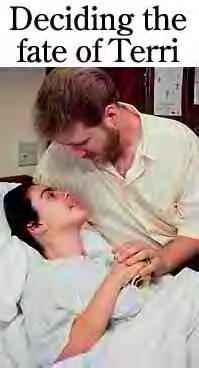
Sharon von Zwieten will use any subject, any person, dead or alive to promote her form of religious bigotry ans rasism. When Michael Schiavo decided to take his wife off life support, her parents saw things differently. That is where the issue should have ended. A privacy issues where a dedicated spouse holds the rights of his spouse in his heart and capable hands. It didn't end there and those that have exploited the privacy of Terri and Michael should hold liability.
http://www.sptimes.com/News/012500/TampaBay/Deciding_the_fate_of_.shtml

32 embellished biased media minutes via von Zwieten - the Invasion of Privacy that rachets up the 'price' of exploitation for political gain.
CNN NEWSNIGHT AARON BROWN
Battle Over Terri Schiavo
Aired March 29, 2005 - 22:00 ET
AARON BROWN, HOST: Good evening, again, everyone.Terri Schiavo has begun her 12th day without a feeding tube, both sides agree now, the end is drawing close. Mrs. Schiavo is reportedly no longer producing urine, a sign her kidneys may be shutting down.That said, those who want to save her have not stopped fighting, at least not publicly.
(BEGIN VIDEOTAPE)
BROWN (voice-over): This evening, Mrs. Schiavo's mother, Mary Schindler made a public plea to her daughter's husband, Michael Schiavo, and to his girlfriend Jody.
MARY SCHINDLER, TERRI SCHIAVO'S MOTHER: Michael and Jody, you have your own children. Please, please give my child back to me.
BROWN: Outside Terri Schiavo's hospice in Pinellas Park, Florida, supporters of Michael Schiavo have joined the crowd of protesters, though they remain vastly outnumbered. And, as you probably know by now, the Reverend Jesse Jackson joined the protesters, and entered the fight on the side of the Schindler family, calling for Florida lawmakers to pass emergency legislation to intervene.
REV. JESSE JACKSON, POLITICAL ACTIVIST, SUPPORTS SCHINDLERS: I was on the phone today, talking with members of the Senate, asking them to be creative enough to try to fashion some emergency legislation to stop the starving, to stop the dehydration.
(END VIDEOTAPE)
BROWN: An outline of another sad day in the Schiavo case. We're joined now from Pinellas Park by Larry Klayman, attorney and former general council of Judicial Watch. He's been with the Schindler family over the past few days, and is in this, as he is in virtually everything I've ever known him to do, a passionate proponent, in this case of that cause. Larry, it's good to see you.
LARRY KLAYMAN, ATTORNEY, FMR. GEN. COUNCIL, JUDICIAL WATCH: Thanks, Aaron, it's good to see you, too.
BROWN: Can you give me a concrete idea that your side has that could turn this around at this point?
KLAYMAN: The Reverend Jackson articulated it very well. He reached out to us. Obviously, we've asked the governor for his help. We believe that he has the executive power. He's a good man, he's been a good governor, we'd like him to act. He has the ability to grant clemency to Terri, in fact, restore her civil rights. But if that does not happen, the legislature in Florida is really where we're at right now. We're trying to reintroduce legislation that was voted down last week. We're looking for senators to support -- state senators -- Jesse Jackson is playing an instrumental role. We believe he will turn around at least three senators, and the procedures exist that this legislation can be reenacted, very, very quickly, perhaps within a day. Now, we're racing the clock, and we urge Jesse Jackson and those senators in Tallahassee to get the job done quickly before it's too late.
BROWN: Larry, someone speaking for the state house in Florida said that they wouldn't get to this till next Tuesday at the earliest, even if it passed the senate.
KLAYMAN: That person is mistaken because they'll be reintroducing the legislation that was discussed last week in the Senate. It can be reintroduced tomorrow at 9:30 a.m. for a new vote. The senate can vote upon it. It will go over to the house. The house would then have an opportunity to adopt the senate bill or house bill. That would then be sent back to the senate. It could all be done in one day, and the whole job could be signed by the governor tomorrow evening. It can happen, if everything breaks the right way. We thank Reverend Jackson for being here and working very hard to get this thing done.
BROWN: Larry, a couple of other things. You said to us earlier today when we talked that the legal system had failed both sides. Let me just play this back to you for a second. This case has probably been litigated as much as any right-to-life or right-to-die case in the history of any country. Each side has had doctors, the court has appointed doctors, Ms. Schiavo has had a guardian, independent of her husband, looking out for her interests. It may be the outcome isn't an outcome that people are comfortable with, and that makes sense to me, but how can you argue that the system failed?
KLAYMAN: Aaron, I saw it in a smaller way. You know, over the years -- that's why I started Judicial Watch in 1994. I'm now in private practice, having run for the senate down here, and this was a big part of my campaign, is that we need to do something about the system where we don't have the best and brightest on the bench. Now, how could this Judge Greer have made a decision, that there was clear and convincing evidence, when the evidence here was simply that Terri had made a statement watching an episode of E.R., of emergency room? And when that kind of a situation arises, there are judges that are supposed to review the decisions of other judges. But judges, like everybody else -- lawyers, doctors, you name it -- protect themselves, and they rally around, they group the wagons, and that was the reason for Judicial Watch, was to watch judges, and it performs a valuable function. But, beyond that, the lesson that will be taken out of this -- and let's pray that Terri lives, because not only do we want her to live as a human being, but she'll be very helpful in getting the job done -- is that we need better judges on the bench, number one, and number two, in the family law system -- and I had a tragedy in my own family where my grandmom had a do not resuscitate order put on her charts and my stepdad at the time told the hospital not to feed her. I went in as the grandson, I had no standing, just like the Schindler family. My grandmother was the closest person in my life, and we need to revise the family laws which simply do not serve the interest of the American people.
BROWN: That is a great conversation, honestly, to have, and we ought to have it, and I'd love to have it with you, perhaps, tomorrow or after this terrible tragedy ends, because there will be other chapters no matter how it ends. That's a good place to start. Larry, it's good to see you.
KLAYMAN: Absolutely. Absolutely. Thank you, Aaron. God bless.
BROWN: This is, I think it's fair to say, a story without a good ending. There may be a "right" ending, but there's not a good one, not when a young woman dies, not when families are so estranged. The fact that there are important principles doesn't alter that essential fact. And the estrangement will continue on after death, with battles over what's to become of Ms. Schiavo's body. Her husband has requested an autopsy, which he hopes will settle some issues in this sad matter, but not likely all, nor will it settle all the family disputes. Here's CNN's David Mattingly.
(BEGIN VIDEOTAPE)
DAVID MATTINGLY, CNN CORRESPONDENT: The decision to have the autopsy conducted by a county medical examiner may not be enough to satisfy Terri Schiavo's family, the Schindlers. Their attorney already suggests experts in cases of abuse and strangulation may be needed in the autopsy to answer their questions about what caused her brain damage.
DAVID GIBBS, SCHINDLER'S ATTORNEY: What happened in 1990? Was there any type of strangulation or abuse or anything that occurred? I think those issues need to be addressed. What kind of condition is Terri in? What kind of condition is her mind and body in? Did she have a heart attack? There's a lot of things that can be known, and I think for the family and for all involved, getting good answers is a very good thing.
MATTINGLY: But experts caution that an autopsy will produce limited findings. Questions about injuries that may or may not have occurred 15 years ago may go unanswered, while questions about the condition of her brain and the diagnosis of a persistent vegetative state could be resolved clearly.
DR. CYRIL WECHT, FORENSIC PATHOLOGIST: What the autopsy can tell you is, what she died of, that is to say, whether there truly is this significant brain damage.
MATTINGLY: The Florida circuit court, again, reaffirmed Michael Schiavo's authority to make the decision to have his wife's body cremated and buried in Pennsylvania where they grew up. On Tuesday Judge George Greer turned down the Schindler's emergency request to have their daughter buried in Florida without cremation.
PAUL O'DONNELL, SCHINDLER FAMILY SPIRITUAL ADVISOR: In our tradition, we like to have the body there at the liturgy, and that afterwards that it's buried in a dignified place, because we believe that the glorified soul will be reunited with the body one day.
MATTINGLY: As far back as November 2002, Michael Schiavo has claimed to be acting on the wishes of his wife Terri, and not his own. He was quoted in the newspaper "St. Petersburg Times" saying, "she never wanted to be put in the ground with bugs. She always told me that." The judge found Schiavo's plans to be consistent with Roman Catholicism. Schiavo's only obligation is to notify the Schindlers of any memorial services and the location of the cemetery. Any change of plans or reconciliation seems very unlikely. The family animosities that erupted over Terri Schiavo's life may well continue long after her life is over. David Mattingly, CNN, Pinellas Park, Florida.
(END VIDEOTAPE)
BROWN: There are some basic medical questions here, so we bring in, again, Dr. Sanjay Gupta who joins us now. 12 days without food and water. What's happening to her body at this point?
DR. SANJAY GUPTA, CNN MEDICAL EXPERT: Couple of very predictable things happen, when someone does not receive any calories or any fluids. Several things happen in a sequence: first, the organs start to shut down, most predictably the kidneys, and you can see that because the body just stops producing urine. What's really happening, though, is those toxins that are otherwise filtered by the kidneys start to buildup in the heart -- I'm sorry, build up in the bloodstream -- eventually affecting the heart, and ultimately -- her heart just would not function properly, and that would probably be the ultimate cause of demise.Aaron?
BROWN: It's heart failure?
GUPTA: That's right.
BROWN: We were looking earlier at -- for lack of a better word -- some pictures of her brain. These were done -- tests that were done on her by the court-appointed neurologist in the case. When you look at them, this is your business...
GUPTA: Yes. BROWN: Is it clear what we are talking about?
GUPTA: Yeah, it is clear what we're talking about. And I think even a layperson can see a significant difference between the brain on the left, which is healthy 25-year-old, and then Terri Schiavo's on the right. All the dark area, the very black area there is fluid, and fluid is essentially filled in areas of the brain where brain cells have died. So I would look at a scan like this and say, there's been a significant amount of brain cell death, and you can tell that sort of throughout the brain, meaning globally, throughout the entire brain. What you can't say, though, Aaron, and this is an important point, is exactly what that person would look like clinically. There are people who have significant amounts of fluid in the brain and are still quite functional. And there are people who have relatively normal-looking brain scans and aren't functional. So you've really got to take all this information together.
BROWN: So all that picture tells us is there's fluid on the brain and it doesn't really tell us anything else?
GUPTA: You couldn't say for sure this person, based on the CT scan, is in a persistent vegetative state. In fact, let me take it one step further. I think we have some actual images of what the brain itself might look like, leaving aside the scans, but taking a look on the left, again, a normal brain or a healthy brain, and then on the right, again, I think even a layperson can tell there's a significant amount lost of brain tissue there. Even to call that a PVS brain, as it says there, is probably not entirely accurate, because you cannot make a clinical diagnosis based on looking at the brain itself.What they're going to do as part of this autopsy is see if it all fits together. We know what she looked like when she was alive, in terms of what she was able to do. Does that fit with what her brain actually looks like as well?
BROWN: All right, thank you for walking us through that. There actually are a couple of other medical questions, and I suspect we have got some days to get to those, about this condition all happened. It's good to see you again.
GUPTA: Thank you.
BROWN: Sanjay Gupta is in Atlanta. Tonight, as we said at the top, around the country there are no doubt hundreds of families like the Schindlers and the Schiavos who are making end of life decisions about a loved one. In some cases, there are no doubt disagreements between the spouse and the parent. You simply don't hear about them. We do not report them. Terri Schiavo became news after she became a cause, and becoming a cause was no accident.
(BEGIN VIDEOTAPE)
BROWN (voice-over): It has been the Schindler family, but most especially 70-year-old Bob Schindler, who has been the driving force that has turned his daughter's life, and it would seem now her death, into a national cause. But he has hardly done it alone. It all began five years ago.
CARRIE GORDON EARLL, POLICY ANALYST, FOCUS ON THE FAMILY: He was starting to shake the bushes, if you will, to let people know that he was concerned about his daughter. By that time, her feeding tube had been ordered removed. And they were in an appeal process. So you know, the Schindler family has had a lot to do with why this is a front burner issue.
BROWN: Michael Schiavo went to court in the winter of the year 2000, seeking to have his wife's feeding tube removed, saying it was her spoken wish. At about that time, right to life groups started putting the story in play on Web sites and through e-mails to reporters around the country. It is a textbook study in how a cause is born.
LARRY SABATO, DIRECTOR, CENTER FOR POLITICS, UNIVERSITY OF VIRGINIA: These interest groups exist for a purpose. And when they find a case that they believe represents that purpose, they latch on like a dog to an ankle, and you just can't separate the two. That's what happened here. BROWN: Every time there was a turn in the Michael Schiavo lawsuit, an appeal upheld, a different medical opinion offered, there was a corresponding uptick on the right to life Web sites. And when selected portions of the family's own home video of Terri Schiavo were made public by her father, it gave a simmering movement new manager.
EARLL: Terri has become that silent spokesperson, and many are galvanized by that, because what it speaks to our human dignity and our place in a civilized society. So hopefully, it will have an impact of the nation.
BROWN: By 2003, the movement gained new strength and a new ally, in Florida Governor Jeb Bush. He pushed a bill through his state's legislature, with the help of the Washington-based Family Research Council, one of the country's largest and most energetic pro-life groups.
TONY PERKINS, PRES., FAMILY RESEARCH COUNCIL: The previous president of Family Research Council, Ken Connor, actually has been serving as the attorney for Jeb Bush in defending Florida's Terri's Law that the legislature there passed a year and a half ago. So the organization has been indirectly and directly involved in this battle for quite some time.
BROWN: The Schindler family began a Web site of its own, TerrisFight.org, inviting donations for basic things, like paper and computer printers and toner. A variety of right to life groups and social conservatives grabbed on.
SABATO: The fact of the matter is, that there is not a crisis, there is not a personal disaster that is not exploited, openly and unashamedly, by one group or another. In this case, there are probably a dozen groups actively trolling for contributions, large and small, from people who have been paying close attention, and they'll get it.
BROWN: By the time Congress and President Bush became part of the drama, the week before last, the case itself had already become the cause for social conservatives. They had been working it for five years. But had the family not been out there, not just seeking help from organizations, but publicly making their pleas, giving the story its human face, there likely would have been no national story at all.
(END VIDEOTAPE)
BROWN: But it is a national story, and we have much more on it tonight, beginning with this.
(BEGIN VIDEO CLIP)
UNIDENTIFIED MALE: Are we to say that the entire federal government is powerless to help her?
(END VIDEO CLIP)
BROWN: Making an industry out of outrage, not just the politics of it all, the business. Later, the voice of the trial we'll never forget.
BROWN: In a moment, Senator Rick Santorum of Pennsylvania, who has traveled to Florida to be with the Schindler family, we'll talk with him.
BROWN The case of Terri Schiavo, as we said earlier, has become a cause -- magnet for a range of people in groups. Rick Santorum, the U.S. senator from Pennsylvania is in Pinellas Park, Florida tonight. A long participant in the right to life movement. And he joins us from there tonight. Good to see you, senator.
SEN. RICK SANTORUM (R), PENNSYLVANIA: Thank you, Aaron.
BROWN: Should Congress have passed a law that explicitly said the court, the federal court must re-evaluate the entirety of the situation?
SANTORUM: Obviously, I believe the answer is yes to that. As you know, under the Constitution, we have a right to prescribe the jurisdiction of the court. And we thought in this case, (UNINTELLIGIBLE) amount to a death case. As you know, there's a police officer standing in that room right now who is not allowing any kind of hydration, not even by tube, but by mouth. What you have is a situation where someone was given a death sentence and no federal court reviewed the facts and circumstances of this case. And so what we -- given the tremendous conflicts in the record that came out during and subsequent to this case, we thought it was appropriate in this case to have a federal court review because in a sense this woman is being given a death sentence by a state court.
BROWN: But if I recall the law, correct me if I'm wrong, what the bill said is the court may -- the court -- the bill did not say the court shall.
SANTORUM: No. Yes, the court shall consider this case. It was required -- they were required to do so, and they were required to have a de novo trial. That's exactly what the bill said, and this judge simply ignored it and snubbed his nose at the Congress.
BROWN: Senator, did the bill say may or shall? This seems to be hanging on one word. Because it's been my impression for a week -- you tell me I'm wrong, I'm wrong.
SANTORUM: It's a misimpression there.
BROWN: It won't be the first time.
SANTORUM: You are absolutely wrong. The bill said "He shall hold a de novo trial." That's what the bill said.
BROWN: And so the...
SANTORUM: He must hold a new trial.
BROWN: The federal district court ignored that, the appeals court ignored that and the U.S. Supreme Court ignored that.
SANTORUM: Well, they didn't ignore it. What they -- the district court ignored it. The appeals court, as you saw in the dissenting opinion, felt the -- decent felt that what the judge did was abuse his discretion and ignored a direct edict of the Congress. What this judge said, is he used a calque (ph) between Senator Levin and Senator Frist to suggest that he had the option of reinserts the tube. And he felt that his looking at the facts of the case that were presented at trial and any other new evidence that they wanted to submit in their briefs was sufficient for a trial de novo. That is clearly not what Congress intended. That's not what a trial de novo is. But the appellate courts felt he did not abuse his discretion. And that, to me, was wrong, but that's they felt. That's what they decided.
BROWN: One final area, if you will. The polling on this, and people always dispute the questions in the polls, but this case has been out there, and I think people understand it -- has suggested pretty strongly that what people want here is to keep these decisions within families where possible and in courts, if absolutely necessary, but out of -- with all due respect, your hands, the hands of the Congress and the Senate. Without -- I'm just curious what you think about that. What do you think that says...
SANTORUM: And I think that's -- I would general agree with that. I think they should be family decisions, first and for most. And secondly, when you have a dispute, as you do in this case. that the courts, unfortunately, have to get involved in these decisions. And what I think we see here is a court that got involved and did so erroneously. And we have a situation which I think is compelling, one that I think is setting a very dangerous precedent in this country, where someone because of their diminished capacity -- a disputed diminished capacity is being starved to death over the objections of someone who's willing to take care of them. I think that is a truly unique case, and one that cries out for, at least, another set of eyes to look at this anew. And that's what the Congress did. It was not trying to insert our judgment. Quite the contrary, we did not say -- in fact, I think it's obvious the fact that we haven't further acted, we did not say that we were going to insist on any particular decision. What we wanted was someone, independent of Judge Greer who's been brought into question under this case, to take a look at the facts and circumstances. And unfortunately, Judge Whittemore decided not to do that against the express intent of the Congress.
BROWN: Sir, do you think there will be new federal law that grows out of this?
SANTORUM: I think there's a -- look, these are issues that one of the things I've found out and I think we've all learned, is these issues are far more common than I think most of us envision. I sometimes I've got to tell you, I get chills listening to doctor after doctor getting on talk shows and television shows saying, Oh, I would easily pull the plug on this case. Or I'd easily remove a feeding tube here. I mean, we do it all the time. I don't think most Americans realize how callous we've become in dealing with people who are of diminished capacity and who otherwise would live if given simple hydration and food, and are simply not allowed to live. That to me is something that we need a public policy discussion on, as to how we're going to treat those that are the least among us.
BROWN: Good to see you, sir. We appreciate your time tonight, thank you.
SANTORUM: Thanks, Aaron.
BROWN: Rick Santorum, senator from Pennsylvania. When Terri Schiavo became a cause, she also became, in truth, an opportunity to some. To some, that sounds crass, and perhaps it is. And it's also true to say, that groups on both sides have used the case for their own ends. And sometimes their own ends has a lot to do with money. Here's our senior political analyst, Bill Schneider.
(BEGIN VIDEOTAPE)
WILLIAM SCHNEIDER, CNN SR. POLITICAL ANALYST (voice-over): The Terri Schiavo issue has sparked plenty of outrage.
REV. PATRICK MAHONEY, DIR. CHRISTIAN DEFENSE
COALITION: Are we to say that the entire federal government is powerless to help her?
SCHNEIDER: In politics outrage can be marked, it's already happening in the Schiavo case. Last month Bob Schindler, Terri Schiavo's father, sent out an e-mail plea to raise money for the legal fight to save his daughter. Those who responded are now on the Terri Schindler-Schiavo Foundation Active Donor List. Response unlimited, a direct mail and telemarketing firm has advertised the list for rent. One has names of more than 6,000 donors, available at the rate of $150 per thousand names. The other for $500 per thousand, lists more than 4,000 E-mail addresses. The outrage industry works for both the right and the left. The American Progress Action Fund calls House Majority Leader Tom DeLay the very picture of political opportunism and hypocrisy, click and donate.You need to target a devil, says an experienced liberal fund raiser.
ROGER CRAVER, DIRECT MAIL CONSULTANT: You know, the business of political causes and issues is a lot like professional wrestling. There is good and there is evil.
SCHNEIDER: Who's the Devil in the Schiavo case, her husband?
MAHONEY: Why should a man who's in a 10 year relationship with another woman, fathered two children, has gone on with his life by some archaic -- archaicing (ph) law now speaks for a woman he has no emotional connection to.
SCHNEIDER: It's hard to see a political pay off for attacking Michael Schiavo. Conservative activists see a bigger target.
RANDALL TERRY, SCHINDLER FAMILY SPOKESMAN: In the past year we have seen the "Pledge of Allegiance" come under attack because of under God. We have seen the 10 Commandments removed from a state court house. We've seen homosexual marriage created out of thin air. And now we see an innocent woman being starved to death.
SCHNEIDER: So who is the Devil.
TERRY: The mood of the country is ready for chief executives and for legislatures to tell the judiciary no, no more, no.
SCHNEIDER: The outraged industry is at work, and judges are a target.
(END VIDEOTAPE)
SCHNEIDER: "The New York Times" quotes a witness who says he was present when the Schindler's agreed to the marketing arrangement, although the witness is not sure how much attention the Schindlers were paying. Now a spokesperson for the Terri Schindler Schiavo Foundation said today quote, "Never at any time did Mr. Schindler ask me to sell those names. I don't believe he fully understood the terms of this deal. It was never his intent to accept money" -- Aaron.
BROWN: Bill, thank you. Good so see you. Bill Schneider in Washington tonight. When he heard that Jesse Jackson was entering the Schiavo case, a cynic we know opined, there must be some sort of federal law that says any news story that runs longer than a week must have Jesse Jackson in it. We take a more charitable view, that is just one more example of the many odd couplings this story has produced. Here's CNN's Susan Candiotti.
(BEGIN VIDEOTAPE)
SUSAN CANDIOTTI CNN CORRESPONDENT (voice-over): Some of them have been here every day, representing different faiths. Some church goers, some not. A dying woman has brought them together.
UNIDENTIFIED FEMALE: We are uniting under the same banner of love for our sister Terri.
CROWD: Let Terri live!
CANDIOTTI: The wheelchair-bound usually lobby for the disabled, now siding with anti-abortion advocates. Among the strangest bedfellows, conservative abortion opponent Randall Terry and liberal human rights activist Reverend Jesse Jackson. (on camera): Politically speaking, before Reverend Jackson showed up here today, what has been your view of him?
RANDALL TERRY, SPOKESMAN FOR PARENTS OF TERRI SCHIAVO: Well, politically, he and I are not on the same side of most issues, I don't think.
CANDIOTTI (voice-over): To say Randall Terry was floored would be an understatement.
TERRY: I couldn't have written this script in my wildest dreams if I was doing a hallucinogenic drug.
CANDIOTTI: A script played out as the Schindlers would have wanted, cameras enveloping Jackson like a swarm of bees, jostling for position. And though he opposed federal legislation in Schiavo's case, he called her situation an injustice. Jackson insisted his presence wasn't odd.
REV. JESSE JACKSON, FOUNDER, RAINBOW/PUSH COALITION: I do not, because her quest to live transcends our mortal, oftentimes self- righteous arguments. And there are those who love the fetus, then want to starve the babies. There are those who want to love Terri and then ignore...
CANDIOTTI: One analyst says the timing of Jackson's involvement appears well-calculated as Terri Schiavo weakens.
CHARLES ZELDEN, NOVA SOUTHEASTERN UNIVERSITY: I suspect, as of many Democrats, he is torn between the more conservative cultural elements of his party and his followers and the more liberal.
CANDIOTTI: But one of the few supporters of Terri Schiavo's husband here, that's Raymond Simmons, standing to the right of Randall Terry, isn't impressed with Jackson's visit.
RAYMOND SIMMONS, SUPPORTER FOR MICHAEL
SCHIAVO: All these politicians are coming here to take credit and get their 15 minutes of fame for their political reasons, and Jesse Jackson coming out here is just adding to the confusion.
CANDIOTTI (on camera): Others may perceive it as confusing, but to those on both sides of Terri Schiavo's fate, any support is welcome at this pivotal moment. Susan Candiotti, CNN, Pinellas Park, Florida.
All 32 minutes of one sided exploitation AS COMPARED TO AN 'Interview of Equality Presenting the Legal View' and not the biased view.
REV. BARRY LYNN, EXEC. DIRECTOR, AMERICANS UNITED FOR SEPARATION OF CHURCH AND STATE: I think the problem here, Larry, is that the Congress should never have gotten involved in this case. The religious right should not have gotten involved in Mrs. Schiavo's case. And with all due respect to my friend, Jesse Jackson, he should not have been involved here in this way.
It's trying to second-guess the legal and the medical judgments that have now been reviewed by 24 different courts and 24 attempted legal interventions. I think this is a civil rights issue. The question is whether Americans have a right to say no to life- sustaining therapies, whether that is a feeding tube, or a ventilator, or a kidney machine, and if they can't speak for themselves, who can we listen to? The courts have said Michael Schiavo have made that decision. People have challenged that decision in court, but I think now that all these processes have gone on, it's time to let Mrs. Schiavo go in the care of that hospice, which has been nothing but kind to her throughout this entire process.
Battle Over Terri Schiavo
Aired March 29, 2005 - 22:00 ET
AARON BROWN, HOST: Good evening, again, everyone.Terri Schiavo has begun her 12th day without a feeding tube, both sides agree now, the end is drawing close. Mrs. Schiavo is reportedly no longer producing urine, a sign her kidneys may be shutting down.That said, those who want to save her have not stopped fighting, at least not publicly.
(BEGIN VIDEOTAPE)
BROWN (voice-over): This evening, Mrs. Schiavo's mother, Mary Schindler made a public plea to her daughter's husband, Michael Schiavo, and to his girlfriend Jody.
MARY SCHINDLER, TERRI SCHIAVO'S MOTHER: Michael and Jody, you have your own children. Please, please give my child back to me.
BROWN: Outside Terri Schiavo's hospice in Pinellas Park, Florida, supporters of Michael Schiavo have joined the crowd of protesters, though they remain vastly outnumbered. And, as you probably know by now, the Reverend Jesse Jackson joined the protesters, and entered the fight on the side of the Schindler family, calling for Florida lawmakers to pass emergency legislation to intervene.
REV. JESSE JACKSON, POLITICAL ACTIVIST, SUPPORTS SCHINDLERS: I was on the phone today, talking with members of the Senate, asking them to be creative enough to try to fashion some emergency legislation to stop the starving, to stop the dehydration.
(END VIDEOTAPE)
BROWN: An outline of another sad day in the Schiavo case. We're joined now from Pinellas Park by Larry Klayman, attorney and former general council of Judicial Watch. He's been with the Schindler family over the past few days, and is in this, as he is in virtually everything I've ever known him to do, a passionate proponent, in this case of that cause. Larry, it's good to see you.
LARRY KLAYMAN, ATTORNEY, FMR. GEN. COUNCIL, JUDICIAL WATCH: Thanks, Aaron, it's good to see you, too.
BROWN: Can you give me a concrete idea that your side has that could turn this around at this point?
KLAYMAN: The Reverend Jackson articulated it very well. He reached out to us. Obviously, we've asked the governor for his help. We believe that he has the executive power. He's a good man, he's been a good governor, we'd like him to act. He has the ability to grant clemency to Terri, in fact, restore her civil rights. But if that does not happen, the legislature in Florida is really where we're at right now. We're trying to reintroduce legislation that was voted down last week. We're looking for senators to support -- state senators -- Jesse Jackson is playing an instrumental role. We believe he will turn around at least three senators, and the procedures exist that this legislation can be reenacted, very, very quickly, perhaps within a day. Now, we're racing the clock, and we urge Jesse Jackson and those senators in Tallahassee to get the job done quickly before it's too late.
BROWN: Larry, someone speaking for the state house in Florida said that they wouldn't get to this till next Tuesday at the earliest, even if it passed the senate.
KLAYMAN: That person is mistaken because they'll be reintroducing the legislation that was discussed last week in the Senate. It can be reintroduced tomorrow at 9:30 a.m. for a new vote. The senate can vote upon it. It will go over to the house. The house would then have an opportunity to adopt the senate bill or house bill. That would then be sent back to the senate. It could all be done in one day, and the whole job could be signed by the governor tomorrow evening. It can happen, if everything breaks the right way. We thank Reverend Jackson for being here and working very hard to get this thing done.
BROWN: Larry, a couple of other things. You said to us earlier today when we talked that the legal system had failed both sides. Let me just play this back to you for a second. This case has probably been litigated as much as any right-to-life or right-to-die case in the history of any country. Each side has had doctors, the court has appointed doctors, Ms. Schiavo has had a guardian, independent of her husband, looking out for her interests. It may be the outcome isn't an outcome that people are comfortable with, and that makes sense to me, but how can you argue that the system failed?
KLAYMAN: Aaron, I saw it in a smaller way. You know, over the years -- that's why I started Judicial Watch in 1994. I'm now in private practice, having run for the senate down here, and this was a big part of my campaign, is that we need to do something about the system where we don't have the best and brightest on the bench. Now, how could this Judge Greer have made a decision, that there was clear and convincing evidence, when the evidence here was simply that Terri had made a statement watching an episode of E.R., of emergency room? And when that kind of a situation arises, there are judges that are supposed to review the decisions of other judges. But judges, like everybody else -- lawyers, doctors, you name it -- protect themselves, and they rally around, they group the wagons, and that was the reason for Judicial Watch, was to watch judges, and it performs a valuable function. But, beyond that, the lesson that will be taken out of this -- and let's pray that Terri lives, because not only do we want her to live as a human being, but she'll be very helpful in getting the job done -- is that we need better judges on the bench, number one, and number two, in the family law system -- and I had a tragedy in my own family where my grandmom had a do not resuscitate order put on her charts and my stepdad at the time told the hospital not to feed her. I went in as the grandson, I had no standing, just like the Schindler family. My grandmother was the closest person in my life, and we need to revise the family laws which simply do not serve the interest of the American people.
BROWN: That is a great conversation, honestly, to have, and we ought to have it, and I'd love to have it with you, perhaps, tomorrow or after this terrible tragedy ends, because there will be other chapters no matter how it ends. That's a good place to start. Larry, it's good to see you.
KLAYMAN: Absolutely. Absolutely. Thank you, Aaron. God bless.
BROWN: This is, I think it's fair to say, a story without a good ending. There may be a "right" ending, but there's not a good one, not when a young woman dies, not when families are so estranged. The fact that there are important principles doesn't alter that essential fact. And the estrangement will continue on after death, with battles over what's to become of Ms. Schiavo's body. Her husband has requested an autopsy, which he hopes will settle some issues in this sad matter, but not likely all, nor will it settle all the family disputes. Here's CNN's David Mattingly.
(BEGIN VIDEOTAPE)
DAVID MATTINGLY, CNN CORRESPONDENT: The decision to have the autopsy conducted by a county medical examiner may not be enough to satisfy Terri Schiavo's family, the Schindlers. Their attorney already suggests experts in cases of abuse and strangulation may be needed in the autopsy to answer their questions about what caused her brain damage.
DAVID GIBBS, SCHINDLER'S ATTORNEY: What happened in 1990? Was there any type of strangulation or abuse or anything that occurred? I think those issues need to be addressed. What kind of condition is Terri in? What kind of condition is her mind and body in? Did she have a heart attack? There's a lot of things that can be known, and I think for the family and for all involved, getting good answers is a very good thing.
MATTINGLY: But experts caution that an autopsy will produce limited findings. Questions about injuries that may or may not have occurred 15 years ago may go unanswered, while questions about the condition of her brain and the diagnosis of a persistent vegetative state could be resolved clearly.
DR. CYRIL WECHT, FORENSIC PATHOLOGIST: What the autopsy can tell you is, what she died of, that is to say, whether there truly is this significant brain damage.
MATTINGLY: The Florida circuit court, again, reaffirmed Michael Schiavo's authority to make the decision to have his wife's body cremated and buried in Pennsylvania where they grew up. On Tuesday Judge George Greer turned down the Schindler's emergency request to have their daughter buried in Florida without cremation.
PAUL O'DONNELL, SCHINDLER FAMILY SPIRITUAL ADVISOR: In our tradition, we like to have the body there at the liturgy, and that afterwards that it's buried in a dignified place, because we believe that the glorified soul will be reunited with the body one day.
MATTINGLY: As far back as November 2002, Michael Schiavo has claimed to be acting on the wishes of his wife Terri, and not his own. He was quoted in the newspaper "St. Petersburg Times" saying, "she never wanted to be put in the ground with bugs. She always told me that." The judge found Schiavo's plans to be consistent with Roman Catholicism. Schiavo's only obligation is to notify the Schindlers of any memorial services and the location of the cemetery. Any change of plans or reconciliation seems very unlikely. The family animosities that erupted over Terri Schiavo's life may well continue long after her life is over. David Mattingly, CNN, Pinellas Park, Florida.
(END VIDEOTAPE)
BROWN: There are some basic medical questions here, so we bring in, again, Dr. Sanjay Gupta who joins us now. 12 days without food and water. What's happening to her body at this point?
DR. SANJAY GUPTA, CNN MEDICAL EXPERT: Couple of very predictable things happen, when someone does not receive any calories or any fluids. Several things happen in a sequence: first, the organs start to shut down, most predictably the kidneys, and you can see that because the body just stops producing urine. What's really happening, though, is those toxins that are otherwise filtered by the kidneys start to buildup in the heart -- I'm sorry, build up in the bloodstream -- eventually affecting the heart, and ultimately -- her heart just would not function properly, and that would probably be the ultimate cause of demise.Aaron?
BROWN: It's heart failure?
GUPTA: That's right.
BROWN: We were looking earlier at -- for lack of a better word -- some pictures of her brain. These were done -- tests that were done on her by the court-appointed neurologist in the case. When you look at them, this is your business...
GUPTA: Yes. BROWN: Is it clear what we are talking about?
GUPTA: Yeah, it is clear what we're talking about. And I think even a layperson can see a significant difference between the brain on the left, which is healthy 25-year-old, and then Terri Schiavo's on the right. All the dark area, the very black area there is fluid, and fluid is essentially filled in areas of the brain where brain cells have died. So I would look at a scan like this and say, there's been a significant amount of brain cell death, and you can tell that sort of throughout the brain, meaning globally, throughout the entire brain. What you can't say, though, Aaron, and this is an important point, is exactly what that person would look like clinically. There are people who have significant amounts of fluid in the brain and are still quite functional. And there are people who have relatively normal-looking brain scans and aren't functional. So you've really got to take all this information together.
BROWN: So all that picture tells us is there's fluid on the brain and it doesn't really tell us anything else?
GUPTA: You couldn't say for sure this person, based on the CT scan, is in a persistent vegetative state. In fact, let me take it one step further. I think we have some actual images of what the brain itself might look like, leaving aside the scans, but taking a look on the left, again, a normal brain or a healthy brain, and then on the right, again, I think even a layperson can tell there's a significant amount lost of brain tissue there. Even to call that a PVS brain, as it says there, is probably not entirely accurate, because you cannot make a clinical diagnosis based on looking at the brain itself.What they're going to do as part of this autopsy is see if it all fits together. We know what she looked like when she was alive, in terms of what she was able to do. Does that fit with what her brain actually looks like as well?
BROWN: All right, thank you for walking us through that. There actually are a couple of other medical questions, and I suspect we have got some days to get to those, about this condition all happened. It's good to see you again.
GUPTA: Thank you.
BROWN: Sanjay Gupta is in Atlanta. Tonight, as we said at the top, around the country there are no doubt hundreds of families like the Schindlers and the Schiavos who are making end of life decisions about a loved one. In some cases, there are no doubt disagreements between the spouse and the parent. You simply don't hear about them. We do not report them. Terri Schiavo became news after she became a cause, and becoming a cause was no accident.
(BEGIN VIDEOTAPE)
BROWN (voice-over): It has been the Schindler family, but most especially 70-year-old Bob Schindler, who has been the driving force that has turned his daughter's life, and it would seem now her death, into a national cause. But he has hardly done it alone. It all began five years ago.
CARRIE GORDON EARLL, POLICY ANALYST, FOCUS ON THE FAMILY: He was starting to shake the bushes, if you will, to let people know that he was concerned about his daughter. By that time, her feeding tube had been ordered removed. And they were in an appeal process. So you know, the Schindler family has had a lot to do with why this is a front burner issue.
BROWN: Michael Schiavo went to court in the winter of the year 2000, seeking to have his wife's feeding tube removed, saying it was her spoken wish. At about that time, right to life groups started putting the story in play on Web sites and through e-mails to reporters around the country. It is a textbook study in how a cause is born.
LARRY SABATO, DIRECTOR, CENTER FOR POLITICS, UNIVERSITY OF VIRGINIA: These interest groups exist for a purpose. And when they find a case that they believe represents that purpose, they latch on like a dog to an ankle, and you just can't separate the two. That's what happened here. BROWN: Every time there was a turn in the Michael Schiavo lawsuit, an appeal upheld, a different medical opinion offered, there was a corresponding uptick on the right to life Web sites. And when selected portions of the family's own home video of Terri Schiavo were made public by her father, it gave a simmering movement new manager.
EARLL: Terri has become that silent spokesperson, and many are galvanized by that, because what it speaks to our human dignity and our place in a civilized society. So hopefully, it will have an impact of the nation.
BROWN: By 2003, the movement gained new strength and a new ally, in Florida Governor Jeb Bush. He pushed a bill through his state's legislature, with the help of the Washington-based Family Research Council, one of the country's largest and most energetic pro-life groups.
TONY PERKINS, PRES., FAMILY RESEARCH COUNCIL: The previous president of Family Research Council, Ken Connor, actually has been serving as the attorney for Jeb Bush in defending Florida's Terri's Law that the legislature there passed a year and a half ago. So the organization has been indirectly and directly involved in this battle for quite some time.
BROWN: The Schindler family began a Web site of its own, TerrisFight.org, inviting donations for basic things, like paper and computer printers and toner. A variety of right to life groups and social conservatives grabbed on.
SABATO: The fact of the matter is, that there is not a crisis, there is not a personal disaster that is not exploited, openly and unashamedly, by one group or another. In this case, there are probably a dozen groups actively trolling for contributions, large and small, from people who have been paying close attention, and they'll get it.
BROWN: By the time Congress and President Bush became part of the drama, the week before last, the case itself had already become the cause for social conservatives. They had been working it for five years. But had the family not been out there, not just seeking help from organizations, but publicly making their pleas, giving the story its human face, there likely would have been no national story at all.
(END VIDEOTAPE)
BROWN: But it is a national story, and we have much more on it tonight, beginning with this.
(BEGIN VIDEO CLIP)
UNIDENTIFIED MALE: Are we to say that the entire federal government is powerless to help her?
(END VIDEO CLIP)
BROWN: Making an industry out of outrage, not just the politics of it all, the business. Later, the voice of the trial we'll never forget.
BROWN: In a moment, Senator Rick Santorum of Pennsylvania, who has traveled to Florida to be with the Schindler family, we'll talk with him.
BROWN The case of Terri Schiavo, as we said earlier, has become a cause -- magnet for a range of people in groups. Rick Santorum, the U.S. senator from Pennsylvania is in Pinellas Park, Florida tonight. A long participant in the right to life movement. And he joins us from there tonight. Good to see you, senator.
SEN. RICK SANTORUM (R), PENNSYLVANIA: Thank you, Aaron.
BROWN: Should Congress have passed a law that explicitly said the court, the federal court must re-evaluate the entirety of the situation?
SANTORUM: Obviously, I believe the answer is yes to that. As you know, under the Constitution, we have a right to prescribe the jurisdiction of the court. And we thought in this case, (UNINTELLIGIBLE) amount to a death case. As you know, there's a police officer standing in that room right now who is not allowing any kind of hydration, not even by tube, but by mouth. What you have is a situation where someone was given a death sentence and no federal court reviewed the facts and circumstances of this case. And so what we -- given the tremendous conflicts in the record that came out during and subsequent to this case, we thought it was appropriate in this case to have a federal court review because in a sense this woman is being given a death sentence by a state court.
BROWN: But if I recall the law, correct me if I'm wrong, what the bill said is the court may -- the court -- the bill did not say the court shall.
SANTORUM: No. Yes, the court shall consider this case. It was required -- they were required to do so, and they were required to have a de novo trial. That's exactly what the bill said, and this judge simply ignored it and snubbed his nose at the Congress.
BROWN: Senator, did the bill say may or shall? This seems to be hanging on one word. Because it's been my impression for a week -- you tell me I'm wrong, I'm wrong.
SANTORUM: It's a misimpression there.
BROWN: It won't be the first time.
SANTORUM: You are absolutely wrong. The bill said "He shall hold a de novo trial." That's what the bill said.
BROWN: And so the...
SANTORUM: He must hold a new trial.
BROWN: The federal district court ignored that, the appeals court ignored that and the U.S. Supreme Court ignored that.
SANTORUM: Well, they didn't ignore it. What they -- the district court ignored it. The appeals court, as you saw in the dissenting opinion, felt the -- decent felt that what the judge did was abuse his discretion and ignored a direct edict of the Congress. What this judge said, is he used a calque (ph) between Senator Levin and Senator Frist to suggest that he had the option of reinserts the tube. And he felt that his looking at the facts of the case that were presented at trial and any other new evidence that they wanted to submit in their briefs was sufficient for a trial de novo. That is clearly not what Congress intended. That's not what a trial de novo is. But the appellate courts felt he did not abuse his discretion. And that, to me, was wrong, but that's they felt. That's what they decided.
BROWN: One final area, if you will. The polling on this, and people always dispute the questions in the polls, but this case has been out there, and I think people understand it -- has suggested pretty strongly that what people want here is to keep these decisions within families where possible and in courts, if absolutely necessary, but out of -- with all due respect, your hands, the hands of the Congress and the Senate. Without -- I'm just curious what you think about that. What do you think that says...
SANTORUM: And I think that's -- I would general agree with that. I think they should be family decisions, first and for most. And secondly, when you have a dispute, as you do in this case. that the courts, unfortunately, have to get involved in these decisions. And what I think we see here is a court that got involved and did so erroneously. And we have a situation which I think is compelling, one that I think is setting a very dangerous precedent in this country, where someone because of their diminished capacity -- a disputed diminished capacity is being starved to death over the objections of someone who's willing to take care of them. I think that is a truly unique case, and one that cries out for, at least, another set of eyes to look at this anew. And that's what the Congress did. It was not trying to insert our judgment. Quite the contrary, we did not say -- in fact, I think it's obvious the fact that we haven't further acted, we did not say that we were going to insist on any particular decision. What we wanted was someone, independent of Judge Greer who's been brought into question under this case, to take a look at the facts and circumstances. And unfortunately, Judge Whittemore decided not to do that against the express intent of the Congress.
BROWN: Sir, do you think there will be new federal law that grows out of this?
SANTORUM: I think there's a -- look, these are issues that one of the things I've found out and I think we've all learned, is these issues are far more common than I think most of us envision. I sometimes I've got to tell you, I get chills listening to doctor after doctor getting on talk shows and television shows saying, Oh, I would easily pull the plug on this case. Or I'd easily remove a feeding tube here. I mean, we do it all the time. I don't think most Americans realize how callous we've become in dealing with people who are of diminished capacity and who otherwise would live if given simple hydration and food, and are simply not allowed to live. That to me is something that we need a public policy discussion on, as to how we're going to treat those that are the least among us.
BROWN: Good to see you, sir. We appreciate your time tonight, thank you.
SANTORUM: Thanks, Aaron.
BROWN: Rick Santorum, senator from Pennsylvania. When Terri Schiavo became a cause, she also became, in truth, an opportunity to some. To some, that sounds crass, and perhaps it is. And it's also true to say, that groups on both sides have used the case for their own ends. And sometimes their own ends has a lot to do with money. Here's our senior political analyst, Bill Schneider.
(BEGIN VIDEOTAPE)
WILLIAM SCHNEIDER, CNN SR. POLITICAL ANALYST (voice-over): The Terri Schiavo issue has sparked plenty of outrage.
REV. PATRICK MAHONEY, DIR. CHRISTIAN DEFENSE
COALITION: Are we to say that the entire federal government is powerless to help her?
SCHNEIDER: In politics outrage can be marked, it's already happening in the Schiavo case. Last month Bob Schindler, Terri Schiavo's father, sent out an e-mail plea to raise money for the legal fight to save his daughter. Those who responded are now on the Terri Schindler-Schiavo Foundation Active Donor List. Response unlimited, a direct mail and telemarketing firm has advertised the list for rent. One has names of more than 6,000 donors, available at the rate of $150 per thousand names. The other for $500 per thousand, lists more than 4,000 E-mail addresses. The outrage industry works for both the right and the left. The American Progress Action Fund calls House Majority Leader Tom DeLay the very picture of political opportunism and hypocrisy, click and donate.You need to target a devil, says an experienced liberal fund raiser.
ROGER CRAVER, DIRECT MAIL CONSULTANT: You know, the business of political causes and issues is a lot like professional wrestling. There is good and there is evil.
SCHNEIDER: Who's the Devil in the Schiavo case, her husband?
MAHONEY: Why should a man who's in a 10 year relationship with another woman, fathered two children, has gone on with his life by some archaic -- archaicing (ph) law now speaks for a woman he has no emotional connection to.
SCHNEIDER: It's hard to see a political pay off for attacking Michael Schiavo. Conservative activists see a bigger target.
RANDALL TERRY, SCHINDLER FAMILY SPOKESMAN: In the past year we have seen the "Pledge of Allegiance" come under attack because of under God. We have seen the 10 Commandments removed from a state court house. We've seen homosexual marriage created out of thin air. And now we see an innocent woman being starved to death.
SCHNEIDER: So who is the Devil.
TERRY: The mood of the country is ready for chief executives and for legislatures to tell the judiciary no, no more, no.
SCHNEIDER: The outraged industry is at work, and judges are a target.
(END VIDEOTAPE)
SCHNEIDER: "The New York Times" quotes a witness who says he was present when the Schindler's agreed to the marketing arrangement, although the witness is not sure how much attention the Schindlers were paying. Now a spokesperson for the Terri Schindler Schiavo Foundation said today quote, "Never at any time did Mr. Schindler ask me to sell those names. I don't believe he fully understood the terms of this deal. It was never his intent to accept money" -- Aaron.
BROWN: Bill, thank you. Good so see you. Bill Schneider in Washington tonight. When he heard that Jesse Jackson was entering the Schiavo case, a cynic we know opined, there must be some sort of federal law that says any news story that runs longer than a week must have Jesse Jackson in it. We take a more charitable view, that is just one more example of the many odd couplings this story has produced. Here's CNN's Susan Candiotti.
(BEGIN VIDEOTAPE)
SUSAN CANDIOTTI CNN CORRESPONDENT (voice-over): Some of them have been here every day, representing different faiths. Some church goers, some not. A dying woman has brought them together.
UNIDENTIFIED FEMALE: We are uniting under the same banner of love for our sister Terri.
CROWD: Let Terri live!
CANDIOTTI: The wheelchair-bound usually lobby for the disabled, now siding with anti-abortion advocates. Among the strangest bedfellows, conservative abortion opponent Randall Terry and liberal human rights activist Reverend Jesse Jackson. (on camera): Politically speaking, before Reverend Jackson showed up here today, what has been your view of him?
RANDALL TERRY, SPOKESMAN FOR PARENTS OF TERRI SCHIAVO: Well, politically, he and I are not on the same side of most issues, I don't think.
CANDIOTTI (voice-over): To say Randall Terry was floored would be an understatement.
TERRY: I couldn't have written this script in my wildest dreams if I was doing a hallucinogenic drug.
CANDIOTTI: A script played out as the Schindlers would have wanted, cameras enveloping Jackson like a swarm of bees, jostling for position. And though he opposed federal legislation in Schiavo's case, he called her situation an injustice. Jackson insisted his presence wasn't odd.
REV. JESSE JACKSON, FOUNDER, RAINBOW/PUSH COALITION: I do not, because her quest to live transcends our mortal, oftentimes self- righteous arguments. And there are those who love the fetus, then want to starve the babies. There are those who want to love Terri and then ignore...
CANDIOTTI: One analyst says the timing of Jackson's involvement appears well-calculated as Terri Schiavo weakens.
CHARLES ZELDEN, NOVA SOUTHEASTERN UNIVERSITY: I suspect, as of many Democrats, he is torn between the more conservative cultural elements of his party and his followers and the more liberal.
CANDIOTTI: But one of the few supporters of Terri Schiavo's husband here, that's Raymond Simmons, standing to the right of Randall Terry, isn't impressed with Jackson's visit.
RAYMOND SIMMONS, SUPPORTER FOR MICHAEL
SCHIAVO: All these politicians are coming here to take credit and get their 15 minutes of fame for their political reasons, and Jesse Jackson coming out here is just adding to the confusion.
CANDIOTTI (on camera): Others may perceive it as confusing, but to those on both sides of Terri Schiavo's fate, any support is welcome at this pivotal moment. Susan Candiotti, CNN, Pinellas Park, Florida.
All 32 minutes of one sided exploitation AS COMPARED TO AN 'Interview of Equality Presenting the Legal View' and not the biased view.
REV. BARRY LYNN, EXEC. DIRECTOR, AMERICANS UNITED FOR SEPARATION OF CHURCH AND STATE: I think the problem here, Larry, is that the Congress should never have gotten involved in this case. The religious right should not have gotten involved in Mrs. Schiavo's case. And with all due respect to my friend, Jesse Jackson, he should not have been involved here in this way.
It's trying to second-guess the legal and the medical judgments that have now been reviewed by 24 different courts and 24 attempted legal interventions. I think this is a civil rights issue. The question is whether Americans have a right to say no to life- sustaining therapies, whether that is a feeding tube, or a ventilator, or a kidney machine, and if they can't speak for themselves, who can we listen to? The courts have said Michael Schiavo have made that decision. People have challenged that decision in court, but I think now that all these processes have gone on, it's time to let Mrs. Schiavo go in the care of that hospice, which has been nothing but kind to her throughout this entire process.
Tuesday, March 29, 2005


The Religious Bigotry of NewsNight's Morning Papers Segment
What's the matter? The women of the nation aren't 'Faux Christian Pussy' enough for you all? I mean is Paula Zahn crossing her legs in a way that is pleasing to Christian Film Makers? Maybe showing 'knee' is in too poor taste for everyone at CNN? LORD knows make-up for women at CNN is out of the question these days? So tell me, Aaron, what is so special about Christian Pussy? Huh? Did Sharon lead down a path of 'tease you but don't please you' that no one at CNN can't recooperate from? Enough for now.
The Christian Science Monitor
Minneapolis Star Tribune
The Oregonian
The Detroit News
Philadelphia Inquirer
Chicago Sun Times
Maybe that isn't enough. What is it actually about the increased DEMAND for women to change to reflect ONLY Christian Pussy values? Are the rest of us TOO much Pussy for most men? Certainly it isn't an issue of not being enough? Maybe it's that we reflect the AUTONOMOUS demand of Privacy Laws and Abortion and Contraception at ALL ages of life that is TOO MUCH for anything but a nation of Faux Christian Pussy. Is that it Aaron? Are the rest of the women of the nation and the world for that matter in free and open societies just TOO GOD DAMN adverse to promoting Bush's form of Political Domination.
Up your ass !!!
Let's see????
Oh, I knew, we need a higher degree of shame.
The Christian Science Monitor
Minneapolis Star Tribune
The Oregonian
The Detroit News
Philadelphia Inquirer
Chicago Sun Times
Maybe that isn't enough. What is it actually about the increased DEMAND for women to change to reflect ONLY Christian Pussy values? Are the rest of us TOO much Pussy for most men? Certainly it isn't an issue of not being enough? Maybe it's that we reflect the AUTONOMOUS demand of Privacy Laws and Abortion and Contraception at ALL ages of life that is TOO MUCH for anything but a nation of Faux Christian Pussy. Is that it Aaron? Are the rest of the women of the nation and the world for that matter in free and open societies just TOO GOD DAMN adverse to promoting Bush's form of Political Domination.
Up your ass !!!
Let's see????
Oh, I knew, we need a higher degree of shame.
Monday, March 28, 2005
Battle Over Terri Schiavo Continues; Judge Deals Blow to Michael Jackson's Defense Team
Aired March 28, 2005 - 22:00 ET
THIS IS A RUSH TRANSCRIPT. THIS COPY MAY NOT BE IN ITS FINAL FORM AND MAY BE UPDATED.
AARON BROWN, HOST: Good evening again, everyone. The battle over Terri Schiavo's life returned to Washington, D.C. again today where about a dozen supporters of her parents protested across the street from the White House. They were led by Christian activist, the Reverend Patrick Mahoney, who called on Congress to take new steps in the case. This is Florida Governor Jeb Bush, said he has done all he can do.
(BEGIN VIDEO CLIP)
GOV. JEB BUSH, (R) FLORIDA: My heart is broken about this. It just breaks my heart that we're not -- we've not erred on the side of life. While I'm respectful of the judiciary's decisions, it just seems that having a fresh look, a de novo look, if you will, would have made sense.
(END VIDEO CLIP)
BROWN: It's now been 10 full days since Miss Schiavo's feeding tube was removed. And for all their bitter differences, her parents and her husband Michael seem to agree on this much tonight -- Terri Schiavo is getting weaker, the end drawing closer. The lawyer for Michael Schiavo said today that Terri Schiavo's nurses have described her pulse as thready. They also said that Miss Schiavo has no urine output, has not had any urine output since last night, a sign of kidney failure. He described her appearance as calm, relaxed, and very peaceful. He said his client wants an autopsy performed after his wife dies.
(BEGIN VIDEO CLIP)
GEORGE FELOS, MICHAEL SCHIAVO'S ATTORNEY: He's requested this very strongly. He believes it's important to have the public know the full and massive extent of the damage to Mrs. Schiavo's brain.
(END VIDEO CLIP)
BROWN: Yesterday the Schindler lawyer said the family believed Terri Schiavo had passed the point of no return, but today the family framed it differently. Her father saying, quote, "it's not too late for someone to save her." Whatever privately they may think, say to one another, or to people around them, publicly they say they are hopeful and that she is doing okay, all things considered. We spoke with her brother, Bobby Schindler, a short time ago.
(BEGIN VIDEOTAPE)
BROWN: Mr. Schindler, give me a sense of how your sister's condition has changed over the last 24, 48 hours, or so.
BOBBY SCHINDLER, TERRI SCHIAVO'S BROTHER: Well, you know, my sister's being dehydrated and starved to death. So she is deteriorating. But she is still fighting hard. She is, from what we can tell, alert, responsive, and just showing an incredible desire to live.
BROWN: When you say she's alert and responsive, can you give viewers a sense of what that means?
BOBBY SCHINDLER: Well, she's still trying very hard to speak to us when we go see her. But it is -- you know, it has taken its toll on her physically. But you know, as I said earlier, I think my sister is fighting to live, and we're going to keep fighting for her.
BROWN: And -- which leads to my next question. I think there's a sense that with the legal options apparently over that the family is essentially resigned to the fact that she is now going to pass away. Is that untrue?
BOBBY SCHINDLER: Yes. No, no. We're not giving up on Terri yet. We're still trying to, you know, find a way to get her out of this mess, and we're going to keep fighting. And as I said, we're just so inspired by my sister's desire to live, and she's kind of keeping us inspired to keep fighting for her.
BROWN: Where does this fight go? If not the courts, how do you in your words get her out of this mess?
BOBBY SCHINDLER: I don't know, sir. But there's a lot of people praying for her. We're going to pray for her. And we're just hoping for a miracle.
BROWN: The governor has pretty much said he has -- there's nothing he can do. There doesn't seem to be any indication the White House can do anything, even if it wanted to. I think it probably does want to. So short of hope and short of prayer, and I don't mean to minimize prayer here, but how -- what can happen?
BOBBY SCHINDLER: Well, you know, we've heard from some of the attorneys that the governor may still have a few options left. We're praying that if in fact that is true that the governor is able to do something. And we just don't know. You know, we're a very -- we're a family that has a lot of faith, and we're going to keep praying, and as I said, we're going to pray for a miracle.
BROWN: At the risk of being incredibly indelicate here, Mr. Schiavo's attorney said a few hours ago that they would ask that an autopsy be performed after your sister dies. I assume that is -- that you would agree with that.
BOBBY SCHINDLER: Well, you know, as I just said, you know, we're dealing with reality here, but right now our family isn't going to think about that. We're not going to focus on that. And we're just going to do everything we can, you know, over these next hours and days to see that we can exhaust every possible way to help save my sister. So that's really what our focus is on right now.
BROWN: I understand that. You said earlier today that you were concerned that something might be happening in the hospice, that the hospice itself may be trying to hasten your sister's death. Can you tell me what your concern is there?
BOBBY SCHINDLER: Well, we do know that at some point a morphine drip is started. We understand that that has not begun yet. But we're hopeful that my -- you know, that she doesn't have to undergo something like that. But it is interesting that they try to describe my sister's experience as painless and something that is a pleasant experience and it's kind of contradictory when they say that they're going to eventually have to start administering a morphine drip.
BROWN: But when you said that earlier, it wasn't that you had any specific reason to believe they might be hastening your sister's death, it was just a general concern that that might happen?
BOBBY SCHINDLER: That's correct.
BROWN: On balance is there anything, you know, for a week or more now as I'm sure you're painfully aware, the country has been focused on your family and your sister and her husband and all the rest. Is there anything you wish people knew that you worry that they do not know about your sister?
BOBBY SCHINDLER: Well, yes. Two things in particular. One is that my sister's condition is being mischaracterized today. And my sister's condition has been mischaracterized for the last, well, over a decade now. She is very much alive. She just needed help. She needs help. She needs rehabilitation. She needs therapy. And this notion that she's brain dead, a vegetable, that she's in this PVS condition, is absolutely misleading and false.
BROWN: And doctors, independent doctors who have looked at her, doctors appointed by the courts who have looked at her and reached that conclusion, are, what, simply wrong?
BOBBY SCHINDLER: Well, there's a lot of controversy over my sister's condition. There are more doctors that have filed affidavits with the court. There's doctors that have examined my sister that all believe that she's not in this condition, than doctors that believe she is. And I urge people, there are 33 affidavits out there. Most of them -- or not most of them. There's close to a dozen, I believe now, that are neurologists that all believe Terri is not in a PVS, and I just urge people to read what these doctors have to say about my sister's condition.
BROWN: And believe me, you're the last person on the planet I want to argue with. Okay?
BOBBY SCHINDLER: Sure.
BROWN: Really. But would you agree that the doctors who feel that way are doctors who by and large have either been retained by your family or have an interest on your family's side as opposed to retained by the court, independent of either side in this?
BOBBY SCHINDLER: Well, it's interesting you say that. Because the doctors that Michael has brought in have been paid and the doctors that have testified on my sister's behalf have all volunteered. And there's more doctors out there. So this notion that Terri is in this condition because all these doctors believe she is is really misleading. There are more doctors that believe she's not than believe she is. And all our family is saying, with all this controversy out there, with -- you know regarding her condition, you know why would you err on the side of death and not err on the side of caution? Which would be life.
BROWN: And just -- I think that's a question a lot of people have. Just a final question.
BOBBY SCHINDLER: Sure.
BROWN: Do you believe that if the feeding tube were reinserted tonight that she would still have the capacity to recover, that the week-plus that she's been without hydration has not further damaged her to a point where she could not recover?
BOBBY SCHINDLER: Well, I'm not a medical doctor, but I'm hopeful if something happens quickly that Terri would, you know, over some time recuperate from what she's been through so far.
BROWN: We appreciate your time again. Thank you.
BOBBY SCHINDLER: Thank you.
BROWN: Thank you, sir.
(END VIDEOTAPE)
BROWN: Bobby Schindler. We talked with him just a short time ago. Language, as much as anything -- and you heard it there as an example -- has shaped the way we see this case. Many words, all carefully chosen have been used to tell this story, depending on people's point of view. Here's our senior analyst, Jeff Greenfield.
(BEGIN VIDEOTAPE)
JEFF GREENFIELD, CNN ANALYST (voice-over): How do we describe what happened here? Here's what Charles Gibson said on "Good Morning America."
CHARLES GIBSON, "GOOD MORNING AMERICA": Almost a week now since her feeding tube was removed.
GREENFIELD: Here's John Roberts on the "CBS Evening News."
JOHN ROBERTS, "CBS EVENING NEWS": The case of Terri Schiavo, the brain-damaged Florida woman whose life-sustaining feeding tube was removed on Friday.
GREENFIELD: But this is Joe Scarborough on MSNBC last Thursday.
JOE SCARBOROUGH, MSNBC HOST: Terri Schiavo, starving to death by judicial decree.
GREENFIELD: And this is House Majority Leader Tom DeLay during the floor debate a week ago Sunday.
REP. TOM DELAY, (R-TX), MAJORITY LEADER: A young woman in Florida is being dehydrated and starved to death. For 58 long hours her mouth has been parched and her hunger pains have been throbbing.
GREENFIELD: The first two describe a clinical medical procedure. The last two describe something closer to a sadistic crime. How do we label the story? In the New York tabloids the "Post" covers Terri's final hours with a picture of a vibrant young woman. The "News" covers the Schiavo family fight with a now famous picture of her a decade after her severe brain injury.And how to describe her condition? Persistent vegetative state evokes an image of someone who has lost all meaningful connection to life. But her parents' supporters use a very different term.
REV. PAT MAHONEY, FAMILY ADVISER: If we cannot protect the rights of a disabled woman who needs our help and advocacy, then what have we become as a nation?
GREENFIELD: That word, "disabled," seems to put Terri Schiavo in the same camp as millions of men and women clearly living lives worth leading.
UNIDENTIFIED FEMALE: Al Terri needs is a wheelchair and a tube.
GREENFIELD: And indeed many in the disability rights community support her parents. And Congressman Barney Frank, a stalwart liberal, says some federal legislation may be need to protect the disabled from a pull the plug philosophy deriving from the cost of medical care.
REP. BARNEY FRANK, (D) MASSACHUSETTS: I've spoken a lot with disability groups who are concerned that even where a choice is made to terminate life it might be coerced by circumstance.
GREENFIELD (on camera): Debates about public policy often involve a battle to seize the high ground of language. Do you support the right to life or the right to choose? Is Social Security reform more appealing than Social Security privatization? But rarely does the choice of words pack so much emotional weight. This time it literally is a matter of life and death. Jeff Greenfield, CNN, New York.
(END VIDEOTAPE)
BROWN: Any semblance of normalcy being so thin on the ground in Pinellas Park you can easily lose sight of a fact in this case, a simple one -- this is a horrible moment for all concerned. It is also for some outside of Terri Schiavo's family an opportunity, a chance to advance a cause, an agenda. Which also means a chance to raise money.
(BEGIN VIDEOTAPE)
BROWN (voice-over): By invoking the Terri Schiavo case, right to life groups in particular say they are seeing an increase in donations. Some of the money going to the Schindler family and some of it going to the organizations themselves.
ANNE LAFFERTY, TRADITIONAL VALUES COALITION: We sent out an e- mail in February and again in March that specifically linked to Terri's Web site. We're sending the money there. All of the groups, including ours, need to raise money and do raise money.
BROWN: This is a Web site for a group called the Traditional Values Coalition, known mostly for campaigning against gay marriage. The Schiavo case still dominates its headlines. But the group has removed a specific request seeking, quote, "a monthly gift for the organization," after news reports cited that solicitation and its direct link to the Schiavo case.
LAFFERTY: I'm a Christian first. I'm a conservative second. And we need to show compassion for a woman. In the United States of America in the 21st century we should not be starving someone to death.BROWN: Another organization calling itself rightmarch.com has widely publicized the Schiavo case. On its Web site, the group seeks donations to, quote, "pay for its efforts and our nationwide ad to save Terri." The Alliance Defense Fund, according to one newspaper account, has sent $300,000 to help pay for legal costs incurred by the Schindler family.
UNIDENTIFIED MALE: Certainly, money has to be raised to support her defense. This is a poor, disabled lady who has no one to stand up for her. Her mom and dad are, of course. And if non-profit ministries like the Alliance Defense Fund don't do it, then nobody will.
BROWN: And the Florida ACLU has paid for two of its lawyers to work on behalf of Michael Schiavo since 2003. But beyond specific direct involvement the ACLU says the Schiavo case should be out of bounds for fund-raising.
HOWARD SIMON, EXECUTIVE DIRECTOR, FLORIDA ACLU: People have a right to make that contribution. I'm really talking about a political organization using this case to increase the size of their own coffers for their other political work. That I think is really unseemly.
BROWN: But a spokeswoman for one of the largest conservative Christian groups, Focus On the Family, says the Schiavo case is ready- made for the cause in general. Terri, she said, is a person we can see and we can rally around her. And so they have.
(END VIDEOTAPE)
BROWN: Much more to come in the hour ahead, including the mother of all scams, a guy paying child support for a child who never existed.Also tonight, another earthquake in what's already a disaster area.They've been here before. What was different this time, and what was the same? A late report tonight from Indonesia.For Michael Jackson it's bad.
(BEGIN VIDEO CLIP)
UNIDENTIFIED MALE: She's going to put him in that bedroom, which makes it more than just sort of oh, let's have an impromptu sleepover. That's a relationship.
(END VIDEO CLIP)
BROWN: Skeletons in the closet, coming to life in court.And then there is this guy ...
(BEGIN VIDEO CLIP)
UNIDENTIFIED MALE: I just thought he was very honest in his poetry.
UNIDENTIFIED MALE: Let's hear it.
(END VIDEO CLIP)
BROWN: Or is it this guy?
(BEGIN VIDEO CLIP)
UNIDENTIFIED MALE: Don't let anyone kid you. He's a cold- blooded killer.
(END VIDEO CLIP)
BROWN: The answer is yes. A poet, a killer, and a fugitive to boot. But in the end, poetic justice. Because this is NEWSNIGHT.
(COMMERCIAL BREAK)
BROWN: In a moment, did the Michael Jackson case just turn into a disaster for the defense? But first, at about a quarter past the hour, time for other headlines of the day. Erica Hill joins us from Atlanta. Good evening, Ms. Hill.
ERICA HILL, CNN HEADLINE NEWS ANCHOR: And good evening to you, Aaron.
The Indonesian vice president says as many as 2,000 people now may be dead on the island of Nias after a massive earthquake struck off the west coast of Indonesia. Hundreds more are believed injured or trapped. The quake's magnitude is estimated between 8.7 and 8.5. Now, initially there were fears the tremor would trigger another powerful tsunami like the one in December.
Might want to start looking for that loose change in the car because you might need it. The national average for regular unleaded gas now $2.15 a gallon. Officials say that's thanks to higher crude oil prices. Regular unleaded is up about 4 1/2 cents, almost 40 cents higher than it was a year ago.
A registered sex offender is charged with first-degree murder and kidnapping in the death of a 10-year-old Iowa girl. Thirty seven- year-old Roger Bentley could face life in prison if convicted. Authorities say Bentley took Jetseta Gage from her home Thursday night. The girl's body was found in an abandoned mobile home the next day.
Chief Justice William Rehnquist is back on the bench after being briefly hospitalized on Sunday. A court spokesman says, quote, "problems developed with the 80-year-old's tracheotomy tube" and he had to be taken by ambulance to the hospital. Rehnquist returned to the Supreme Court last week for the first time since last October when he was diagnosed with thyroid cancer and underwent a tracheotomy.
Three million truck drivers across the U.S. will soon be fingerprinted and have criminal background checks in the coming months. Federal officials say they want to prevent the use of trucks in possible terrorist attacks. The truckers' information will be cross-checked with terrorism databases. Of the greatest concern here, people who haul flammable, radioactive, or other dangerous loads.
And that is the latest from Headline News" at this hour.
Aaron, back to you.
BROWN: Erica, thank you.
Michael Jackson spoke out over the weekend. In addition to comparing himself to Nelson Mandela, he told a radio audience that he is at the emotional low point of his life. Which means he can't be feeling any better now. Not after a judge in his molestation trial opened the door today to Mr. Jackson's potentially damaging past. Normally unproven accusations are not allowed in court, but the law is different in California, where child molesting is concerned. In a moment the ramifications. First the facts and CNN's Ted Rowlands.
(BEGIN VIDEOTAPE)
TED ROWLANDS, CNN CORRESPONDENT (voice-over): Michael Jackson is now at the center of not one but six allegations of sexual abuse. In addition to the accuser he is facing in his current trial, the judge's ruling allows prosecutors to detail what they claim are examples of sexual abuse against five other boys ages 10 to 13. One of the alleged victims is actor Macaulay Culkin, who Jackson befriended in the early 1990s. Culkin himself is not expected to testify. In fact, he has publicly stated that no abuse took place.
LARRY KING, CNN HOST: What happened at the house? That's what all these people are concerned about.
MACAULAY CULKIN, ACTOR: You know, that's what's so weird.
KING: What did happen?
CULKIN: Nothing happened. I mean, nothing really. We played videogames, you know. We, you know, played at the amusement park.
ROWLANDS: Prosecutors say in fact only one of the alleged victims will actually testify. Instead the judge is allowing other witnesses, not the children, to detail the alleged cases of abuse. Prosecutors say their witnesses will describe seeing Jackson in bed with four of the children and on some occasions allegedly they saw underwear, apparently the child's and Jackson's, on the floor beside the bed. Another witness is expected to testify that her son slept in the same bed with Jackson dozens of times. In 1993 that child was the subject of abuse allegations against Jackson, which resulted in a financial settlement. While the alleged victim is not expected to testify, the mother's testimony could be very damaging to Jackson.
RAYMOND CHANDLER, ALLEGED VICTIM'S RELATIVE: She is going to put him in that bedroom, which makes it more than just sort of, oh, let's have an impromptu sleepover. That's a relationship. Fifty, 60 nights, night after night, in about ten locations around the world.
ROWLANDS: Jackson's lawyer, Thomas Mesereau, argued that allowing these allegations without direct testimony from the alleged victims is unfair. Mesereau told the judge that the prosecution has a, quote, "weak case" and this testimony could hurt Jackson's right to a fair trial. Michael Jackson, who was not in court when the ruling was made, did show up later, but had no comment.(on camera): Prosecutors say it'll take at least two weeks before they start introducing evidence of prior sexual abuse allegations. One clear effect of this ruling is that the estimated five-month long trial will be extended. Ted Rowlands, CNN, Santa Maria, California.
(END VIDEOTAPE)
BROWN: Maureen Orth joins us now from Santa Maria. She's covering the case for "Vanity Fair" magazine. And with us here in New York, CNN legal analyst Jeffrey Toobin. And we're glad to see you both. Maureen, the first -- the early stage of the trial seemed not to go terribly well for the prosecution. Has it turned?
MAUREEN ORTH, "VANITY FAIR": Well, yes. Because allowing these patterns of past abuse, alleged abuse, is going to be very, very damaging to Michael Jackson because the prosecutor said today all of the children were age 10 to 13. The way he kind of wooed them and showered them with gifts is very similar to what the accuser in this case has testified. So -- and this is emotional testimony that the jury's going to hear. And that's what Tom Mesereau said to the judge. Once this kind of emotion is unleashed, it's very hard to combat it. And sparks really flew in the courtroom today between these two lawyers. It was very kind of exciting to watch.
BROWN: I turn to my lawyer. Jeffrey, normally you can't get in two past speeding tickets, but California law makes an exception on child molesting.
JEFFREY TOOBIN, CNN LEGAL ANALYST: They changed the law in '95 to make it easier to prosecute pedophile priests. But this to me is just a shocking use of the law. Because remember, there are five kids at issue here. Three of them to this day claim that nothing happened inappropriate. Only one of the five will actually testify in court. So Michael Jackson is going to have to answer accusations when the victims don't even say they're victims. That to me seems like a very peculiar use of the law.
BROWN: Maureen, is the point of the law here that particularly children who might find themselves in this situation are too embarrassed to talk about it don't want to talk about it, don't want to be known as the Michael Jackson kid?
ORTH: That's right. And that's why I think a lot of these people who have alleged -- who have said that in fact nothing happened aren't going to come to take the stand on his behalf. They just want -- Everybody wants to run away from this and not be known as anything remotely like that. But there have been many employees at Neverland and relatives of some of these victims who are supposedly going to say what they saw, whether or not the victims want to admit it.
BROWN: Jeffrey, here's where I'm a little -- normally I get why we keep previous bad actions or allegations out. But if you've paid someone -- oh let's just pick a number out of the sky-- $20 million to settle a civil case and part of the settlement is not -- is not to testify in any criminal case, that does have -- it makes me a little uncomfortable about whether the criminal justice system is being thwarted. So maybe this law isn't such a terrible idea.
TOOBIN: Oh, I don't think the law is a terrible idea at all. And ...
BROWN: Then what's your problem here?
TOOBIN: Well, the problem is there are two of these kids, there was money paid. And I don't have any problem with their being allowed to testify, or testimony about them. It's the three others. No criminal charges, no civil case, no complaint by the kids, but Michael Jackson still has to defend himself against those accusations? That just seems ...
BROWN: Well, where do these allegations come from if they ...
TOOBIN: Well, apparently, witnesses, guards at Neverland, perhaps family members. That seems to me a little tenuous when, you know, people are only supposed to be tried for one thing at a time.
BROWN: Any idea how they're going to defend against these, Maureen?
ORTH: Well, you know, it's very interesting. For example, in the case of the accuser from 1993, he was able to draw Michael Jackson's genitalia that had special markings on it, discolorations of skin, and those markings were then later proved to be true. His drawings were later proved to be true because the prosecution took pictures of Michael Jackson.
I would assume all of that evidence still is around. And so they don't really need the corroboration, actually, of the victims if they've got that kind of evidence.He did not detail in court today specifically what these employees were going to say, but a lot of them have said it before. Some of them have sold their stories. But they allege the same kind of groping, the same kind of touching, the same kind of masturbatory techniques that this current accuser has stated in court.
BROWN: Jeffrey, I'll give you the final word here. Is this a huge blow for the Jackson side, and is it ripe for appeal should he be convicted?
TOOBIN: Certainly, nothing in the case compares in terms of bad news and nothing is as appealable ...
BROWN: Not even the child's testimony?
TOOBIN: Oh, absolutely. This is worse, I think. Because the child's testimony had a lot of problems. The number and extent of these witnesses is worse, and -- but it is a legally questionable ruling, I think, and will be the focus of his appeal if he's convicted.
BROWN: Do you know if this law has been tested?
TOOBIN: Yes, it has been tested several times, and they've never thrown out a conviction. But I don't believe there's ever been a case with the use to this extent.
BROWN: Jeffrey, nice to see you.
TOOBIN: Nice to see you.
BROWN: Maureen, good to see you. Thank you, both.
ORTH: Thank you.
BROWN: Still to come on the program forget No Child Left Behind. Try no child at all. How a woman managed to collect thousands of dollars in child support in what turned out to be a beauty of a scam.Never a doubt where the rooster is concerned. "Morning Papers" always arrive, and you know why. Because this is NEWSNIGHT.
(COMMERCIAL BREAK)
BROWN: OK. At about half past the hour, these are the facts of life. There are ways of making a baby, and there are ways you cannot possibly make a baby. Bear that in mind as the story you're about to see unfolds. It is the story of a father who couldn't be and a mother who shouldn't have. And, as for the child, here's CNN's Sean Callebs.
(BEGIN VIDEOTAPE)
SEAN CALLEBS, CNN CORRESPONDENT (voice-over): This is Viola Trevino, dashing into an Albuquerque, New Mexico, courtroom in 2004 with a small child in tow. It was another skirmish in a long battle over child support payments with her ex-husband. It started in 1999. As their divorce became final that year, Trevino said she was pregnant and that the father was her soon-to-be-ex-husband Steve Barreras.
STEVE BARRERAS, PRISON GUARD: I couldn't believe it at first.
CALLEBS: Barreras, a prison guard, agreed to talk only if we masked his appearance for his own security. Medical records show he had a vasectomy two years before Viola Trevino said he made her pregnant. Still, in 2002, a court ruled against Barreras and forced him to pay more than $20,000 in child support. Trevino was a very convincing witness.
SHELLY BARRERAS, WIFE OF STEVE: She's very good at what she does, and she makes people believe her.
CALLEBS: Shelly is Steve Barreras' current wife. For years, the two battled bureaucracy without success. Court records show that Trevino presented a birth certificate, Social Security number, baptismal records, and two DNA tests that showed Barreras was the father of a young girl named Stephanie Renee (ph).
SHELLY BARRERAS: No one would believe with us two DNA documents. No one would believe us.
CALLEBS: They sought help from New Mexico's Child Support Enforcement Division. The response, a one-paragraph statement. "We cannot help you any further in getting a copy of the birth certificate, but your daughter does exist, as I am sure you already knew."
BETINA GONZALES MCCRACKEN, NEW MEXICO HUMAN SERVICES DEPARTMENT: We felt that that was sufficient evidence to say that there was a child and that child indeed was the child of Mr. Barreras.
CALLEBS: Finally, this December, Steve and Shelly won a round. The courts demanded Trevino produce the child who by now should have been 5 years old. That's when she came to court accompanied by this child. But the little girl wasn't 5. She was 2. Her name isn't Stephanie. It's Delilah (ph). And it turned out that she wasn't Steve Barreras's child. She wasn't even Viola Trevino's child. Trevino had found the little girl with her grandmother on an Albuquerque street and lured them to the courthouse with a promise of seeing Santa Claus and $50 for presents. Once outside, the courthouse Trevino grabbed the child, dashed inside, leaving the confused grandmother in the streets.
GEORGIA CHAVEZ, GRANDMOTHER: Oh, God, I thought I'd never see my granddaughter again. That was the most scariest thing that ever happened to me.
CALLEBS: But Mrs. Chavez did follow her granddaughter to the courtroom and, finally, Trevino admitted the 2-year-old little girl was not Stephanie Renee. The judge ruled she had seen enough.
UNIDENTIFIED FEMALE: There is no child named Stephanie Renee Trevino.
STEVE BARRERAS: It was a great burden taken off of me, because for so long we had gone into courts trusting, thinking that the courts are going to take care of this problem, because that's what the courts do. We trusted in justice here.
CALLEBS: Court records show Trevino made the whole story up, the documents faked, even the DNA information phony. (on camera): The case has now made it onto the radar of New Mexico Governor Bill Richardson. He says it is unbelievable that one person could spin such an apparent web of deceit and deception. Richardson is now demanding to know how state officials were duped.
GOV. BILL RICHARDSON (D), NEW MEXICO: This is the most egregious example of a bureaucracy abuse and negligence that I've ever heard of.
CALLEBS: Because of Trevino's ability to manipulate the system, the governor has launched an investigation. Richardson says it will soon be state policy that child welfare employees sign affidavits stating they have seen the children they work with. Steve and Shelly are relieved and now planning several lawsuits. Trevino has an attorney as well, who says that she never said Barreras fathered a child. The courts had it wrong. But now she claims her ex-husband hasn't paid enough alimony. Sean Callebs, CNN, Albuquerque, New Mexico.
(END VIDEOTAPE)
BROWN: Well, she doesn't lack for chutzpah. Still to come on the program, the words of a poet that failed to tell the true story about the man. We'll take a break first. From New York, this is NEWSNIGHT.
(COMMERCIAL BREAK)
BROWN: We live by the rule of law, however imperfect. It's a line from a poem written by a man named J.J. Jameson, a poet with some notoriety among poets in Chicago. We live by the rule of law. What makes this particular verse intriguing is what police a half a continent away in Massachusetts have to say about its author, that he did everything except live by the rule of the law. The story tonight from CNN's Keith Oppenheim.
(BEGIN VIDEOTAPE)
KEITH OPPENHEIM, CNN CORRESPONDENT (voice-over): In Chicago, he would often stand before fellow poets and recite.
NORMAN A. PORTER, POET: To this day, I maintain that very same such politeness. Thank you.
(CHEERING AND APPLAUSE)
OPPENHEIM: Just weeks ago, ChicagoPoetry.com named him poet of the month.
C.J. LAITY, CHICAGOPOETRY.COM: I just thought he was very honest in his poetry.
UNIDENTIFIED MALE: J.J. Jameson, let's hear it.
(CHEERING AND APPLAUSE)
OPPENHEIM: One side of the man Chicagoans called J.J. Jameson.
LT. DET. KEVIN HORTON, MASSACHUSETTS STATE POLICE: Don't let anyone kid you. He's a cold-blooded killer.
OPPENHEIM: His real name, according to the police, is Norman Porter Jr. The 65-year-old has been extradited to Massachusetts, where he's confined to a maximum security jail cell. Back in 1960, Norman Porter was convicted for the murder of a Boston-area clothing store clerk, John Pigott.
HORTON: Mr. Pigott was 20 years old, just got out of college. He was engaged. And he blew his head off. I mean, he shot him in cold blood and killed him.
OPPENHEIM: One year later, Porter assaulted the head jailer at a county lockup, while another inmate fatally shot the man. For both crimes, he was sentenced to two terms of life in prison. (on camera): But, as Massachusetts detectives tell it, Norman Porter's circumstances would change. His first life sentence was commuted by then Governor Michael Dukakis, and Porter, getting his undergraduate degree from Boston University while in prison, was ultimately transferred to a minimum security work release program. In 1985, Norman Porter found a way to slip out of that prison, an escape that made him one of the most wanted fugitives in the United States.
PORTER: And where in the blue blazes do I now go?
OPPENHEIM (voice-over): By the early '90s, Porter had gone to Chicago, turned into a poet, wrote two collections of verse, and changed his name.
LAITY: When he read, everybody -- he had everybody's attention, and people just loved him. So if he could -- anyone could con prison guards into trusting him enough to allow him just to walk out, it was J.J. Jameson. He really had sort of a power over people like that.
OPPENHEIM: He earned a living at a handyman. In fact, it was at this church where Porter, AKA Jameson, did odd jobs that police finally caught up with him again. He hadn't completely given up his old life. He'd been arrested for theft in 1993. Then police took fingerprints, but when they checked for possible matches to other crimes, they only compared them to cases in Illinois. Years later, the prints were run against a national data base. It was only a month ago that Massachusetts detectives linked those prints to J.J. Jameson, an easy name to find as it turned out.
LAITY: What kind of person who's living as a fugitive, running from the law, wants to be in the public spotlight and wants to become a notable poet and wants to get their picture on my Web site and be poet of the month? So, I think there was a certain aspect in his poetry and in his life as a poem -- as a poet that he wanted to get caught.
OPPENHEIM: Now that he is caught, his poet friends are convinced that, while his freedom is over, his writing isn't and this man with two names will still write poetry in prison. Others just want to make sure he stays there. Keith Oppenheim, CNN, Chicago.
(END VIDEOTAPE)
BROWN: Coming up on the program, we'll update some of the other stories that made news tonight, and our continuing anniversary series "Then and Now." In focus tonight, the woman who was at the center of the disputed vote count in Florida during the 2000 presidential campaign. We take a break first. Around the world, this is NEWSNIGHT.
(COMMERCIAL BREAK)
BROWN: I believe this is the third week we've been on the same day, January 26, and that terrible helicopter crash in Iraq. Coming up, a woman who made a name for herself in the 2000 election. First, at about a quarter to the hour, time for other stories that made news tonight. Erica Hill joins us from Atlanta -- Erica.
HILL: Hi again, Aaron.
Police say the juvenile son of the tribal chairman of a Minnesota Indian reservation is now in custody in connection with last week's school shootings. The Associated Press reports the boy was arrested on Sunday as part of an investigation into a potentially wider plot; 10 people died in last Monday's rampage at the Red Lake Indian Reservation, including the suspected gunman, 16-year-old Jeff Weise. Last week, an FBI agent said it appeared Weise acted alone.
In a report due out on Tuesday, U.N. Secretary-General Kofi Annan is expected to be cleared of any conflicts of interest in the now defunct oil-for-food program in Iraq. A U.N. investigative committee will find that Annan did not exert any influence over the multimillion-dollar annual contract awarded to a Swiss company that employed his son Kojo. But the panel will also fault Kofi Annan for management lapses and failing to correct bureaucratic flaws in the program.
A federal judge says she is close to setting a trial date for Zacarias Moussaoui, the only person charged in the U.S. in connection with the September 11 attacks. The government and Moussaoui's lawyers have agreed on a trial schedule. The Supreme Court ruled last week that Moussaoui could not have access to three al Qaeda prisoners he said would help his defense. The government plans to seek the death penalty in the case.
A report ordered by Congress finds serious gaps in a new system of computerized background checks for airline passengers. Officials say the system doesn't protect the privacy of travelers and the Transportation Security Administration hasn't met nine of the 10 criteria it must meet before launching it. The project, known as flight secure -- or Secure Flight, rather -- is aimed at identifying passengers who should get additional security attention.
And that is the latest from Headline News -- Aaron, back to you.
BROWN: Erica, thank you. An obscure office within the state government of the state of Florida was quite literally thrust into the spotlight overnight, as the dispute over the 2000 presidential vote count unfolded. So was the woman who occupied the office of Florida secretary of state, Katherine Harris. Her role in the most contested election of our time now as we continue our 25th anniversary series "Then and Now."
(BEGIN VIDEOTAPE)
KATHERINE HARRIS (R), FLORIDA SECRETARY OF STATE: But please understand.
MILES O'BRIEN, CNN ANCHOR (voice-over): She was the first lady of the election night that lasted 36 days, when the Sunshine State was in the spotlight. As Florida's secretary of state, Katherine Harris ended the 2000 vote recount.
HARRIS: I hereby declare Governor George W. Bush the winner of Florida's 25 electoral votes.
AL GORE, VICE PRESIDENT OF THE UNITED STATES: And many thousands of votes that were cast on Election Day have not yet been counted at all.
O'BRIEN: Her decision was challenged and overturned by the state Supreme Court, but later upheld by the U.S. Supreme Court. Throughout the election debacle, Harris endured ridicule about everything from her right-leaning politics to her hair and makeup.
HARRIS: I think they had to learn that I really wasn't Cruella De Vil. I think that was a learning curve.
O'BRIEN: Harris is now in her second term as a U.S. congresswoman representing Florida's 13th District. She keeps a bronze statue of the famous Florida ballot in her office on Capitol Hill, complete with pregnant and dangling chads.
HARRIS: No. 1, it's in my office, so that people don't feel awkward about bringing it up. It's just sort of -- it kind of takes the edge away.
O'BRIEN: She has written a book called "Center of the Storm" about her experiences during election 2000.
HARRIS: It was a remarkable experience. I learned a great deal.
O'BRIEN: Harris makes her home in Sarasota, Florida with her husband and stepdaughter.
(END VIDEOTAPE)
BROWN: This year, CNN marks 25 years, 25 years of bringing you the news. This series gives us a chance to look back at some of the major stories of our time and the newsmakers who played a role in those stories. Morning papers, however, just allow us to look ahead until tomorrow. And we will after the break.
(COMMERCIAL BREAK)
(ROOSTER CROWING)
BROWN: OK, time to check morning papers from around the country and around the world.
We'll start with "The Christian Science Monitor." A couple of things to mention. "Iraqi Troops Training: Signs of Progress. Critics Say Pentagon Keeps Revising Numbers of Trained Forces, Proving U.S. Has No Exit Strategy, But Military Sees Gains." I hope the military's right on this. Down here, Ed, if you will, "Oil Prices Spread To Grapes, TVs, and Pizzas." I guess the cost of getting a pizza delivered is going up as gas prices have gone up. That's true in New York. But they deliver them by bicycle here. Go figure.
This is actually today's "Minneapolis Star Tribune," but I like the headline. And this story, I think, by and large, has probably been undercovered. "We Don't Want to Sing" is the headline out of Red Lake, the Red Lake Indian reservation. "Prayers But Not Song Come Easily, as Community Mourns." The paper's done wonderful coverage on a very bad story.
Couple of other things on the page. Down here, "A Rousing Repeat for Gophers." That's the University of Minnesota Golden Gophers women's hockey team, NCAA champs again.
"The Oregonian" out West in Portland, Oregon. Down here, please. "Potter Rebuffs Pageant, Saying It's Not Open to All. Mrs. Oregon must be married to a man, and that excludes other living relationships," the mayor says. You know, there's controversy wherever you look. They also put the earthquake -- I would, too -- on the front page. "Major Quake Off Indonesia Kills Hundreds." It actually may run into the thousands now.
"The Detroit News" leads auto, as it often does. "Memo" -- or "Memos: Ford Made Explorer Roof Weaker." Uh-oh. "Automaker Says SUV Exceeds Federal Safety Standards and Is a Safe Vehicle."
"Philadelphia Inquirer" puts Michael Jackson on the front page. "Jackson Jurors Can Hear of Five Other Boys." Puts Michael Schiavo, or the Schiavo case, on the front page, too. "Husband Plans Autopsy. Michael Schiavo Says It Would Show the Extent of Brain Damage."
"The Chicago Sun-Times" ends it, as it always does. Up top, "Desperate for House Wipes," a little word play there. "America's Wild For Disposable Cleaning Cloths. Manufacturers Hoping to Clean Up." Get it?
Weather for Chicago tomorrow, "finally," 65 tomorrow.
We'll wrap it up in a moment.
(COMMERCIAL BREAK)
BROWN: Before we go, Bill Hemmer looks ahead at tomorrow's "AMERICAN MORNING."
(BEGIN VIDEO CLIP)
BILL HEMMER, CNN ANCHOR: Aaron, tomorrow on "AMERICAN MORNING," April 15 getting closer and closer. And for millions of Americans, the quickest way to get taxes out of the way is to go online. And now the government's making it easier than ever to file over the Internet. We'll take you through the process step by step, everything you need to know to do it right and to do it safe. See you tomorrow at 7:00 a.m. Eastern time -- Aaron.
(END VIDEO CLIP)
BROWN: Bill.And we'll see you tomorrow at 10:00 Eastern time. Until then, good night for all of us.
TO ORDER A VIDEO OF THIS TRANSCRIPT, PLEASE CALL 800-CNN-NEWS OR USE OUR SECURE ONLINE ORDER FORM LOCATED AT www.fdch.com
Aired March 28, 2005 - 22:00 ET
THIS IS A RUSH TRANSCRIPT. THIS COPY MAY NOT BE IN ITS FINAL FORM AND MAY BE UPDATED.
AARON BROWN, HOST: Good evening again, everyone. The battle over Terri Schiavo's life returned to Washington, D.C. again today where about a dozen supporters of her parents protested across the street from the White House. They were led by Christian activist, the Reverend Patrick Mahoney, who called on Congress to take new steps in the case. This is Florida Governor Jeb Bush, said he has done all he can do.
(BEGIN VIDEO CLIP)
GOV. JEB BUSH, (R) FLORIDA: My heart is broken about this. It just breaks my heart that we're not -- we've not erred on the side of life. While I'm respectful of the judiciary's decisions, it just seems that having a fresh look, a de novo look, if you will, would have made sense.
(END VIDEO CLIP)
BROWN: It's now been 10 full days since Miss Schiavo's feeding tube was removed. And for all their bitter differences, her parents and her husband Michael seem to agree on this much tonight -- Terri Schiavo is getting weaker, the end drawing closer. The lawyer for Michael Schiavo said today that Terri Schiavo's nurses have described her pulse as thready. They also said that Miss Schiavo has no urine output, has not had any urine output since last night, a sign of kidney failure. He described her appearance as calm, relaxed, and very peaceful. He said his client wants an autopsy performed after his wife dies.
(BEGIN VIDEO CLIP)
GEORGE FELOS, MICHAEL SCHIAVO'S ATTORNEY: He's requested this very strongly. He believes it's important to have the public know the full and massive extent of the damage to Mrs. Schiavo's brain.
(END VIDEO CLIP)
BROWN: Yesterday the Schindler lawyer said the family believed Terri Schiavo had passed the point of no return, but today the family framed it differently. Her father saying, quote, "it's not too late for someone to save her." Whatever privately they may think, say to one another, or to people around them, publicly they say they are hopeful and that she is doing okay, all things considered. We spoke with her brother, Bobby Schindler, a short time ago.
(BEGIN VIDEOTAPE)
BROWN: Mr. Schindler, give me a sense of how your sister's condition has changed over the last 24, 48 hours, or so.
BOBBY SCHINDLER, TERRI SCHIAVO'S BROTHER: Well, you know, my sister's being dehydrated and starved to death. So she is deteriorating. But she is still fighting hard. She is, from what we can tell, alert, responsive, and just showing an incredible desire to live.
BROWN: When you say she's alert and responsive, can you give viewers a sense of what that means?
BOBBY SCHINDLER: Well, she's still trying very hard to speak to us when we go see her. But it is -- you know, it has taken its toll on her physically. But you know, as I said earlier, I think my sister is fighting to live, and we're going to keep fighting for her.
BROWN: And -- which leads to my next question. I think there's a sense that with the legal options apparently over that the family is essentially resigned to the fact that she is now going to pass away. Is that untrue?
BOBBY SCHINDLER: Yes. No, no. We're not giving up on Terri yet. We're still trying to, you know, find a way to get her out of this mess, and we're going to keep fighting. And as I said, we're just so inspired by my sister's desire to live, and she's kind of keeping us inspired to keep fighting for her.
BROWN: Where does this fight go? If not the courts, how do you in your words get her out of this mess?
BOBBY SCHINDLER: I don't know, sir. But there's a lot of people praying for her. We're going to pray for her. And we're just hoping for a miracle.
BROWN: The governor has pretty much said he has -- there's nothing he can do. There doesn't seem to be any indication the White House can do anything, even if it wanted to. I think it probably does want to. So short of hope and short of prayer, and I don't mean to minimize prayer here, but how -- what can happen?
BOBBY SCHINDLER: Well, you know, we've heard from some of the attorneys that the governor may still have a few options left. We're praying that if in fact that is true that the governor is able to do something. And we just don't know. You know, we're a very -- we're a family that has a lot of faith, and we're going to keep praying, and as I said, we're going to pray for a miracle.
BROWN: At the risk of being incredibly indelicate here, Mr. Schiavo's attorney said a few hours ago that they would ask that an autopsy be performed after your sister dies. I assume that is -- that you would agree with that.
BOBBY SCHINDLER: Well, you know, as I just said, you know, we're dealing with reality here, but right now our family isn't going to think about that. We're not going to focus on that. And we're just going to do everything we can, you know, over these next hours and days to see that we can exhaust every possible way to help save my sister. So that's really what our focus is on right now.
BROWN: I understand that. You said earlier today that you were concerned that something might be happening in the hospice, that the hospice itself may be trying to hasten your sister's death. Can you tell me what your concern is there?
BOBBY SCHINDLER: Well, we do know that at some point a morphine drip is started. We understand that that has not begun yet. But we're hopeful that my -- you know, that she doesn't have to undergo something like that. But it is interesting that they try to describe my sister's experience as painless and something that is a pleasant experience and it's kind of contradictory when they say that they're going to eventually have to start administering a morphine drip.
BROWN: But when you said that earlier, it wasn't that you had any specific reason to believe they might be hastening your sister's death, it was just a general concern that that might happen?
BOBBY SCHINDLER: That's correct.
BROWN: On balance is there anything, you know, for a week or more now as I'm sure you're painfully aware, the country has been focused on your family and your sister and her husband and all the rest. Is there anything you wish people knew that you worry that they do not know about your sister?
BOBBY SCHINDLER: Well, yes. Two things in particular. One is that my sister's condition is being mischaracterized today. And my sister's condition has been mischaracterized for the last, well, over a decade now. She is very much alive. She just needed help. She needs help. She needs rehabilitation. She needs therapy. And this notion that she's brain dead, a vegetable, that she's in this PVS condition, is absolutely misleading and false.
BROWN: And doctors, independent doctors who have looked at her, doctors appointed by the courts who have looked at her and reached that conclusion, are, what, simply wrong?
BOBBY SCHINDLER: Well, there's a lot of controversy over my sister's condition. There are more doctors that have filed affidavits with the court. There's doctors that have examined my sister that all believe that she's not in this condition, than doctors that believe she is. And I urge people, there are 33 affidavits out there. Most of them -- or not most of them. There's close to a dozen, I believe now, that are neurologists that all believe Terri is not in a PVS, and I just urge people to read what these doctors have to say about my sister's condition.
BROWN: And believe me, you're the last person on the planet I want to argue with. Okay?
BOBBY SCHINDLER: Sure.
BROWN: Really. But would you agree that the doctors who feel that way are doctors who by and large have either been retained by your family or have an interest on your family's side as opposed to retained by the court, independent of either side in this?
BOBBY SCHINDLER: Well, it's interesting you say that. Because the doctors that Michael has brought in have been paid and the doctors that have testified on my sister's behalf have all volunteered. And there's more doctors out there. So this notion that Terri is in this condition because all these doctors believe she is is really misleading. There are more doctors that believe she's not than believe she is. And all our family is saying, with all this controversy out there, with -- you know regarding her condition, you know why would you err on the side of death and not err on the side of caution? Which would be life.
BROWN: And just -- I think that's a question a lot of people have. Just a final question.
BOBBY SCHINDLER: Sure.
BROWN: Do you believe that if the feeding tube were reinserted tonight that she would still have the capacity to recover, that the week-plus that she's been without hydration has not further damaged her to a point where she could not recover?
BOBBY SCHINDLER: Well, I'm not a medical doctor, but I'm hopeful if something happens quickly that Terri would, you know, over some time recuperate from what she's been through so far.
BROWN: We appreciate your time again. Thank you.
BOBBY SCHINDLER: Thank you.
BROWN: Thank you, sir.
(END VIDEOTAPE)
BROWN: Bobby Schindler. We talked with him just a short time ago. Language, as much as anything -- and you heard it there as an example -- has shaped the way we see this case. Many words, all carefully chosen have been used to tell this story, depending on people's point of view. Here's our senior analyst, Jeff Greenfield.
(BEGIN VIDEOTAPE)
JEFF GREENFIELD, CNN ANALYST (voice-over): How do we describe what happened here? Here's what Charles Gibson said on "Good Morning America."
CHARLES GIBSON, "GOOD MORNING AMERICA": Almost a week now since her feeding tube was removed.
GREENFIELD: Here's John Roberts on the "CBS Evening News."
JOHN ROBERTS, "CBS EVENING NEWS": The case of Terri Schiavo, the brain-damaged Florida woman whose life-sustaining feeding tube was removed on Friday.
GREENFIELD: But this is Joe Scarborough on MSNBC last Thursday.
JOE SCARBOROUGH, MSNBC HOST: Terri Schiavo, starving to death by judicial decree.
GREENFIELD: And this is House Majority Leader Tom DeLay during the floor debate a week ago Sunday.
REP. TOM DELAY, (R-TX), MAJORITY LEADER: A young woman in Florida is being dehydrated and starved to death. For 58 long hours her mouth has been parched and her hunger pains have been throbbing.
GREENFIELD: The first two describe a clinical medical procedure. The last two describe something closer to a sadistic crime. How do we label the story? In the New York tabloids the "Post" covers Terri's final hours with a picture of a vibrant young woman. The "News" covers the Schiavo family fight with a now famous picture of her a decade after her severe brain injury.And how to describe her condition? Persistent vegetative state evokes an image of someone who has lost all meaningful connection to life. But her parents' supporters use a very different term.
REV. PAT MAHONEY, FAMILY ADVISER: If we cannot protect the rights of a disabled woman who needs our help and advocacy, then what have we become as a nation?
GREENFIELD: That word, "disabled," seems to put Terri Schiavo in the same camp as millions of men and women clearly living lives worth leading.
UNIDENTIFIED FEMALE: Al Terri needs is a wheelchair and a tube.
GREENFIELD: And indeed many in the disability rights community support her parents. And Congressman Barney Frank, a stalwart liberal, says some federal legislation may be need to protect the disabled from a pull the plug philosophy deriving from the cost of medical care.
REP. BARNEY FRANK, (D) MASSACHUSETTS: I've spoken a lot with disability groups who are concerned that even where a choice is made to terminate life it might be coerced by circumstance.
GREENFIELD (on camera): Debates about public policy often involve a battle to seize the high ground of language. Do you support the right to life or the right to choose? Is Social Security reform more appealing than Social Security privatization? But rarely does the choice of words pack so much emotional weight. This time it literally is a matter of life and death. Jeff Greenfield, CNN, New York.
(END VIDEOTAPE)
BROWN: Any semblance of normalcy being so thin on the ground in Pinellas Park you can easily lose sight of a fact in this case, a simple one -- this is a horrible moment for all concerned. It is also for some outside of Terri Schiavo's family an opportunity, a chance to advance a cause, an agenda. Which also means a chance to raise money.
(BEGIN VIDEOTAPE)
BROWN (voice-over): By invoking the Terri Schiavo case, right to life groups in particular say they are seeing an increase in donations. Some of the money going to the Schindler family and some of it going to the organizations themselves.
ANNE LAFFERTY, TRADITIONAL VALUES COALITION: We sent out an e- mail in February and again in March that specifically linked to Terri's Web site. We're sending the money there. All of the groups, including ours, need to raise money and do raise money.
BROWN: This is a Web site for a group called the Traditional Values Coalition, known mostly for campaigning against gay marriage. The Schiavo case still dominates its headlines. But the group has removed a specific request seeking, quote, "a monthly gift for the organization," after news reports cited that solicitation and its direct link to the Schiavo case.
LAFFERTY: I'm a Christian first. I'm a conservative second. And we need to show compassion for a woman. In the United States of America in the 21st century we should not be starving someone to death.BROWN: Another organization calling itself rightmarch.com has widely publicized the Schiavo case. On its Web site, the group seeks donations to, quote, "pay for its efforts and our nationwide ad to save Terri." The Alliance Defense Fund, according to one newspaper account, has sent $300,000 to help pay for legal costs incurred by the Schindler family.
UNIDENTIFIED MALE: Certainly, money has to be raised to support her defense. This is a poor, disabled lady who has no one to stand up for her. Her mom and dad are, of course. And if non-profit ministries like the Alliance Defense Fund don't do it, then nobody will.
BROWN: And the Florida ACLU has paid for two of its lawyers to work on behalf of Michael Schiavo since 2003. But beyond specific direct involvement the ACLU says the Schiavo case should be out of bounds for fund-raising.
HOWARD SIMON, EXECUTIVE DIRECTOR, FLORIDA ACLU: People have a right to make that contribution. I'm really talking about a political organization using this case to increase the size of their own coffers for their other political work. That I think is really unseemly.
BROWN: But a spokeswoman for one of the largest conservative Christian groups, Focus On the Family, says the Schiavo case is ready- made for the cause in general. Terri, she said, is a person we can see and we can rally around her. And so they have.
(END VIDEOTAPE)
BROWN: Much more to come in the hour ahead, including the mother of all scams, a guy paying child support for a child who never existed.Also tonight, another earthquake in what's already a disaster area.They've been here before. What was different this time, and what was the same? A late report tonight from Indonesia.For Michael Jackson it's bad.
(BEGIN VIDEO CLIP)
UNIDENTIFIED MALE: She's going to put him in that bedroom, which makes it more than just sort of oh, let's have an impromptu sleepover. That's a relationship.
(END VIDEO CLIP)
BROWN: Skeletons in the closet, coming to life in court.And then there is this guy ...
(BEGIN VIDEO CLIP)
UNIDENTIFIED MALE: I just thought he was very honest in his poetry.
UNIDENTIFIED MALE: Let's hear it.
(END VIDEO CLIP)
BROWN: Or is it this guy?
(BEGIN VIDEO CLIP)
UNIDENTIFIED MALE: Don't let anyone kid you. He's a cold- blooded killer.
(END VIDEO CLIP)
BROWN: The answer is yes. A poet, a killer, and a fugitive to boot. But in the end, poetic justice. Because this is NEWSNIGHT.
(COMMERCIAL BREAK)
BROWN: In a moment, did the Michael Jackson case just turn into a disaster for the defense? But first, at about a quarter past the hour, time for other headlines of the day. Erica Hill joins us from Atlanta. Good evening, Ms. Hill.
ERICA HILL, CNN HEADLINE NEWS ANCHOR: And good evening to you, Aaron.
The Indonesian vice president says as many as 2,000 people now may be dead on the island of Nias after a massive earthquake struck off the west coast of Indonesia. Hundreds more are believed injured or trapped. The quake's magnitude is estimated between 8.7 and 8.5. Now, initially there were fears the tremor would trigger another powerful tsunami like the one in December.
Might want to start looking for that loose change in the car because you might need it. The national average for regular unleaded gas now $2.15 a gallon. Officials say that's thanks to higher crude oil prices. Regular unleaded is up about 4 1/2 cents, almost 40 cents higher than it was a year ago.
A registered sex offender is charged with first-degree murder and kidnapping in the death of a 10-year-old Iowa girl. Thirty seven- year-old Roger Bentley could face life in prison if convicted. Authorities say Bentley took Jetseta Gage from her home Thursday night. The girl's body was found in an abandoned mobile home the next day.
Chief Justice William Rehnquist is back on the bench after being briefly hospitalized on Sunday. A court spokesman says, quote, "problems developed with the 80-year-old's tracheotomy tube" and he had to be taken by ambulance to the hospital. Rehnquist returned to the Supreme Court last week for the first time since last October when he was diagnosed with thyroid cancer and underwent a tracheotomy.
Three million truck drivers across the U.S. will soon be fingerprinted and have criminal background checks in the coming months. Federal officials say they want to prevent the use of trucks in possible terrorist attacks. The truckers' information will be cross-checked with terrorism databases. Of the greatest concern here, people who haul flammable, radioactive, or other dangerous loads.
And that is the latest from Headline News" at this hour.
Aaron, back to you.
BROWN: Erica, thank you.
Michael Jackson spoke out over the weekend. In addition to comparing himself to Nelson Mandela, he told a radio audience that he is at the emotional low point of his life. Which means he can't be feeling any better now. Not after a judge in his molestation trial opened the door today to Mr. Jackson's potentially damaging past. Normally unproven accusations are not allowed in court, but the law is different in California, where child molesting is concerned. In a moment the ramifications. First the facts and CNN's Ted Rowlands.
(BEGIN VIDEOTAPE)
TED ROWLANDS, CNN CORRESPONDENT (voice-over): Michael Jackson is now at the center of not one but six allegations of sexual abuse. In addition to the accuser he is facing in his current trial, the judge's ruling allows prosecutors to detail what they claim are examples of sexual abuse against five other boys ages 10 to 13. One of the alleged victims is actor Macaulay Culkin, who Jackson befriended in the early 1990s. Culkin himself is not expected to testify. In fact, he has publicly stated that no abuse took place.
LARRY KING, CNN HOST: What happened at the house? That's what all these people are concerned about.
MACAULAY CULKIN, ACTOR: You know, that's what's so weird.
KING: What did happen?
CULKIN: Nothing happened. I mean, nothing really. We played videogames, you know. We, you know, played at the amusement park.
ROWLANDS: Prosecutors say in fact only one of the alleged victims will actually testify. Instead the judge is allowing other witnesses, not the children, to detail the alleged cases of abuse. Prosecutors say their witnesses will describe seeing Jackson in bed with four of the children and on some occasions allegedly they saw underwear, apparently the child's and Jackson's, on the floor beside the bed. Another witness is expected to testify that her son slept in the same bed with Jackson dozens of times. In 1993 that child was the subject of abuse allegations against Jackson, which resulted in a financial settlement. While the alleged victim is not expected to testify, the mother's testimony could be very damaging to Jackson.
RAYMOND CHANDLER, ALLEGED VICTIM'S RELATIVE: She is going to put him in that bedroom, which makes it more than just sort of, oh, let's have an impromptu sleepover. That's a relationship. Fifty, 60 nights, night after night, in about ten locations around the world.
ROWLANDS: Jackson's lawyer, Thomas Mesereau, argued that allowing these allegations without direct testimony from the alleged victims is unfair. Mesereau told the judge that the prosecution has a, quote, "weak case" and this testimony could hurt Jackson's right to a fair trial. Michael Jackson, who was not in court when the ruling was made, did show up later, but had no comment.(on camera): Prosecutors say it'll take at least two weeks before they start introducing evidence of prior sexual abuse allegations. One clear effect of this ruling is that the estimated five-month long trial will be extended. Ted Rowlands, CNN, Santa Maria, California.
(END VIDEOTAPE)
BROWN: Maureen Orth joins us now from Santa Maria. She's covering the case for "Vanity Fair" magazine. And with us here in New York, CNN legal analyst Jeffrey Toobin. And we're glad to see you both. Maureen, the first -- the early stage of the trial seemed not to go terribly well for the prosecution. Has it turned?
MAUREEN ORTH, "VANITY FAIR": Well, yes. Because allowing these patterns of past abuse, alleged abuse, is going to be very, very damaging to Michael Jackson because the prosecutor said today all of the children were age 10 to 13. The way he kind of wooed them and showered them with gifts is very similar to what the accuser in this case has testified. So -- and this is emotional testimony that the jury's going to hear. And that's what Tom Mesereau said to the judge. Once this kind of emotion is unleashed, it's very hard to combat it. And sparks really flew in the courtroom today between these two lawyers. It was very kind of exciting to watch.
BROWN: I turn to my lawyer. Jeffrey, normally you can't get in two past speeding tickets, but California law makes an exception on child molesting.
JEFFREY TOOBIN, CNN LEGAL ANALYST: They changed the law in '95 to make it easier to prosecute pedophile priests. But this to me is just a shocking use of the law. Because remember, there are five kids at issue here. Three of them to this day claim that nothing happened inappropriate. Only one of the five will actually testify in court. So Michael Jackson is going to have to answer accusations when the victims don't even say they're victims. That to me seems like a very peculiar use of the law.
BROWN: Maureen, is the point of the law here that particularly children who might find themselves in this situation are too embarrassed to talk about it don't want to talk about it, don't want to be known as the Michael Jackson kid?
ORTH: That's right. And that's why I think a lot of these people who have alleged -- who have said that in fact nothing happened aren't going to come to take the stand on his behalf. They just want -- Everybody wants to run away from this and not be known as anything remotely like that. But there have been many employees at Neverland and relatives of some of these victims who are supposedly going to say what they saw, whether or not the victims want to admit it.
BROWN: Jeffrey, here's where I'm a little -- normally I get why we keep previous bad actions or allegations out. But if you've paid someone -- oh let's just pick a number out of the sky-- $20 million to settle a civil case and part of the settlement is not -- is not to testify in any criminal case, that does have -- it makes me a little uncomfortable about whether the criminal justice system is being thwarted. So maybe this law isn't such a terrible idea.
TOOBIN: Oh, I don't think the law is a terrible idea at all. And ...
BROWN: Then what's your problem here?
TOOBIN: Well, the problem is there are two of these kids, there was money paid. And I don't have any problem with their being allowed to testify, or testimony about them. It's the three others. No criminal charges, no civil case, no complaint by the kids, but Michael Jackson still has to defend himself against those accusations? That just seems ...
BROWN: Well, where do these allegations come from if they ...
TOOBIN: Well, apparently, witnesses, guards at Neverland, perhaps family members. That seems to me a little tenuous when, you know, people are only supposed to be tried for one thing at a time.
BROWN: Any idea how they're going to defend against these, Maureen?
ORTH: Well, you know, it's very interesting. For example, in the case of the accuser from 1993, he was able to draw Michael Jackson's genitalia that had special markings on it, discolorations of skin, and those markings were then later proved to be true. His drawings were later proved to be true because the prosecution took pictures of Michael Jackson.
I would assume all of that evidence still is around. And so they don't really need the corroboration, actually, of the victims if they've got that kind of evidence.He did not detail in court today specifically what these employees were going to say, but a lot of them have said it before. Some of them have sold their stories. But they allege the same kind of groping, the same kind of touching, the same kind of masturbatory techniques that this current accuser has stated in court.
BROWN: Jeffrey, I'll give you the final word here. Is this a huge blow for the Jackson side, and is it ripe for appeal should he be convicted?
TOOBIN: Certainly, nothing in the case compares in terms of bad news and nothing is as appealable ...
BROWN: Not even the child's testimony?
TOOBIN: Oh, absolutely. This is worse, I think. Because the child's testimony had a lot of problems. The number and extent of these witnesses is worse, and -- but it is a legally questionable ruling, I think, and will be the focus of his appeal if he's convicted.
BROWN: Do you know if this law has been tested?
TOOBIN: Yes, it has been tested several times, and they've never thrown out a conviction. But I don't believe there's ever been a case with the use to this extent.
BROWN: Jeffrey, nice to see you.
TOOBIN: Nice to see you.
BROWN: Maureen, good to see you. Thank you, both.
ORTH: Thank you.
BROWN: Still to come on the program forget No Child Left Behind. Try no child at all. How a woman managed to collect thousands of dollars in child support in what turned out to be a beauty of a scam.Never a doubt where the rooster is concerned. "Morning Papers" always arrive, and you know why. Because this is NEWSNIGHT.
(COMMERCIAL BREAK)
BROWN: OK. At about half past the hour, these are the facts of life. There are ways of making a baby, and there are ways you cannot possibly make a baby. Bear that in mind as the story you're about to see unfolds. It is the story of a father who couldn't be and a mother who shouldn't have. And, as for the child, here's CNN's Sean Callebs.
(BEGIN VIDEOTAPE)
SEAN CALLEBS, CNN CORRESPONDENT (voice-over): This is Viola Trevino, dashing into an Albuquerque, New Mexico, courtroom in 2004 with a small child in tow. It was another skirmish in a long battle over child support payments with her ex-husband. It started in 1999. As their divorce became final that year, Trevino said she was pregnant and that the father was her soon-to-be-ex-husband Steve Barreras.
STEVE BARRERAS, PRISON GUARD: I couldn't believe it at first.
CALLEBS: Barreras, a prison guard, agreed to talk only if we masked his appearance for his own security. Medical records show he had a vasectomy two years before Viola Trevino said he made her pregnant. Still, in 2002, a court ruled against Barreras and forced him to pay more than $20,000 in child support. Trevino was a very convincing witness.
SHELLY BARRERAS, WIFE OF STEVE: She's very good at what she does, and she makes people believe her.
CALLEBS: Shelly is Steve Barreras' current wife. For years, the two battled bureaucracy without success. Court records show that Trevino presented a birth certificate, Social Security number, baptismal records, and two DNA tests that showed Barreras was the father of a young girl named Stephanie Renee (ph).
SHELLY BARRERAS: No one would believe with us two DNA documents. No one would believe us.
CALLEBS: They sought help from New Mexico's Child Support Enforcement Division. The response, a one-paragraph statement. "We cannot help you any further in getting a copy of the birth certificate, but your daughter does exist, as I am sure you already knew."
BETINA GONZALES MCCRACKEN, NEW MEXICO HUMAN SERVICES DEPARTMENT: We felt that that was sufficient evidence to say that there was a child and that child indeed was the child of Mr. Barreras.
CALLEBS: Finally, this December, Steve and Shelly won a round. The courts demanded Trevino produce the child who by now should have been 5 years old. That's when she came to court accompanied by this child. But the little girl wasn't 5. She was 2. Her name isn't Stephanie. It's Delilah (ph). And it turned out that she wasn't Steve Barreras's child. She wasn't even Viola Trevino's child. Trevino had found the little girl with her grandmother on an Albuquerque street and lured them to the courthouse with a promise of seeing Santa Claus and $50 for presents. Once outside, the courthouse Trevino grabbed the child, dashed inside, leaving the confused grandmother in the streets.
GEORGIA CHAVEZ, GRANDMOTHER: Oh, God, I thought I'd never see my granddaughter again. That was the most scariest thing that ever happened to me.
CALLEBS: But Mrs. Chavez did follow her granddaughter to the courtroom and, finally, Trevino admitted the 2-year-old little girl was not Stephanie Renee. The judge ruled she had seen enough.
UNIDENTIFIED FEMALE: There is no child named Stephanie Renee Trevino.
STEVE BARRERAS: It was a great burden taken off of me, because for so long we had gone into courts trusting, thinking that the courts are going to take care of this problem, because that's what the courts do. We trusted in justice here.
CALLEBS: Court records show Trevino made the whole story up, the documents faked, even the DNA information phony. (on camera): The case has now made it onto the radar of New Mexico Governor Bill Richardson. He says it is unbelievable that one person could spin such an apparent web of deceit and deception. Richardson is now demanding to know how state officials were duped.
GOV. BILL RICHARDSON (D), NEW MEXICO: This is the most egregious example of a bureaucracy abuse and negligence that I've ever heard of.
CALLEBS: Because of Trevino's ability to manipulate the system, the governor has launched an investigation. Richardson says it will soon be state policy that child welfare employees sign affidavits stating they have seen the children they work with. Steve and Shelly are relieved and now planning several lawsuits. Trevino has an attorney as well, who says that she never said Barreras fathered a child. The courts had it wrong. But now she claims her ex-husband hasn't paid enough alimony. Sean Callebs, CNN, Albuquerque, New Mexico.
(END VIDEOTAPE)
BROWN: Well, she doesn't lack for chutzpah. Still to come on the program, the words of a poet that failed to tell the true story about the man. We'll take a break first. From New York, this is NEWSNIGHT.
(COMMERCIAL BREAK)
BROWN: We live by the rule of law, however imperfect. It's a line from a poem written by a man named J.J. Jameson, a poet with some notoriety among poets in Chicago. We live by the rule of law. What makes this particular verse intriguing is what police a half a continent away in Massachusetts have to say about its author, that he did everything except live by the rule of the law. The story tonight from CNN's Keith Oppenheim.
(BEGIN VIDEOTAPE)
KEITH OPPENHEIM, CNN CORRESPONDENT (voice-over): In Chicago, he would often stand before fellow poets and recite.
NORMAN A. PORTER, POET: To this day, I maintain that very same such politeness. Thank you.
(CHEERING AND APPLAUSE)
OPPENHEIM: Just weeks ago, ChicagoPoetry.com named him poet of the month.
C.J. LAITY, CHICAGOPOETRY.COM: I just thought he was very honest in his poetry.
UNIDENTIFIED MALE: J.J. Jameson, let's hear it.
(CHEERING AND APPLAUSE)
OPPENHEIM: One side of the man Chicagoans called J.J. Jameson.
LT. DET. KEVIN HORTON, MASSACHUSETTS STATE POLICE: Don't let anyone kid you. He's a cold-blooded killer.
OPPENHEIM: His real name, according to the police, is Norman Porter Jr. The 65-year-old has been extradited to Massachusetts, where he's confined to a maximum security jail cell. Back in 1960, Norman Porter was convicted for the murder of a Boston-area clothing store clerk, John Pigott.
HORTON: Mr. Pigott was 20 years old, just got out of college. He was engaged. And he blew his head off. I mean, he shot him in cold blood and killed him.
OPPENHEIM: One year later, Porter assaulted the head jailer at a county lockup, while another inmate fatally shot the man. For both crimes, he was sentenced to two terms of life in prison. (on camera): But, as Massachusetts detectives tell it, Norman Porter's circumstances would change. His first life sentence was commuted by then Governor Michael Dukakis, and Porter, getting his undergraduate degree from Boston University while in prison, was ultimately transferred to a minimum security work release program. In 1985, Norman Porter found a way to slip out of that prison, an escape that made him one of the most wanted fugitives in the United States.
PORTER: And where in the blue blazes do I now go?
OPPENHEIM (voice-over): By the early '90s, Porter had gone to Chicago, turned into a poet, wrote two collections of verse, and changed his name.
LAITY: When he read, everybody -- he had everybody's attention, and people just loved him. So if he could -- anyone could con prison guards into trusting him enough to allow him just to walk out, it was J.J. Jameson. He really had sort of a power over people like that.
OPPENHEIM: He earned a living at a handyman. In fact, it was at this church where Porter, AKA Jameson, did odd jobs that police finally caught up with him again. He hadn't completely given up his old life. He'd been arrested for theft in 1993. Then police took fingerprints, but when they checked for possible matches to other crimes, they only compared them to cases in Illinois. Years later, the prints were run against a national data base. It was only a month ago that Massachusetts detectives linked those prints to J.J. Jameson, an easy name to find as it turned out.
LAITY: What kind of person who's living as a fugitive, running from the law, wants to be in the public spotlight and wants to become a notable poet and wants to get their picture on my Web site and be poet of the month? So, I think there was a certain aspect in his poetry and in his life as a poem -- as a poet that he wanted to get caught.
OPPENHEIM: Now that he is caught, his poet friends are convinced that, while his freedom is over, his writing isn't and this man with two names will still write poetry in prison. Others just want to make sure he stays there. Keith Oppenheim, CNN, Chicago.
(END VIDEOTAPE)
BROWN: Coming up on the program, we'll update some of the other stories that made news tonight, and our continuing anniversary series "Then and Now." In focus tonight, the woman who was at the center of the disputed vote count in Florida during the 2000 presidential campaign. We take a break first. Around the world, this is NEWSNIGHT.
(COMMERCIAL BREAK)
BROWN: I believe this is the third week we've been on the same day, January 26, and that terrible helicopter crash in Iraq. Coming up, a woman who made a name for herself in the 2000 election. First, at about a quarter to the hour, time for other stories that made news tonight. Erica Hill joins us from Atlanta -- Erica.
HILL: Hi again, Aaron.
Police say the juvenile son of the tribal chairman of a Minnesota Indian reservation is now in custody in connection with last week's school shootings. The Associated Press reports the boy was arrested on Sunday as part of an investigation into a potentially wider plot; 10 people died in last Monday's rampage at the Red Lake Indian Reservation, including the suspected gunman, 16-year-old Jeff Weise. Last week, an FBI agent said it appeared Weise acted alone.
In a report due out on Tuesday, U.N. Secretary-General Kofi Annan is expected to be cleared of any conflicts of interest in the now defunct oil-for-food program in Iraq. A U.N. investigative committee will find that Annan did not exert any influence over the multimillion-dollar annual contract awarded to a Swiss company that employed his son Kojo. But the panel will also fault Kofi Annan for management lapses and failing to correct bureaucratic flaws in the program.
A federal judge says she is close to setting a trial date for Zacarias Moussaoui, the only person charged in the U.S. in connection with the September 11 attacks. The government and Moussaoui's lawyers have agreed on a trial schedule. The Supreme Court ruled last week that Moussaoui could not have access to three al Qaeda prisoners he said would help his defense. The government plans to seek the death penalty in the case.
A report ordered by Congress finds serious gaps in a new system of computerized background checks for airline passengers. Officials say the system doesn't protect the privacy of travelers and the Transportation Security Administration hasn't met nine of the 10 criteria it must meet before launching it. The project, known as flight secure -- or Secure Flight, rather -- is aimed at identifying passengers who should get additional security attention.
And that is the latest from Headline News -- Aaron, back to you.
BROWN: Erica, thank you. An obscure office within the state government of the state of Florida was quite literally thrust into the spotlight overnight, as the dispute over the 2000 presidential vote count unfolded. So was the woman who occupied the office of Florida secretary of state, Katherine Harris. Her role in the most contested election of our time now as we continue our 25th anniversary series "Then and Now."
(BEGIN VIDEOTAPE)
KATHERINE HARRIS (R), FLORIDA SECRETARY OF STATE: But please understand.
MILES O'BRIEN, CNN ANCHOR (voice-over): She was the first lady of the election night that lasted 36 days, when the Sunshine State was in the spotlight. As Florida's secretary of state, Katherine Harris ended the 2000 vote recount.
HARRIS: I hereby declare Governor George W. Bush the winner of Florida's 25 electoral votes.
AL GORE, VICE PRESIDENT OF THE UNITED STATES: And many thousands of votes that were cast on Election Day have not yet been counted at all.
O'BRIEN: Her decision was challenged and overturned by the state Supreme Court, but later upheld by the U.S. Supreme Court. Throughout the election debacle, Harris endured ridicule about everything from her right-leaning politics to her hair and makeup.
HARRIS: I think they had to learn that I really wasn't Cruella De Vil. I think that was a learning curve.
O'BRIEN: Harris is now in her second term as a U.S. congresswoman representing Florida's 13th District. She keeps a bronze statue of the famous Florida ballot in her office on Capitol Hill, complete with pregnant and dangling chads.
HARRIS: No. 1, it's in my office, so that people don't feel awkward about bringing it up. It's just sort of -- it kind of takes the edge away.
O'BRIEN: She has written a book called "Center of the Storm" about her experiences during election 2000.
HARRIS: It was a remarkable experience. I learned a great deal.
O'BRIEN: Harris makes her home in Sarasota, Florida with her husband and stepdaughter.
(END VIDEOTAPE)
BROWN: This year, CNN marks 25 years, 25 years of bringing you the news. This series gives us a chance to look back at some of the major stories of our time and the newsmakers who played a role in those stories. Morning papers, however, just allow us to look ahead until tomorrow. And we will after the break.
(COMMERCIAL BREAK)
(ROOSTER CROWING)
BROWN: OK, time to check morning papers from around the country and around the world.
We'll start with "The Christian Science Monitor." A couple of things to mention. "Iraqi Troops Training: Signs of Progress. Critics Say Pentagon Keeps Revising Numbers of Trained Forces, Proving U.S. Has No Exit Strategy, But Military Sees Gains." I hope the military's right on this. Down here, Ed, if you will, "Oil Prices Spread To Grapes, TVs, and Pizzas." I guess the cost of getting a pizza delivered is going up as gas prices have gone up. That's true in New York. But they deliver them by bicycle here. Go figure.
This is actually today's "Minneapolis Star Tribune," but I like the headline. And this story, I think, by and large, has probably been undercovered. "We Don't Want to Sing" is the headline out of Red Lake, the Red Lake Indian reservation. "Prayers But Not Song Come Easily, as Community Mourns." The paper's done wonderful coverage on a very bad story.
Couple of other things on the page. Down here, "A Rousing Repeat for Gophers." That's the University of Minnesota Golden Gophers women's hockey team, NCAA champs again.
"The Oregonian" out West in Portland, Oregon. Down here, please. "Potter Rebuffs Pageant, Saying It's Not Open to All. Mrs. Oregon must be married to a man, and that excludes other living relationships," the mayor says. You know, there's controversy wherever you look. They also put the earthquake -- I would, too -- on the front page. "Major Quake Off Indonesia Kills Hundreds." It actually may run into the thousands now.
"The Detroit News" leads auto, as it often does. "Memo" -- or "Memos: Ford Made Explorer Roof Weaker." Uh-oh. "Automaker Says SUV Exceeds Federal Safety Standards and Is a Safe Vehicle."
"Philadelphia Inquirer" puts Michael Jackson on the front page. "Jackson Jurors Can Hear of Five Other Boys." Puts Michael Schiavo, or the Schiavo case, on the front page, too. "Husband Plans Autopsy. Michael Schiavo Says It Would Show the Extent of Brain Damage."
"The Chicago Sun-Times" ends it, as it always does. Up top, "Desperate for House Wipes," a little word play there. "America's Wild For Disposable Cleaning Cloths. Manufacturers Hoping to Clean Up." Get it?
Weather for Chicago tomorrow, "finally," 65 tomorrow.
We'll wrap it up in a moment.
(COMMERCIAL BREAK)
BROWN: Before we go, Bill Hemmer looks ahead at tomorrow's "AMERICAN MORNING."
(BEGIN VIDEO CLIP)
BILL HEMMER, CNN ANCHOR: Aaron, tomorrow on "AMERICAN MORNING," April 15 getting closer and closer. And for millions of Americans, the quickest way to get taxes out of the way is to go online. And now the government's making it easier than ever to file over the Internet. We'll take you through the process step by step, everything you need to know to do it right and to do it safe. See you tomorrow at 7:00 a.m. Eastern time -- Aaron.
(END VIDEO CLIP)
BROWN: Bill.And we'll see you tomorrow at 10:00 Eastern time. Until then, good night for all of us.
TO ORDER A VIDEO OF THIS TRANSCRIPT, PLEASE CALL 800-CNN-NEWS OR USE OUR SECURE ONLINE ORDER FORM LOCATED AT www.fdch.com
Subscribe to:
Posts (Atom)