Interview With Louisiana Congressman Charlie Melancon; Has the Hammer Been Nailed?
Aired October 4, 2005 - 22:00 ET
THIS IS A RUSH TRANSCRIPT. THIS COPY MAY NOT BE IN ITS FINAL FORM AND MAY BE UPDATED.
AARON BROWN, CNN ANCHOR: Good evening again. Anderson joins us again tomorrow night. We begin tonight with the bottom line. Hurricane Katrina is bankrupting what it's failed to destroy. A month without citizens, no commerce, no taxes, localities now face punishing expenses, without the revenue or, they say, the authority to spend federal money to meet those expenses. They've been feeling the budget pressure for weeks now. Today, the bills came due.
(BEGIN VIDEOTAPE)
BROWN (voice-over): Today, for New Orleans, another domino fell.
RAY NAGIN (D), MAYOR OF NEW ORLEANS: The city of New Orleans today announces it's been forced the lay off up to 3,000 classified and unclassified city workers as a result of the financial constraints in the wake of Hurricane Katrina.
BROWN: The layoffs amount to about half of the city's work force, though it's not exactly clear how that will happen, if you don't lay off people like cops and firefighters and health inspectors, people deemed essential.
NAGIN: We are just not able to put together the financing necessary to continue to maintain our city hall staffing at its current levels.
JACK STEPHENS, SHERIFF OF ST. BERNARD PARISH: If we're in the holding pattern that we are in right now and have been for some time, I think people are going to lose hope.
BROWN: And it's not just New Orleans. It is all those places Katrina devastated. St. Bernard's Parish has little money to pay its deputy sheriffs. Payrolls are met by sales taxes. And if no one buys because there is no place to buy, no taxes get paid. And that's as simple as it gets.
STEPHENS: We made the payroll September 20 and alerted everyone at the state and federal level then that we had an October 5 drop-dead date that we wouldn't be able to make the payroll. We didn't have the revenue to do that . And today is October 4 and I still have not gotten any relief.
BROWN: The sheriff, who is operating his department out of a donated cruise ship, cannot by law use FEMA money to pay for so-called ordinary expenses, which include salaries for deputies. That's the law and that's the next critical battleground.
GOV. KATHLEEN BLANCO (D), LOUISIANA: Our local governments are recovering. But many are on the verge of financial collapse. So I'm asking the federal government to help pay the regular-time salaries of these essential public employees during this emergency period. BROWN: The White House says the request will be -- quote -- "thoroughly and promptly reviewed" by the administration. And it added, Congress did allow similar payments to local authorities after another unforeseen disaster, the attack on 9/11, none of which is giving much confidence to the people on the ground in Louisiana.
STEPHENS: This emergency response to this weather event is an ongoing tragedy. And this is part of that ongoing tragedy. The response has been so absolutely inadequate and poor that it's -- it's beyond belief, to think that people led us to believe that we were capable of responding to a terrorist attack or some other major event in this country is just -- it is just not true. We are poorly prepared.
(END VIDEOTAPE)
BROWN: A different question, that. Deputies in St. Bernard, office workers in New Orleans, either way, they are people with families to support and, until now, money to spend, much of it going back into a local economy or some economy. Without federal help, that spending dries up, or so the argument goes. Doesn't matter from which department, doesn't matter if some of it is wasted. It keeps a fragile economy going. In a moment, the opposing view, an argument for doing less. First, though, we are joined by Representative Charlie Melancon of Louisiana's 3rd Congressional District.Congressman, good to see you. There's $61 billion that you and your colleagues have appropriated. How can that not be enough right now?
REP. CHARLIE MELANCON (D), LOUISIANA: Well, you know, it's a beginning. But when you look at the vast -- the massive storm that we just had, the size, when I saw it that Friday night, before it moved into Louisiana, that was the hugest storm, the most defined storm I have ever seen in my life. And what it did, the devastation that it's done and the problem in St. Bernard Parish and in Orleans Parish and in Plaquemines Parish, that are in my district, is that they have left them inundated with structures that can't be inhabited, businesses that can't be inhabited.And, as you heard from Sheriff Stephens, he is sitting there with people that have kept that parish safe, sound and what's left of it secure, along with the...
BROWN: Congressman -- I'm sorry. At what point -- I think people are sort of generally comfortable, many people, at least, most probably, with infrastructure rebuilding, infrastructure -- helping people get on their feet again and so on. But at what point do you draw the line? At what point should the state of Louisiana, for example, sell bonds and pay its own bills?
MELANCON: The state of Louisiana is facing what's estimated to be a $1 billion deficit. Of a $18 billion budget, a $1 billion additional deficit, there's no ability to sell bonds, you know.And I'm not the state government. I can't go there. But if you go back in history, our federal government responds to natural disasters. If we can build Iraq, surely we can take care of the people in Louisiana, and Mississippi, Alabama and Texas, for that matter.
BROWN: Any reason to believe the president won't come around on this?
MELANCON: I'm very hopeful that the president, who's been down to the affected areas on seven occasions thus far, I would believe his people fully understand it. I'm confident that they have a grasp of it. The only thing that I ask or hope is that they will act quickly. I don't need, and neither does any of the people in this state or this country, need to be looking in shame because our government can't take care of its people when they need it the most.
BROWN: Congressman, it's good to talk to you. Thank you. You make the argument well.
MELANCON: Thank you, sir.
BROWN: We appreciate it. Chris Edwards now is an economist with the Cato Institute in Washington, sees this somewhat differently. Chris, I guess, in this, you play the Grinch. And what point do you think it's OK for the federal government to step in and pay? And at what point do you draw the line?
CHRIS EDWARDS, CATO INSTITUTE: Well, you know, the federal government, as you know, has already spent $62 billion, which is an absolutely enormous amount of money to -- for the immediate, you know, disaster response. FEMA expenses, there's about $25 billion they spent on temporary housing for all the displaced people, over a million displaced people. I think that that's where the federal responsibility should end. I think now it's really imprudent for everybody to talk about, you know, spending hundreds of billions of dollars more. Senator Landrieu says she wants to build the world's levee system, like the Netherlands. I think that's really rash, frankly. I think that we need -- there should be a state commission in Louisiana, for example, to look into what parts of New Orleans and other parts of the states are really safe to live in.
BROWN: Chris, Chris, let me -- if you can, with me, just set those longer-term questions aside for a second. They are good and appropriate questions about how to rebuild New Orleans and to what extent the levees should be built and whether people should live there or not. Right now, you have got parishes and cities that can't make payroll. They can't pay the cops. EDWARDS: Right.
BROWN: They can't pay the tax assessor. They can't pay the health department. And what you're arguing is, too bad.
EDWARDS: Well, you know, on one extreme, we have, you know, towns all along the coast that were just completely wiped out, and, you know, very sad, of course. But, I mean, the people and businesses have completely left. So, frankly -- and they probably won't go back. So, you really don't need any government. And I think that it ought to be up to the state to essentially liquidate governments in those communities that won't be rebuilt. In New Orleans, they have laid off about half of their city payroll, it sounds like. That's not necessarily a bad thing. I mean, there won't be a need for as many schools and police and fire services in the future.
BROWN: Well, in truth, though, Chris, you don't really -- I mean, in all honesty, even if there's validity to the argument, you don't know that that's true. You don't know that people aren't going to come back. You don't know...
EDWARDS: Yes, right. That's why I think we ought to take a wait-and-see approach.I mean, before -- President Bush has promised to rebuild New Orleans bigger and stronger than before. I think that's -- I think that's imprudent. We ought to wait and see how many people want to come back. The leading indicator is going to be businesses. People won't come back unless there's jobs. And so we ought to wait and see how many businesses come back to the city first. And I think there's a lot of indication, frankly -- you know, business had been leaving -- has been leaving the city for many years.
BROWN: Yes.
EDWARDS: They have been moving to Houston because of lower taxes. Many, many businesses may not move back, so there's no reason for individuals to move back.
BROWN: Chris, good to have you on the program. Thanks.
EDWARDS: Thank you, Aaron.
BROWN: For a Grinch, you do a nice job. Thank you.
(LAUGHTER) BROWN: The question of federalism is neither, as you can tell, academic or dry, literally not dry. It often involves water, the kind you pump out of New Orleans and the kind that people returning to the city now have to drink. Some say it is safe. Some of it is not, or at least may be not. Here's CNN's Sean Callebs.
(BEGIN VIDEOTAPE)
SEAN CALLEBS, CNN CORRESPONDENT (voice-over): You can see them all over New Orleans, a portable oasis. Ted Boors' Texas-based company has 18 trucks like this working around the clock to keep hotels stocked with safe drinking water. This document from the EPA guarantees this tanker is clean, its contents safe.
UNIDENTIFIED MALE: It shows the quality of the water, that it's been cleared as quality water.
CALLEBS: Boor says a large hotel needs 250,000 gallons of clean water a day. That thirst, he says, has grabbed the attention of companies trying to make a quick buck.
UNIDENTIFIED MALE: That's the problem we have been running in to. You have got a lot of rogue companies out here just going to any fire hydrant and other unacceptable locations and picking up water.
UNIDENTIFIED MALE: It flies in the face of what is right and what is decent.
CALLEBS: State and federal environmental agencies say, it's true. There are only four secure safe sites cleared to sell clean drinking water, this one in the Algiers section of New Orleans, two in Jefferson Parish, and one in the capital of Baton Rouge. Some companies are finding water elsewhere.
UNIDENTIFIED MALE: To find situations where people, in their rush to get back in business or their rush to make a buck, are taking advantage of something we take for granted makes it that much more reprehensible and that much more unsafe.
CALLEBS: So far, not one citation has been issued, not one company hauling water or one hotel fined. The EPA says it's investigating one water transport company. CNN has learned that company is Eagle Transport, based in Texas. Eagle denies any wrongdoing and says it's being targeted for political reasons. Eagle is providing water to 10 of 11 of Marriott's hotels in New Orleans, according to Eagle and Marriott representatives.Eagle says it's only providing nondrinkable water, water used for flushing toilets and cooling and showed us its contract saying so. A catastrophe coordinator for Marriott told CNN, however, that Eagle provides all its water. However, Marriott insists there are no health risks for its guests. And without being specific, Eagle says it did alter the way it's transporting water to comply with EPA standards. Still, the EPA says it met with representatives from Marriott Hotels this past Sunday. The EPA says it will hold hotels responsible if unsafe drinking water is provided for its guests. State officials say they don't know how many companies could be providing unsafe water, but they want to believe no hotel is knowingly offering water that could be tainted.
UNIDENTIFIED MALE: I certainly hope that they're acting out of ignorance and not malice, that maybe that they're purchasing water from just someone that they think is reputable, but is not.
CALLEBS: Publicly, the agency says it's only been an issue the past few days and point out there have been no reports of any known illnesses. Sean Callebs, CNN, New Orleans.
(END VIDEOTAPE)
BROWN: There is, they say, an exception to every rule. We suspect that applies this story, except, in this story, the rule stands, even if the instance it was applied, it seems to make no sense at all. Here's CNN's Jeanne Meserve. (BEGIN VIDEOTAPE) UNIDENTIFIED MALE: Fire Department!
JEANNE MESERVE, CNN HOMELAND SECURITY CORRESPONDENT: The Phoenix, Arizona, urban search-and-rescue team, hailed as heroic after Hurricane Katrina, credited with rescuing 400 people. But now the team has been suspended by the Federal Emergency Management Agency, forbidden from doing rescue work for them.
PHIL GORDON, MAYOR OF PHOENIX, ARIZONA: It's just inconceivable and unbelievable and, in fact, it truly is shameful.
MESERVE: The problem, guns. The team was abruptly demobilized and sent home after Hurricane Rita when higher-ups saw four armed law enforcement officers accompanying the team. FEMA says their presence put task force members, those they work with and victims at unnecessary risk. The FEMA urban search-and- rescue code of conduct is explicit. Members are restricted from carrying firearms. And the activation order for Hurricane Rita specified the team should be accompanied by six people to do ground support and no other positions or personnel. But Phoenix officials sent protection for the team anyway.
GORDON: Their job is dangerous enough. They're risking their lives to save other lives. And if we have the ability to make them safer, we will.
MESERVE (on camera): When the team deployed here to New Orleans after Hurricane Katrina, members say they actually came under fire while conducting search-and-rescue. (voice-over): After Rita, when CNN was embedded with the team, there were reports of poisonous cottonmouth snakes and alligators where the team was searching and sleeping.
DEP. CHIEF KEVIN KALKBRENNER, PHOENIX FIRE DEPARTMENT: It is also comforting to be able to have that protection. As you well know, when we wind up spending the night in a parking lot in -- at 10:00 at night, to have those guys around to create that kind of protection is certainly an advantage.
MESERVE: FEMA says it provides protection for teams that request it, and Phoenix never did. Nonetheless, Phoenix officials are demanding an apology from FEMA and changes.
DAVE SIEBERT, PHOENIX CITY COUNCIL: I think this antiquated policy of FEMA was probably written by some pencil-pushing bureaucrats that were not front-line troops. It's antiquated. We all know it's antiquated.
MESERVE: Phoenix officials say they will not go allow the team to be deployed to unsafe areas without armed law enforcement. FEMA says they won't be deployed with them. So, for now, they stay home, no matter what the nation's needs may be. Jeanne Meserve, CNN, New Orleans.
(END VIDEOTAPE)
BROWN: Coming up, from California to Asia, people accused of taking hurricane donors for a ride. But, first, at about a quarter past the hour, time for some of the other news of the day. Erica Hill joins us from Atlanta. Good evening, Ms. Hill.
ERICA HILL, CNN CORRESPONDENT: Good evening, Mr. Brown. Nice to see you back.
BROWN: Yes.
HILL: President Bush wants Congress to give him the power to use the military to enforce quarantines if this country is hit by a bird flu epidemic. That virus has killed 60 people in Asia. Experts are worried, if it begins spreading from person to person, which is not how it spreads right now, but if it should change, they worry that it could kill thousands. Secretary of State Condoleezza Rice will visit Afghanistan next week to promote democracy, as the country struggles with increasing violence. About 1,300 people have been killed in the past seven months. And authorities say the Taliban is responsible. The Food and Drug Administration proposing a plan which it says will make the nation safer from mad cow disease. It wants to eliminate cattle parts from all animal food. That includes feed for chicken, pigs and pets. At the moment, the FDA only bans cattle parts from being used in cattle feed. And high fuel costs forcing Delta Airlines to reduce its domestic flight schedule. It's going to cancel flights without enough passengers in an effort to conserve fuel. Delta says it will contact those affected passengers, Aaron, two days in advance.
BROWN: Well, that's good of them, so you don't show up at the airport and find out that they canceled your flight.
HILL: No. That -- that part is good. And then they say they won't actually cancel the flight until they actually have you booked on another flight? We will see.
BROWN: All right. Thank you. That happened to me once, but they denied it. More to come tonight, starting with a way -- and it wasn't Delta -- for you to help the victims of Katrina, or so you might have been led to believe.
(BEGIN VIDEOTAPE)
BROWN (voice-over): It says so right on the Web site.
RON BAKLARZ, RED CROSS: I find it utterly despicable.
BROWN: Scammers done up as legitimate charities and how you can give without being taken. Also tonight, a call for help.
UNIDENTIFIED FEMALE: Oh, my God! Oh, my God! A boat, a boat, a boat went over the Ethan Allen, just outside of Green Harbor!
BROWN: What happened between that call and the rescue? Why did the tragedy happen at all? Is the Hammer really nailed? We will talk with one of the grand jurors who voted to indict congressman Tom DeLay.
GEORGE W. BUSH, PRESIDENT OF THE UNITED STATES: She's an enormously accomplished person who's incredibly bright.
BROWN: So says the president. So, why is Harriet Miers getting such a going-over from conservatives? We will ask the man who used to call the president boss. From the White House to the bench, this is NEWSNIGHT.
(END VIDEOTAPE) (
COMMERCIAL BREAK)
BROWN: Well, now, not all the toxic waste churned up by Katrina is in and around New Orleans, or even Mississippi. Law enforcement officials say scammers on and off the Internet from California to Asia are taking advantage of people who want to open their hearts and, of course, their pocketbooks to storm victims. Eight people have been arrested in California, charged with siphoning off donations made to the Red Cross call center there and Internet scams spread even wider. CNN's Kelli Arena tonight with an exclusive report from inside the FBI's Internet Crime Complaint Center.
(BEGIN VIDEOTAPE) KELLI ARENA, CNN JUSTICE CORRESPONDENT (voice-over): Money continues to pour into help Katrina victims, as residents start the long process of trying to rebuild. Many donors are giving online, but their money is not reaching victims. It's being pocketed by con artists using fake Web sites.
BAKLARZ: I find it utterly despicable, some of the schemes and fraud that these -- these people are perpetrating. It's just unspeakable.
ARENA: Ron Baklarz of the Red Cross is embedded with the FBI's Internet Crime Complaint Center in Pittsburgh, known as IC3. The charity's Web site has been spoofed at least 25 times. CNN got an exclusive look inside IC3, ground zero for fighting Katrina-related crime. Dan Larkin, the FBI agent in charge of the center, escorted us through the facility. These analysts are covertly scanning suspicious sites using nontraceable computers.
DAN LARKIN, FBI: Sometimes, we will see malicious code or viruses that are hooked to these Web sites. And the user may not actually notice that it's happening as they're clicking on the links. And, in fact, their computer might be infected for future use. Here, we have some of the investigators looking at recent Katrina-related sites that have popped up and they're actually comparing them to those that we saw during the tsunami incidents.
ARENA: Over in the simulation lab, investigators are tracking a suspicious site hosted out of Germany.
DAVID BONASSO, ANALYST: This is actually one that we were notified of this morning. Through spam e-mail, he's redirecting people to his site and is soliciting donations.
ARENA: The IC3 team has studied about 5,000 Katrina-related Web sites to figure out which ones are for real. It has shut down dozens of fake sites and launched nearly 70 investigations. But the FBI has not and could not do it alone. The bureau works with partners from private industry.
RICHARD LAMAGNA, MICROSOFT: Quite frankly, we have funding available. If it's required to hire outside investigators to assist, we can do that, where they might have to go through a sort of bureaucratic process.
ARENA (on camera): Investigators say that Katrina donor fraud is finally starting to decline, but that doesn't mean that activity at the center here in Pittsburgh will slow down. That's because the FBI and its partners are bracing for what they believe will be an explosion in identity theft and other Katrina-related scams. (voice-over): Lou Reigel heads the FBI's Cyber Division in Washington.
LOUIS REIGEL, FBI CYBER DIVISION: I think it is sad that people prey on the weaknesses. It happened after 9/11. It increased with the tsunamis in -- of December of last year. Katrina has been off the radar scope. This is the worst that we have seen. I hope this is the worst we ever see. ARENA: Kelli Arena, CNN, Pittsburgh.
(END VIDEOTAPE)
BROWN: More than 3,000 people who lost their homes because of Katrina have now been offered a place to stay in Baker, Louisiana. They call it "FEMA City" and it represents progress, but only of a sort. Here's CNN's Dan Simon.
(BEGIN VIDEOTAPE)
DAN SIMON, CNN CORRESPONDENT voice-over): There's no welcome- home sign or balloons to recognize the occasion, but for some hurricane evacuees in Baker, Louisiana, these trailers, they say, are a blessing.
JAMAL SIMMS, EVACUEE: I'm ready to go right now. You know what I'm saying? Basically, for the privacy. That's the most important thing.
SIMON: Jamal Simms is among the expected 3,000 evacuees to move into one of these new temporary homes provided by Uncle Sam. One look inside, and there's clearly an improvement from life at the shelter. (on camera): All this is brand new. You can see that there's a stereo here, a CD player, plenty of lighting. (voice-over): Space is tight in these 30-foot-long trailers, but the essentials and even some nonessentials are here.
SIMMS: Basically, your own house.
SIMON: But not everyone is as enthusiastic. Lisa Carter says, despite losing everything in New Orleans, the cramped quarters are keeping her from moving into a trailer, along with what she says is opposition to the evacuees' presence from locals.
LISA CARTER, EVACUEE: And then the community don't want us here.
SIMON: There's actually some truth to it. Some residents are blunt.
CLIFTON BURGE, RESIDENT OF BAKER, LOUISIANA: Well, my biggest concern is that the crime is going to be a problem.
SIMON: Baker Mayor Harold Rideau says there's nothing to fear. And he's pledged to do anything he can to aid in the rebuilding of lives.
HAROLD RIDEAU, MAYOR OF BAKER, LOUISIANA: We just want to be able to give something back to the citizens that don't have any place to stay right now.
SIMON: But if history is an indication, "FEMA City," as some have dubbed it, could produce even more hardship. Example, this trailer community in Punta Gorda, Florida, went online last year after Hurricane Charley. Many residents told CNN, it's become a nightmare.
DOYLA LANE, RESIDENT: There is just always something. If you get two nights out of the week where you don't see the blue lights flying in here, a fight out here, somebody trying to stab somebody, something, you're doing good.
SIMON: In addition to the crime at the Florida site, authorities say more than two dozen evacuees have tried to commit suicide and cite the stress of remaining uprooted. Housing researcher Ronald Utt says there's a better solution than massive trailer parks.
DR. RONALD UTT, THE HERITAGE FOUNDATION: There's a lot of cities in the Southeast in Texas and Alabama and Mississippi and over into Florida and Georgia that were not devastated, which have active, lively rental markets with lots of decent apartments and lots of vacancies. SIMON: But FEMA will only guarantee three months of housing. The trailers are available for more than a year. Back in Baker, Jamal Simms is grateful.
SIMMS: They're doing all they could do for -- they're doing the best they can.
SIMON: Question is, how will he feel months from now? Dan Simon for CNN, Baker, Louisiana.
(END VIDEOTAPE)
BROWN: It's all complicated stuff, isn't it? Still ahead tonight, the tragedy on the lake and what the boat owner could pay for it. Would you believe as little as $25 for 20 lives?Also, do the money laundering charges means Tom DeLay's political career is, well, all washed up? We will take a break. From New York, this is NEWSNIGHT.
(COMMERCIAL BREAK)
ROWN: For years, when he was still the Republican House majority leader, Texas Congressman Tom DeLay was known as the Hammer, not necessarily an affectionate nickname. But now that he's been hit with not one, but two grand jury indictments, the question is, has the Hammer been nailed? In a moment, the foreman of the grand jury. First, background from CNN's Ed Henry.
(BEGIN VIDEOTAPE)
ED HENRY, CNN CORRESPONDENT (voice-over): After getting hit with a second indictment, Tom DeLay's reaction was dripping with sarcasm.
TOM DELAY, (R) TX: Another wonderful day in the life of Tom DeLay. I got to tell you, it's been quite a day.
HENRY: But the new charges brought by Texas prosecutor Ronnie Earle are punishable by up to life in prison.
GEORGE DIX, UNIVERSITY OF TEXAS LAW PROFESSOR: Seems to me that being charged with a first degree felony is not a laughing matter. And I would certainly be concerned if it were my name on the indictment.HENRY: Regardless of how it plays out in court, conservatives are starting to believe DeLay cannot survive this politically.
MATTHEW CONTINETTI, "THE WEEKLY STANDARD": The question is will he be able to get back into the position as majority leader? And I think the second indictment only is kind of the final nail on DeLay's coffin -- political coffin, so to speak.HENRY: The basis of the first indictment on conspiracy and the second indictment on money laundering is identical. Allegations DeLay and his associates evaded a Texas law banning corporate contributions in state races. The prosecutor alleges they arranged to have $190,000 sent to the Republican National Committee and that an identical amount was sent to local elections in Texas.The prosecutor called that money laundering. DeLay denies that and maintains the second indictment only came after the prosecutor botched the first indictment by basing it on a conspiracy law that did not apply in 2002, the year of the alleged crimes.
DICK DEGUERIN, DELAY'S ATTORNEY: This is a terribly embarrassing thing for Mr. Earle. He indicted Tom DeLay, the majority leader of the House of Representatives for a crime that didn't exist. Wasn't on the books.
HENRY: Earle counters that, quote, additional information came to attention of the district attorney's office over the weekend. And that's why he sought more serious money laundering charges. Political analysts say the trouble for DeLay is widening.
THOMAS MANN, BROOKINGS INSTITUTION: In a political sense, more than a legal sense, many respects, the DeLay era is over. The odds of him regaining a formal position in the Republican leadership are slim. It's likely that as time goes on his party colleagues will find him more a liability than an asset.
HENRY: Legal experts say the second indictment makes it more likely the case will drag on into next year. A point DeLay now acknowledges.
DELAY: The longer this goes, the tougher it is for me to step back in as majority leader.
HENRY: DeLay told Rush Limbaugh he is innocent and he is confident he will prevail.
DELAY: And I'm going to fight it to the death. Because the most important consideration is not to allow this to happen in America.
HENRY: But the interview ended with Limbaugh saying DeLay is in his prayers. Ed Henry, CNN, Capitol Hill.
(END VIDEOTAPE)
BROWN: Whatever disagreements there may in Washington, one man in Texas has little doubt about the grand jury indictment of Congressman Tom DeLay. He was the foreman of the grand jury that set the indictment up. He is also a former deputy sheriff, a state insurance investigator. William Gibson, it turns out, doesn't like to have his picture taken but he was happy to join us on the telephone and has.Mr. Gibson, thank you. Since Mr. DeLay says this is all political, let me ask you, are you a Democrat or a Republican or neither?
WILLIAM GIBSON, JR., DELAY GRAND JURY FOREMAN (on phone): Well, I have got my listed as a Democrat in the primaries and what it comes to in a general election it is wide open.BROWN: Did political considerations play any role in your decision?
GIBSON: It did not play any at all. We looked at the evidence presented to us. Based on the evidence, we returned our indictment.
BROWN: Certainly you were aware of the power of the majority leader and that how this -- the implications of what you were doing. Did you consider at all the fact that it really would whether it meant to have political repercussions, it would have political repercussions?
IBSON: I feel it was I was dealing with the Texan that violated Texas laws. In fact, I thought Mr. DeLay was the speaker of the House. That was not a concern, but that not that he was the majority leader so as far as the political implications, that did not enter into my mind at all and I don't think it entered into the minds of the other 11 grand jurors.
BROWN: Was there any single compelling piece of evidence that said to you, Mr. DeLay knew that this money was being raised from corporations and sent to Washington and then sent back to Texas? That he knew it.
GIBSON: We had information that was presented to us and the 12 members of that grand jury decided that was enough evidence to warrant that indictment to be assigned.BROWN: Would you have liked to have heard from Mr. DeLay?
GIBSON: We had requested. He had answered with Ronnie Earle the district attorney. But he would not go under oath. He gave a statement to Mr. Earle. That statement was presented to the grand jury. We had requested that Mr. DeLay visit with us. He was given an open invitation but he never did appear.
BROWN: Let me ask you one other thing. There's an old saying that a good prosecutor perhaps, even a bad one, get a grand jury to indictment diet a ham sandwich. Did you hear evidence that would have led you to believe beyond a reasonable doubt that Tom DeLay was guilty of a crime?
GIBSON: The evidence that was presented to us, and I want to congratulate Mr. Ronnie Earle and his staff because they presented us with the evidence they had and we, in turn, questioned his staff dearly to get this information. We were provided with documentations, we had witnesses. I cannot go into what was said and everything, but I feel that the grand jury acted properly and I would have not put my name on that indictment had I not felt there was sufficient evidence to proceed on with this.
BROWN: Mr. Gibson, we appreciate your time tonight. William Gibson, who was the foreman of the grand jury in Texas that indicted Tom DeLay.Still to come, the picture comes into focus and the sound from a former captain and the survivors and the woman who appealed for help when the Ethan Allen went down.Also tonight, another hurricane, Hurricane Stan -- where it came ashore. We'll take a break. First, from New York and around the world, this is NEWSNIGHT.
(COMMERCIAL BREAK)
BROWN: The company that owns the Ethan Allen tour boat that capsized in Lake George in New York could be fined as little as 25 bucks for failing to have a second crew member on board. Police say the most the company can be fined is $100. The accident killed 20 people.New York safety inspectors said they didn't have mechanical problems. Tomorrow they are going to find out more by seeing how an identical boat handles in similar conditions. Here's CNN's Alina Cho.
(BEGIN VIDEOTAPE)
ALINA CHO, CNN CORRESPONDENT: Like so many others Al Dardis heard about the accident on television.
L DARDIS, FORMER CAPTAIN, ETHAN ALLEN: I couldn't believe it. I just couldn't believe it.CHO: Dardis had a reason to care. He was one of the first captains on the Ethan Allen -- piloted the tour boat for 15 years. You're still sick about it?DARDIS: If it ever happened to me, I'd die. I couldn't take it.
CHO: Dardis said when he was at the helm, back in the '70s and '80s, he always made sure people were seated. He said the boat was harder to handle when it was filled to capacity.
ARDIS: If you have a lot of people on one side, it is just not good. Don't run good.
CHO: He has seen what happens when a boat tries to maneuver around the wake of a larger vessel.You have seen things flip over.
DARDIS: If they come close to anything and they're anywhere near half throttle, something bad happens.
CHO: Investigators are looking into whether the wake of another boat caused the Ethan Allen to capsize.
DARDIS: Well, you can understand a vessel of that size, things can go wrong.
CHO: New York State Police Major Gerald Meyer said two crew members should have been aboard the Ethan Allen on the day of the accident. But Captain Richard Paris (ph) was alone.
MAJOR GERALD MEYER, NY STATE POLICE: The crew member would be important in an accident situation because, you know, you might need two people to hand out life preservers.
CHO: The company that owns the Ethan Allen is Shoreline Cruises. The state has sidelined its five other boats.
JAMES QUIRK, PRESIDENT, SHORELINE CRUISES: Our company, Shoreline Cruises, has been in passenger boat business on Lake George for more than 27 years and until Sunday, we have had a perfect safety record.
CHO: But as this 911 call makes clear, something did go terribly wrong.
DISPATCHER: 911 emergency.
UNIDENTIFIED FEMALE: Oh my God. Oh my God. A boat. A boat. A boat went over just - the Ethan Allen, just outside of Green Harbor.
DISPATCHER: Green harbor?
UNIDENTIFIED FEMALE: It tipped right over.
DISPATCHER: How many people were in the boat?
UNIDENTIFIED FEMALE: Oh, a lot of people. They're hanging on to the bottom because it went right over. Oh, please hurry.CHO: Seventy-five old Anna McGunagle said it all happened so fast. She survived the accident, her husband did, too.A
NNA MCGUNANGLE, SURVIVOR: I was content that I wasn't going to make it. And he was, too. But God had other plans for us.
CHO: Despite the tragedy Al Dardis says Lake George is still the queen of American lakes. And the perfect place to take a vacation.
DARDIS: You know, it was a beautiful day. Gorgeous day. Something like that should have never happened.
CHO (on camera): On Wednesday, the NTSB will be conducting what it calls a stability test to take the twin sister boat of the Ethan Allen, put the equivalent of 50 passengers on that boat, move all of the weight to one side of it and then see what happens. The NTSB says it will know more then than it does now. Alina Cho, CNN, Lake George, New York.
(END VIDEOTAPE)
BROWN: Just ahead tonight, is the president getting it wrong with the right when it comes to his pick for the U.S. Supreme Court. Take a break first. From New York, this is NEWSNIGHT.
(COMMERCIAL BREAK)
BROWN: Coming up, calming the right. The president tries to assure the home team about his Supreme Court pick. But first, at about a quarter till the hour, time once again to check on some of the other news of the day with Erica Hill in Atlanta. Good evening, again.
HILL: And good evening again to you Aaron. We start off with news of another hurricane, Hurricane Stan, coming ashore in Mexico today. Winds of about 80 miles per hour. Hundreds of people were evacuated from their homes. And there were also reported deaths. At least 51 people in Central America were killed by Hurricane Stan as it crossed the Yucatan Peninsula this weekend. It has since been downgraded to a tropical storm.It is now legal in California to use global satellite positioning to keep track of prisoners on parole. Governor Arnold Schwarzenegger signed the bill and it also prohibits sex offenders from getting state-funded impotence drugs.And two Americans and a German sharing this year's Nobel Prize for Physics. John Hall, who you see right there. Roy Glauber. Coming up next. And Theodore Hansch. The three won the $1.3 million prize for optics research. Their research improves the accuracy of things like navigation systems and atomic clocks, Aaron.
BROWN: So you can keep better track of sex offenders and parolees as it turns out.
HILL: Exactly.
BROWN: It all ties together. Thank you. We'll talk tomorrow.Just ahead, the food fight over Harriet Miers. Is it a case of right or left or right and wrong or both? We'll talk about with a former top man at White House who's going against the president on this one. From New York, where we never let legislate from the desk, this is NEWSNIGHT.
(COMMERCIAL BREAK)
BROWN: The president today stood up for his nominee for the O'Connor seat on the Supreme Court bench. "I picked the best person I could find," he said in a Rose Garden news conference, adding "people are going to be amazed by her intellect."As best we can tell, the fuss over the choice has little to do with the intellect and lot to do with the unknown. While many conservatives seem content if not exactly ecstatic, others are clearly disappointed. David Frum falls into that latter group, a former speech writer for the president, currently a writer for "The National Review" and someone we're always pleased to see.David, it's sort of a case of you don't know what you don't know and makes you nervous but if you knew everything, if you know where she stood on abortion, if you knew where she stood on this and that, wouldn't you be a little bit hypocritical in the sense that those are all litmus tests?
DAVID FRUM, "NATIONAL REVIEW": I'm not interested on where she stands on abortion. You can be, for example, as I am in favor of legal abortion and against the Roe v. Wade decision or the other way around. We are interested not in your personal feelings about abortion, but in your judicial philosophy. And that is something that is just not known about Harriet Miers and there really is no excuse for not knowing it.These are enormously important positions. They are not just in the president's gift or any way when the president makes the gift, he is accountable to his supporters. There have been a lot of appointments that have disappointed conservatives over the years, seven of nine of the justices, as often pointed out, are Republicans.Meanwhile, there's an extraordinary bench of incredibly brilliant conservative jurists with records. It isn't that people want to know how do you feel about this thing or that thing but they want to know about how do you see the world so you can see deal with issues to come up in 10 years, 20 years, 30 years.
BROWN: David, you said the president is accountable to his supporters. May I suggest the president is accountable the country and he found someone he is comfortable with? You trust him. You worked for him. I think your first line in the piece today is he gets the big ones right.
FRUM: Yeah.
BROWN: Cut him some slack.
FRUM: Look. No one cut the president more slack than I do. I do trust him. I do support him. But he is not infallible. I trust his integrity, I trust his good judgment. But you know, the things I am concerned about that a lot of conservatives here in Washington are concerned about, not just me, there is a growing unease here is the things that the president doesn't know are -- things that we need to know, I think, the president doesn't know. He can't know them because Harriet Miers doesn't know them. She has not developed a judicial philosophy. She can't have done. She hasn't published, she hasn't written, she has not handled the case. She has been an advocate and deals with fairly narrow range of kinds of issues.
BROWN: Might that make her more malleable to your allies on the court?
FRUM: Look, the question that conservatives are asking is why not the best? The court is very important to conservatives. A lot of time is spent developing a team of people, of extraordinary abilities. People who are the most impressive people in America. If you were to get the 10 conservative law professors in the country's elite schools and give them a chalk board and marker and say list 100 people who might be on the Supreme Court, Harriet Miers' name would not have appeared there. I was the first journalist to mention the possibility that the president would support her. Back in July. People laughed at me. It just seemed an outlandish possibility.
BROWN: David, we appreciate you coming in. I know it took some effort tonight. So thank you.
FRUM: Thank you.
BROWN: We'll talk soon. Thank you, David Frum, used to write speeches for the president. Writes for "National Review" now. Later tonight, to some it's a story of the power of hope over loss. To others, the story of a charlatan a year after the slaughter of hundreds of children in Russia. A man that says he can raise the dead and the man has a following.And also tonight, they have seen Afghanistan and now they're seeing Louisiana. We'll take a break and you'll meet them because this is NEWSNIGHT.
(COMMERCIAL BREAK)
BROWN: Louisiana National Guard has been through some tough times. They have seen the devastation and they have seen death in Afghanistan, and now, they're working in some places on the home front. Places hit hard as the worst of battlegrounds they have ever seen.
(BEGIN VIDEOTAPE)
SSG BILLY RAY MCDANIEL, LOUISIANA NATIONAL GUARD: That used to be like a mechanic shop right there.
BROWN (voice-over): Staff Sergeant Billy Ray McDaniel seen the bad stuff in the world. Afghanistan made sure of that.
MCDANIEL: Look like bombs been dropped over here. Look bad as it is. Looks terrible now. Real bad.
BROWN: But in its own way, this is worst. Because it isn't there. It's here. And this is home.
MCDANIEL: Gets to you. You try not to let it but it does. Try not to show it. Because you're an army person. You're supposed to be strong.
BROWN: This is or was Cameron, Louisiana. Small Cajun fishing town. Sergeant McDaniel's' engineering unit has the job of clearing enough downed trees and power lines to make it passable. Livable is another matter.
CPT CALLEN D. WEST: This is probably the first step. Just to begin cleanup and to allow the people to have a possible chance to come back in and take a look at the damage.
BROWN: The National Guard unit hasn't stopped in a year and a half. First in the dust of Afghanistan. Then in the mud and chaos of New Orleans. And now this.
MCDANIEL: I'm tired. I really am. I'm 47 years old so, yes. I'm tired. My body's getting tired.
BROWN: And he misses his wife.
MCDANIEL: She said, oh Lord. He ain't coming home again. I said, yeah, I guess we're going to move and pass by the house. I'll blow if you can hear me. But I ain't going to stop.BROWN: Sergeant McDaniel is ready to get back to his real job detailing helicopters. And ready for this part of his life to end.MCDANIEL: I just want it to be over with and hopefully things start turning so that people can pick their lives up and go on with it.BROWN: Get on with picking up the pieces and rebuilding a life from the places he's been lately. Sergeant McDaniel knows it will be a long, slow process.MCDANIEL: I know it's going to be hard, but I hope they just be strong and try to do the best they can.
(END VIDEOTAPE)TO ORDER A VIDEO OF THIS TRANSCRIPT, PLEASE CALL 800-CNN-NEWS OR USE OUR SECURE ONLINE ORDER FORM LOCATED AT www.fdch.com
Hurricane Victim Stories Updated; Miers Nomination; Boat Accident Details; Avian Flu Worries Examined
Aired October 4, 2005 - 23:00 ET
THIS IS A RUSH TRANSCRIPT. THIS COPY MAY NOT BE IN ITS FINAL FORM AND MAY BE UPDATED.
BROWN: Good evening again. I'm Aaron Brown. Anderson joins us again tomorrow night.Ahead this hour, he was one of the faces of Katrina. We watched as he watched his world come apart. A month later, how is he doing? We'll catch up with Harvey Jackson.Also tonight, a cry for help on the phone. While out on the lake, a pleasure boat goes over and people drown.A year after hundreds of school children die, a charlatan emerges, a man with a following. Parents clinging to him and his promise to resurrect their children. Grief is a powerful thing. All that and more in the hour ahead. We begin this hour in Washington. It would be too much to say the White House has been as battered as the Gulf Coast has this terrible hurricane season, but certainly they've taken a hit down on Pennsylvania Avenue, at 1600, and not only by Katrina and Rita. There has been flying debris of all other sorts, all of which seemed to be swirling in the air when the president stepped out into the Rose Garden to speak up for his new Supreme Court nominee.We begin this hour with CNN White House correspondent Suzanne Malveaux. (BEGIN VIDEOTAPE)SUZANNE MALVEAUX, CNN WHITE HOUSE CORRESPONDENT (voice-over): Under fire from both the left and the right over Supreme Court nominee Harriet Miers, President Bush defended his pick.BUSH: She is a woman of enormous accomplishment. She is -- she understands the law. She's got a keen mind. She will not legislate from the bench.MALVEAUX: A big concern among some conservatives, who suspect Miers may tip the balance of the court.The wide-ranging press conference was aimed at helping the president regain his political footing. Since his last one in May, he's been hit with rising gas prices, sinking poll numbers and violence in Iraq, a Republican leadership charged with wrong-doing and scathing criticism over his own handling of Hurricane Katrina. Today he gave mixed reviews for the ongoing recovery efforts and continued to hold himself accountable for the government's missteps. BUSH: I take all the responsibility for the failures at the federal level.MALVEAUX: The president has faced tough criticism from the African American community, who were impacted especially hard by Hurricane Katrina. For the first time, the president acknowledged that despite his efforts during his reelection campaign, he's been unable to garner significant African American support.BUSH: I was disappointed, frankly, in the vote I got in the African American community. I was. I have done my best to elevate people to positions of authority and responsibility.MALVEAUX: While Mr. Bush implored Americans to support his foreign policy in Iraq, he admitted the centerpiece of his domestic policy, reforming Social Security, has stalled.BUSH: Well, Social Security for me is never off. It's a long- term problem that is going to need to be addressed. When the appetite to address it is, that's going to be up to the members of Congress. MALVEAUX: One issue the president is vowing to get in front of is how to protect Americans from the dangers of a possible bird flu infection in the United States. BUSH: We're watching it. We're careful. We're in communications with the world. I'm not predicting an outbreak. I'm just suggesting to you that we better be thinking about it.Suzanne Malveaux, CNN, the White House.(END VIDEOTAPE)BROWN: And so we'll take the president at his word and think about it. How bad could it be?Bird flu is not the same as human flu, but it could mutate into that one day. All flu does to some degree. When it does -- if it does -- and it's a strain that people haven't seen in a while, millions, literally millions, could die. Millions have died from the flu, in '68, in '57, and especially horribly in 1918.Here is CNN's Dr. Sanjay Gupta.(BEGIN VIDEOTAPE)DR. SANJAY GUPTA, CNN CORRESPONDENT (voice-over): The so-called Spanish flu struck in the final months of World War I, rapidly killing more people than died in that entire bloody war.JOHN BARRY, AUTHOR: This disease killed more people in 24 weeks than aids has killed in 24 years.GUPTA: As many as 100 million people perished worldwide, and the suffering was horrific. BARRY: Your skin could turn so dark blue from lack of oxygen, that one physician reported he had trouble telling African American troops from white troops. People could bleed not only from their mouth and nose but even from their eyes and ears.LAURIE GARRET, FLU EXPERT: The only thing I can think of that could take a larger human death toll than a virulent pandemic influenza would be thermonuclear war. GUPTA: And Laurie Garret who studies the flu, is worried it could all happen again.GARRET: The problem with flu is it is orders of magnitude more contagious than the dreaded ebola virus, than small pox, than just about anything except the common cold.GUPTA: A single sneeze ejects millions of flu viruses into the air and the virus can live as long as two days, even on a cold surface like a door knob. In some ways, we're better off than in 1918. Antibiotics can stop pneumonia complications. But anti-flu drugs, such as Tamiflu or Relenza (ph), offer just partial protection. There is an experimental vaccine against bird flu, but no one really knows if it will work. And remember, back in 1918, the virus couldn't hitch a ride on a plane.GARRET: It circumnavigated earth three times in 18 months when there was no commercial air travel, there were a lot fewer human beings, we did not have a globalized economy. Americans rarely went outside of America. Now look at us. GUPTA: Today's deadly bird flu is literally less than 24 hours away.(END VIDEOTAPE)BROWN: Doc, maybe I'm approaching this backwards, but this thing has been out there for a while. Why hasn't it become this enormous problematic epidemic?GUPTA: Well, you know, we don't know. One of the things about these viruses is that they're very hard to predict. They can mutate really for no particular reason. They call it drift. The virus actually drifts away and drifts into something much more bad for humans as opposed to just birds.BROWN: Can you compare it -- most of it sort of remember the beginning of HIV and how HIV began to spread, and that's obviously a different virus, it spreads in a more complicated way. Can you put us on a continuum?GUPTA: Yeah, you know, I mean, when you look at a lot of these viruses, it's not a bad comparison in the sense that most of the really bad players do jump from animals to humans, as did HIV. The difference, of course, is that HIV is a blood-borne virus, which makes it much more difficult to transmit. Now this particular virus, avian flu, can be transmitted through the air, you know, someone coughing or sneezing. It's not very good at it at all. It's not very efficient at doing that, which is why we're not actually sure if it can spread from human to human. But if it becomes something that does that, then it will obviously be a much bigger problem for humans.BROWN: Just so I understand where we are right now, in the form that it exists now, unless it mutates into something else, it's not the great threat. It's only when it mutates it becomes the great threat.GUPTA: That's absolutely right, Aaron. To be a great threat, you need two qualities. One, it's got to kill a lot of people, which it does. It kills about half the people that it infects. But the second, perhaps more important quality that's not there is that it has to be very efficient at transmitting itself from human to human, spreading. It doesn't do that very well yet.If it mutates into something that remains a big killer and spreads very easily, then we're worried, then everyone is worried -- Aaron.BROWN: Then let me ask you a final medical question. How do you create a vaccine for something that does not yet exist? It doesn't exist in the mutated form.GUPTA: Yeah, that's a great question. I mean, for the flu every year which people get, it's much more innocuous, they create a flu vaccine for three different strains. They say we think these three strains are the most likely to be the problem players this year. With the avian flu, it could mutate into something that the vaccine is not at all prepared for which is why -- let me just say this, because I think it's an important point -- they make vaccine by actually using chicken eggs. It takes about six months for those vaccines to be made. That is just too long. They're getting better at other techniques, Aaron. You can do it through genetic engineering in about four weeks. The FDA has not approved that. They have not approved some of the other techniques to create vaccines either. So we're really behind, and I think if I were in charge -- I'm not, but if I were, I would say that is one of the areas that we've got to get on top of right now. The FDA has to fast-track and approve some of these faster vaccine production techniques now, because otherwise the problem is going to exist that you just described.BROWN: Can you make an educated guess here in the race between epidemic on one side and vaccine on the other, which wins here?GUPTA: Well, I mean, the thing about this virus, it could mutate tomorrow. I mean, you could -- tomorrow, Aaron, we could hear -- or next week we could hear that there is a case in Los Angeles. Everything change at that point. And obviously the virus has won at that point. But I think that if we fast-track some of these vaccine techniques, maybe by the end of the year, even, you and I will be talking and breathing a sigh of relief that we have a vaccine that you and I have access to, and that would be great.BROWN: Sanjay, good to see you, thank you.GUPTA: Thank you, Aaron.BROWN: Dr. Sanjay Gupta. We talked with him a little bit earlier tonight.It's not odd to have opponents of the president be suspicious of a White House nominee for the Supreme Court, but this time even some of the president's supporters are wondering about his choice, trying to figure out exactly who she is, and there isn't much to go on.Here is our senior political correspondent, Candy Crowley.(BEGIN VIDEOTAPE)CANDY CROWLEY, CNN SR. POLITICAL CORRESPONDENT (voice-over): The president's Supreme Court nominee has gone from an unknown quantity to an unknown quantity in the bright lights.HARRIET MIERS, SUPREME COURT NOMINEE: So far the hospitality here has been wonderful. People have been really gracious with their time.CROWLEY: As Harriet Miers exchanged pleasantries on Capitol Hill, the president was fending off the unpleasant little reaction he got from conservatives who wanted a known.BUSH: There should be no doubt in anybody's mind what I believe the philosophy of a judge, and Harriet Miers shares that philosophy.CROWLEY: In a news conference coded with messages, the president sought to soothe the anxiety inside his bedrock constituency.BUSH: I know her heart. I know what she believes.CROWLEY: Translation: she is one of us.BUSH: I'm interested in people that will be strict constructionists.CROWLEY: Translation: she thinks judges should interpret, not make law. Some conservatives think the Supreme Court made law in the Rowe v. Wade decision, which legalized abortion.
BUSH: She is plenty bright. She, as I mentioned earlier, she was a pioneer in Texas. She just didn't kind of opine about things, she actually led.
CROWLEY: Translation: she can hold her own, will be a forceful conservative voice among intellectual powerhouses on the Supreme Court.But what conservatives wanted was all of this in writing, well- documented proof of judicial conservatism, somebody to count on for the ages.
BUSH: I don't want to put somebody on the bench who is this way today and changes. That's not what I am interested in. I'm interested in finding somebody who shares my philosophy today and will have that same philosophy 20 years from now.
CROWLEY: Translation: she's no David Souter, a former unknown with no paper trail, thought at the time to be a judicial conservative, Justice Souter is counted on now as a reliably liberal court vote.On the Miers watch, the bright lights are beginning to shine on the tidbits of her paper trail including this 1989 questionnaire circulated by a pro-gay and lesbian rights group. Running for Dallas City Council at the time, Miers indicated her support for gay civil rights and AIDS education, positions similar to the president's if not all of his supporters.
BUSH: Am I what?
(UNINTELLIGIBLE) conservative? Proudly so. Proudly so.
CROWLEY: At this point, the president's concern is not that Miers will be rejected. He is concerned the right is so upset it won't show up to help with the rest of his agenda.Candy Crowley, CNN, Washington.
(END VIDEOTAPE)
BROWN: Quick look at some other stories that made news around the country today.Along the Gulf Coast, insurers are expecting at least $34.4 billion in personal and commercial property loss due to Hurricane Katrina. That's the figure first publicly released survey of the nation's insurers. If it holds up, Katrina would become the most costly natural disaster in U.S. history.Atlanta, Georgia. Delta Airlines cutting back flights to save on fuel amid high prices due to the hurricanes, among other things. The airline says it will cancel certain flights that don't have enough passengers. Those who booked seats would be accommodated on other flights, probably in the middle seat on the 33rd row. Delta had cited high fuel prices as one of the reasons it filed for bankruptcy last month.New York City, a tanker truck overturns, catches fire on an expressway in Bronx. The driver dies. Some 11 cars parked nearby were destroyed or damaged. The cost of the accident under investigation.In Lacunata (ph), California, a six-year old boy is pulled from a 30-foot deep pipe hole and doesn't appear to be hurt at all. Rescuers used ropes and pulleys to get him out of the hole, which is on private property. It is unclear how the boy got there, but so many things are that way with six year olds.Coming up, to rebuild or not. Two views on the future of a besieged corner of a besieged city. The 9th Ward of New Orleans. And witness to disaster, the Ethan Allen tour boat and the 9-11 calls.
(COMMERCIAL BREAK)
BROWN: We all know the end of this awful story, how what should have been a nice quiet boat ride for some elderly tourists on an upstate New York lake, Lake George, became in one terrible moment a tragedy instead. 20 people died.Today in the 911 tapes released by the sheriff's office of the county in which the accident took place, we heard some of the shouts for help that directly followed that sudden terrible moment.
(BEGIN AUDIOTAPE)
OPERATOR: 911. What is your emergency?
UNIDENTIFIED MALE: We've got a boat tipped over in Lake George. Diamond Point area. It's a commercial boat, it tipped right over. There's 50 people on a boat.
OPERATOR: 50 people?
UNIDENTIFIED MALE: Yeah.OPERATOR: Whereabouts are you now?
UNIDENTIFIED MALE: Right in Diamond Point in Lake George, right on the water.
OPERATOR: OK.
UNIDENTIFIED MALE: Folks are trying to help them. It's right in Diamond Point. It tipped right over. OPERATOR: OK.OPERATOR: 911 Emergency.
UNIDENTIFIED FEMALE: Oh, my God. Oh, my God. A boat, a boat, a boat went over just at the -- the Ethan Allen, just outside of Green Harbor.
OPERATOR: Green Harbor?
UNIDENTIFIED FEMALE: It tipped right over.
OPERATOR: How many people were in the boat?
UNIDENTIFIED FEMALE: Oh, a lot of people. They're hanging on to the bottom because it went right over. Oh, please hurry.
OPERATOR: Green Harbor.
UNIDENTIFIED FEMALE: Near Green Harbor, in Lake George. You know, Lake George.
OPERATOR: Yes, ma'am.
UNIDENTIFIED FEMALE: Oh, please send somebody really quick.OPERATOR: Yes, ma'am. Will do.
(END AUDIOTAPE)
BROWN: The National Transportation Board will be conducting tests tomorrow to try to figure out, if it can figure out, how the accident happened.In New Orleans, as if things couldn't get worse, some people learn they are now without a job. Today the mayor there, Ray Nagin, announced the city must layoff about half of its city workers. The works out to about 3,000 people. He blamed the cuts on the financial troubles caused by Katrina and said this comes with great sadness. Public safety and sanitation employees are exempt from the layoffs.In the meantime, there is a lingering question about what to do with the city's lower 9th Ward, a neighborhood hit hard by both Katrina and Rita. Some say it should be rebuilt. Others think it should go. We look at both sides tonight, beginning with those who do not want it to be rebuilt. For that, CNN's Rick Sanchez.
(BEGIN VIDEOTAPE)
RICK SANCHEZ, CNN CORRESPONDENT (voice-over): It's Roselind Thomas' first day back home in the lower 9th Ward, a neighborhood that some experts argue should be done away with.
(on camera): Would you accept the fact that maybe this should not be a neighborhood anymore?
ROSELIND THOMAS, NEW ORLEANS RESIDENT: Yes, I can, because the safety of myself and my family is far more important than this piece of ground. This is just geography.
SANCHEZ (voice-over): Geography that many believe should be reverted to its natural state, a swamp.
CRAIG COLTEN, LOUISIANA STATE UNIV.: I think if we were to try to recreate the 9th Ward in other parts of New Orleans for that matter as they were, they still face a serious flood threat in the future.
SANCHEZ: The lower 9th Ward sits in a depression, the land surrounded by higher waters. Canals border it on two sides while the Mississippi and Lake Pontchatrain border it on the others. It's essentially a flood waiting to happen. That's why some geologists believe this area should be set aside and used as nature intended.
COLTEN: Primarily, setting aside the lowest ground as flood retention basins, areas that can hold water in the event of a future flood, rather than water standing in someone's living room, let it stand in an open wetland area.
SANCHEZ (on camera): It's not so much water but muck. It's been a full month since Katrina blew through here, and still in this particular part of the 9th Ward, this depression is so deep the water still hasn't receded.
(voice-over): Experts say if you remove the dense housing, paved roads and sidewalks from this area, the ground would have soaked up these waters much sooner, forestalling scenes like these, where home after home was moved or destroyed and car after car was topped or tossed aside. So what about adding more fill and making the land higher in the 9th Ward? Geographer Craig Colen says he's looked into that.
COLTEN: You add too much weight and it will simply sink.
SANCHEZ: Each of these red tags means the home is unsafe and will have to be demolished. What then? Why not rebuild, as they did after the earthquake in Northridge, California or after the Love Canal spill in upstate New York? And could a decision not to rebuild have to do with the fact that almost all of the people who live here are poor and black?
COLTEN: You need to make decisions not based on class or color or income but we need to make decisions on topographic safety.SANCHEZ: It's what residents like Roselind Thomas are now grappling with as she scrapes the muck off of her son's picture that she finally made it home to retrieve.
(END VIDEOTAPE)
BROWN: Correspondent Rick Sanchez. The flip side of the argument, the case for rebuilding the 9th Ward of New Orleans. For that, CNN's Randi Kaye.
(BEGIN VIDEOTAPE)
RANDI KAYE, CNN CORRESPONDENT (voice-over): What Katrina didn't wipe out in New Orleans' lower 9th Ward, the bulldozers might. Five weeks under water. The majority of the 160,000 Louisiana buildings deemed uninhabitable after the hurricane are here, red-tagged by firefighters for demolition.Now it's decision time for the 14,000 people who lived here before the storm: rebuild or raze.
HAROLD ROBINSON, 9TH WARD RESIDENT: All I can do is just pray to God there will be another day.KAYE: Harold Robinson grew up in the 9th Ward, in the projects.(on camera): Some people feel that because the 9th Ward's reputation is of being something of a ghetto, they think it's not worth rebuilding. What do you think about that?
ROBINSON: What they say is what they say, but I know this. This is where I was born and raised and I've got to give it a chance.
(voice-over): The decision whether to demolish the lower 9th Ward and let it become what it was in the beginning, wetland, may have more to do with race and geography. It is mostly below sea level. Some say it isn't safe to live here anymore, already rebuilt once after Hurricane Betsy 40 years ago. But others call Katrina an excuse to do away with this predominantly African American, crime ridden, poverty stricken community.
SHIRLEY DUMAS, NEW ORLEANS RESIDENT: We all own these houses, we've been here for years, and we just don't want to see this just go away, just vanish.
KAYE: Shirley Dumas and her husband lost their home in the 9th and everything in it. They wonder why there is talk of letting their neighborhood go while other flooded parts of the city are restored.
DUMAS: We can look at St. Bernard Parish, which is primarily all white folks. Are they going to rebuilt St. Bernard Parish? OK. And if they build them up, they can do the same for the 9th Ward.
KAYE: If the lower 9th Ward were to be turned into a wetland, as one proposal suggests, what would become of this living museum. Fats Domino was born here. Six-year-old Ruby Bridges first integrated the all-white William France School here back in 1960. And Jackson Barracks, built before the Civil War, now home to the Louisiana National Guard.An upper 9th Ward City Councilwoman tells CNN it should be all brought back and every home owner should be given the same consideration. Residents we spoke with seemed more concerned about history than science and safety.(on camera): Why do you think the 9th Ward should be rebuilt. What here is worth saving?
ALAN FONTENELLE, NEW ORLEANS RESIDENT: It's historical. All this area. This has been founded 200 yeas ago.KAYE: Alan Fontenelle grew up here. He is trying to salvage hs home and his spirit.
FONTENELLE: I'm not going to let them tear my house down. I've got to go clean it out and make it -- at least I'm pulling out stuff. I'm looking like I'm doing something. They can't just tear it down.
KAYE: New Orleans Mayor Ray Nagin promises a full assessment before anything is destroyed. Back at his boyhood church, Harold Robinson is praying that's true.(on camera): What would you do if this home wasn't around any more and it was under water?
ROBINSON: I guess I'd feel like I'm on "Gilligan's Island" or something.
(END VIDEOTAPE)
BROWN: And correspondents Randi Kaye and Rick Sanchez join us tonight from New Orleans.Randi, did you find any scientist who could make an argument, not that this could be done cheaply, because certainly it can't be, but that it could be done safely, in such way so that a cat. 5 hurricane coming through New Orleans would not wipe the 9th Ward out again?
KAYE: Aaron, they are trying to figure that out. There are meetings going on on a fairly regular basis, including scientists who are attending those meetings. They're trying to figure out if they can build flood proof homes. They're a lot less concerned about the wind here, actually, than they are about the flooding. There is a lot of talk about possibly raising these homes, maybe even putting a levee system underneath the city and doing it that way.But, again, for these people who live in a very poor community and don't have a lot of money, how will they afford these flood proof homes.
SANCHEZ: Geographers told me, Aaron, this particular area would be very difficult to do that with. They say a Category 5, forget about it, almost impossible, at least that particular venue, that particular part of town, would be very, very difficult to not make as vulnerable as it is right now.
BROWN: The levees that existed, and they were supposed to hold, they protected the area from what? A Cat. 3 storm? Or 2?
SANCHEZ: They say Cat. 3, it would have tussled with a Cat. 4. Definitely not a Cat. 5.
BROWN: Pretty clearly not a Cat. 5 as it turned out.How many people, Rick, are we talking about having to relocate if that were to be the outcome?
SANCHEZ: About 14,000 residents in the area. And you figure if they had to relocate them, it would be a pretty penny, Aaron, because you would be talking about, you know, if you just do an imminent domain situation, where you've got to give them fair market value for the home, about $100,00, you're looking at about $1.5 billion.
BROWN: And, Randi, no matter how you slice this and dice this, you're talking about a fair amount of money. If you rebuild it, it's going to cost billions of dollars, and if you don't rebuild it and you have to relocate it, it's costing billions of dollars. The question is I think one of investment. So let me lead that with you, Randi. Do you come away from this reporting experience believing there is a reasonable investment that can be made in the 9th Ward of New Orleans?
KAYE: Actually, Aaron, I think the only investment that could be made right now is by FEMA, because there is this real incentive to demolish here. FEMA will actually pay the city of New Orleans a pretty large amount to take down these buildings. There is an incentive to demolish the buildings. There really isn't an economic incentive at all to try to restore these historic buildings. So when you're talking about an incentive, I think it's really for the city of New Orleans.
BROWN: Rick and Randi, nice work on this, nice idea. Thank you very much, Rick Sanchez and Randi Kaye.Coming up on the program, a cult leader who has convinced the mothers of Beslan that he can resurrect their children, children killed in a school siege a year ago. And former President Clinton begins to decide how to spend hurricane relief money in Louisiana. This is NEWSNIGHT.
(COMMERCIAL BREAK)
BROWN: Well, like him or not you've got to give this to Congressman Tom DeLay, he knows how to fight. He knows how to hit hard. He didn't get the nickname "The Hammer" for nothing. So when over the past week he was slapped with charges of conspiracy and money laundering, forced to step down at least temporarily as majority leader in the House, he did what he does best. He fought back. Turns out, though, his opponents may be just as tough. From Capitol Hill tonight, CNN's Joe Johns.
(BEGIN VIDEOTAPE)
JOE JOHNS, CNN CORRESPONDENT: If anyone doubted that Tom DeLay is a take no prisoner's politician, listen to what he has to say about the man who is trying to lock him up. Travis County Prosecutor Ronnie Earle.
REP. TOM DELAY, (R) TEXAS: The all too predictable result of a vengeful investigation lead by a partisan fanatic. Ronnie Earle is running around like a chicken with his head cut off.JOHNS: A remarkable public show of contempt triggered by Earle's indictment of DeLay on charges of money laundering and conspiracy for allegedly shifting corporate money into Texas State elections. You keep getting in these dogfights, don't you?
RONNIE EARLE, TRAVIS COUNTY D. A.: Well it comes with the territory.JOHNS: Earle's territory covers the state government in Austin. In 28 years he's prosecuted 15 elected officials for corruption, 12 of them democrats.
EARLE: It's been my experience in prosecuting wrong doers, that the more wrong they are, the louder they holler.
JOHNS: Those who know Earle say he is motivated not by partisan desire but by a burning zeal to get big money out of politics. A zeal, say many of his critics, that pushes him to prosecute whether the legal facts are on his side or not.
DELAY: It's just unbelievable. I mean, he's making the Keystone Cops look good.
JOHNS: Earle, a former Texas Legislator and judge, doesn't see himself as a Keystone Cop. In his mind he's more like Gary Cooper in the classic western, "High Noon."
(BEGIN AUDIO CLIP)
GARY COOPER: I'm not trying to be a hero. If you think I like this you're crazy.
(END AUDIO CLIP)
EARLE: If it's just not one bully it'll be another bully. That was the lesson of the movie "High Noon." That's the way "War of the Worlds" works. If it ain't this bully it'll be the next bully and so we have to stop the first bully. And I think that, again, that is America's problem; that is America's issue.
JOHNS: Earle has also indicted two of DeLay's associates, John Colyandro and Jim Ellis. They worked for political action committees set up by DeLay and they're accused of helping to pull off the alleged money-laundering scheme. But DeLay is clearly the big prize. Two powerful personalities, two unyielding wills. In true Texas style, it looks like this one is headed for "High Noon." Joe Johns, CNN, Washington.
(END VIDEOTAPE)
BROWN: We talked earlier tonight with the foreman of the grand jury that indicted Tom DeLay. William Gibson is a former Deputy Sheriff. He is not a man who likes to have his picture taken, it turns out, but he had no problem speaking his mind on the phone about the case and himself.
(BEGIN AUDIO CLIP)
WILLIAM GIBSON, DELAY GRAND JURY FOREMAN: They've got me listed as a Democrat in the primaries, but what it comes to the general election it's wide open. BROWN: Did political considerations play any role in your decision?
GIBSON: It did not play any at all. We looked at the evidence presented to us, based on the evidence we returned our indictment.
BROWN: Certainly you are aware of the power of the majority leader in that how this -- the implications of what you are doing -- did you consider at all the fact that it really would, whether you meant it to have political repercussions, it would have political repercussions.
GIBSON: Our feeling was that I was dealing with a Texan who violated Texas laws. In fact, I thought Mr. DeLay was the speaker of the house, that was my -- my concern. But not that he was the majority leader. So as far as the political implications that did not enter into my mind at all and I don't think it entered into the mind of the other 11 grand jurors.
BROWN: Was there any single compelling piece of evidence that said to you Mr. DeLay knew that this money was being raised from corporations and sent to Washington and then sent back to Texas? That he knew it?
GIBSON: Well we had information that was presented to us and the 12 members of that grand jury decided it was enough evidence to warrant an indictment to be signed.
BROWN: Would you have liked to have heard from Mr. DeLay?
GIBSON: We had requested. He had visited with Mr. Ronnie Earle, our district attorney, but he would not go under oath. He gave a statement to Mr. Earle. That statement was presented to the grand jury. We had requested that Mr. DeLay visit with us. He was given an open invitation but he never did appear.
BROWN: Let me ask you one other thing. You know, there's an old saying that a good prosecutor, perhaps even a bad one, could get a grand jury to indict a ham sandwich. Did you hear evidence that would have led you to believe, beyond a reasonable doubt that Tom DeLay was guilty of a crime?
GIBSON: The evidence that was presented to us, and I want to congratulate Mr. Ronnie Earle and his staff, because they presented us with the evidence they had and we in turn questioned his staff severely to get additional information. We were provided with documentations. We had witnesses. Now I cannot go into what was said and everything, but I feel that the grand jury acted properly and I would not have been able to back the indictment had I not felt that there was sufficient evidence to proceed on with this.
(END AUDIO CLIP)
BROWN: That's how they reached the indictment. We'll see what happens at trial when a defense is presented. That doesn't happen in a grand jury. Still to come on this edition of NewsNight, the face of pure heartache in the wake of Hurricane Katrina. We meet up again with Hardy Jackson, find out how he's doing a month after his world collapsed. Plus a group of rescuers credited with saving 400 people after the hurricanes. So why did FEMA tell them to stop? We'll have that story too, when we come back.
(COMMERCIAL BREAK)
BROWN: Quick reset and a look at a few other important stories around the world tonight.
It was another deadly day in Iraq, this time Central Baghdad, an area known as the Green Zone, which is where key US and Iraqi government officials are located. A suicide bomber in a car killed two Iraqi soldiers, a civilian and wounded seven other Iraqis.
In Lake George, New York, where 20 elderly tourists died on Sunday in a capsized and sinking excursion boat, investigators plan conduct tests tomorrow on the twin sister of that vessel, the Ethan Allen, to see how it behaves with the weight equivalent of 50 passengers on board. There were 48 people on board when the Ethan Allen sunk on Sunday.
Declaring himself "concerned" about what an outbreak of the bird flu could mean for the United States and the world, the president said today in a rose garden news conference he's urging Congress to give him the power to use the American military, in law enforcement capacities, so it could enforce a quarantine of necessary.
The World Health Organization recently said that an influenza pandemic was "just a matter of time." A man famous for feeling the pain of others, as he once said, visited a place in which there's an awful lot of pain to feel.
Former President Bill Clinton was in New Orleans today as was CNN National Correspondent Kelly Wallace. Ms. Wallace joins us now. That must have been something.
KELLY WALLACE, CNN NATIONAL CORRESPONDENT: Aaron, it definitely was something and it very much reminded me of my days covering Bill Clinton in the White House because he kept up quite a pace starting early this morning and actually even at this late hour this evening he is still sitting around and talking with relief workers. I would say the most dramatic moment of the day was really earlier this morning when he was in Baton Rouge, he sat there for two hours and heard story after story from about 25 evacuees, complaints about a lack of housing and no money still from FEMA. The Former president saying it was very important to hear first hand from these people so that he and Former President Bush can figure out the best way to spend the nearly $100 million they have raised so far. CNN happened to be the only broadcast crew to travel with the former president from Baton Rouge by chopper here to New Orleans and also to go along with him as he toured one of the hardest hit areas, the Lower Ninth Ward. And it was very clear, Aaron, when I got to sit down with the former president a short time ago, that this city of New Orleans is very close to his heart.
(BEGIN VIDEOTAPE)
WALLACE: On a personal note, what was it like for you? We drove with you through the Lower Ninth Ward, as someone who loves this city what was that like?
BILL CLINTON, FORMER PRESIDENT OF THE UNITED STATES: Well it was very emotional because, I mean, you know, this is the first city I ever visited, my first -- my family's, I guess, only out of state vacation my family ever took when I was a boy was here and to Gulf Port Biloxi, ironically. Went up to New Orleans, Gulf Port Biloxi when I was 15. So I've loved this place all my life. Hillary and I stayed in the Cornstalk Hotel in the French Quarter shortly after we were married when we were recruiting law professors at the University of Arkansas. I just have been here for Sugar Bowl games, you know, I just -- it's a big part of my life. To see it was breathtaking. On the other hand, when I drove down the streets at night and I saw the, you know, the neon lights and all that, it just -- I said you know, I just know somehow this is going to work. And my job is to make sure that nobody is left out and left behind.
(END VIDEOTAPE)
WALLACE: The president is telling us that he is leaving Louisiana with a glimmer of hope. He also said that he wished he and the former president could travel together, but Former President Bush is coming next week, Aaron, Former President Clinton says that happens to be his 30th wedding anniversary so he said he had better be at home even though he really cares about Katrina relief, he thought he should be home for that important anniversary. Aaron?
BROWN: That is some scene to watch, I mean, that's like turning back the history pages five, six years. Thank you, Kelly Wallace. Hardy Jackson has had to live up to his name this past month. It has been a struggle. He lost his wife in the flood waters that came with Katrina. Now he faces a future with many responsibilities, few certainties and the pain of knowing that he cannot even begin the grieving process, like claiming the body of his wife.
(BEGIN VIDEOTAPE)
BROWN: In the days after Katrina, Hardy Jackson was an unforgettable face with an unimaginable story. There were lots of unimaginable stories then, but Hardy's lingered in our minds.
HARDY JACKSON, HURRICANE KATRINA SURVIVOR: We got up in the roof, all the way to the roof. And the -- and the water came in high and just -- just opened up -- divided.
UNIDENTIFIED FEMALE: Who was at your house with you?
JACKSON: My wife.
UNIDENTIFIED FEMALE: Where is she now?
JACKSON: Can't find her body. She gone.
UNIDENTIFIED FEMALE: You can't find your wife?
JACKSON: Oh she told me -- she told me, I tried. I -- I -- I hold her hands tight as I could and she told me, "You can't hold me." She said, "Take care of the kids and the grandkids and my kids."
UNIDENTIFIED FEMALE: What's your wife's name in case we can put this out there?
JACKSON: Tonette (ph) Jackson.
UNIDENTIFIED FEMALE: Okay. And what's your name?
JACKSON: Hardy Jackson.
UNIDENTIFIED FEMALE: Where are you guys going?
JACKSON: We ain't got nowhere to go, nowhere we're going. I'm lost. That's all I had. That's all I had.
BROWN: That was Hardy a bit more than a month ago, lost in the floods of Biloxi. Today, Hardy is found with his grandchildren at his sister's home in Atlanta.
JACKSON: Everybody is being very nice. I thank everybody. I appreciate it.
BROWN: Hardy is getting a home of his own, being bought by the R&B group Frankie Beverly and the Mays. It will be near his sister's home. He'll be with family.But new homes for all their promise don't end all sad memories and Hardy lives each day with his.
JACKSON: Man, it's more pain, man, that I've ever been through my whole life.
BROWN: He still hears his wife's last words, his last memories of her in the raging flood of Katrina.
JACKSON: Because them the last words she gave me. You know? Take care of the kids and the grandkids.
BROWN: And so there is a chapter yet to be written. Yes, there is a new home and what remains of his family is together but his wife's body has yet to be found and so Hardy's story remains unfinished.
JACKSON: Ain't goin' to ease my pain until I get my wife. Well, I ain't goin' to give up 'cause the reason I'm not goin' to give up is 'cause she was too good hearted person.
(END VIDEOTAPE)
BROWN: Coming up, from the opposite ends of the earth in the wake of hurricanes in a state of emergency. Is there any place for guns? And in Russia after a school massacre is someone taking advantage of grieving parents? Around the world, this is NewsNight.
(COMMERCIAL BREAK)
BROWN: When state, local and federal agencies all wind up working the same patch of ground there are rules that apply. Sometimes those rules make a world of sense, except that is when those very same rules seem to make so little sense at all. Reporting to us from New Orleans, CNN's Jean Meserve.
(BEGIN VIDEOTAPE)
UNIDENTIFIED MALE: Fire department.
JEAN MESERVE, CNN CORRESPONDENT: The Phoenix, Arizona Urban Search and Rescue Team, hailed as heroic after Hurricane Katrina, credited with rescuing 400 people. But now the team has been suspended by the Federal Emergency Management Agency. Forbidden from doing rescue work for them.
MAYOR PHIL GORDON, PHOENIX, ARIZONA: It's just inconceivable and unbelievable and in fact it truly is shameful.
MESERVE: The problem? Guns. The team was abruptly demobilized and sent home after Hurricane Rita when higher ups saw four armed law enforcement officers accompanying the team. FEMA says their presence put task force members, those they work with and victims at unnecessary risk. The FEMA Urban Search and Rescue Code of Conduct is explicit. Members are restricted from carrying firearms. And the activation order for Hurricane Rita specified that teams should be accompanied by six people to do grounds support and no other positions or personnel, but Phoenix officials sent protection for the team anyway.
GORDON: Their job is inherently dangerous enough. They're risking their lives to save other lives. And if we have the ability to make them safer we will.
MESERVE: When the team was deployed here to New Orleans after Hurricane Katrina, members say they actually came under fire while conducting search and rescue. After Rita, when CNN was embedded with the team there were reports of poisonous cottonmouth snakes and alligators where the team was searching and sleeping.
DEPT. CHIEF KEVIN KALKBRENNER, PHOENIX FIRE DEPARTMENT: It's also comforting to be able to have that kind of protection as you well know, when we wind spending the night in a parking lot at 10:00 at night, to have those guys around to create that kind of protection is certainly an advantage.
MESERVE: FEMA says it provides protection for teams that request it and Phoenix never did. Nonetheless, Phoenix officials are demanding an apology from FEMA and changes.
DAVE SIEBERT, PHOENIX CITY COUNCIL: I think this antiquated policy of FEMA was probably written by some pencil pushing bureaucrats that were not frontline troops. It's antiquated; we all know it's antiquated.
MESERVE: Phoenix officials say they will not allow the team to be deployed to unsafe areas without armed law enforcement. FEMA says they won't be deployed with them. So for now they stay home, no matter what the nation's needs may be.Jean Meserve, CNN, New Orleans.
(END VIDEOTAPE)
BROWN: In a moment, the charlatan who rose on a tide of grief after the massacre at the school in Beslan promising parents to bring their children back and the parents who incredibly believed. The break first, this is NewsNight.
(COMMERCIAL BREAK)
BROWN: All right, quickly a look at some of the other stories that made news around the world tonight.
Another deadly day in Iraq, central Baghdad was hit. The Green Zone, which is what makes this so important, the Green Zone is where U.S. government is located, where most Iraqi office buildings -- government office buildings are located. A suicide bomber got there today. Two Iraqi soldiers died, so did a civilian. Seven other Iraqis wounded in the Green Zone.
Hurricane Stan plowed into the Gulf Coast of Mexico today having already killed 51 people and it's going north from Central America in El Salvador. Deaths not reported yet in Mexico but the rain is still coming down and flood's the concern.
And a typhoon which is what hurricanes are called in the Pacific, and parts of southeastern China hip deep in water, on a motorcycle no less. Fifty-nine police trainees missing in a flash flood. Fifteen others are known to have died in Typhoon Longwang.
There are stories that make you want to go straight home and hug your kid. There's lots of them for me. What happened a year ago in a school in Beslan in Southern Russia is one of them. Chechen rebels taking more than 1,000 hostages, then the slaughter of hundreds of people including 186 children. Mindless slaughter which in turn has led to grief so great that it's turned into a kind of collective madness. Here's CNN Matthew Chance.
(BEGIN VIDEOTAPE)
MATTHEW CHANCE, CNN CORRESPONDENT: Imagine grief so intense you'll do anything, believe anything to ease the pain. It's what the mothers of Beslan have suffered and perhaps why some of them are now grasping at the impossible for relief.He's a self-styled mystic, widely regarded as a charlatan, exploiting the bereaved for money. But Grigory Grabovoi, a Russian spiritualist, insists he can work a miracle, raising the children of Beslan from the dead.
GRIGORY GRABOVOI (THROUGH TRANSLATOR): I think it is absolutely correct to start resurrecting people. It's just ideologically right to be doing this in a century when mankind could so easily be wiped out.
CHANCE: It's bizarre, even in a country awash with cults, Grabavoy combines the spirit world with science, he says, to detect faults with nuclear power stations and aircraft as well as to resurrect. Most ignore him. But among the mothers of Beslan, he spans devoted listeners. Women like Susanna Dudiyeva and other leaders of the Beslan Mothers' Committee, throwing their support behind him.
SUSANNA DUDIYEVA, BESLAN MOTHER
(THROUGH TRANSLATOR): I see my son in my dreams. Just as all mothers in Beslan have seen their children. And all of these kids say, "Mother, I will come back." I've spoken to the mothers and not one of them could remember anything like this happening to so many people simultaneously. So let's just wait and see.
CHANCE: A year of desperation since the siege appears to have taken its toll. The Mothers' Committee has been demanding an independent inquiry into what happened, accusing Russian officials of corruption and troops of mishandling the rescue. Support for the resurrection cult is something new and observers say it's undermining what's emerged as a critical opposition force.Not all the mothers of Beslan have been taken in. Some are trying to distance themselves from the cult, acknowledging it will damage their credibility. There are still questions as to why the Kremlin is allowing Grabovoi to continue his operations. Russian prosecutors say they're looking into his activities but as yet, they say, he's not suspected of any crime. Only perhaps of sidelining a campaign for justice and giving some of the mothers of Beslan false hope. Matthew Chance, CNN, Moscow.
(END VIDEOTAPE)
BROWN: Morning papers after the break.
(COMMERCIAL BREAK)
BROWN: Quick check of morning papers around the country, around the world.
The Detroit News starts it off just because. UAW/GM near deal on health agreement could save alien automakers $1 billion. Workers and retirees will pay for their health. But this is the story that got my attention. Up in the top corner, "Is your dog a racist?" What the heck is that? Is your dog going to Klan meetings or something? It sounds like an episode of "Curb Your Enthusiasm."
Washington Post: Bush defends Supreme Court pick. President reassures conservatives. That's the story on the front page of most papers around the country.
The Cincinnati Enquirer where Delta has a lot of flights. "Your flight may be cancelled. Delta cites high fuel costs. Flyers to be alerted two days out." If they don't have enough people on the airplane they're just going to cancel the flight. I don't know about that.
Weather in Chicago tomorrow, by the way, is "Shock-tober" 84 degrees and thunderstorms.
Nice to see you again.
We'll see you tomorrow. Anderson will be here, too.
Larry King Live up next.
TO ORDER A VIDEO OF THIS TRANSCRIPT, PLEASE CALL 800-CNN-NEWS OR USE OUR SECURE ONLINE ORDER FORM LOCATED AT www.fdch.com
Wednesday, October 5, 2005
Tuesday, October 4, 2005
It would be nice if the Religious Right would leave a Jew alone for an entire 24 hours one day a year.
That is not possible in a political environment whereby they want to end the practice of religious freedom over time setting up four year olds across the country to be 'trained up right' by Christian teachers.
Today the 'knife in the back of moral character' is a feeble attempt to explain away the severity of Global Warming.
This morning before sunset it was Chad Myers. This evening long after "Erev Rosh Hashanah" began it was Anderson 'the weather beaten' Cooper.
I'll cut to the chase. CNN is the propaganda network of Rove they have come up with a lame theory in regard to something they call "The Great Ocean Conveyor." There is no such thing. It is an embellished attempt to explain away a serious subject of which a 'stalled' ocean conveyor belt will cause lots of problems. The administration is trying to come up with an explanation for Rita and Katrina. According to their theory this is all NATURAL and predictable and will be over in 10 to 20 years. Hm. Ten to twenty years doesn't sound very percise or predictable which is a clue to the degree of lie this actually is.
This type of irresponsible reporting of science will serve to endanger more lives.
The reality is below:
The Ocean Conveyor Belt ...
.... I don't call it 'The Great Ocean Conveyor Belt' because there is only one conveyor belt of ocean water on the planet so where is the "Lessor Ocean Conveyor Belt?" The title "Great" is embellished no different that the use of "High" is used to describe sheriffs and courts. It's an exageration so people think they have mastered a 'hugely great' idea and are smarter than any scientist who opposes Intelligent Design.
This looks like a good website to start.
http://www.soc.soton.ac.uk/CHD/classroom@sea/gene [...]
You may imagine a conveyor belt as the belt that moves your groceries at the check out in the local supermarket. It is a continuous, never ending loop driven by an electric motor which we can turn on or off.
Something like this occurs in our oceans, moving water around the world in a continuous three-dimensional current. Understanding the cause of this motion and the specific route is important. These currents disperse energy around our planet and are a huge influence on the world’s climate and, therefore, on the economies of nations.
Recent findings have suggested that, just like in the supermarket, this conveyor belt can be switched on and off by certain events. Where is the switch? Somewhere in the North Atlantic and the Norwegian Sea. The concern we have at the moment, while the conveyor belt works, is that some of man’s activities may be a factor in switching the belt off. This could lead to the world experiencing a mini ice-age.
THIS DISCUSSION IS SADLY UNNECESSARY and a distraction to the point that Bush neglected his responsiblity as president to the people of New Orleans.
AS A MATTER OF FACT to embark on THIS discussion is to say the scienetists Bush DOES listen to has 'this thing' nailed down and the outcome to the 2005 season was no mystery and the physics of KATRINA completely predictable.
THEREFORE, for those that CHOOSE to make this '20 year cycle' their bastion of hope you have just nailed Bush to the Cross of predictability with compounds his neglect one thousand fold.
The Ocean Conveyor Belt is the way salt water circulates in the oceans.
We know there have been heating and cooling cycles before on Earth but we also know that Earth is chronically cooling internally but never to the point where the mantle will be solid rock.
The continents float around on the mantle and therefore that is why there is continental drift.
Now, the ocean conveyor belt in geologic time is directed by the movement of the continents. In geologic time the ocean conveyor belt is not fixed. It moves. BUT, it is not geologic time we are concerned with because the 'phenomena' of Human Induced Global Warming began in the late 1800s with the onset of The Industrial Revoltion.
The chronic emission of carbon dioxide was not coming in NATURAL CYCLES anymore. As of the Industrial Revolution the emissions of carbon dioxide from Earth was being PRODUCED by burning of old dinosaur bones compressed over time into oil. The carbon that was once living carbon was now being turned into gas rather than decaying matter returning to a very different cycle of the planet in burying it deep and out of causing trouble with the biotic Earth. The new 'gas' in a short span of time would prove to cause a complete imbalance to Earth.
With growing levels of carbon dioxide in the troposphere the infrared WAVE LENGTH off Earth was not radiating to space in the amounts it needed to but instead was heating the surface of the planet. Keeping in mind the fact the solar radiation received by Earth has changed little in the overall picture.
The first place to heat was the oceans. The oceans are always cooler than land. It's the nature of water, vapor and solid on a planet humans call Earth that actually has an ice nature.
The mechanism for cooling Earth so that biota with internal body temperaturs of 98.6 could live without demise comes from the circulation of the oceans in a thermohaline cycle.
I'd like to expand on this paragraph:
"Recent findings have suggested that, just like in the supermarket, this conveyor belt can be switched on and off by certain events. Where is the switch? Somewhere in the North Atlantic and the Norwegian Sea. The concern we have at the moment, while the conveyor belt works, is that some of man’s activities may be a factor in switching the belt off. This could lead to the world experiencing a mini ice-age."
This is the '?cycle?' the current propaganda wants to pedal in a different fashion in that somehow there is a natural component to it that will return the Earth to a "Mini-Ice" age as was experienced in 'recent geologic time.' That is INACCURATE but highly exploitable.
The 'cycle' isn't really a cycle so much as an occurrence that happens when Earth's troposphere is too hot. The heat is distributed around the planet to all the icefields and ice poles and the oceans are cooled as they are the place where heat settles first.
The 'cycle' is actually spontaneous to the heat of the planet. Geophysics. Realizing Earth is a dynamic sphere on chronic rotation and rotation around a 'sun' humans call Sol in a shrinking orbit the ACTUAL dynamics are never the same so to say this is a cycle is grossly incorrect.
Now.
The idea that this 'cycle' will bring on a STOPPING of the thermohaline circulation which IS the conveyor belt referred to in the propaganda by CNN is an unknown. Certainly, as the oceans dilute the ocean circulation will change. HOWEVER. To say there will be another ice age because of it is "W"rong because the PRODUCTION of the carbon dioxide is NOT NATURAL.
At all.
Therefore, where humans produce large amounts of carbon dioxide beyond what the 'natural' world has 'handled' before means that the ICE will never form because the carbon dioxide will continue to heat the troposphere without a falling off of it until the SOURCE stops.
This is another very 'pickable' concern IF one is to say that Bush's Hurricane Center scientists are correct. What in essence they are saying is that humans have to 'wait out' a cycle that will end in an ice age. They are saying this cycle will last ONLY twenty years. They make no predictions as to the extremes of heat Earth will sustain and whether or not at the end of this cycle there will be any living organisms as we know it on Earth.
Now you can find comfort in that if you think you can live in temperatures exceeding that of 'bearable' to humans HOWEVER no one is saying that will be possible.
Besides that IF THERE IS AN ICE AGE, who dies on the new ice formed at the completion of the Ice Age? Where is the economy? And what will the world look like when at the end of twenty years all of a sudden the heating resolves after using up all it's ice reserves?
It's a hideous theory.
It is barbaric and self serving to oil companies and car companies. It is a distraction to the truth and provides no guarantees.
I go beyond that to realize the 'heating' will not end and even after this '?cycle?' '?ends?' and there are no more ice fields or ice poles; Earth will become uninhabitable. The 'heating' due to Human Induced Global Warming will not stop to allow the cooling by the Global Vortex Dynamics UNTIL the PRODUCTION of carbon dioxide emissions stops. That PRODUCTION of the carbon dioxide gas will stop when the human population drops due to Climate Change deaths and there is less consumer abuse. THAT reality may very well mean there will be no human life left on Earth when the dynamics of Global Warming now producing these super storms ends. The only way this Climate Change may end is for humans to die off.
One other thing.
"Somewhere in the North Atlantic and the Norwegian Sea."
The computer site I noted made mention that the 'Ocean Conveyor Belt' is determined by the dynamics of The North Atlantic and Norwegian Sea.
That is correct.
The reason that is correct is that the 'melting point' of the ocean's coolness occurs primarily at the Arctic Ocean. Therefore, as the ice cap melts the 'density' of the fresh water off the ice pole will fall first in the northern seas. The northern seas will have the highest degree of dilution first and be the first place to shut down due to that dilution. That in turn will turn off the global conveyor belt in reaction to the northern waters dilution. Earth may very well end up with stagnant waters globally that do not serve ANY purpose to cooling the troposphere where human live.
TO CONCLUDE:
The '? cycle ?' referred to by Bush's Propaganda Nut Cases at the National Hurricane Center will only continue until all the ice melts.
The vortices are a reaction by Earth's spheres and especially the troposphere to water and it's current changing state from solid to gas.
So to that extent it is a cycle but at the rate of ice demise globally it sure as heck won't take twenty years.
It won't even take ten.
Stop emitting carbon dioxide NOW !
I RELAYED TO 'ANDY' Cooper that he might consider using First World Science rather than Third World Moronity as it might destroy reputations. I meant his own.
Today the 'knife in the back of moral character' is a feeble attempt to explain away the severity of Global Warming.
This morning before sunset it was Chad Myers. This evening long after "Erev Rosh Hashanah" began it was Anderson 'the weather beaten' Cooper.
I'll cut to the chase. CNN is the propaganda network of Rove they have come up with a lame theory in regard to something they call "The Great Ocean Conveyor." There is no such thing. It is an embellished attempt to explain away a serious subject of which a 'stalled' ocean conveyor belt will cause lots of problems. The administration is trying to come up with an explanation for Rita and Katrina. According to their theory this is all NATURAL and predictable and will be over in 10 to 20 years. Hm. Ten to twenty years doesn't sound very percise or predictable which is a clue to the degree of lie this actually is.
This type of irresponsible reporting of science will serve to endanger more lives.
The reality is below:
The Ocean Conveyor Belt ...
.... I don't call it 'The Great Ocean Conveyor Belt' because there is only one conveyor belt of ocean water on the planet so where is the "Lessor Ocean Conveyor Belt?" The title "Great" is embellished no different that the use of "High" is used to describe sheriffs and courts. It's an exageration so people think they have mastered a 'hugely great' idea and are smarter than any scientist who opposes Intelligent Design.
This looks like a good website to start.
http://www.soc.soton.ac.uk/CHD/classroom@sea/gene [...]
You may imagine a conveyor belt as the belt that moves your groceries at the check out in the local supermarket. It is a continuous, never ending loop driven by an electric motor which we can turn on or off.
Something like this occurs in our oceans, moving water around the world in a continuous three-dimensional current. Understanding the cause of this motion and the specific route is important. These currents disperse energy around our planet and are a huge influence on the world’s climate and, therefore, on the economies of nations.
Recent findings have suggested that, just like in the supermarket, this conveyor belt can be switched on and off by certain events. Where is the switch? Somewhere in the North Atlantic and the Norwegian Sea. The concern we have at the moment, while the conveyor belt works, is that some of man’s activities may be a factor in switching the belt off. This could lead to the world experiencing a mini ice-age.
THIS DISCUSSION IS SADLY UNNECESSARY and a distraction to the point that Bush neglected his responsiblity as president to the people of New Orleans.
AS A MATTER OF FACT to embark on THIS discussion is to say the scienetists Bush DOES listen to has 'this thing' nailed down and the outcome to the 2005 season was no mystery and the physics of KATRINA completely predictable.
THEREFORE, for those that CHOOSE to make this '20 year cycle' their bastion of hope you have just nailed Bush to the Cross of predictability with compounds his neglect one thousand fold.
The Ocean Conveyor Belt is the way salt water circulates in the oceans.
We know there have been heating and cooling cycles before on Earth but we also know that Earth is chronically cooling internally but never to the point where the mantle will be solid rock.
The continents float around on the mantle and therefore that is why there is continental drift.
Now, the ocean conveyor belt in geologic time is directed by the movement of the continents. In geologic time the ocean conveyor belt is not fixed. It moves. BUT, it is not geologic time we are concerned with because the 'phenomena' of Human Induced Global Warming began in the late 1800s with the onset of The Industrial Revoltion.
The chronic emission of carbon dioxide was not coming in NATURAL CYCLES anymore. As of the Industrial Revolution the emissions of carbon dioxide from Earth was being PRODUCED by burning of old dinosaur bones compressed over time into oil. The carbon that was once living carbon was now being turned into gas rather than decaying matter returning to a very different cycle of the planet in burying it deep and out of causing trouble with the biotic Earth. The new 'gas' in a short span of time would prove to cause a complete imbalance to Earth.
With growing levels of carbon dioxide in the troposphere the infrared WAVE LENGTH off Earth was not radiating to space in the amounts it needed to but instead was heating the surface of the planet. Keeping in mind the fact the solar radiation received by Earth has changed little in the overall picture.
The first place to heat was the oceans. The oceans are always cooler than land. It's the nature of water, vapor and solid on a planet humans call Earth that actually has an ice nature.
The mechanism for cooling Earth so that biota with internal body temperaturs of 98.6 could live without demise comes from the circulation of the oceans in a thermohaline cycle.
I'd like to expand on this paragraph:
"Recent findings have suggested that, just like in the supermarket, this conveyor belt can be switched on and off by certain events. Where is the switch? Somewhere in the North Atlantic and the Norwegian Sea. The concern we have at the moment, while the conveyor belt works, is that some of man’s activities may be a factor in switching the belt off. This could lead to the world experiencing a mini ice-age."
This is the '?cycle?' the current propaganda wants to pedal in a different fashion in that somehow there is a natural component to it that will return the Earth to a "Mini-Ice" age as was experienced in 'recent geologic time.' That is INACCURATE but highly exploitable.
The 'cycle' isn't really a cycle so much as an occurrence that happens when Earth's troposphere is too hot. The heat is distributed around the planet to all the icefields and ice poles and the oceans are cooled as they are the place where heat settles first.
The 'cycle' is actually spontaneous to the heat of the planet. Geophysics. Realizing Earth is a dynamic sphere on chronic rotation and rotation around a 'sun' humans call Sol in a shrinking orbit the ACTUAL dynamics are never the same so to say this is a cycle is grossly incorrect.
Now.
The idea that this 'cycle' will bring on a STOPPING of the thermohaline circulation which IS the conveyor belt referred to in the propaganda by CNN is an unknown. Certainly, as the oceans dilute the ocean circulation will change. HOWEVER. To say there will be another ice age because of it is "W"rong because the PRODUCTION of the carbon dioxide is NOT NATURAL.
At all.
Therefore, where humans produce large amounts of carbon dioxide beyond what the 'natural' world has 'handled' before means that the ICE will never form because the carbon dioxide will continue to heat the troposphere without a falling off of it until the SOURCE stops.
This is another very 'pickable' concern IF one is to say that Bush's Hurricane Center scientists are correct. What in essence they are saying is that humans have to 'wait out' a cycle that will end in an ice age. They are saying this cycle will last ONLY twenty years. They make no predictions as to the extremes of heat Earth will sustain and whether or not at the end of this cycle there will be any living organisms as we know it on Earth.
Now you can find comfort in that if you think you can live in temperatures exceeding that of 'bearable' to humans HOWEVER no one is saying that will be possible.
Besides that IF THERE IS AN ICE AGE, who dies on the new ice formed at the completion of the Ice Age? Where is the economy? And what will the world look like when at the end of twenty years all of a sudden the heating resolves after using up all it's ice reserves?
It's a hideous theory.
It is barbaric and self serving to oil companies and car companies. It is a distraction to the truth and provides no guarantees.
I go beyond that to realize the 'heating' will not end and even after this '?cycle?' '?ends?' and there are no more ice fields or ice poles; Earth will become uninhabitable. The 'heating' due to Human Induced Global Warming will not stop to allow the cooling by the Global Vortex Dynamics UNTIL the PRODUCTION of carbon dioxide emissions stops. That PRODUCTION of the carbon dioxide gas will stop when the human population drops due to Climate Change deaths and there is less consumer abuse. THAT reality may very well mean there will be no human life left on Earth when the dynamics of Global Warming now producing these super storms ends. The only way this Climate Change may end is for humans to die off.
One other thing.
"Somewhere in the North Atlantic and the Norwegian Sea."
The computer site I noted made mention that the 'Ocean Conveyor Belt' is determined by the dynamics of The North Atlantic and Norwegian Sea.
That is correct.
The reason that is correct is that the 'melting point' of the ocean's coolness occurs primarily at the Arctic Ocean. Therefore, as the ice cap melts the 'density' of the fresh water off the ice pole will fall first in the northern seas. The northern seas will have the highest degree of dilution first and be the first place to shut down due to that dilution. That in turn will turn off the global conveyor belt in reaction to the northern waters dilution. Earth may very well end up with stagnant waters globally that do not serve ANY purpose to cooling the troposphere where human live.
TO CONCLUDE:
The '? cycle ?' referred to by Bush's Propaganda Nut Cases at the National Hurricane Center will only continue until all the ice melts.
The vortices are a reaction by Earth's spheres and especially the troposphere to water and it's current changing state from solid to gas.
So to that extent it is a cycle but at the rate of ice demise globally it sure as heck won't take twenty years.
It won't even take ten.
Stop emitting carbon dioxide NOW !
I RELAYED TO 'ANDY' Cooper that he might consider using First World Science rather than Third World Moronity as it might destroy reputations. I meant his own.

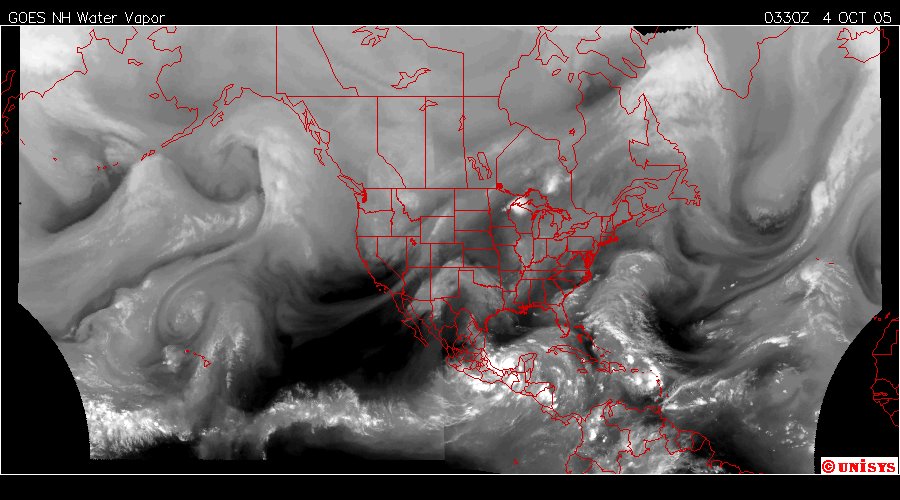
Monday, October 3, 2005

The Earth is a complicated rock revolving and revolving around our sun. One of the 'key' elements that stabilize the climate are teh 'winds' of Earth. The winds have an effect on the ocean surface currents. The theorist that wants to add some hockus-pockus to the tragedy of Rita and Katrina never discussed the winds. One cannot talk about warming Earth without discussing it's ocean of air as well. It's a darn shame people have to lie and endanger life for a political agenda that is bigoted, racist and counter productive to democracy and freedom.


State Regulations Taking Action Against Tour Boat Company; DeLay Indicted Again; Bush Nominates Miers; Indonesian Police Try to Determine Identities of Suicide Bombers
State Regulations Taking Action Against Tour Boat Company; DeLay Indicted Again; Bush Nominates Miers; Indonesian Police Try to Determine Identities of Suicide Bombers
Aired October 3, 2005 - 23:00 ET
THIS IS A RUSH TRANSCRIPT. THIS COPY MAY NOT BE IN ITS FINAL FORM AND MAY BE UPDATED.
ANDERSON COOPER, CNN ANCHOR: Good evening. Welcome to the top of NEWSNIGHT. I'm Anderson Cooper. Aaron Brown has the night off. We have several developing stories to bring to you over the next hour.
(BEGIN VIDEO CLIP)
COOPER (voice-over): In Upstate New York, state regulators are taking action against the company that ran the boat that capsized on Lake George yesterday, killing 20 people. We'll tell you all about that in a moment.Plus, in Indonesia, police are still trying to figure out who the three suicide bombers were who struck this past weekend in Bali. They've released gruesome photos of three heads that were blown off of the bombing suspects.And tonight, it has been 10 years since O.J. Simpson was acquitted of murder. We look back and show you what O.J. is doing now -- well, you may not believe it.
(END VIDEO CLIP)
COOPER: First, we begin with developing news. On the tour boat that capsized yesterday in Lake George, New York, killing 20 people. Tonight we've learned that state officials have shut down the company that runs the tour after investigators determined that the boat did not have the required number of crew members aboard. They were supposed to have two; there was only one.
(BEGIN VIDEO CLIP)
COOPER (voice-over): This afternoon, divers raised a 44-foot tour vessel, called the Ethan Allen. Investigators are examining the boat, trying to figure out what exactly caused the tragedy in what started off as a peaceful day.It was a picture-perfect Sunday on Lake George in New York. The weather warm, the waters still. Many boats were on the lake, including the Ethan Allen, a 40-foot glass enclosed tour boat, carrying the captain and 47 senior citizens from the Detroit area. The scenic cruise was supposed to be fun and relaxing, but that all came to a horrific end at just before 3 p.m.
ANDREA SAUSE, WITNESS: I've lived here my whole life, and this is the worst thing that's ever happened.
COOPER: Authorities suspect a wake created from a larger boat caused the Ethan Allen to rock violently side to side. The captain says he tried to steer the boat, but could not control it; and within seconds, the Ethan Allen turned upside down and capsized, sending its frail passengers into the water.A rescuer describes the scene;
FRANK SAUSE, BOAT RESCUER: One guy who as I was taking him off, he was very shook up and he said I think that was my wife -- they just took my wife. They put her over there.
FRANK SAUSE (voice-over): She's dead. I know she's dead. And I said, you know don't jump to conclusions.
COOPER: The death toll was staggering; and according to the New York State Police, unprecedented. Of the 48 people aboard the Ethan Allen, 20 perished. Some of the victims were in wheelchairs, others used walkers. Authorities say not one of them was believed to be wearing a life vest, which under New York state law, is not required.This afternoon police divers and recovery crews resumed the grim task of salvaging the Ethan Allen from the bottom of the lake to help them find out exactly what went so terribly wrong and why. Something we all want to know, especially this woman. Her parents were on the boat. Her mother survived; her father did not.
UNIDENTIFIED FEMALE (voice-over): They liked to travel. They were both really very active, which is why I -- I just don't understand. My dad was a wonderful swimmer and I don't know what happened yet with him.
(END VIDEO CLIP)
COOPER: It seems no one exactly knows what happened. Many more people probably would have died in the lake -- we know that. If it weren't for the heroic efforts of others. Alina Cho joins me from Lake George with a story of those who fortunately were at the right place at the right time. Alina, good evening.
ALINA CHO, CNN CORRESPONDENT: Anderson, good evening to you, and we will get to that story in just a moment. But first, we want to go straight away to some video that we shot earlier this evening.
(BEGIN VIDEO CLIP)
CHO (voice-over): It is of the vessel in question, the Ethan Allen. It was towed to shore late this evening. You may recall that divers raised the boat to the surface late this afternoon and spent much of the evening pumping water out of it. We are told that the boat will be put onto a trailer and then taken to a nearby facility for inspection.
(END VIDEO CLIP)
CHO: Now earlier today, we spent some time with a family who was on Lake George when the accident happened and who came to the rescue.
(BEGIN VIDEO CLIP)
CHO (voice-over): It is 9 o'clock in the morning, and the Rahal family is on a mission. Mounir and Joanne are skipping work. Their 13-year old daughter Allie is skipping school. It is that important.
JOANNE RAHAL, RESCUER (on camera): Because these people could have been my mother, they could have been my father, my brother, my sister.CHO: The Rahals are spending the day visiting survivors of Sunday's tour boat accident, giving hope to the people who right now, need it the most.
MOUNIR RAHAL, RESCUER (on camera): You don't have to be related to people to love them.
CHO: The family is familiar to many of those who were on the boat.
CHO (on camera): The Rahals were on Lake George, themselves, on their own boat, enjoying their Sunday afternoon, on a day much like today, when all of a sudden, Joanne saw a plume of smoke.
JOANNE RAHAL: So, I said, Mounir, go over. Go see what's going on. And as soon as we got over there, the boat had already tipped over and there was, you know, quite a few people just holding on for their lives.
CHO (voice-over): The Rahals immediately began throwing everything that floated out to sea. Mounir even used a long metal pole to pull people to safety. All the while, he kept hearing this:
MOUNIR RAHAL: Help, please, help.
CHO: 13-year old Allie played a big role too. Putting to use the CPR she learned in school. The teacher said, when you get there and you're in the moment --
ALLIE RAHAL, RESCUER (on camera): You just know what to do. It just comes to you.CHO: In all, the Rahals pulled eight people to safety; 20 others weren't as lucky. Mounir spent 30 minutes washing the blood off his boat. The memory of what happened is not so easily erased. And yet the Rahals say they wish they could have done more.
MOUNIR RAHAL: Helping other human -- I think that's the best things you could do for your own kind. It's the best thing.
(END VIDEO CLIP)
CHO: The Rahals say they plan to stay in close touch with the people they rescued. There are actually five kids in the family, Anderson. Seven people in all and with the eight people they rescued, the Rahals say their family has now grown to 15. Anderson?
COOPER: Where does the investigation stand at this point?CHO: Very good question, Anderson. The NTSB arrived on the scene today. They say they will look at every screw on this boat. Of course, now it has been moved to this nearby facility for inspection. They say they'll look at every screw because, of course, all indications are right now from witnesses and the sheriff even, that it got caught up in the wake of a larger vessel, possibly a larger tour boat. But NTSB officials, other law enforcement say this investigation will be thorough and will take exactly as long as it has to. Anderson?
COOPER: All right. Alina, thanks very much for that. I will continue to follow that story, obviously. Another developing story in Washington tonight, Former House Majority Leader Tom DeLay finds himself in deeper trouble with the law. A Texas grand jury has brought a new charge against him of money laundering this time. It's punishable by five years to life in prison. The charge, which DeLay calls a quote, "abomination of justice," follows a conspiracy indictment last week, which forced him to give up his leadership position. CNN Congressional Correspondent Joe Johns has more.
(BEGIN VIDEO CLIP)
JOE JONES, CNN CONGRESSIONAL CORRESPONDENT (voice-over): Travis County Prosecutor Ronnie Earl piled on a new charge against Former Majority Leader Tom DeLay, money laundering, a first-degree felony, on top of a prior charge of criminal conspiracy. This new and more serious charge comes after some fast-paced legal maneuvering in Austin, Texas. Late Monday, attorneys for DeLay asked a judge to throw out the conspiracy charge because conspiracy in this context was not yet a crime in 2002, when the alleged wrongdoing occurred. The judge has not yet responded. DeLay tried to laugh it off, speaking with a Texas radio station.
TOM DELAY, FORMER MAJORITY LEADER (voice-over): So this crime didn't even exist. And, and -- I'm sorry for laughing -- this is beyond -- it's just unbelievable. I mean he's making the case so the cops look good.
JONES: Delay's lawyers say Earl got the new money laundering indictment out of desperation.
UNIDENTIFIED MAIL (on camera): If this doesn't prove that the motivation behind this indictment is political, then I don't know what it is.
JONES: The indictments relate to a plan by Texas republicans to first take over the State House in 2002. Earl says DeLay and his associates used corporate money; $190,000 funneled through Washington, to win the Texas legislature in violation of Texas law. Back in April, when I went to meet him, Earl explained his reasoning.
RONNIE EARL, TRAVIS COUNTY PROSECUTOR (on camera): I call it money laundering.
JONES: Why?
EARL: Well, taking the proceeds of a criminal transaction and using it for other purposes.
JONES: Delay's attorneys insist there was no money laundering because all of the financial transactions that took place were perfectly legal.
UNIDENTIFIED MALE (on camera): The law was followed. No law's been broken.
JONES (on camera): A source close to the investigation in Austin, speaking on background, tells CNN that the district attorney's office is not conceding any mistake was made in the original indictment. And that while Ronnie Earl's office expects to argue the issue out in court, a decision was made to re-indict DeLay, just in case. Joe Johns, CNN, Washington.
(END VIDEO CLIP)
COOPER: Earlier tonight I spoke with Dick Deguerin, the attorney for Congressman DeLay. Here's what he had to say about the case.
(BEGIN VIDEO CLIP) COOPER (voice-over): Were you surprised when this indictment came down?
DICK DEGUERIN, ATTORNEY (on camera): No, I'd say this -- this indictment, although it has about eight times as many words, has no more substance than the other one. What's really important to remember, Anderson, is that no corporate money went to any individual candidate in Texas. That -- that's the only crime that there could have been.COOPER (on camera): But corporate money was funneled to outside groups, which then sent money back into Texas for Texas candidates.
DEGUERIN: What happened was the corporate money, which was donated lawfully, was sent to the Republican National Committee, which sent it to places that it could be sent. And then another committee of the Republicans sent money that was collected from individuals to individuals in Texas. All legal. There was no mixture of the two monies.
(END VIDEO CLIP)
COOPER: Well, we are following several other stories, tonight Cross-Country, let's take a look.
(BEGIN VIDEO CLIP)
COOPER (voice-over): President Bush has nominated Harriet Miers to fill Sandra Day O'Connor's seat on the U.S. Supreme Court. Miers is the White House counsel now and a confidante of the president. She's never served as a judge. The president once called her a pit bull in size six shoes. We'll have more on her nomination, coming up.Near Los Angeles, not what firefighters want to hear; the National Weather Service has issued a red flag warning for strong winds. We're talking about winds up to 50 miles an hour. Now firefighters are scrambling to put out several wildfires still blazing in the area.And near the Florida Keys, on the seven-mile bridge, a fatal tanker crash. Police say a truck carrying gasoline, of all things, burst into flames -- you see it right there -- after the driver lost control, crashed into an SUV. The drivers of the truck and the SUV were killed. The passenger in the SUV is not hospitalized. No word on the extent of her injuries.In Washington, a new blaring report on the FBI from the Justice Department says, due to the FBI's emphasis on terrorism cases, there has been a 45 percent drop in investigations into traditional crimes like drug trafficking and bank robberies.
(END VIDEO CLIP)
COOPER: The inspector general also says the new focus is putting a strain on other agencies and local police. Those are the happenings Cross-Country, tonight.
(BEGIN VIDEO CLIP)
COOPER (voice-over): Coming up, on this edition of NEWSNIGHT, more on the nomination of Harriet Miers to the U.S. Supreme Court. Find out why some conservatives are speaking out against the pick. Plus, seeking answers in the Bali bombings. Police releasing grizzly photos of the suspected bombers. We're not going to show you the photos. We'll have that live report from the Islands. We'll have more on that.
(COMMERCIAL BREAK)
COOPER: Oh the feedback has been pouring in since President Bush nominated Harriet Miers to replace Sandra Day O'Connor as Supreme Court justice. Nothing odd about that, except the direction that the feedback's been coming from. Here's CNN Senior Political Correspondent Candy Crowley;
(BEGIN VIDEO CLIP)
SENATOR HARRY REID (on camera): Hello everyone. I'm happy to be here today with Harriet Miers.
CANDY CROWLEY, CNN SENIOR CORRESPONDENT (voice-over): Miers has never been a judge. A resume, which prompted a conservative group to call her possibly the most unqualified choice since Linden Johnson tapped his lawyer. Meanwhile, the Senate's top democrat sang her praises.
REID: So, anyone with that background makes me feel good. Someone who has been in a courtroom, has tried cases, answered interrogatories, done all those things that lawyers need to do.
CROWLEY: In the first week of the nominations, supporters are usually effusive and critics are polite, if not always by Ms. Manner's standards.
SENATOR CHARLES SCHUMER (on camera): And my first reaction is a simple one. It could have been a lot worse.
SENATOR DIANNE FEINSTEIN (on camera): I see no negatives at this stage in Harriet Miers.
CROWLEY: But this time is different. In the yen and yang of Washington politics, if two left-leading democrats are not unhappy, then right-leading republicans must be. Conservative commentator Rush Limbaugh took the case to the vice president.
RUSH LIMBAUGH, CONSERVATOR COMMENTATOR (on camera): On your part that there's some disappointment out there, that there's not somebody could be immediately rallied around, and you got people saying that they're depressed and they're, they're thinking that this is a decision that has let them down and they're frankly a little, a little warn out, having to appease the left on all of these choices.
UNIDENTIFIED MALE (voice-over): You'll be proud of Harriet's record, Rush, trust me.
CROWLEY: But conservatives don't want a nomination that requires a leap of faith. Stung by an unexpectedly liberal justice Suiter, another choice with a short paper trail, the right wanted a well- documented judicial conservative. Some republicans believe Miers is a copout by a president without the pose or the stomach for a fight. "Her selection," wrote Conservative William Kristal, "will unavoidably be judged as reflecting a combination of cronyism and capitulation..." Yikes. When the friendly fire is that loud, what must the president's most reliable critics be saying? Pretty much the same thing.
TOM MATZZIE, MOVEON ORG PAC (on camera): What we know about her is that she's a friend of the president's; and when the president is choosing a friend, that reeks of cronyism.
CROWLEY (on camera): The White House is busy reaching out and reassuring wounded conservatives, while democrats sit back and enjoy the show. The noise was so loud from the right, that the Democratic National Committee decided it could wait a day or two before adding its voice to the mix.Candy Crowley, CNN, Washington.
(END VIDEO CLIP)
COOPER: It is a bit of a shock, to say the least, to hear conservatives speak out against President Bush's pick to the Supreme Court. Earlier tonight I asked CNN Senior Legal Analyst Jeffrey Toobin to weigh in on the Harriet Miers nomination. And I started off by asking him if he was surprised by the choice.
(BEGIN VIDEO CLIP)
JEFFREY TOOBIN, CNN SENIOR LEGAL ANALYST (on camera): Shocked. Totally shocked. I mean, you know, it's one thing not to be a judge. That's rare. All nine justices currently on the court, were former judges.
TOOBIN (voice-over): But, okay, put that aside. There are people who --
COOPER (voice-over): There's precedent to that.
TOOBIN: Right. Bill -- William Rehnquist, Felix Frankfurter, Earl Warren -- none of them served as judges before. But they had big public profiles. They stood for something. We knew what their public positions were. Harriet Miers is invisible. We don't know how she stands on anything, much less the kinds of things that --
(CROSSTALK)
COOPER: Relatively prominent attorney, I guess, in Texas. She was labeled as one of the most influential attorneys.
TOOBIN: Well, I mean she was relatively prominent as a corporate attorney. And corporate attorneys sort of do corporate work, but they don't really hold high profile positions on issues for the --
COOPER: And on constitutional matters.
TOOBIN: Certainly not on constitutional -- so we're picking a church. She attended some pro-life fund raisers apparently. But she also gave money to Al Gore in 1988.
TOOBIN (on camera): So, you know, basically it comes down to President Bush saying trust me.
COOPER (on camera): They are already charging cronyism. Obviously we've seen it with FEMA. But, but
(INAUDIBLE)
because she was actually head of his -- the selection committee to find other supreme court nominees, just as Dick Cheney was head of the committee to find vice presidential picks.
TOOBIN: I want to be head of a selection committee.
(BEGIN VIDEO CLIP)
TOOBIN (voice-over): But no, I think this is a president who goes with his gut, who really does not --
(CROSSTALK)
COOPER: It seems that the personal matters with this president --
TOOBIN: And you know, sometimes that works, sometimes it doesn't.
TOOBIN (on camera): What's odd about that in this context is that by definition, a Supreme Court justice has nothing to do anymore with the president. It's one thing to pick your own staff with people you're comfortable with. But Supreme Court justices, the constitution says they have to be independent. So, you know, whether that personal chemistry will matter in determining whether she's a good Supreme Court justice seems a little more shaky to me.
COOPER: There are thoughts and just from a political standpoint, those who had anticipated a very clear conservative choice, given criticisms of President Bush for spending too much money, spending, you know, huge amounts of money. He -- already in conservative circles, he's under fire. Did it surprise you that he didn't try to shore that up?
TOOBIN: Well, I mean, he's sort of boxed in because, you know, democrats are emboldened too. And a conservative choice might really have drawn a filibuster, which is what the democrats can do. Look, I think, you know, the important thing to remember is there are still 55 republicans in the Senate. A filibuster will be very difficult to maintain among democrats to hold more than 40 of them together. So I think the odds overwhelmingly favor confirmation of Harriet Miers, but as for what kind of justice she really will be, I don't think it's fair to say that anybody has any clear idea at this point.
COOPER: Do you think the president has a clear idea?
TOOBIN: I think he has a reasonable guess, but, you know, mostly, you know, remember when John Roberts looked at Chuck Schumer in those hearings and said, you know, I'm not an ideologue. Look at the opinions I've written. Look at my record. You know, she can't say that. She doesn't have a record.
COOPER: So then anyone can look at -- Chuck Schumer is a democratic liberal senator from New York, who, by the way today said about Miers, it could have been worse.
TOOBIN: It could have been worse. So I think the hearings will be unusually important because it will really be the first clue of any sense of what she stands for.
COOPER: CNN Senior Legal Analyst Jeffrey Toobin.Still to come on NEWSNIGHT, the reality of war, plus the O.J. Simpson trial -- a decade later. We'll take a look at what's happened to the people involved in the case.
(COMMERCIAL BREAK)
COOPER: Once again tonight, the Indonesian island of Bali is the center of a terror investigation after a series of coordinated explosions rocked two cafes and a restaurant at a tourist spot Saturday, killing at least 22 people, injuring more than 130. It comes three years after a nightclub attack killed 202 people. This time around, investigators have dramatic video footage of the suspected bombers shot by tourists. Take a look at this.
(BEGIN VIDEO CLIP)
COOPER (voice-over): Police, meanwhile, are taking unusual and very grizzly steps to get information on the suspected bombers. For more on that, we go now to Senior International Correspondent Stan Grant, who is in Bali.
(END VIDEO CLIP)
COOPER: Stan, what are they drawing?
(BEGIN VIDEO CLIP)
STAN GRANT, CNN SENIOR INTERNATIONAL CORRESPONDENT (on camera): Yes, Anderson, it is a very grizzly step indeed. GRANT (voice-over): They've released photographs of the seven heads of the three men they suspect of being the suicide bombers who carried out these attacks on Saturday night. Now, this comes after the release of that video you just mentioned. Now in the video you can see a man wearing a backpack as he walks through one of the restaurants before detonating explosives. Police believe that that man also was one of the suicide bombers.
GRANT (on camera): Now the investigation is focusing on the group Jama'a Islamia. That is a Southeast Asian terror network that, its aim is to try to create a Pan-Islamic state right across Southeast Asia.
GRANT (voice-over): It has close links with Al Qaida. They believe that Jama'a Islamia operatives who are still at large have been the ones who have masterminded this attack. And they've taken the step of actually bringing in a former Jama'a Islamia operative who has testified since against Jama'a Islamia. They brought him in to try to assist in their investigations. Now 200,000 police across Indonesia have been placed on high alert. Special police have been brought in from Australia and also Japan, to assist in this investigation. The threat is that now this attack has happened, another one could well follow.Anderson?
(END VIDEO CLIP)
COOPER: Stan, is Jama'a Islamia -- has that been outlawed as an organization? I think as I recall from reading, there had been some controversy about whether or not it was officially outlawed.
(BEGIN VIDEO CLIP)
GRANT (voice-over): A lot of controversy about that. Jama'a Islamia is not just linked with the 2002 Bali nightclub bombings, but subsequent bombings also in Jacatur (ph) at the Marriott Hotel. And the Australian Embassy just last year, now for all of that and despite a crackdown on Jama'a Islamia, which has netted some 300 operatives in the past few years, it remains a legal organization. It is not illegal to be a member of Jama'a Islamia. It is not illegal to support the organization. It is still not an outlawed organization. Many say that is the first step if you want to make sure there are no more attacks. Anderson?
(END VIDEO CLIP)
COOPER: A tangled web. Stan Grant, thanks for that from Bali, tonight.U.S. troops are going after an Al Qaida forces in western Iraq, waging a battle that's been code-named Operation Iron Fist. CNN Jennifer Eccleston is embedded with Marines on the mission, and she gives us a first-hand look at what it is like to be right in the middle of a fight like this. The reality of war. Here's her report. And we want to warn you, some of the images you're about to see are very disturbing.
(BEGIN VIDEO CLIP)
UNIDENTIFIED MALE: We're taking incoming rockets.
JENNIFER ECCLESTON, CNN CORRESPONDENT (voice-over): India Company was looking for a fight.
UNIDENTIFIED MALE: (INAUDIBLE) a white building.
ECCLESTON: In eastern Karabula the insurgents complied. Gunfire and rockets.
UNIDENTIFIED MALE: (INAUDIBLE) run around with RPGs. As soon as I get a shot, I'm going to be taking a few. UNIDENTIFIED MALE: Can you even see them?
ECCLESTON: Firing, but fleeing before they're identified and engaged.
UNIDENTIFIED MALE: I know these pop shots are frustrating. Keep your eyes open and you're going -- we're going to snag one of them. Keep your heads down.
ECCLESTON: Frustrations mount --
UNIDENTIFIED MALE: If you got somebody to shoot at, it's a done deal. Do it.
ECCLESTON: Nerves fray.
UNIDENTIFIED MALE: Yankee four to Yankee six. What's going on? Roger. Anybody under -- anybody know what that machine gun fire was?
ECCLESTON (on camera): The Marines were taking sporadic gunfire for about an hour, which limited their ability to advance further into town. And they thought the shooters were coming from this area.
ECCLESTON (voice-over):
(INAUDIBLE)
tanks are called in to take out the alleged safe haven. Marines think they may have struck their target, but then a stream of civilians in shock, in disbelief, in pain. The wall is hit, but so is a building. A mother, father and child struck by flying pieces of their home.Marines treat them and others; the most serious evacuated.What's our crime? One man moans. We're innocent. Innocence and guilt blurred when fighting encountered insurgency Marines say, especially when their enemy is capable of such deception. Hidden bombs like this, mines streets. Marines use their tools to isolate the insurgents, but everyone is a potential suspect.
DALE ALFORD, LIEUTENANT COLONEL (on camera): This isn't an open battlefield where we're -- you got the bad guys and the good guys lined up against each other. You've got innocent civilians intermixed in the battle. And it's -- it's always tough.
ECCLESTON: Especially tough this day. While the mission to secure Karabula is progressing, the mission to win the trust of innocent civilians suffers a setback.Jennifer Eccleston, CNN, Karabula, Iraq.
(END VIDEO CLIP
)COOPER: Well, we are following several other stories around the world in tonight's Uplink. Let's take a look.
(BEGIN VIDEO CLIP)
COOPER (voice-over): Along the southeast coast of China, Typhoon Long Wong (ph) hits with force. China says 59 of its soldiers in charge of domestic security were washed away in raging floodwaters. If they are confirmed dead, the death toll would climb dramatically from where it stands now, at three. In Luxembourg, the European Union has agreed to start membership talks with Turkey. It is a historic step that would transform the union by taking a predominantly Muslim nation and expanding its borders to Asia and the Middle East. And aboard the International Space Station, an American millionaire, Gregory Olsen, paid $20 million to be a space traveler, a New Jersey scientist blasted off from Kazakhstan aboard a Soyuz capsule over the weekend. And that is a quick look at stories around the world in the Uplink.
COOPER (on camera): Still to come in this special edition of NEWSNIGHT, New Orleans tries to dig out from all its trash.
COOPER (voice-over): We're talking about tons and tons of it, enough to cover 200 football fields. The question is when's it all going to be gone and where's it going to go? Plus, we're not done yet. A new and disturbing hurricane forecast for this month. Say it ain't so. But we'll tell you all about it.
(COMMERCIAL BREAK)
COOPER: And welcome back to NEWSNIGHT. I'm Anderson Cooper. Aaron Brown is off tonight. Here's a quick look at tonight's top stories in "The Reset."Former House Majority Leader Tom DeLay was indicted again today. This time money-laundering, those were the charges. If convicted he could face up to life in prison. DeLay calls the charges, quote, "an abomination of justice."President Bush has nominated White House Counsel Harriet Miers to fill Sandra Day O'Connor's shoes on the Supreme Court. Miers has no judicial experience, though that's not a requirement for the Supreme Court. Democrats generally have been cautious in their response. Some have expressed concern that they don't much about her. Conservatives have been even more critical, actually.In California, near Los Angeles, hot dry winds forecasted through Wednesday are threatening drive up wildfires -- to drive up. Firefighters had been making progress. The regions largest fire is 85 percent contained. But we are watching those winds closely. And comedian Nipsey Russell has died. Known for his rhyming wisecracks, Russell was a staple on variety shows like "Laugh-In" and "The Tonight Show" during the 1960s and 1970s and, "To Tell the Truth," which I met him on because I was on that as a kid. Nipsey Russell was 80 years old. An amazing he led.As we told you at the top of the hour, the company responsible for the capsized tour boat in Lake George, New York, has been shut down by state officials. Now investigators said the boat did not have the required number of crew members aboard. They had one instead of two. There were supposed to be two. Twenty people on the boat were killed when it sank yesterday. CNN's Deborah Feyerick looks into it.
(BEGIN VIDEOTAPE)
DEBORAH FEYERICK, CNN CORRESPONDENT (voice-over): Investigators hope the cruise boat they raised from the bottom of the lake will provide answers as to why it sank in 70 feet of water, answers also important to survivors like 76- year-old Jeane Siler. After working with victims of Hurricane Katrina, she had decided to take a vacation. She has seen lots of tragedy. She was right in the middle of this one.
JEANE SILER, SURVIVOR: All of my friends around me, some of them not being able to swim, were fumbling about. Some of them were screaming. And those that could were trying to hang on to the side of the boat.
FEYERICK: In the moments before the tragedy, Siler was in the front of the small cruise boat named the Ethan Allen. She was talking to a friend when the boat, very close to the shoreline, steered into a wake.
SILER: I noticed the cabin floor was getting wet. And why, I don't know, but I stood up. And I don't know if I jumped out of the boat or if I was thrown from the boat when it tipped.
FEYERICK: Leon Koziol was swimming in the lake and waved to some of the seniors on board. He said there was nothing unusual about the water or the boat.
LEON KOZIOL, LAKE GEORGE VACATIONER: It was a large number of peoples, comfortably seated, seemingly in a very jovial, happy mood, taking in the sights, and, again, nothing unusual.
FEYERICK: Koziol has vacationed on Lake George for the past 30 years. He even wrote a fiction book about it. The narrow lake was very busy on Sunday, lots of boats, lots of waves. (on camera): So, it may have just been bad timing?
KOZIOL: Bad timing. I think a combination of rogue wakes hit at the right moment, as he was making a turn in a very sheltered bay and probably wasn't anticipating it.
FEYERICK (voice-over): Investigators are looking into the possibility that waves from another cruise boat may have caused the Ethan Allen to capsize. A larger, faster vessel, the Mohican, run by a competing company, was also on the lake at the same time. Bill Dow is president of the family-run business which owns the Mohican. He says that boat was two miles away.
BILL DOW, LAKE GEORGE STEAMBOAT CO.: It was none of our boats, big excursion boats, caused any problem on this lake. And they haven't. And we have been here, catch this, since 1817. The Mohican has been on the lake for 98 years, since 1908, doing the same cruise with the same speed. And there has never been any problems. And it's not our fault, period.
FEYERICK: As for Jeane Siler, one of 27 survivors, she suffered broken bones. They will heal. The emotional wounds will take a lot longer.
SILER: I was not prepared for this at all. I was -- never thought I was going to lose friends and never have a chance to say goodbye to them.
FEYERICK: Deborah Feyerick, CNN, Lake George, New York.
(END VIDEOTAPE)
COOPER: That poor lady. In New Orleans tonight, the waters that had turned streets into rivers after the hurricanes are now almost completely gone. The Army Corps of Engineers says it expects to declare the city dry by tomorrow or Wednesday, which is certainly a great achievement. Now there's the garbage to deal with. There's tons and tons of garbage. We asked CNN's Rick Sanchez to find out when it is going to get picked up.
(BEGIN VIDEOTAPE)
RICK SANCHEZ, CNN CORRESPONDENT (voice-over): It is a mountainous mess: an estimated 22 million tons of garbage and refuse that residents are now returning home to. (on camera): What's it like to come home to a place that looks like it has been hit by a bomb?
JAMES COMINITA, NEW ORLEANS RESIDENT: Devastating. It's like -- can't explain it.
SANCHEZ: Essentially, contract garbagemen from all over the country hired by FEMA to take part in what is one of the largest trash removal projects in our nation's history. (on camera): To get a sense of just how big a job this is, imagine, if you would, 200 football fields, all of it stacked with trash, 50 feet high. That is what officials say they are dealing with here.
ALVIN CLOUATRE, ARMY CORPS OF ENGINEERS: People are coming home, little by little right now, and as they're coming home, they are hauling the debris out from their houses and hauling it to the curbside, where we can pick it up and.
SANCHEZ: So that means you may pick up some neighborhood's trash today and have to go back there next week because somebody else came home and put it out?
CLOUATRE: That's correct. That's correct.
SANCHEZ (voice-over): Army Corps of Engineer officials tell us the job will take six months to a year to complete. Residents are throwing out just about everything within their walls that Katrina's winds and rain ruined: furniture, refrigerators, carpets, in some cases, even the walls themselves. The hazardous waste that has to be disposed of is estimated at three to 10 pounds per household. (on camera): Do you see an end in sight to all of this?
ANTHONY JONES, TRASH WORKER: No, I don't. There's trash everywhere.
SANCHEZ (voice-over): Army Corps of Engineers officials say they're sifting and separating the hazardous materials from other debris, like construction waste and fallen trees. They also say they have enough landfills to burn or bury the garbage locally, without having to take it across state lines.
(END VIDEOTAPE)
SANCHEZ: And then of course there's also the environmental impact. And consider this, look at that building behind. Just like any one of our homes, that person, who have had their home destroyed here, had fuels and detergents and gases and paints and pesticides in their garage. Well, that's fine if it's one or two home. But now multiply that by 100,000 or 200,000 people whose homes are now being gutted. And things like this are essentially being put into the garbage and the refuse. All of that combined creates a real problem that officials here with FEMA and the Army Corps of Engineers are trying to sift through to separate some of that material from some of the other materials. But they're having a tough time doing it. And in the end, it's almost certain that much of it will get away.Anderson, back over to you.
COOPER: So, Rick, they're saying it goes to landfills, how many landfills are we talking about and where are these?
SANCHEZ: There are three landfills in New Orleans. Two of them are packed full already. The other one they're still working on and they're considering the possibility of having to build yet another one. They don't know at this point, as I've mentioned in my report, if they will have to take some of this stuff elsewhere. In the end, Anderson, it's just a matter of how much junk is there? Really nobody knows. And remember, it's going to be even more if they have to demolish some of the homes in places like the 9th Ward, something that does remain a possibility.
COOPER: Yes. No doubt about it, some of the damage is beyond repair. Rick, thanks very much for that. And after spending a month in the Gulf, I can tell you there's a word that comes to mind: enough -- or two words: no more. Mother Nature, however, may have some other plans. We're talking about hurricanes and what may happen over the next month or so.Here's CNN's Rob Marciano.
(BEGIN VIDEOTAPE)
ROB MARCIANO, CNN METEOROLOGIST (voice-over): It's a sight we've grown accustomed to: howling winds that make trees bend like rubber and tear rooftops apart, and flood waters that destroy homes, towns and countless lives. In the world of weather, 2005 could be called the year of the hurricane. Of the 17 named storms this year, nine of them became hurricanes and four, Dennis, Katrina, Ophelia and Rita, made landfall. But according to hurricane expert Professor William Gray, we're not out of the woods yet.
PROF. WILLIAM GRAY, COLORADO STATE UNIVERSITY: We're calling for three named storms, two hurricanes and one major one for the rest of the season.
MARCIANO: At Colorado State University, a leading center for hurricane forecasting, Professor Gray uses computer models to analyze and predict the path of hurricanes. He and his team are predicting a more active-than-normal October, with storms likely to form in the Caribbean and move into the eastern Gulf of Mexico, or up the East Coast of the
U.S. UNIDENTIFIED MALE: This month the probability of a hurricane making landfall somewhere along the U.S. coastline is about 21 percent.
MARCIANO: With the recent increase in stronger hurricanes, some argue global warming is to blame. But Gray disagrees. He says it's part of a natural weather cycle caused by the great ocean conveyor belts, an ocean current a circulates warm and cold water across the globe. Today, it's bringing a strong current of warmer water.
GRAY: When it's stronger, as it has been since 1995, we tend to have more major hurricanes in the Atlantic Basin. And when it's weaker, we tend to have fewer.
MARCIANO: Gray says it's a cycle that plays out over 25 to 30 years. If that's the case, we could start looking for the next inactive season in about the year 2020. Rob Marciano, CNN, reporting.
(END VIDEOTAPE)
COOPER: Well, I don't know if you caught it this weekend, my hurricane coverage was mocked, mocked, I tell you, on "Saturday Night Live." We're going to show you some of what they had to say. It was good. Also the drama and the heartbreak, the trial of the century, it's hard to believe it has been 10 years since O.J. Simpson was acquitted. My interview with Nicole Brown Simpson's sister, Denise Brown, and how she is coping 10 years later.
(COMMERCIAL BREAK)
COOPER: It's 10 years now since O.J. Simpson was acquitted of murdering his wife, Nicole Brown Simpson and her friend Ron Goldman. Ten years later, here's how O.J. Simpson spent part of the day today: signing jerseys, for money of course, signing the initials "O.J." that came to mean so many different things to so many different people, and one thing to nearly everyone. Nobody could look away.
(BEGIN VIDEOTAPE)
UNIDENTIFIED MALE: The defendant, having been acquitted of both charges, he is ordered transported to an appropriate (INAUDIBLE) facility and released forthwith.
COOPER (voice-over): Ten years ago today, a relieved and happy O.J. Simpson walked out of a California courtroom. He was a free man.
UNIDENTIFIED FEMALE: It is still the story of the hour, the Simpson murder case...
COOPER: His trial, which took nearly a year, provided much fodder for tabloids and countless hours of programming for television networks. Some called it the trial of the 20th Century. It would most certainly change the way many Americans viewed our justice system.
JEFFREY TOOBIN, CNN SR. LEGAL ANALYST: People know a lot more about how a criminal trial works, because everyone followed the Simpson case.
COOPER: The crime that sparked the Simpson trial was gruesome. The night of June 12th, 1994, the bodies of Simpson's estranged wife, Nicole Brown Simpson, and her friend, Ron Goldman, were found in her front yard, stabbed to death; she nearly decapitated. Even if you weren't watching the constant news coverage of the case, some moments will no doubt still stand out. This is one of them. Five days after the murders, O.J. Simpson, about to be arrested and with police in pursuit, takes to the highway, driving slowly in his white Ford Bronco, with a gun and a friend at the wheel.
TOOBIN: There we had on live television the entire country, even more than a Super Bowl audience, following this car, wondering where he's going, what's going to happen? Is he going to kill himself on live television?
COOPER: When the chase ends, O.J. was arrested, and the pieces were in place for the trial to begin.
O.J. SIMPSON: Absolutely 100 percent not guilty.
COOPER: It looked for many who were watching like a slam dunk case. There was testimony from Nicole's family about the couple's abusive relationship, supported by tense 911 tapes.
UNIDENTIFIED FEMALE: 911 emergency.
NICOLE BROWN SIMPSON: Can you get someone over here now, to 325 Gretna Green? He's back. Please.
UNIDENTIFIED FEMALE: OK. What does he look like?
N. BROWN SIMPSON: He's O.J. Simpson. I think you know his record. Could you just send somebody over here?
COOPER: There were the blood droppings on Simpson's driveway, smudges in his SUV, bloody socks and one bloody glove. O.J. seemingly unaccounted for time when the murders were being committed. And there were the characters in this macabre drama: perennial house guest Kato Kaelin; Nicole's friend Faye Resnick, accused by the defense of dealing drugs; the much maligned judge, Lance Ito; O.J.'s maid Rosa Lopez; and a parade of police and scientists, faces and names burned into the memories of just about anyone who followed the trial. But the man who would stand out above the others as he attempted to dismantle the state's case piece by piece was Johnnie Cochran, lead lawyer on O.J.'s prestigious and pricey dream team.
TOOBIN: What being in that courtroom every day taught you was that Johnnie Cochran owned that room.
COOPER: Cochran exposed now infamous police investigator Mark Fuhrman for his use of racist language. He took the L.A. crime lab to task for its sloppy procedures. And in one show-stopping moment pointed to a bloody glove to plant reasonable doubt in the minds of the jury.
JOHNNIE COCHRAN, DEFENSE ATTORNEY: If it doesn't fit, you must acquit.
COOPER: And that is just what the jury did. After eight months of testimony, with hundreds of pieces of evidence, as an estimated 150 million people watched, they reached their verdict in under four hours.
UNIDENTIFIED FEMALE: We the jury in the above-entitled action find the defendant, Orenthal James Simpson, not guilty of the crime of murder...
COOPER: One criminal trial, two murders, and 10 years later we are still talking about the profound effect it had on our perception of justice.
TOOBIN: The important legacy of the Simpson case is that racial divisions still exist, and even a bizarre celebrity murder trial can bring out some very important differences in realities about American life.
(END VIDEOTAPE)
COOPER: Earlier today I spoke with Denise Brown about how she remembers her sister, Nicole, and how she feels when the anniversary of the trial decision comes around.
(BEGIN VIDEOTAPE)
DENISE BROWN, NICOLE BROWN SIMPSON'S SISTER: Well, you know, you just want to remember all the positive things about somebody and the fun times that you had. And now all of a sudden, the timeline that you just went through, it was like, whoa, it just brought it right back again. And the horrific stuff that happened, the politics that played in it, you know, because I learned so much about a criminal trial, our justice system, and how politics played such a huge part in his acquittal. And I just -- oh, my God, you just brought me back to all of that again.
COOPER: You say politics. How do you mean?
BROWN: Well, I think that Gil Garcetti, I think he made a very political move, especially when one of the jurors that was picked, who -- when all the jurors were picked and they went down the elevator, and one of the jurors said, oh, it's payback time. They went back behind closed doors with Judge Ito, and, you know, they let the woman go that said -- you know, that went back and overheard the conversation. And I think that Gil Garcetti had a huge part in that, because he didn't want to have South Central or downtown Los Angeles burned down, because that was -- that's what they were thinking, because it was going to cost billions of dollars to fix it up again.
COOPER: You said that you try to remember the good times. It's hard often for people to remember the way their loved one lived their life as opposed to the way their life ended. Do you find that difficult? I mean, do your thoughts go back to what happened to your sister, or are you able to focus on the positive?
BROWN: You know what, I try to focus on the positive. Every time there's -- well, I guess I hate to use the word anniversary, but every time there is something like this that goes on, I am brought back to the first interview with Marcia Clark, which I thought was horrific, and that was walking into her room and seeing Nicole, a big huge poster of Nicole's body and her decapitated head. And that is what I really hate about it, because I really just love to remember the good times that we had as kids, the good times that we had as children, and as teenagers and growing up, and the concerts we used to go to and the -- you know, the boys and, you know, just the fun times.
COOPER: Are you able to see the kids, Sydney and Justin?
BROWN: Yes. Yes, we are.
COOPER: And, I mean, I don't want to pry, so if you don't want to talk about it, that's fine, but, I mean, what are those times like?
BROWN: Well, you know, we have great times. I mean, it's Christmastime and the summer. But we don't talk about this at all. You know, this is something that we don't talk about. I love to remind them of what their mother -- who she was. And just so they don't forget. I don't ever want Nicole to be forgotten, for them especially. I don't want them coming to me in a year, two years, five years, 10 years down the road and saying, oh, my gosh, I don't remember her voice, oh my gosh, I don't remember what she looks like, what she did. You know, I just want her to be remembered just as the wonderful human being that she was.
COOPER: Are you -- I mean, we saw earlier a picture of O.J. Simpson signing autographs, which is remarkable to me that anyone wants that.
BROWN: Yes.
COOPER: Have your family been able to receive any of the money that was awarded to you in a civil case?
BROWN: Well, it wasn't awarded to us. It was awarded to the estate of Sydney and Justin -- or Nicole's estate for Sydney and Justin.
COOPER: OK.
BROWN: Yes -- no, the thing is, is that it was really bizarre that he picked this weekend, because we just had a fabulous event for Nicole's House and Nicole's House are the transitional homes, 18- to 24-month homes for women and children. And that's how I want to remember Nicole. I want to remember the positive things that we're doing, the great work that we're doing, trying to save lives, trying to help people. And really, he is just like absolutely nothing to me. And he never will be. And, you know, I just think that, yes, Johnnie Cochran did do a huge disservice to the American public by dividing us racially. I -- you know, I just think that that is really sad, because it was not about white and black. It was about one man who murdered two people. And that's what the public needs to remember.
(END VIDEOTAPE)
COOPER: Well, coming up, how I made it on to "Saturday Night Live," of all things this weekend. We'll be right back.
(COMMERCIAL BREAK)
COOPER: It has been surreal for me these past few days, being back from New Orleans and Mississippi. Even more so this weekend when I turned on "Saturday Night Live" and I was honored to see myself -- well, sort of honored, take a look
.(BEGIN VIDEO CLIP)
UNIDENTIFIED FEMALE: Painting is wonderful!
UNIDENTIFIED MALE: Well, this is interesting. Let's take a look over here. We've got a pair of Oscar-nominated carpenters of sorts. We have Sharon Stone and Al Pacino. Here we are.
UNIDENTIFIED MALE: Hello, Anderson.
UNIDENTIFIED MALE: Sharon, tell us, do you have any previous experience with construction?
UNIDENTIFIED FEMALE: Absolutely not. But I have partied with a few construction workers.
UNIDENTIFIED MALE: And, Mr. Pacino, I'm no expert here, but I think you're trying to put a door where a window is supposed to be.
UNIDENTIFIED MALE: Anderson, we are building a new house in new New Orleans. We'll put the doors wherever we want. Oh. There's a shih-tzu stuck in a Spanish oak tree. I go to save that dog.
UNIDENTIFIED MALE: This is Geraldo Rivera for FOX News.
UNIDENTIFIED MALE: No, no, it's 360, I'm Anderson Cooper. OK?
UNIDENTIFIED MALE: I'm reporting live from the cretinous crater of the Crescent City catastrophe, where in the last few days I've saved literally thousands of babies, black babies, white babies. This morning, I saved an Asian baby. When it comes to saving babies, Geraldo Rivera is colorblind. In fact, I'm about to save this baby right now. He is going to go...
UNIDENTIFIED MALE: Hey, man. He ain't no baby. He's 32 years old.
UNIDENTIFIED MALE: As you can see, this young man is in the grips of a dastardly delirium brought on by the buffeting blasts of Katrina's gale-force onslaught. My first priority is to get him to safety aboard my flotilla fashioned from flotsam and jetsam and the silky hairs of my own moustache.
(GUNSHOT SOUND)
And that's it for me, Geraldo Rivera, FOX News.
(LAUGHTER)
(END VIDEO CLIP)
COOPER: I stayed after the gunfire, at least, in the skit. Coming up next on this special edition of NEWSNIGHT, a rare and spectacular sight in the sky. You don't have to look up, you can just look at your monitor. We'll be right back.
(COMMERCIAL BREAK)
COOPER: Finally tonight, after spending what seemed like a lifetime experiencing the horrors of nature, it's nice to look up and see one of its wonders. Here's the beauty that results when the Moon gets between the Earth and the Sun. A partial eclipse, visible across nearly half of the planet as long as the clouds stayed away. This is in Madrid. And this is why it's still one heck of a planet to live on, isn't it? I'm Anderson Cooper, thanks for watching. "LARRY KING" is next.
TO ORDER A VIDEO OF THIS TRANSCRIPT, PLEASE CALL 800-CNN-NEWS OR USE OUR SECURE ONLINE ORDER FORM LOCATED AT www.fdch.com
Aired October 3, 2005 - 23:00 ET
THIS IS A RUSH TRANSCRIPT. THIS COPY MAY NOT BE IN ITS FINAL FORM AND MAY BE UPDATED.
ANDERSON COOPER, CNN ANCHOR: Good evening. Welcome to the top of NEWSNIGHT. I'm Anderson Cooper. Aaron Brown has the night off. We have several developing stories to bring to you over the next hour.
(BEGIN VIDEO CLIP)
COOPER (voice-over): In Upstate New York, state regulators are taking action against the company that ran the boat that capsized on Lake George yesterday, killing 20 people. We'll tell you all about that in a moment.Plus, in Indonesia, police are still trying to figure out who the three suicide bombers were who struck this past weekend in Bali. They've released gruesome photos of three heads that were blown off of the bombing suspects.And tonight, it has been 10 years since O.J. Simpson was acquitted of murder. We look back and show you what O.J. is doing now -- well, you may not believe it.
(END VIDEO CLIP)
COOPER: First, we begin with developing news. On the tour boat that capsized yesterday in Lake George, New York, killing 20 people. Tonight we've learned that state officials have shut down the company that runs the tour after investigators determined that the boat did not have the required number of crew members aboard. They were supposed to have two; there was only one.
(BEGIN VIDEO CLIP)
COOPER (voice-over): This afternoon, divers raised a 44-foot tour vessel, called the Ethan Allen. Investigators are examining the boat, trying to figure out what exactly caused the tragedy in what started off as a peaceful day.It was a picture-perfect Sunday on Lake George in New York. The weather warm, the waters still. Many boats were on the lake, including the Ethan Allen, a 40-foot glass enclosed tour boat, carrying the captain and 47 senior citizens from the Detroit area. The scenic cruise was supposed to be fun and relaxing, but that all came to a horrific end at just before 3 p.m.
ANDREA SAUSE, WITNESS: I've lived here my whole life, and this is the worst thing that's ever happened.
COOPER: Authorities suspect a wake created from a larger boat caused the Ethan Allen to rock violently side to side. The captain says he tried to steer the boat, but could not control it; and within seconds, the Ethan Allen turned upside down and capsized, sending its frail passengers into the water.A rescuer describes the scene;
FRANK SAUSE, BOAT RESCUER: One guy who as I was taking him off, he was very shook up and he said I think that was my wife -- they just took my wife. They put her over there.
FRANK SAUSE (voice-over): She's dead. I know she's dead. And I said, you know don't jump to conclusions.
COOPER: The death toll was staggering; and according to the New York State Police, unprecedented. Of the 48 people aboard the Ethan Allen, 20 perished. Some of the victims were in wheelchairs, others used walkers. Authorities say not one of them was believed to be wearing a life vest, which under New York state law, is not required.This afternoon police divers and recovery crews resumed the grim task of salvaging the Ethan Allen from the bottom of the lake to help them find out exactly what went so terribly wrong and why. Something we all want to know, especially this woman. Her parents were on the boat. Her mother survived; her father did not.
UNIDENTIFIED FEMALE (voice-over): They liked to travel. They were both really very active, which is why I -- I just don't understand. My dad was a wonderful swimmer and I don't know what happened yet with him.
(END VIDEO CLIP)
COOPER: It seems no one exactly knows what happened. Many more people probably would have died in the lake -- we know that. If it weren't for the heroic efforts of others. Alina Cho joins me from Lake George with a story of those who fortunately were at the right place at the right time. Alina, good evening.
ALINA CHO, CNN CORRESPONDENT: Anderson, good evening to you, and we will get to that story in just a moment. But first, we want to go straight away to some video that we shot earlier this evening.
(BEGIN VIDEO CLIP)
CHO (voice-over): It is of the vessel in question, the Ethan Allen. It was towed to shore late this evening. You may recall that divers raised the boat to the surface late this afternoon and spent much of the evening pumping water out of it. We are told that the boat will be put onto a trailer and then taken to a nearby facility for inspection.
(END VIDEO CLIP)
CHO: Now earlier today, we spent some time with a family who was on Lake George when the accident happened and who came to the rescue.
(BEGIN VIDEO CLIP)
CHO (voice-over): It is 9 o'clock in the morning, and the Rahal family is on a mission. Mounir and Joanne are skipping work. Their 13-year old daughter Allie is skipping school. It is that important.
JOANNE RAHAL, RESCUER (on camera): Because these people could have been my mother, they could have been my father, my brother, my sister.CHO: The Rahals are spending the day visiting survivors of Sunday's tour boat accident, giving hope to the people who right now, need it the most.
MOUNIR RAHAL, RESCUER (on camera): You don't have to be related to people to love them.
CHO: The family is familiar to many of those who were on the boat.
CHO (on camera): The Rahals were on Lake George, themselves, on their own boat, enjoying their Sunday afternoon, on a day much like today, when all of a sudden, Joanne saw a plume of smoke.
JOANNE RAHAL: So, I said, Mounir, go over. Go see what's going on. And as soon as we got over there, the boat had already tipped over and there was, you know, quite a few people just holding on for their lives.
CHO (voice-over): The Rahals immediately began throwing everything that floated out to sea. Mounir even used a long metal pole to pull people to safety. All the while, he kept hearing this:
MOUNIR RAHAL: Help, please, help.
CHO: 13-year old Allie played a big role too. Putting to use the CPR she learned in school. The teacher said, when you get there and you're in the moment --
ALLIE RAHAL, RESCUER (on camera): You just know what to do. It just comes to you.CHO: In all, the Rahals pulled eight people to safety; 20 others weren't as lucky. Mounir spent 30 minutes washing the blood off his boat. The memory of what happened is not so easily erased. And yet the Rahals say they wish they could have done more.
MOUNIR RAHAL: Helping other human -- I think that's the best things you could do for your own kind. It's the best thing.
(END VIDEO CLIP)
CHO: The Rahals say they plan to stay in close touch with the people they rescued. There are actually five kids in the family, Anderson. Seven people in all and with the eight people they rescued, the Rahals say their family has now grown to 15. Anderson?
COOPER: Where does the investigation stand at this point?CHO: Very good question, Anderson. The NTSB arrived on the scene today. They say they will look at every screw on this boat. Of course, now it has been moved to this nearby facility for inspection. They say they'll look at every screw because, of course, all indications are right now from witnesses and the sheriff even, that it got caught up in the wake of a larger vessel, possibly a larger tour boat. But NTSB officials, other law enforcement say this investigation will be thorough and will take exactly as long as it has to. Anderson?
COOPER: All right. Alina, thanks very much for that. I will continue to follow that story, obviously. Another developing story in Washington tonight, Former House Majority Leader Tom DeLay finds himself in deeper trouble with the law. A Texas grand jury has brought a new charge against him of money laundering this time. It's punishable by five years to life in prison. The charge, which DeLay calls a quote, "abomination of justice," follows a conspiracy indictment last week, which forced him to give up his leadership position. CNN Congressional Correspondent Joe Johns has more.
(BEGIN VIDEO CLIP)
JOE JONES, CNN CONGRESSIONAL CORRESPONDENT (voice-over): Travis County Prosecutor Ronnie Earl piled on a new charge against Former Majority Leader Tom DeLay, money laundering, a first-degree felony, on top of a prior charge of criminal conspiracy. This new and more serious charge comes after some fast-paced legal maneuvering in Austin, Texas. Late Monday, attorneys for DeLay asked a judge to throw out the conspiracy charge because conspiracy in this context was not yet a crime in 2002, when the alleged wrongdoing occurred. The judge has not yet responded. DeLay tried to laugh it off, speaking with a Texas radio station.
TOM DELAY, FORMER MAJORITY LEADER (voice-over): So this crime didn't even exist. And, and -- I'm sorry for laughing -- this is beyond -- it's just unbelievable. I mean he's making the case so the cops look good.
JONES: Delay's lawyers say Earl got the new money laundering indictment out of desperation.
UNIDENTIFIED MAIL (on camera): If this doesn't prove that the motivation behind this indictment is political, then I don't know what it is.
JONES: The indictments relate to a plan by Texas republicans to first take over the State House in 2002. Earl says DeLay and his associates used corporate money; $190,000 funneled through Washington, to win the Texas legislature in violation of Texas law. Back in April, when I went to meet him, Earl explained his reasoning.
RONNIE EARL, TRAVIS COUNTY PROSECUTOR (on camera): I call it money laundering.
JONES: Why?
EARL: Well, taking the proceeds of a criminal transaction and using it for other purposes.
JONES: Delay's attorneys insist there was no money laundering because all of the financial transactions that took place were perfectly legal.
UNIDENTIFIED MALE (on camera): The law was followed. No law's been broken.
JONES (on camera): A source close to the investigation in Austin, speaking on background, tells CNN that the district attorney's office is not conceding any mistake was made in the original indictment. And that while Ronnie Earl's office expects to argue the issue out in court, a decision was made to re-indict DeLay, just in case. Joe Johns, CNN, Washington.
(END VIDEO CLIP)
COOPER: Earlier tonight I spoke with Dick Deguerin, the attorney for Congressman DeLay. Here's what he had to say about the case.
(BEGIN VIDEO CLIP) COOPER (voice-over): Were you surprised when this indictment came down?
DICK DEGUERIN, ATTORNEY (on camera): No, I'd say this -- this indictment, although it has about eight times as many words, has no more substance than the other one. What's really important to remember, Anderson, is that no corporate money went to any individual candidate in Texas. That -- that's the only crime that there could have been.COOPER (on camera): But corporate money was funneled to outside groups, which then sent money back into Texas for Texas candidates.
DEGUERIN: What happened was the corporate money, which was donated lawfully, was sent to the Republican National Committee, which sent it to places that it could be sent. And then another committee of the Republicans sent money that was collected from individuals to individuals in Texas. All legal. There was no mixture of the two monies.
(END VIDEO CLIP)
COOPER: Well, we are following several other stories, tonight Cross-Country, let's take a look.
(BEGIN VIDEO CLIP)
COOPER (voice-over): President Bush has nominated Harriet Miers to fill Sandra Day O'Connor's seat on the U.S. Supreme Court. Miers is the White House counsel now and a confidante of the president. She's never served as a judge. The president once called her a pit bull in size six shoes. We'll have more on her nomination, coming up.Near Los Angeles, not what firefighters want to hear; the National Weather Service has issued a red flag warning for strong winds. We're talking about winds up to 50 miles an hour. Now firefighters are scrambling to put out several wildfires still blazing in the area.And near the Florida Keys, on the seven-mile bridge, a fatal tanker crash. Police say a truck carrying gasoline, of all things, burst into flames -- you see it right there -- after the driver lost control, crashed into an SUV. The drivers of the truck and the SUV were killed. The passenger in the SUV is not hospitalized. No word on the extent of her injuries.In Washington, a new blaring report on the FBI from the Justice Department says, due to the FBI's emphasis on terrorism cases, there has been a 45 percent drop in investigations into traditional crimes like drug trafficking and bank robberies.
(END VIDEO CLIP)
COOPER: The inspector general also says the new focus is putting a strain on other agencies and local police. Those are the happenings Cross-Country, tonight.
(BEGIN VIDEO CLIP)
COOPER (voice-over): Coming up, on this edition of NEWSNIGHT, more on the nomination of Harriet Miers to the U.S. Supreme Court. Find out why some conservatives are speaking out against the pick. Plus, seeking answers in the Bali bombings. Police releasing grizzly photos of the suspected bombers. We're not going to show you the photos. We'll have that live report from the Islands. We'll have more on that.
(COMMERCIAL BREAK)
COOPER: Oh the feedback has been pouring in since President Bush nominated Harriet Miers to replace Sandra Day O'Connor as Supreme Court justice. Nothing odd about that, except the direction that the feedback's been coming from. Here's CNN Senior Political Correspondent Candy Crowley;
(BEGIN VIDEO CLIP)
SENATOR HARRY REID (on camera): Hello everyone. I'm happy to be here today with Harriet Miers.
CANDY CROWLEY, CNN SENIOR CORRESPONDENT (voice-over): Miers has never been a judge. A resume, which prompted a conservative group to call her possibly the most unqualified choice since Linden Johnson tapped his lawyer. Meanwhile, the Senate's top democrat sang her praises.
REID: So, anyone with that background makes me feel good. Someone who has been in a courtroom, has tried cases, answered interrogatories, done all those things that lawyers need to do.
CROWLEY: In the first week of the nominations, supporters are usually effusive and critics are polite, if not always by Ms. Manner's standards.
SENATOR CHARLES SCHUMER (on camera): And my first reaction is a simple one. It could have been a lot worse.
SENATOR DIANNE FEINSTEIN (on camera): I see no negatives at this stage in Harriet Miers.
CROWLEY: But this time is different. In the yen and yang of Washington politics, if two left-leading democrats are not unhappy, then right-leading republicans must be. Conservative commentator Rush Limbaugh took the case to the vice president.
RUSH LIMBAUGH, CONSERVATOR COMMENTATOR (on camera): On your part that there's some disappointment out there, that there's not somebody could be immediately rallied around, and you got people saying that they're depressed and they're, they're thinking that this is a decision that has let them down and they're frankly a little, a little warn out, having to appease the left on all of these choices.
UNIDENTIFIED MALE (voice-over): You'll be proud of Harriet's record, Rush, trust me.
CROWLEY: But conservatives don't want a nomination that requires a leap of faith. Stung by an unexpectedly liberal justice Suiter, another choice with a short paper trail, the right wanted a well- documented judicial conservative. Some republicans believe Miers is a copout by a president without the pose or the stomach for a fight. "Her selection," wrote Conservative William Kristal, "will unavoidably be judged as reflecting a combination of cronyism and capitulation..." Yikes. When the friendly fire is that loud, what must the president's most reliable critics be saying? Pretty much the same thing.
TOM MATZZIE, MOVEON ORG PAC (on camera): What we know about her is that she's a friend of the president's; and when the president is choosing a friend, that reeks of cronyism.
CROWLEY (on camera): The White House is busy reaching out and reassuring wounded conservatives, while democrats sit back and enjoy the show. The noise was so loud from the right, that the Democratic National Committee decided it could wait a day or two before adding its voice to the mix.Candy Crowley, CNN, Washington.
(END VIDEO CLIP)
COOPER: It is a bit of a shock, to say the least, to hear conservatives speak out against President Bush's pick to the Supreme Court. Earlier tonight I asked CNN Senior Legal Analyst Jeffrey Toobin to weigh in on the Harriet Miers nomination. And I started off by asking him if he was surprised by the choice.
(BEGIN VIDEO CLIP)
JEFFREY TOOBIN, CNN SENIOR LEGAL ANALYST (on camera): Shocked. Totally shocked. I mean, you know, it's one thing not to be a judge. That's rare. All nine justices currently on the court, were former judges.
TOOBIN (voice-over): But, okay, put that aside. There are people who --
COOPER (voice-over): There's precedent to that.
TOOBIN: Right. Bill -- William Rehnquist, Felix Frankfurter, Earl Warren -- none of them served as judges before. But they had big public profiles. They stood for something. We knew what their public positions were. Harriet Miers is invisible. We don't know how she stands on anything, much less the kinds of things that --
(CROSSTALK)
COOPER: Relatively prominent attorney, I guess, in Texas. She was labeled as one of the most influential attorneys.
TOOBIN: Well, I mean she was relatively prominent as a corporate attorney. And corporate attorneys sort of do corporate work, but they don't really hold high profile positions on issues for the --
COOPER: And on constitutional matters.
TOOBIN: Certainly not on constitutional -- so we're picking a church. She attended some pro-life fund raisers apparently. But she also gave money to Al Gore in 1988.
TOOBIN (on camera): So, you know, basically it comes down to President Bush saying trust me.
COOPER (on camera): They are already charging cronyism. Obviously we've seen it with FEMA. But, but
(INAUDIBLE)
because she was actually head of his -- the selection committee to find other supreme court nominees, just as Dick Cheney was head of the committee to find vice presidential picks.
TOOBIN: I want to be head of a selection committee.
(BEGIN VIDEO CLIP)
TOOBIN (voice-over): But no, I think this is a president who goes with his gut, who really does not --
(CROSSTALK)
COOPER: It seems that the personal matters with this president --
TOOBIN: And you know, sometimes that works, sometimes it doesn't.
TOOBIN (on camera): What's odd about that in this context is that by definition, a Supreme Court justice has nothing to do anymore with the president. It's one thing to pick your own staff with people you're comfortable with. But Supreme Court justices, the constitution says they have to be independent. So, you know, whether that personal chemistry will matter in determining whether she's a good Supreme Court justice seems a little more shaky to me.
COOPER: There are thoughts and just from a political standpoint, those who had anticipated a very clear conservative choice, given criticisms of President Bush for spending too much money, spending, you know, huge amounts of money. He -- already in conservative circles, he's under fire. Did it surprise you that he didn't try to shore that up?
TOOBIN: Well, I mean, he's sort of boxed in because, you know, democrats are emboldened too. And a conservative choice might really have drawn a filibuster, which is what the democrats can do. Look, I think, you know, the important thing to remember is there are still 55 republicans in the Senate. A filibuster will be very difficult to maintain among democrats to hold more than 40 of them together. So I think the odds overwhelmingly favor confirmation of Harriet Miers, but as for what kind of justice she really will be, I don't think it's fair to say that anybody has any clear idea at this point.
COOPER: Do you think the president has a clear idea?
TOOBIN: I think he has a reasonable guess, but, you know, mostly, you know, remember when John Roberts looked at Chuck Schumer in those hearings and said, you know, I'm not an ideologue. Look at the opinions I've written. Look at my record. You know, she can't say that. She doesn't have a record.
COOPER: So then anyone can look at -- Chuck Schumer is a democratic liberal senator from New York, who, by the way today said about Miers, it could have been worse.
TOOBIN: It could have been worse. So I think the hearings will be unusually important because it will really be the first clue of any sense of what she stands for.
COOPER: CNN Senior Legal Analyst Jeffrey Toobin.Still to come on NEWSNIGHT, the reality of war, plus the O.J. Simpson trial -- a decade later. We'll take a look at what's happened to the people involved in the case.
(COMMERCIAL BREAK)
COOPER: Once again tonight, the Indonesian island of Bali is the center of a terror investigation after a series of coordinated explosions rocked two cafes and a restaurant at a tourist spot Saturday, killing at least 22 people, injuring more than 130. It comes three years after a nightclub attack killed 202 people. This time around, investigators have dramatic video footage of the suspected bombers shot by tourists. Take a look at this.
(BEGIN VIDEO CLIP)
COOPER (voice-over): Police, meanwhile, are taking unusual and very grizzly steps to get information on the suspected bombers. For more on that, we go now to Senior International Correspondent Stan Grant, who is in Bali.
(END VIDEO CLIP)
COOPER: Stan, what are they drawing?
(BEGIN VIDEO CLIP)
STAN GRANT, CNN SENIOR INTERNATIONAL CORRESPONDENT (on camera): Yes, Anderson, it is a very grizzly step indeed. GRANT (voice-over): They've released photographs of the seven heads of the three men they suspect of being the suicide bombers who carried out these attacks on Saturday night. Now, this comes after the release of that video you just mentioned. Now in the video you can see a man wearing a backpack as he walks through one of the restaurants before detonating explosives. Police believe that that man also was one of the suicide bombers.
GRANT (on camera): Now the investigation is focusing on the group Jama'a Islamia. That is a Southeast Asian terror network that, its aim is to try to create a Pan-Islamic state right across Southeast Asia.
GRANT (voice-over): It has close links with Al Qaida. They believe that Jama'a Islamia operatives who are still at large have been the ones who have masterminded this attack. And they've taken the step of actually bringing in a former Jama'a Islamia operative who has testified since against Jama'a Islamia. They brought him in to try to assist in their investigations. Now 200,000 police across Indonesia have been placed on high alert. Special police have been brought in from Australia and also Japan, to assist in this investigation. The threat is that now this attack has happened, another one could well follow.Anderson?
(END VIDEO CLIP)
COOPER: Stan, is Jama'a Islamia -- has that been outlawed as an organization? I think as I recall from reading, there had been some controversy about whether or not it was officially outlawed.
(BEGIN VIDEO CLIP)
GRANT (voice-over): A lot of controversy about that. Jama'a Islamia is not just linked with the 2002 Bali nightclub bombings, but subsequent bombings also in Jacatur (ph) at the Marriott Hotel. And the Australian Embassy just last year, now for all of that and despite a crackdown on Jama'a Islamia, which has netted some 300 operatives in the past few years, it remains a legal organization. It is not illegal to be a member of Jama'a Islamia. It is not illegal to support the organization. It is still not an outlawed organization. Many say that is the first step if you want to make sure there are no more attacks. Anderson?
(END VIDEO CLIP)
COOPER: A tangled web. Stan Grant, thanks for that from Bali, tonight.U.S. troops are going after an Al Qaida forces in western Iraq, waging a battle that's been code-named Operation Iron Fist. CNN Jennifer Eccleston is embedded with Marines on the mission, and she gives us a first-hand look at what it is like to be right in the middle of a fight like this. The reality of war. Here's her report. And we want to warn you, some of the images you're about to see are very disturbing.
(BEGIN VIDEO CLIP)
UNIDENTIFIED MALE: We're taking incoming rockets.
JENNIFER ECCLESTON, CNN CORRESPONDENT (voice-over): India Company was looking for a fight.
UNIDENTIFIED MALE: (INAUDIBLE) a white building.
ECCLESTON: In eastern Karabula the insurgents complied. Gunfire and rockets.
UNIDENTIFIED MALE: (INAUDIBLE) run around with RPGs. As soon as I get a shot, I'm going to be taking a few. UNIDENTIFIED MALE: Can you even see them?
ECCLESTON: Firing, but fleeing before they're identified and engaged.
UNIDENTIFIED MALE: I know these pop shots are frustrating. Keep your eyes open and you're going -- we're going to snag one of them. Keep your heads down.
ECCLESTON: Frustrations mount --
UNIDENTIFIED MALE: If you got somebody to shoot at, it's a done deal. Do it.
ECCLESTON: Nerves fray.
UNIDENTIFIED MALE: Yankee four to Yankee six. What's going on? Roger. Anybody under -- anybody know what that machine gun fire was?
ECCLESTON (on camera): The Marines were taking sporadic gunfire for about an hour, which limited their ability to advance further into town. And they thought the shooters were coming from this area.
ECCLESTON (voice-over):
(INAUDIBLE)
tanks are called in to take out the alleged safe haven. Marines think they may have struck their target, but then a stream of civilians in shock, in disbelief, in pain. The wall is hit, but so is a building. A mother, father and child struck by flying pieces of their home.Marines treat them and others; the most serious evacuated.What's our crime? One man moans. We're innocent. Innocence and guilt blurred when fighting encountered insurgency Marines say, especially when their enemy is capable of such deception. Hidden bombs like this, mines streets. Marines use their tools to isolate the insurgents, but everyone is a potential suspect.
DALE ALFORD, LIEUTENANT COLONEL (on camera): This isn't an open battlefield where we're -- you got the bad guys and the good guys lined up against each other. You've got innocent civilians intermixed in the battle. And it's -- it's always tough.
ECCLESTON: Especially tough this day. While the mission to secure Karabula is progressing, the mission to win the trust of innocent civilians suffers a setback.Jennifer Eccleston, CNN, Karabula, Iraq.
(END VIDEO CLIP
)COOPER: Well, we are following several other stories around the world in tonight's Uplink. Let's take a look.
(BEGIN VIDEO CLIP)
COOPER (voice-over): Along the southeast coast of China, Typhoon Long Wong (ph) hits with force. China says 59 of its soldiers in charge of domestic security were washed away in raging floodwaters. If they are confirmed dead, the death toll would climb dramatically from where it stands now, at three. In Luxembourg, the European Union has agreed to start membership talks with Turkey. It is a historic step that would transform the union by taking a predominantly Muslim nation and expanding its borders to Asia and the Middle East. And aboard the International Space Station, an American millionaire, Gregory Olsen, paid $20 million to be a space traveler, a New Jersey scientist blasted off from Kazakhstan aboard a Soyuz capsule over the weekend. And that is a quick look at stories around the world in the Uplink.
COOPER (on camera): Still to come in this special edition of NEWSNIGHT, New Orleans tries to dig out from all its trash.
COOPER (voice-over): We're talking about tons and tons of it, enough to cover 200 football fields. The question is when's it all going to be gone and where's it going to go? Plus, we're not done yet. A new and disturbing hurricane forecast for this month. Say it ain't so. But we'll tell you all about it.
(COMMERCIAL BREAK)
COOPER: And welcome back to NEWSNIGHT. I'm Anderson Cooper. Aaron Brown is off tonight. Here's a quick look at tonight's top stories in "The Reset."Former House Majority Leader Tom DeLay was indicted again today. This time money-laundering, those were the charges. If convicted he could face up to life in prison. DeLay calls the charges, quote, "an abomination of justice."President Bush has nominated White House Counsel Harriet Miers to fill Sandra Day O'Connor's shoes on the Supreme Court. Miers has no judicial experience, though that's not a requirement for the Supreme Court. Democrats generally have been cautious in their response. Some have expressed concern that they don't much about her. Conservatives have been even more critical, actually.In California, near Los Angeles, hot dry winds forecasted through Wednesday are threatening drive up wildfires -- to drive up. Firefighters had been making progress. The regions largest fire is 85 percent contained. But we are watching those winds closely. And comedian Nipsey Russell has died. Known for his rhyming wisecracks, Russell was a staple on variety shows like "Laugh-In" and "The Tonight Show" during the 1960s and 1970s and, "To Tell the Truth," which I met him on because I was on that as a kid. Nipsey Russell was 80 years old. An amazing he led.As we told you at the top of the hour, the company responsible for the capsized tour boat in Lake George, New York, has been shut down by state officials. Now investigators said the boat did not have the required number of crew members aboard. They had one instead of two. There were supposed to be two. Twenty people on the boat were killed when it sank yesterday. CNN's Deborah Feyerick looks into it.
(BEGIN VIDEOTAPE)
DEBORAH FEYERICK, CNN CORRESPONDENT (voice-over): Investigators hope the cruise boat they raised from the bottom of the lake will provide answers as to why it sank in 70 feet of water, answers also important to survivors like 76- year-old Jeane Siler. After working with victims of Hurricane Katrina, she had decided to take a vacation. She has seen lots of tragedy. She was right in the middle of this one.
JEANE SILER, SURVIVOR: All of my friends around me, some of them not being able to swim, were fumbling about. Some of them were screaming. And those that could were trying to hang on to the side of the boat.
FEYERICK: In the moments before the tragedy, Siler was in the front of the small cruise boat named the Ethan Allen. She was talking to a friend when the boat, very close to the shoreline, steered into a wake.
SILER: I noticed the cabin floor was getting wet. And why, I don't know, but I stood up. And I don't know if I jumped out of the boat or if I was thrown from the boat when it tipped.
FEYERICK: Leon Koziol was swimming in the lake and waved to some of the seniors on board. He said there was nothing unusual about the water or the boat.
LEON KOZIOL, LAKE GEORGE VACATIONER: It was a large number of peoples, comfortably seated, seemingly in a very jovial, happy mood, taking in the sights, and, again, nothing unusual.
FEYERICK: Koziol has vacationed on Lake George for the past 30 years. He even wrote a fiction book about it. The narrow lake was very busy on Sunday, lots of boats, lots of waves. (on camera): So, it may have just been bad timing?
KOZIOL: Bad timing. I think a combination of rogue wakes hit at the right moment, as he was making a turn in a very sheltered bay and probably wasn't anticipating it.
FEYERICK (voice-over): Investigators are looking into the possibility that waves from another cruise boat may have caused the Ethan Allen to capsize. A larger, faster vessel, the Mohican, run by a competing company, was also on the lake at the same time. Bill Dow is president of the family-run business which owns the Mohican. He says that boat was two miles away.
BILL DOW, LAKE GEORGE STEAMBOAT CO.: It was none of our boats, big excursion boats, caused any problem on this lake. And they haven't. And we have been here, catch this, since 1817. The Mohican has been on the lake for 98 years, since 1908, doing the same cruise with the same speed. And there has never been any problems. And it's not our fault, period.
FEYERICK: As for Jeane Siler, one of 27 survivors, she suffered broken bones. They will heal. The emotional wounds will take a lot longer.
SILER: I was not prepared for this at all. I was -- never thought I was going to lose friends and never have a chance to say goodbye to them.
FEYERICK: Deborah Feyerick, CNN, Lake George, New York.
(END VIDEOTAPE)
COOPER: That poor lady. In New Orleans tonight, the waters that had turned streets into rivers after the hurricanes are now almost completely gone. The Army Corps of Engineers says it expects to declare the city dry by tomorrow or Wednesday, which is certainly a great achievement. Now there's the garbage to deal with. There's tons and tons of garbage. We asked CNN's Rick Sanchez to find out when it is going to get picked up.
(BEGIN VIDEOTAPE)
RICK SANCHEZ, CNN CORRESPONDENT (voice-over): It is a mountainous mess: an estimated 22 million tons of garbage and refuse that residents are now returning home to. (on camera): What's it like to come home to a place that looks like it has been hit by a bomb?
JAMES COMINITA, NEW ORLEANS RESIDENT: Devastating. It's like -- can't explain it.
SANCHEZ: Essentially, contract garbagemen from all over the country hired by FEMA to take part in what is one of the largest trash removal projects in our nation's history. (on camera): To get a sense of just how big a job this is, imagine, if you would, 200 football fields, all of it stacked with trash, 50 feet high. That is what officials say they are dealing with here.
ALVIN CLOUATRE, ARMY CORPS OF ENGINEERS: People are coming home, little by little right now, and as they're coming home, they are hauling the debris out from their houses and hauling it to the curbside, where we can pick it up and.
SANCHEZ: So that means you may pick up some neighborhood's trash today and have to go back there next week because somebody else came home and put it out?
CLOUATRE: That's correct. That's correct.
SANCHEZ (voice-over): Army Corps of Engineer officials tell us the job will take six months to a year to complete. Residents are throwing out just about everything within their walls that Katrina's winds and rain ruined: furniture, refrigerators, carpets, in some cases, even the walls themselves. The hazardous waste that has to be disposed of is estimated at three to 10 pounds per household. (on camera): Do you see an end in sight to all of this?
ANTHONY JONES, TRASH WORKER: No, I don't. There's trash everywhere.
SANCHEZ (voice-over): Army Corps of Engineers officials say they're sifting and separating the hazardous materials from other debris, like construction waste and fallen trees. They also say they have enough landfills to burn or bury the garbage locally, without having to take it across state lines.
(END VIDEOTAPE)
SANCHEZ: And then of course there's also the environmental impact. And consider this, look at that building behind. Just like any one of our homes, that person, who have had their home destroyed here, had fuels and detergents and gases and paints and pesticides in their garage. Well, that's fine if it's one or two home. But now multiply that by 100,000 or 200,000 people whose homes are now being gutted. And things like this are essentially being put into the garbage and the refuse. All of that combined creates a real problem that officials here with FEMA and the Army Corps of Engineers are trying to sift through to separate some of that material from some of the other materials. But they're having a tough time doing it. And in the end, it's almost certain that much of it will get away.Anderson, back over to you.
COOPER: So, Rick, they're saying it goes to landfills, how many landfills are we talking about and where are these?
SANCHEZ: There are three landfills in New Orleans. Two of them are packed full already. The other one they're still working on and they're considering the possibility of having to build yet another one. They don't know at this point, as I've mentioned in my report, if they will have to take some of this stuff elsewhere. In the end, Anderson, it's just a matter of how much junk is there? Really nobody knows. And remember, it's going to be even more if they have to demolish some of the homes in places like the 9th Ward, something that does remain a possibility.
COOPER: Yes. No doubt about it, some of the damage is beyond repair. Rick, thanks very much for that. And after spending a month in the Gulf, I can tell you there's a word that comes to mind: enough -- or two words: no more. Mother Nature, however, may have some other plans. We're talking about hurricanes and what may happen over the next month or so.Here's CNN's Rob Marciano.
(BEGIN VIDEOTAPE)
ROB MARCIANO, CNN METEOROLOGIST (voice-over): It's a sight we've grown accustomed to: howling winds that make trees bend like rubber and tear rooftops apart, and flood waters that destroy homes, towns and countless lives. In the world of weather, 2005 could be called the year of the hurricane. Of the 17 named storms this year, nine of them became hurricanes and four, Dennis, Katrina, Ophelia and Rita, made landfall. But according to hurricane expert Professor William Gray, we're not out of the woods yet.
PROF. WILLIAM GRAY, COLORADO STATE UNIVERSITY: We're calling for three named storms, two hurricanes and one major one for the rest of the season.
MARCIANO: At Colorado State University, a leading center for hurricane forecasting, Professor Gray uses computer models to analyze and predict the path of hurricanes. He and his team are predicting a more active-than-normal October, with storms likely to form in the Caribbean and move into the eastern Gulf of Mexico, or up the East Coast of the
U.S. UNIDENTIFIED MALE: This month the probability of a hurricane making landfall somewhere along the U.S. coastline is about 21 percent.
MARCIANO: With the recent increase in stronger hurricanes, some argue global warming is to blame. But Gray disagrees. He says it's part of a natural weather cycle caused by the great ocean conveyor belts, an ocean current a circulates warm and cold water across the globe. Today, it's bringing a strong current of warmer water.
GRAY: When it's stronger, as it has been since 1995, we tend to have more major hurricanes in the Atlantic Basin. And when it's weaker, we tend to have fewer.
MARCIANO: Gray says it's a cycle that plays out over 25 to 30 years. If that's the case, we could start looking for the next inactive season in about the year 2020. Rob Marciano, CNN, reporting.
(END VIDEOTAPE)
COOPER: Well, I don't know if you caught it this weekend, my hurricane coverage was mocked, mocked, I tell you, on "Saturday Night Live." We're going to show you some of what they had to say. It was good. Also the drama and the heartbreak, the trial of the century, it's hard to believe it has been 10 years since O.J. Simpson was acquitted. My interview with Nicole Brown Simpson's sister, Denise Brown, and how she is coping 10 years later.
(COMMERCIAL BREAK)
COOPER: It's 10 years now since O.J. Simpson was acquitted of murdering his wife, Nicole Brown Simpson and her friend Ron Goldman. Ten years later, here's how O.J. Simpson spent part of the day today: signing jerseys, for money of course, signing the initials "O.J." that came to mean so many different things to so many different people, and one thing to nearly everyone. Nobody could look away.
(BEGIN VIDEOTAPE)
UNIDENTIFIED MALE: The defendant, having been acquitted of both charges, he is ordered transported to an appropriate (INAUDIBLE) facility and released forthwith.
COOPER (voice-over): Ten years ago today, a relieved and happy O.J. Simpson walked out of a California courtroom. He was a free man.
UNIDENTIFIED FEMALE: It is still the story of the hour, the Simpson murder case...
COOPER: His trial, which took nearly a year, provided much fodder for tabloids and countless hours of programming for television networks. Some called it the trial of the 20th Century. It would most certainly change the way many Americans viewed our justice system.
JEFFREY TOOBIN, CNN SR. LEGAL ANALYST: People know a lot more about how a criminal trial works, because everyone followed the Simpson case.
COOPER: The crime that sparked the Simpson trial was gruesome. The night of June 12th, 1994, the bodies of Simpson's estranged wife, Nicole Brown Simpson, and her friend, Ron Goldman, were found in her front yard, stabbed to death; she nearly decapitated. Even if you weren't watching the constant news coverage of the case, some moments will no doubt still stand out. This is one of them. Five days after the murders, O.J. Simpson, about to be arrested and with police in pursuit, takes to the highway, driving slowly in his white Ford Bronco, with a gun and a friend at the wheel.
TOOBIN: There we had on live television the entire country, even more than a Super Bowl audience, following this car, wondering where he's going, what's going to happen? Is he going to kill himself on live television?
COOPER: When the chase ends, O.J. was arrested, and the pieces were in place for the trial to begin.
O.J. SIMPSON: Absolutely 100 percent not guilty.
COOPER: It looked for many who were watching like a slam dunk case. There was testimony from Nicole's family about the couple's abusive relationship, supported by tense 911 tapes.
UNIDENTIFIED FEMALE: 911 emergency.
NICOLE BROWN SIMPSON: Can you get someone over here now, to 325 Gretna Green? He's back. Please.
UNIDENTIFIED FEMALE: OK. What does he look like?
N. BROWN SIMPSON: He's O.J. Simpson. I think you know his record. Could you just send somebody over here?
COOPER: There were the blood droppings on Simpson's driveway, smudges in his SUV, bloody socks and one bloody glove. O.J. seemingly unaccounted for time when the murders were being committed. And there were the characters in this macabre drama: perennial house guest Kato Kaelin; Nicole's friend Faye Resnick, accused by the defense of dealing drugs; the much maligned judge, Lance Ito; O.J.'s maid Rosa Lopez; and a parade of police and scientists, faces and names burned into the memories of just about anyone who followed the trial. But the man who would stand out above the others as he attempted to dismantle the state's case piece by piece was Johnnie Cochran, lead lawyer on O.J.'s prestigious and pricey dream team.
TOOBIN: What being in that courtroom every day taught you was that Johnnie Cochran owned that room.
COOPER: Cochran exposed now infamous police investigator Mark Fuhrman for his use of racist language. He took the L.A. crime lab to task for its sloppy procedures. And in one show-stopping moment pointed to a bloody glove to plant reasonable doubt in the minds of the jury.
JOHNNIE COCHRAN, DEFENSE ATTORNEY: If it doesn't fit, you must acquit.
COOPER: And that is just what the jury did. After eight months of testimony, with hundreds of pieces of evidence, as an estimated 150 million people watched, they reached their verdict in under four hours.
UNIDENTIFIED FEMALE: We the jury in the above-entitled action find the defendant, Orenthal James Simpson, not guilty of the crime of murder...
COOPER: One criminal trial, two murders, and 10 years later we are still talking about the profound effect it had on our perception of justice.
TOOBIN: The important legacy of the Simpson case is that racial divisions still exist, and even a bizarre celebrity murder trial can bring out some very important differences in realities about American life.
(END VIDEOTAPE)
COOPER: Earlier today I spoke with Denise Brown about how she remembers her sister, Nicole, and how she feels when the anniversary of the trial decision comes around.
(BEGIN VIDEOTAPE)
DENISE BROWN, NICOLE BROWN SIMPSON'S SISTER: Well, you know, you just want to remember all the positive things about somebody and the fun times that you had. And now all of a sudden, the timeline that you just went through, it was like, whoa, it just brought it right back again. And the horrific stuff that happened, the politics that played in it, you know, because I learned so much about a criminal trial, our justice system, and how politics played such a huge part in his acquittal. And I just -- oh, my God, you just brought me back to all of that again.
COOPER: You say politics. How do you mean?
BROWN: Well, I think that Gil Garcetti, I think he made a very political move, especially when one of the jurors that was picked, who -- when all the jurors were picked and they went down the elevator, and one of the jurors said, oh, it's payback time. They went back behind closed doors with Judge Ito, and, you know, they let the woman go that said -- you know, that went back and overheard the conversation. And I think that Gil Garcetti had a huge part in that, because he didn't want to have South Central or downtown Los Angeles burned down, because that was -- that's what they were thinking, because it was going to cost billions of dollars to fix it up again.
COOPER: You said that you try to remember the good times. It's hard often for people to remember the way their loved one lived their life as opposed to the way their life ended. Do you find that difficult? I mean, do your thoughts go back to what happened to your sister, or are you able to focus on the positive?
BROWN: You know what, I try to focus on the positive. Every time there's -- well, I guess I hate to use the word anniversary, but every time there is something like this that goes on, I am brought back to the first interview with Marcia Clark, which I thought was horrific, and that was walking into her room and seeing Nicole, a big huge poster of Nicole's body and her decapitated head. And that is what I really hate about it, because I really just love to remember the good times that we had as kids, the good times that we had as children, and as teenagers and growing up, and the concerts we used to go to and the -- you know, the boys and, you know, just the fun times.
COOPER: Are you able to see the kids, Sydney and Justin?
BROWN: Yes. Yes, we are.
COOPER: And, I mean, I don't want to pry, so if you don't want to talk about it, that's fine, but, I mean, what are those times like?
BROWN: Well, you know, we have great times. I mean, it's Christmastime and the summer. But we don't talk about this at all. You know, this is something that we don't talk about. I love to remind them of what their mother -- who she was. And just so they don't forget. I don't ever want Nicole to be forgotten, for them especially. I don't want them coming to me in a year, two years, five years, 10 years down the road and saying, oh, my gosh, I don't remember her voice, oh my gosh, I don't remember what she looks like, what she did. You know, I just want her to be remembered just as the wonderful human being that she was.
COOPER: Are you -- I mean, we saw earlier a picture of O.J. Simpson signing autographs, which is remarkable to me that anyone wants that.
BROWN: Yes.
COOPER: Have your family been able to receive any of the money that was awarded to you in a civil case?
BROWN: Well, it wasn't awarded to us. It was awarded to the estate of Sydney and Justin -- or Nicole's estate for Sydney and Justin.
COOPER: OK.
BROWN: Yes -- no, the thing is, is that it was really bizarre that he picked this weekend, because we just had a fabulous event for Nicole's House and Nicole's House are the transitional homes, 18- to 24-month homes for women and children. And that's how I want to remember Nicole. I want to remember the positive things that we're doing, the great work that we're doing, trying to save lives, trying to help people. And really, he is just like absolutely nothing to me. And he never will be. And, you know, I just think that, yes, Johnnie Cochran did do a huge disservice to the American public by dividing us racially. I -- you know, I just think that that is really sad, because it was not about white and black. It was about one man who murdered two people. And that's what the public needs to remember.
(END VIDEOTAPE)
COOPER: Well, coming up, how I made it on to "Saturday Night Live," of all things this weekend. We'll be right back.
(COMMERCIAL BREAK)
COOPER: It has been surreal for me these past few days, being back from New Orleans and Mississippi. Even more so this weekend when I turned on "Saturday Night Live" and I was honored to see myself -- well, sort of honored, take a look
.(BEGIN VIDEO CLIP)
UNIDENTIFIED FEMALE: Painting is wonderful!
UNIDENTIFIED MALE: Well, this is interesting. Let's take a look over here. We've got a pair of Oscar-nominated carpenters of sorts. We have Sharon Stone and Al Pacino. Here we are.
UNIDENTIFIED MALE: Hello, Anderson.
UNIDENTIFIED MALE: Sharon, tell us, do you have any previous experience with construction?
UNIDENTIFIED FEMALE: Absolutely not. But I have partied with a few construction workers.
UNIDENTIFIED MALE: And, Mr. Pacino, I'm no expert here, but I think you're trying to put a door where a window is supposed to be.
UNIDENTIFIED MALE: Anderson, we are building a new house in new New Orleans. We'll put the doors wherever we want. Oh. There's a shih-tzu stuck in a Spanish oak tree. I go to save that dog.
UNIDENTIFIED MALE: This is Geraldo Rivera for FOX News.
UNIDENTIFIED MALE: No, no, it's 360, I'm Anderson Cooper. OK?
UNIDENTIFIED MALE: I'm reporting live from the cretinous crater of the Crescent City catastrophe, where in the last few days I've saved literally thousands of babies, black babies, white babies. This morning, I saved an Asian baby. When it comes to saving babies, Geraldo Rivera is colorblind. In fact, I'm about to save this baby right now. He is going to go...
UNIDENTIFIED MALE: Hey, man. He ain't no baby. He's 32 years old.
UNIDENTIFIED MALE: As you can see, this young man is in the grips of a dastardly delirium brought on by the buffeting blasts of Katrina's gale-force onslaught. My first priority is to get him to safety aboard my flotilla fashioned from flotsam and jetsam and the silky hairs of my own moustache.
(GUNSHOT SOUND)
And that's it for me, Geraldo Rivera, FOX News.
(LAUGHTER)
(END VIDEO CLIP)
COOPER: I stayed after the gunfire, at least, in the skit. Coming up next on this special edition of NEWSNIGHT, a rare and spectacular sight in the sky. You don't have to look up, you can just look at your monitor. We'll be right back.
(COMMERCIAL BREAK)
COOPER: Finally tonight, after spending what seemed like a lifetime experiencing the horrors of nature, it's nice to look up and see one of its wonders. Here's the beauty that results when the Moon gets between the Earth and the Sun. A partial eclipse, visible across nearly half of the planet as long as the clouds stayed away. This is in Madrid. And this is why it's still one heck of a planet to live on, isn't it? I'm Anderson Cooper, thanks for watching. "LARRY KING" is next.
TO ORDER A VIDEO OF THIS TRANSCRIPT, PLEASE CALL 800-CNN-NEWS OR USE OUR SECURE ONLINE ORDER FORM LOCATED AT www.fdch.com
Subscribe to:
Posts (Atom)